 Français (France)
 English (UK)
 English (US)
 Deutsch (Deutschland)

Contents
- Rodel, wooden sled, or plastic sled: three very different rides
- Steering and braking: three moves to learn before your first run
- Helmet, boots, and padding: the gear that matters
- Kids: how old, and in front or behind?
- Sledding hills and tubing hills: free, paid, or after dark
- The longest run? It depends on the brochure
- Tubing hills and alpine coasters: no steering required
- Rules of the hill, and why the dog stays home
- Gear
- Video
- FAQ
220,488. That’s how many people were treated in U.S. emergency departments for sledding injuries from 2008 through 2017, according to a study by the Center for Injury Research and Policy at Nationwide Children’s Hospital, in Columbus, Ohio, and nearly 70% of them were 19 or younger [1]. Sledding still looks like child’s play. Yet in a 2020 study by the KFV, Austria’s accident-prevention board, sledders averaged about 19 mph (30 km/h), with peaks of 37 mph (60 km/h) [2]. So choosing a sled and a hill really means choosing how you’ll turn, and how you’ll stop.
Rodel, wooden sled, or plastic sled: three very different rides
The Swiss Council for Accident Prevention (BFU) sorts sleds into three families [3]. The classic wooden sled, rigid, with flat runners and a slatted seat, is hard to steer but carries a child or a bag just fine. The The Austrian and German name for a sled with a flexible frame, slanted steel-shod runners, and a steering strap. Alpine resorts often call it a toboggan, though it isn’t the flat-bottomed American kind. steers with your body weight, your legs, and a strap. The plastic bobsled, often fitted with a steering wheel, is a hit with kids, but it’s fast and hard to brake on packed or icy snow.
American pediatricians add a word about two other shapes. The AAP recommends steerable sleds, not snow disks or inner tubes, which give you less control over where the sled goes [4]. And in the Nationwide Children’s study, children hurt on snow tubes and disks had a greater risk of concussion or closed-head injury than children riding sleds or toboggans [1].
| Sled | What it is | Who it’s for | Its limit |
|---|---|---|---|
| Classic wooden sled | Rigid, flat runners, slatted seat that doesn’t absorb bumps | Occasional sledders, hauling kids and gear | Hard to steer |
| Rodel | Flexible frame, slanted steel-shod runners, fabric seat | Groomed runs, even hard or icy ones | Pricier, takes technique |
| Plastic bobsled | Light shell, often with a steering wheel | Kids, on gentle slopes and soft snow | Very fast, hard to steer and brake on packed or icy snow |
| Snow disk (saucer) or inner tube | Round plastic disk or inflatable tube | Tubing hills with set lanes | Less control over where it goes, says the AAP |
Sources: BFU brochure for the first three rows, AAP for the last [3, 4].
The difference between a flexible sled and a rigid one is more than a detail. In Austria, the State of Tyrol’s guidelines for natural toboggan runs spell it out, and on its black-rated runs, the hardest, a Rodel is required [5]. The famous Davos sled, by contrast, is a wooden sled: made of ash, about 31 to 51 inches (80 to 130 cm) long, steered and braked with your feet, and named after the first historic sled race in Davos, Switzerland, in 1883 [6]. The German Alpine Club (DAV) adds an environmental argument: take plastic sleds and saucers out only on continuous snow cover with no rocks showing, so they don’t shed microplastics [7].
Steering and braking: three moves to learn before your first run
On a wooden sled, sit upright with your feet on the runners [8]. To turn, shift your weight toward the inside of the turn and dig your foot into the snow next to the inside runner. On a Rodel, also press your leg against the outside runner and pull on the strap. To brake, the BFU gives the same instructions for both: both feet flat in the snow, right next to the runners, the front of the sled lifted, and your legs not locked straight [9]. Rocky Mountain National Park sums it up for its own sledding hill: before you go, have a plan for how to slow down and how to stop [10].
The KFV measured how much each method changes things at 15.5 mph (25 km/h) [11]. In winter boots, brake with your whole sole, not your heels.
| Method | Distance to stop |
|---|---|
| Sled hand brake | 23 ft (7 m) |
| Sled tipped onto its edge | 28.5 ft (8.7 m) |
| Spikes on your boots | 32.8 ft (10 m) |
| Winter boots | 48.2 ft (14.7 m) |
On hard or icy snow, the BFU prefers slip-on traction spikes, whose points matter most at the heel; chain-style traction devices work less well, since they put too much load on your feet when you brake [9]. Hand brakes are a split decision: the KFV recommends them, but the Preda-Bergün run in Switzerland bans them, along with plastic bobsleds [2, 12]. And at Hidden Valley, in Colorado’s Rocky Mountain National Park, sleds with metal runners aren’t allowed at all: the park bans metal sleds, runner type or otherwise, and any metal-edged equipment [10, 13]. Read the rules of your hill before you gear up.
Helmet, boots, and padding: the gear that matters
In the Nationwide Children’s study, the head was the body part injured most often, in children and adults alike, and the researchers recommend a helmet for sledding [1]. Austria’s figures make the same case: about 2,200 people are treated in the hospital there each year after a sledding accident, 75% of them weren’t wearing a helmet, and two people die on average each year [11]. KFV crash simulations show that a child without a helmet risks serious head injuries from about 6 mph (10 km/h) [15]. Yet on average over the seven years to 2023, more than 93% of people on Austria’s ski slopes wore a helmet, against only 37% on its toboggan runs [16].
The right gear, according to the BFU: a ski, snowboard, or even bike helmet, a back protector, sturdy high-top boots with good tread, and spikes if the run is icy [9]. Nationwide Children’s researchers say properly fitted snow sport helmets or bicycle helmets are best [1]. The German Alpine Club adds goggles, sturdy gloves, and ski pants with snow cuffs or gaiters, but no ski boots [7]; Winter Park doesn’t allow ski boots on its tube hill either [17]. For everything else, dress as you would for a winter hike, with our guide to the three-layer system, and pack the rest from our winter hiking checklist.
Kids: how old, and in front or behind?
No prevention body sets a minimum age for riding a sled. What they set is supervision. The AAP says children under 12 should always be supervised while sledding, and suggests keeping young children, preschoolers for example, apart from older kids and teens [4]. In Switzerland and Austria, the BFU and the KFV say no sledding without supervision for kids under 8 [3, 2]. The age and height limits you’ll run into are set by operators: Winter Park welcomes all ages on its tube hill, as long as riders are at least 36 inches tall [17], Frisco Adventure Park asks for at least 3 feet [18], and on the alpine coaster at Les Planards, in Chamonix, kids can ride with an adult from age 3 [19].
Here’s the detail that changes everything: where your child sits on your sled. In front of you and close, says the BFU, which caps a sled at two riders [3]. Behind you, says the KFV, based on crash simulations against a tree [15]. Two serious organizations, two answers, and the KFV backs its answer with those tests. Either way, the rest doesn’t change: a helmet, a slower speed, never three on one sled, and, as the Nationwide Children’s researchers put it, no more riders than the manufacturer says the sled can safely hold [1]. On a tubing hill, the question doesn’t even come up: at Frisco and Winter Park, everyone rides in their own tube, kids included [18, 17].
| BFU (Switzerland) | KFV (Austria) | |
|---|---|---|
| Where the child sits | In front of the adult, close | Behind the adult |
| What the advice is based on | Not stated in the brochure | Crash simulations against a tree |
| Two on one sled | Never more than two | The heavier person in front |
| Without supervision | Not under age 8 | Not under age 8 |
Sledding hills and tubing hills: free, paid, or after dark
For little kids, a gentle hill close to home is often all you need, as long as it passes the AAP’s test: no obstructions like trees or fences, snow rather than ice, a slope of less than 30°, a flat runoff at the bottom, and no crowds [4]. Nationwide Children’s researchers add plenty of room to slow down at the end: skip driveways and hills that end in a street, a drop-off, a parking lot, or a pond or river [1].
Before you pick a park, check your city’s rules. In January 2015, Dubuque, Iowa, passed a sledding ban covering all but two of its 50 parks, citing liability concerns and demands from its insurance carrier [20, 21]. The same AP report described Omaha, Nebraska, banning sledding on one popular hill for a winter, then allowing it again because most people ignored the ban, and padding posts and putting hay bales around trees instead [20]. Rules like these change, so ask your parks department which hills are open this winter.
In Colorado, the Hidden Valley sledding hill is the only place in Rocky Mountain National Park where sledding is allowed, about 7 miles from the Beaver Meadows and Fall River entrances. It’s a pretty gentle hill that you walk up with your sled or tube; there’s no tow and no rental, and the hill is unstaffed, so you sled at your own risk [10]. A one-day park pass for a private vehicle costs $30 [22], and our guide to national park reservations and fees covers the rest.
| Place | Hill | Price | Good to know |
|---|---|---|---|
| Hidden Valley, Rocky Mountain National Park | Designated sledding hill, walk up with your sled | Park entry: $30 per private vehicle for 1 day | Feet first advised; no metal runners, no pets, no rentals |
| Frisco Adventure Park, Frisco | Tubing lanes with a surface lift, lit in the evening | $40 an hour, $45 on holidays (2025-26) | At least 3 ft tall, one rider per tube, reservations required; the park map also marks a free sledding hill |
| Winter Park Resort | Coca-Cola Tube Hill: individual lanes, covered conveyor lift | Not listed on the page; buy ahead | At least 36 in tall, one guest per tube, no ski boots |
Sources: National Park Service, Town of Frisco, Winter Park Resort [10, 22, 18, 17]. Frisco’s rates are those of the 2025-26 brochure, the latest one published.
After dark? Frisco’s tubing hill is lit for evening tubing [18], and last winter Winter Park ran night tubing on Thursdays, Fridays, and Saturdays from 5 to 7 p.m., from December 18, 2025, to March 28, 2026 [17]. Tubing sells out fast over the holidays and spring break, Winter Park warns, so book early; and a ski lift ticket won’t get you onto the tube hill [17]. On an ordinary hill, the Nationwide Children’s researchers’ advice goes the other way: only ride during daylight hours [1].
The longest run? It depends on the brochure
In the Alps, sledding has its own groomed runs, served by a lift or even a train, and the records fly. The Cosmojet in Val Thorens, in the French Alps, calls itself “the longest sledge run in France”: 6 km (3.7 miles) on its operator’s French page, 5 km (3.1 miles) on its English one [23, 24]. In Switzerland, the Graubünden tourist office calls the Preda-Bergün run, at 3.7 miles (6 km), the longest lit sled run in Europe [12]; in Austria, the Wildkogel bills itself as the longest lit toboggan run in the world, at 8.7 miles (14 km) [25]. They can’t both be right. Remember the numbers, not the titles.
| Run | Length | What’s claimed | Claimed by |
|---|---|---|---|
| Cosmojet, Val Thorens (France) | 3.7 or 3.1 mi (6 or 5 km) | Longest in France | The operator |
| Preda-Bergün, Graubünden (Switzerland) | 3.7 mi (6 km) | Longest lit run in Europe | Graubünden’s tourist office |
| Wildkogel, Salzburg (Austria) | 8.7 mi (14 km) | Longest lit run in the world | The operator |
| Big Pintenfritz, Grindelwald (Switzerland) | 9.3 mi (15 km) | One of the longest in Europe | The operator |
| Wallberg, Bavaria (Germany) | 4 mi (6.5 km) | Among the longest in Germany | The operator |
The numbers alone are worth the trip. In Bergün, you sled 3.7 miles (6 km) down a mountain-pass road closed to traffic [12], and the Rhaetian Railway takes you back up to Preda over viaducts and through spiral tunnels: 19 CHF a run, train included, with the run open until 11 p.m. Tuesday through Sunday, from December 19, 2026, to March 14, 2027 [26]. At the Wildkogel, you get 8.7 miles (14 km) and about 4,300 feet (1,300 m) of vertical drop, for €24 a run [25]. In Grindelwald, the Big Pintenfritz runs 9.3 miles (15 km) from the summit of the Faulhorn, at about 8,800 feet (2,680 m), which you reach on foot from First [27, 28]. And in Tyrol, 70 natural toboggan runs carry the state’s quality label, rated blue (easy), red (intermediate), or black (difficult) [29, 5].
Tubing hills and alpine coasters: no steering required
Tubing hills work differently: no steering, just a tube, a lane, and a lift back up. At Frisco Adventure Park, some lanes are steeper and faster, others gentler; tubes are provided, and up to 4 tubes may be connected [18]. At Winter Park, you fly down individual lanes with banked curves, then ride a covered conveyor lift back up [17].
In the Alps, several alpine coasters, sleds on a rail track, stay open in winter. The one at Les Planards, in Chamonix, has about 4,300 feet (1,300 m) of track; kids ride with an adult from age 3 and alone from 53 inches (1.35 m) tall, for €10 a ride for one or two people, at November 2, 2026, prices [30, 19]. Montgenèvre’s Monty Express, also in the French Alps, covers about 4,600 feet (1,400 m) with nearly 1,000 feet (300 m) of vertical drop; kids ride solo from 49 inches (1.25 m), and it costs from €12.80 for an adult and free for kids under 6 [31]. No snow to read and no technique to learn, but a brake to use and a gap to keep.
Rules of the hill, and why the dog stays home
- Keep control of your speed and direction, and pass with plenty of room [9].
- Walk up and stop along the edge, never in a curve [9, 7]. At Hidden Valley, you walk your sled up the designated hill, and skiers, snowboarders, and snowshoers must slow down and yield to sledders [10].
- Stay off ski runs: the BFU says they’re generally off-limits to sledders, and “Don’t toboggan on ski slopes” is one of the ten rules of the KFV and Rodel Austria [9, 14].
- Respect closing hours: at the Wallberg, in Bavaria, the run is closed from 5 p.m. to 9 a.m. for grooming, and the operator warns of a danger to life while the snow groomers are out [32].
- Never tow a sled behind a car, an ATV, or a snowmobile: those cases were only 3% of the injuries in the Nationwide Children’s study, but 14% of them required hospitalization [1]. The AAP also says not to pull a sled with a snowmobile [4].
- Leave the dog at home: the BFU advises against bringing one, and dogs are banned at Hidden Valley, Bergün, the Wallberg, and the Wildkogel, which cites the risk of collisions [3, 10, 26, 32, 25].
- After dark, bring a headlamp and reflective clothing [11].
- No alcohol, and help out if there’s an accident: two of the ten rules of the KFV and Rodel Austria [14].
An open sled run in the mountains has one more advantage over a wild slope: when it’s officially open, the avalanche danger there is practically ruled out, according to the German Alpine Club, as our guide to winter hiking on groomed trails explains [33]. An untouched backcountry slope, however tempting, offers no such guarantee. For a winter outing beyond the hill, start with our guide to snowshoeing for beginners.
The best time to go? A late-January afternoon, when the light fades and the curves of the run glow under the lights. With a helmet, a sled that steers, and feet that know how to brake, there’s only one thing left to want: one more run.
Gear related to this article
No affiliation: no commission, no sponsored products.
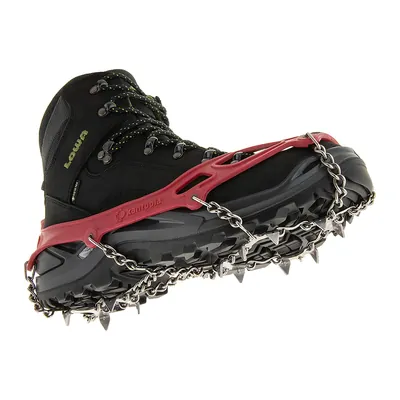
Kahtoola MICROspikes
Traction devices that stretch over your boots: 12 stainless steel spikes of 0.41 in per foot on chains, with a harness that stays supple down to -22 °F. For icy stretches of winter trails.
View on Amazon (opens in a new tab)
Worth watching
A surgeon at St. Louis Children’s Hospital shares sledding injury figures and the advice that helps families plan a safer day on the hill.

The video is hosted by YouTube (Google): nothing loads until you play it, and Google may then set cookies.
FAQ
What’s the best sled for kids?
One they can steer and stop. The AAP recommends steerable sleds rather than snow disks or inner tubes, which give less control, and a Nationwide Children’s study found a greater risk of concussion for children hurt on tubes and disks. The Swiss BFU says only a Rodel, a flexible sled with slanted runners, really steers on hard or icy snow, and keeps plastic bobsleds for gentle slopes and soft snow.
How old should kids be to go sledding?
No prevention body sets a minimum age. The AAP says children under 12 should always be supervised while sledding, and the Swiss BFU and Austrian KFV say kids under 8 should never sled unsupervised. Limits come from operators: Winter Park welcomes all ages on its tube hill from 36 inches tall, Frisco from 3 feet, and the alpine coaster at Les Planards, in Chamonix, takes kids from age 3 with an adult.
How do I find a good sledding hill near me?
Look for the AAP’s checklist: no trees, fences, or other obstructions, snow rather than ice, a slope of less than 30°, a flat runoff at the bottom, and no crowds. Skip hills that end in a street, a parking lot, or water. Then check your city’s rules: in 2015, Dubuque, Iowa, banned sledding on all but two hills in town. Your parks department knows which hills are open.
Where can I go tubing in Colorado?
Two examples: Frisco Adventure Park, where tubing cost $40 an hour last winter ($45 on holidays), riders must be at least 3 feet tall, and reservations are required; and the Coca-Cola Tube Hill at Winter Park Resort, open to riders 36 inches and taller, where tickets sell out over the holidays. In Rocky Mountain National Park, you can bring a sled or tube to Hidden Valley, with no lift and no rentals.
Do you need a helmet for sledding?
It’s wise, and every safety group we read says so, more or less firmly. The AAP suggests considering a helmet for your child; Nationwide Children’s researchers say to make it a rule for everyone, with properly fitted snow sport or bike helmets as the best choice; and the Swiss BFU says a ski, snowboard, or bike helmet works. The reason: in Austria, 75% of people treated in the hospital after a sledding accident weren’t wearing one.
Sources
- Nationwide Children’s Hospital, “Despite Decrease in Recent Years, Rate of Sledding-Related Injuries Still Concerning,” news release on a study in the Clinical Journal of Sports Medicine, December 16, 2020, accessed November 13, 2026. nationwidechildrens.org https://www.nationwidechildrens.org/newsroom/news-releases/2020/12/cirp-sledding-injuries ↩
- KFV (Kuratorium für Verkehrssicherheit), “Kinderleicht und effektiv: Rodelhandbremsen senken Unfallrisiko beim Rodeln,” December 7, 2022 (in German), accessed November 13, 2026. kfv.at https://www.kfv.at/kinderleicht-und-effektiv-rodelhandbremsen-senken-unfallrisiko-beim-rodeln/ ↩
- BFU (Swiss Council for Accident Prevention), brochure “Luge: en piste sans danger,” 3.001.02, October 2021 (in French, PDF), accessed November 13, 2026. bfu.ch https://www.bfu.ch/api/publications/bfu_3.001.02_Luge%20%E2%80%93%20En%20piste%20sans%20danger.pdf ↩
- American Academy of Pediatrics, HealthyChildren.org, “Playing Outside in Winter: Tips to Keep Kids Warm & Safe,” last updated January 27, 2026, accessed November 13, 2026. healthychildren.org https://www.healthychildren.org/English/safety-prevention/at-play/Pages/Winter-Safety.aspx ↩
- State of Tyrol, sports department, “Tiroler Naturrodelbahn-Gütesiegel. Klassifizierung und Anforderungen an die Sicherheitstechnik,” guidelines, 2019 (in German, PDF), accessed November 13, 2026. tirol.gv.at https://www.tirol.gv.at/fileadmin/themen/sport/berg-und-ski/downloads_berg_und_ski/Rodelbahnen/Tiroler_Naturrodelbahn_Guetesiegel.pdf ↩
- Destination Davos Klosters, “The Davos sledge,” accessed November 13, 2026. davos.ch https://www.davos.ch/en/information/portrait-image/storybook/the-davos-sledge ↩
- German Alpine Club (DAV), “Rodeln: 10 DAV-Empfehlungen,” January 20, 2022, last modified January 15, 2025 (in German), accessed November 13, 2026. alpenverein.de https://www.alpenverein.de/artikel/rodeln-10-dav-empfehlungen_458d31cc-0b55-4ee8-a330-29ef2fe13ef5 ↩
- BFU, “Schlitteln ohne Unfall: sicher ins Tal statt ins Spital,” advice page (in German), accessed November 13, 2026. bfu.ch https://www.bfu.ch/de/ratgeber/schlitteln ↩
- BFU, “Faire de la luge sans accident,” advice page (in French), accessed November 13, 2026. bfu.ch https://www.bfu.ch/fr/conseils/faire-de-la-luge-sans-accident ↩
- National Park Service, Rocky Mountain National Park, “Sledding at Hidden Valley,” last updated January 29, 2026, accessed November 13, 2026. nps.gov https://www.nps.gov/places/romo_sleddinghiddenvalley.htm ↩
- KFV, “Nach Unfallserie: Helmtragen beim Rodeln kann Leben retten,” January 2, 2025 (in German), accessed November 13, 2026. kfv.at https://www.kfv.at/nach-unfallserie-helmtragen-beim-rodeln-kann-leben-retten/ ↩
- Graubünden Ferien, “Preda-Bergün-Schlittelbahn” (in German), accessed November 13, 2026. graubuenden.ch https://www.graubuenden.ch/de/touren/preda-berguen-schlittelbahn ↩
- National Park Service, Rocky Mountain National Park, “Superintendent’s Compendium,” 2026, accessed November 13, 2026. nps.gov https://www.nps.gov/romo/learn/management/rmnp_compendium.htm ↩
- KFV and Rodel Austria, “Rodelregeln,” bilingual poster published by the State of Tyrol (in German and English, PDF), accessed November 13, 2026. tirol.gv.at https://www.tirol.gv.at/fileadmin/themen/sport/berg-und-ski/downloads_berg_und_ski/Rodelbahnen/KFV_Rodelregeln.pdf ↩
- KFV, “Crash-Simulation zeigt: Darum solltest du beim Rodeln immer einen Helm tragen,” January 24, 2021 (in German), accessed November 13, 2026. kfv.at https://www.kfv.at/crash-simulation-zeigt-darum-solltest-du-beim-rodeln-immer-einen-helm-tragen/ ↩
- KFV, “2.000 bis 3.000 Rodelunfälle erwartet: Helmquote beim Rodeln stagniert in Österreich bei niedrigen 37 Prozent,” January 20, 2023 (in German), accessed November 13, 2026. kfv.at https://www.kfv.at/2-000-bis-3-000-rodelunfaelle-erwartet-helmquote-beim-rodeln-stagniert-in-oesterreich-bei-niedrigen-37-prozent/ ↩
- Winter Park Resort, “Snow Tubing at Coca-Cola Tube Hill,” accessed November 13, 2026. winterparkresort.com https://www.winterparkresort.com/things-to-do/activities/coca-cola-tubing ↩
- Town of Frisco, Colorado, “Frisco Adventure Park, Winter 2025-26,” brochure (PDF), accessed November 13, 2026. townoffrisco.com https://www.townoffrisco.com/wp-content/uploads/2025/11/2025-2026-Frisco-Adventure-Park-Brochure_For-Web.pdf ↩
- Parc de loisirs des Planards, Chamonix, “Billetterie,” prices in effect as of November 2, 2026 (in French), accessed November 13, 2026. planards.fr https://www.planards.fr/billetterie/ ↩
- Scott McFetridge, Associated Press, “Some Midwest Cities Limiting Sledding Due to Liability Concerns,” January 5, 2015, republished by Insurance Journal, accessed November 13, 2026. amp.insurancejournal.com https://amp.insurancejournal.com/news/midwest/2015/01/05/351702.htm ↩
- NPR, All Things Considered, “Threatened By Liability, Iowa City Bans Sledding,” January 14, 2015, accessed November 13, 2026. npr.org https://www.npr.org/2015/01/14/377267045/threatened-by-liability-iowa-city-bans-sledding ↩
- National Park Service, Rocky Mountain National Park, “Fees & Passes,” last updated December 9, 2025, accessed November 13, 2026. nps.gov https://www.nps.gov/romo/planyourvisit/fees.htm ↩
- SETAM, operator of the Val Thorens ski area, “Cosmojet, la piste de luge spatiale!” (in French), accessed November 13, 2026. ski.valthorens.com https://ski.valthorens.com/cosmojet-la-piste-de-luge-spatiale/ ↩
- SETAM, operator of the Val Thorens ski area, “Cosmojet, the crazy sledge run!,” 2026-27 season, accessed November 13, 2026. ski.valthorens.com https://ski.valthorens.com/en/cosmojet-the-crazy-sledge-run/ ↩
- Wildkogel-Arena Neukirchen & Bramberg, “Rodeln,” page updated November 13, 2026 (in German), accessed November 13, 2026. wildkogel-arena.at https://www.wildkogel-arena.at/de/aktivitaeten-erleben/rodeln.html ↩
- Bergün Filisur Tourismus, “Sledging,” 2026-27 hours and prices, accessed November 13, 2026. berguen-filisur.graubuenden.ch https://www.berguen-filisur.graubuenden.ch/en/aktivitaten/winter/sledging ↩
- Jungfraubahnen, “Pintenfritz, das Original” (in German), accessed November 13, 2026. jungfrau.ch https://www.jungfrau.ch/de-ch/schlitteln/big-pintenfritz/geschichte/ ↩
- Jungfraubahnen, “Big Pintenfritz” (in German), accessed November 13, 2026. jungfrau.ch https://www.jungfrau.ch/de-ch/schlitteln/big-pintenfritz/ ↩
- State of Tyrol, press release “Tiroler Gütesiegel: Qualitätsgarant für Wintersportanlagen,” December 3, 2025 (in German), accessed November 13, 2026. tirol.gv.at https://www.tirol.gv.at/presse/meldungen/meldung/tiroler-guetesiegel-als-qualitaetsgarant-fuer-die-heimischen-wintersportanlagen/ ↩
- Parc de loisirs des Planards, Chamonix, “Luge sur rails” (in French), accessed November 13, 2026. planards.fr https://www.planards.fr/luge-sur-rails/ ↩
- Montgenèvre tourist office, “Luge Monty Express” (in French), accessed November 13, 2026. montgenevre.com https://montgenevre.com/hiver/activites/luge-monty-express ↩
- Wallbergbahn, Rottach-Egern, “Die Rodelbahn” (in German), accessed November 13, 2026. wallbergbahn.de https://www.wallbergbahn.de/de/die-rodelbahn.html ↩
- German Alpine Club (DAV), “Sicher wandern im Schnee,” last modified March 20, 2023 (in German), accessed November 13, 2026. alpenverein.de https://www.alpenverein.de/artikel/sicher-wandern-im-schnee_19158f10-be75-4fbc-a65e-3254fad90796 ↩
- Wallbergbahn, “Rodeln am Wallberg,” 2026-27 sledding tickets (in German), accessed November 13, 2026. wallbergbahn.de https://www.wallbergbahn.de/de/rodeltickets.html ↩
- Tirol Werbung, “Nachtrodeln Elferbahnen,” Neustift im Stubaital, December 30, 2026, to March 5, 2027 (in German), accessed November 13, 2026. tirol.at https://www.tirol.at/aktivitaeten/events/alle-events/nachtrodeln-elferbahnen-1 ↩
- Club 99, sled rental in Bergün, “Preise,” 2026-27 season (in German), accessed November 13, 2026. club-99.ch https://club-99.ch/preise/ ↩

Trail running, snow, water, nature and destinations
Nolwenn covers trail running, snow, water, nature and destinations for Outfarer. Curious about everything, from meteor showers to night-train schedules, she has a knack for digging up the one detail that changes everything, and nailing it in a single sentence.


