 Français (France)
 English (UK)
 English (US)
 Deutsch (Deutschland)

Contents
- Wooden sledge, toboggan or plastic bob: three very different machines
- Steering and braking: three moves to know before you set off
- Helmet, boots, back protector: the kit that matters
- Children: from what age, and in front or behind?
- Sledging hills in Britain: where you’re welcome, and where you’re not
- Alpine toboggan runs: by lift, by train or by night
- The longest run? Ask the brochure
- Alpine coasters: no snow required
- Rules of the run, and why the dog stays at home
- Kit
- FAQs
On Austria’s ski slopes, more than 93% of people wore a helmet on average over the seven years to 2023. On its toboggan runs, just 37% did, according to the Kuratorium für Verkehrssicherheit (KFV), Austria’s accident prevention body [1]. Sledging still passes for child’s play; yet in a KFV study from 2020, sledgers averaged 30 km/h (about 19 mph), with peaks of 60 km/h (37 mph) [2]. Choosing a sledge and a run comes down to two things: how you’ll turn, and how you’ll stop.
Wooden sledge, toboggan or plastic bob: three very different machines
The Swiss Council for Accident Prevention (BFU) sorts sledges into three families [3]. The classic wooden sledge, rigid, with flat runners and a slatted seat, is hard to steer but carries a child or a rucksack well. The The Rodel of the German-speaking Alps: a flexible frame, angled metal-shod runners and a steering strap. Austrian and Swiss pages in English call it a toboggan. is steered with your body weight, your legs and a strap. The plastic bob, often fitted with a steering wheel, delights children, but it is very fast and hard to brake on packed or icy snow.
| Sledge | What it is | Who it suits | Its limit |
|---|---|---|---|
| Classic wooden sledge | Rigid, flat runners, a slatted wooden seat that doesn’t absorb shocks | Occasional sledgers, carrying children and kit | Hard to steer |
| Toboggan (Rodel) | Flexible frame, angled metal-shod runners, a fabric seat that absorbs shocks | Prepared runs, icy ones included | Pricier, and the technique takes learning |
| Plastic bob | Plastic shell, often with a steering wheel, short-lived | Children, on gentle slopes and soft, wet snow | Very fast, hard to steer and brake on packed or icy snow |
The difference between a flexible and a rigid frame is no detail. The Land of Tyrol’s guidelines for natural toboggan runs define it in black and white, and on the runs they grade black, a toboggan with a flexible frame is required [4]. The famous Davos sledge is one of the wooden kind: made of ash, 80 to 130 cm long, steered and braked with the feet, and slower than a toboggan. It takes its name from Davos’s first sledge race, in 1883, the year an English poet and critic, John Addington Symonds, founded and chaired the International Davos Tobogganing Club [5]. The German Alpine Club (DAV) adds an argument of its own: plastic bobs and saucers only on continuous snow cover with no stones showing, so as not to scatter microplastics [6].
Steering and braking: three moves to know before you set off
On a wooden sledge, sit upright with your feet on the runners [7]. To turn, shift your weight towards the inside of the bend and press your foot into the snow beside the inside runner [8]; the harder you press, the tighter the turn, adds Tirol Werbung, the Tyrol tourist board [9]. On a toboggan, you also press your leg against the outside runner and pull on the strap to lighten the inside one. To brake, the BFU gives the same advice for both: both feet flat in the snow just beside the runners, the front of the sledge lifted, legs not locked straight [8].
The KFV has measured what each method changes, at 25 km/h (about 16 mph) [10]. If you’re braking in winter boots, use the whole sole, not your heels.
| Method | Distance to stop |
|---|---|
| Toboggan hand brake | 7 m |
| Toboggan tipped onto its edge | 8.7 m |
| Spikes on your boots | 10 m |
| Winter boots | 14.7 m |
The BFU also recommends spikes, whose points matter most at the heel; chains for boots are less suitable, because they put too much load on your feet when braking [8]. As for hand brakes, the KFV recommends them, but the run from Preda to Bergün, in Switzerland, bans mechanical brakes, along with plastic bobs [2, 11]: read the rules of your run before you buy the kit.
Helmet, boots, back protector: the kit that matters
In Austria, around 2,200 people are treated in hospital after sledging accidents every year; around 75% of them weren’t wearing a helmet, and on average two people a year are killed [10]. Crash simulations by the KFV and Graz University of Technology show that a child without a helmet risks serious head injuries from about 10 km/h [13]. In Switzerland, some 6,400 runs by Swiss residents end at the doctor’s each year, according to the BFU [8], and more than half of sledgers there already wear a helmet, its 2021 leaflet notes [3]. For the UK, we found no national figures on sledging injuries.
Children: from what age, and in front or behind?
No accident prevention body sets a minimum age for getting on a sledge. What they do set is supervision: no sledging without an adult watching for children under 8, say the BFU and the KFV [3, 2]. The age limits you’ll come across are the operators’ own. On the Wildkogel, in Austria, children aged 6 and under must ride on their parents’ sledge [14]. Between Preda and Bergün, small children must be accompanied by an adult [11], and the Wallberg run, in Bavaria, is not suitable for very young children [15]. On Val Thorens’s Cosmojet, a child may ride alone only if over 9 and taller than 1.25 m [16].
Here’s the detail that changes everything: where your child sits on your sledge. In front and close to you, says the BFU, which limits a sledge to two people [3]. Behind you, says the KFV, after computer-simulated crashes into a tree: in front, the child is pressed into the tree by the adult’s weight; behind, the adult’s back gives the child’s head some extra protection [13]. Two serious bodies, two answers, and the KFV backs its own with those simulations. Either way, the rest doesn’t change: a helmet, a gentle speed, and never three on a sledge.
| BFU (Switzerland) | KFV (Austria) | |
|---|---|---|
| Where the child sits | In front of the adult, close to them | Behind the adult |
| What the advice rests on | Not stated in the leaflet | Computer-simulated crashes into a tree |
| Two on a sledge | Never more than two | The heavier person in front |
| Without supervision | Not under 8 | Not under 8 |
Sledging hills in Britain: where you’re welcome, and where you’re not
When snow does fall, the best hill is rarely the steepest. The BFU’s golden rule travels well: a gentle slope, free of obstacles, with a clear run-out at the bottom and easy to keep an eye on if you have young children [8]. Some councils point the way. Warwick District Council lists parks with suitable slopes, from Abbey Fields in Kenilworth to Priory Park in Warwick, and asks sledgers to watch for hazards such as trees and benches and to be considerate to others [17]. In Surrey, the National Trust calls Snowball Ridge, at Frensham Little Pond, a fantastic place for sledging, provided the winter brings snow [18].
| Place | Recommended by | What to know |
|---|---|---|
| The Hayfield, Glenmore Forest Park, near Aviemore | VisitCairngorms | ‘Probably the most popular place to sledge in the Cairngorms’, with a slope that runs out to the flat |
| Play park and Games Park, Braemar | VisitCairngorms | Called safe sledging spots, easy to find |
| Golf courses in the Cairngorms | VisitCairngorms | Keep off the greens and tees |
| Snowball Ridge, Frensham Little Pond, Surrey | National Trust | Only when there’s snow, of course |
| Abbey Fields, Kenilworth; Priory Park, Warwick | Warwick District Council | Suitable slopes; watch for trees and benches |
Sources: Warwick District Council, National Trust, VisitCairngorms [17, 18, 19].
Alpine toboggan runs: by lift, by train or by night
In the Alps, the long runs are usually paid for with the ride up. At Bergün, in the Swiss canton of Graubünden, the Rhaetian Railway takes you up to Preda, and you sledge 6 km back down to the valley: CHF 19 for a single ride with the train, or CHF 44 for an adult day card and CHF 22 for a child aged 5 to 15, from 19 December 2026 to 14 March 2027 [21]. On the Wallberg, above Rottach-Egern in Bavaria, the 6.5 km run itself is free and used at your own risk [15]; the lift costs €30 for two ascents, or €16 for children aged 6 to 15 [22]. In Davos, the Schatzalp run charges no usage fee either [23].
Night sledging has practically achieved cult status in the Tyrol, says Tirol Werbung [24]. At Neustift, in the Stubai Valley, the Elferbahn takes sledgers up on Wednesday and Friday evenings from 7.30pm to 9pm, the run is lit until 1am, and a hired sledge costs €9 plus a €50 deposit, from 30 December 2026 to 5 March 2027 [25]. On the Wildkogel, the run is floodlit until 10pm (6pm on Mondays), and evening runs aren’t included in the ski pass [14], so budget for them alongside your lift pass. At Bergün, the run stays open until 11pm from Tuesday to Sunday [21]. Even on a floodlit run, take a good head torch, advises Tirol Werbung [24].
The longest run? Ask the brochure
Graubünden Tourism calls Bergün’s 6 km ‘the longest floodlit toboggan run in Europe’ [11]; the Wildkogel, in Austria’s Salzburg region, bills its 14 km as ‘the world’s longest illuminated toboggan run’ [14]. They can’t both be right. Even a single operator can disagree with itself: Val Thorens’s Cosmojet, France’s longest sledge run by its own account, is 5 km long on its English page and 6 km on its French one [16, 26]. Remember the numbers, not the titles.
| Run | Length | What’s claimed | Who claims it |
|---|---|---|---|
| Big Pintenfritz, Grindelwald (Switzerland) | 15 km | One of the longest in Europe | The operator |
| Wildkogel, Salzburg region (Austria) | 14 km | The world’s longest floodlit run | The Wildkogel-Arena |
| Wallberg, Bavaria (Germany) | 6.5 km | One of the longest in Germany | The operator |
| Preda-Bergün, Graubünden (Switzerland) | 6 km | Europe’s longest floodlit run | Graubünden Tourism |
| Cosmojet, Val Thorens (France) | 5 km or 6 km | France’s longest | The operator |
The numbers, though, are worth the trip. On the Wildkogel, 14 km (8.7 miles) and a height difference of around 1,300 m, for €24 a single ride, or €12 for children [14]. At Grindelwald, the Big Pintenfritz runs for 15 km (9.3 miles) [27]; it starts on the Faulhorn, at 2,680 m, which you reach on foot from First in about two and a half hours, and the sledging ticket costs CHF 55 for adults [28]. In the Tyrol, Tirol Werbung counts more than 200 toboggan runs, over 750 km in all [9], and 70 natural runs carry the Land’s quality seal, graded blue, red or black by difficulty [29, 4].
Alpine coasters: no snow required
Some sledges run on rails, whatever the weather. Near Edinburgh, Midlothian Council’s Alpine Coaster at Hillend runs 980 m in all, 667 m of it downhill, with a vertical drop of about 74 m and a top speed regulated to 28 mph. You can ride alone from over 9 and 1.4 m tall; children aged 4 to 8 must ride with someone over 9 and 1.4 m tall, and a single off-peak ride costs £8 [30]. In Chamonix, the Planards coaster has 1,300 m of track and is now open all year round, from 3 years old with an adult and alone from 1.35 m [31], at €10 a ride for one or two people, at the prices in force on 2 November 2026 [32]. No snow to read and no technique to learn, but a brake to use and a distance to keep.
Rules of the run, and why the dog stays at home
- Stay in control of your speed and direction, and overtake at a safe distance [8, 12].
- Walk up and stop at the side of the run, never on a bend [8, 6].
- Don’t sledge on ski runs: the BFU says they are generally off limits, the KFV and Rodel Austria rules say ‘Don’t toboggan on ski slopes’, and Cairngorm Mountain bans sledging anywhere in its ski area [8, 12, 20].
- Respect the opening hours: the Wallberg run is closed from 5pm to 9am for grooming, when the snow groomers bring a risk of fatal injury [15]; on the Wildkogel, the run is closed to everyone after 10pm [14].
- Leave the dog at home: the BFU advises against bringing one, and dogs are banned at Bergün, on the Wallberg and on the Wildkogel, which cites the risk of collisions [3, 21, 15, 14].
- At night, take a head torch and reflective clothing [10], even on a floodlit run [24].
- No alcohol, and give first aid if there’s an accident: two of the ten rules of the KFV and Rodel Austria [12].
An open toboggan run has one advantage a wild slope lacks: in the mountains, when it is officially open, the avalanche danger on it is practically ruled out, according to the DAV, as our guide to winter walking on groomed paths explains [33]. It’s the same logic that keeps beginners on waymarked trails in our snowshoeing guide for beginners. An untouched slope, however tempting, offers no such guarantee.
The best moment? A late January afternoon, when the light fades and the bends appear under the lamps. With a helmet, a sledge that turns and feet that know how to brake, there’s only one thing left to want: another run.
Kit related to this article
No affiliation: no commission, no sponsored products.
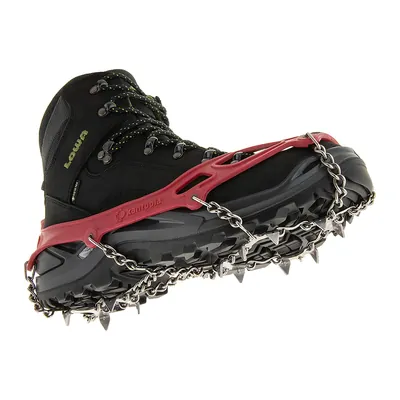
Kahtoola MICROspikes
Traction devices that stretch over your boots: 12 stainless steel spikes of 10.4 mm per foot on chains, with a harness that stays supple down to -30 °C. For icy stretches of winter paths.
View on Amazon (opens in a new tab)
FAQs
Where can I go sledging near me in the UK?
Look for a gentle slope free of obstacles, with a clear run-out at the bottom. Some councils list suitable slopes: Warwick District Council names parks such as Abbey Fields in Kenilworth and Priory Park in Warwick. In the Cairngorms, VisitCairngorms recommends the Hayfield at Glenmore, near Aviemore. Stay off ski runs: Cairngorm Mountain doesn’t allow sledging anywhere within its ski area boundary.
Where are the longest toboggan runs in the Alps?
The figures come from the operators. At Grindelwald, the Big Pintenfritz runs for 15 km from the Faulhorn, which you reach on foot in about two and a half hours. The Wildkogel, in Austria, claims the world’s longest floodlit run, at 14 km, while Graubünden Tourism gives that title for Europe to Bergün’s 6 km, where a train takes you back up.
Where can you go sledging in Austria?
The Tyrol is the obvious start: Tirol Werbung counts more than 200 toboggan runs there, and 70 natural runs carry the Land of Tyrol’s quality seal, graded blue, red or black. The Wildkogel, in the Salzburg region, has 14 km floodlit until 10pm (6pm on Mondays). Before you go, read the ten rules of the KFV and Rodel Austria, published in English, including ‘Don’t go head first’.
What’s the best sledge for adults?
For prepared runs, a toboggan, or Rodel: according to the BFU, only it can be steered properly on packed and icy slopes, thanks to its flexible frame and angled runners. On the Tyrol’s black-graded natural runs, it’s required. A classic wooden sledge is better for carrying a child or kit, and a plastic bob only suits gentle slopes and soft snow.
Do you need a helmet for sledging?
It depends on the run: Val Thorens’s Cosmojet makes one compulsory, while Bergün and the Wildkogel recommend it. The BFU advises a helmet for everyone, and says a ski, snowboard or cycle helmet will do. Ask the operator whether your run requires one. The reason for the advice is plain: in Austria, around 75% of sledgers treated in hospital weren’t wearing a helmet.
Sources
- KFV (Kuratorium für Verkehrssicherheit), ‘2.000 bis 3.000 Rodelunfälle erwartet: Helmquote beim Rodeln stagniert in Österreich bei niedrigen 37 Prozent’, 20 January 2023 (in German), accessed 13 November 2026. kfv.at https://www.kfv.at/2-000-bis-3-000-rodelunfaelle-erwartet-helmquote-beim-rodeln-stagniert-in-oesterreich-bei-niedrigen-37-prozent/ ↩
- KFV, ‘Kinderleicht und effektiv: Rodelhandbremsen senken Unfallrisiko beim Rodeln’, 7 December 2022 (in German), accessed 13 November 2026. kfv.at https://www.kfv.at/kinderleicht-und-effektiv-rodelhandbremsen-senken-unfallrisiko-beim-rodeln/ ↩
- Swiss Council for Accident Prevention (BFU), ‘Luge: en piste sans danger’, leaflet 3.001.02, October 2021 (in French, PDF), accessed 13 November 2026. bfu.ch https://www.bfu.ch/api/publications/bfu_3.001.02_Luge%20%E2%80%93%20En%20piste%20sans%20danger.pdf ↩
- Amt der Tiroler Landesregierung, Abteilung Sport (Land of Tyrol), ‘Tiroler Naturrodelbahn-Gütesiegel. Klassifizierung und Anforderungen an die Sicherheitstechnik’, guidelines, 2019 (in German, PDF), accessed 13 November 2026. tirol.gv.at https://www.tirol.gv.at/fileadmin/themen/sport/berg-und-ski/downloads_berg_und_ski/Rodelbahnen/Tiroler_Naturrodelbahn_Guetesiegel.pdf ↩
- Destination Davos Klosters, ‘The Davos sledge, a Swiss invention’, accessed 13 November 2026. davos.ch https://www.davos.ch/en/information/portrait-image/storybook/the-davos-sledge ↩
- German Alpine Club (DAV), ‘Rodeln: 10 DAV-Empfehlungen’, 20 January 2022, last changed 15 January 2025 (in German), accessed 13 November 2026. alpenverein.de https://www.alpenverein.de/artikel/rodeln-10-dav-empfehlungen_458d31cc-0b55-4ee8-a330-29ef2fe13ef5 ↩
- Swiss Council for Accident Prevention (BFU), ‘Schlitteln ohne Unfall: sicher ins Tal statt ins Spital’ (in German), accessed 13 November 2026. bfu.ch https://www.bfu.ch/de/ratgeber/schlitteln ↩
- Swiss Council for Accident Prevention (BFU), ‘Faire de la luge sans accident’ (in French), accessed 13 November 2026. bfu.ch https://www.bfu.ch/fr/conseils/faire-de-la-luge-sans-accident ↩
- Tirol Werbung (Tyrol tourist board), ‘Tobogganing and sledging: Tips for steering and braking’, accessed 13 November 2026. tyrol.com https://www.tyrol.com/activities/sport/tobogganing/tobogganing-technique-tips ↩
- KFV, ‘Nach Unfallserie: Helmtragen beim Rodeln kann Leben retten’, 2 January 2025 (in German), accessed 13 November 2026. kfv.at https://www.kfv.at/nach-unfallserie-helmtragen-beim-rodeln-kann-leben-retten/ ↩
- Graubünden Tourism, ‘Preda-Bergün-Schlittelbahn’, accessed 13 November 2026. graubuenden.ch https://www.graubuenden.ch/en/tours/preda-bergun-schlittelbahn ↩
- KFV and Rodel Austria, ‘Rodelregeln: Tobogganing rules’, bilingual poster published by the Land of Tyrol (in German and English, PDF), accessed 13 November 2026. tirol.gv.at https://www.tirol.gv.at/fileadmin/themen/sport/berg-und-ski/downloads_berg_und_ski/Rodelbahnen/KFV_Rodelregeln.pdf ↩
- KFV, ‘Crash-Simulation zeigt: Darum solltest du beim Rodeln immer einen Helm tragen’, 24 January 2021 (in German), accessed 13 November 2026. kfv.at https://www.kfv.at/crash-simulation-zeigt-darum-solltest-du-beim-rodeln-immer-einen-helm-tragen/ ↩
- Wildkogel-Arena Neukirchen & Bramberg, ‘Toboggan runs in the Wildkogel Arena’, accessed 13 November 2026. wildkogel-arena.at https://www.wildkogel-arena.at/en/activities-experiences/to-go-tobogganing.html ↩
- Brauneck- und Wallbergbahnen, ‘The toboggan run’, Wallberg, Rottach-Egern, accessed 13 November 2026. wallbergbahn.de https://www.wallbergbahn.de/en/the-toboggan-run-1.html ↩
- SETAM, operator of the Val Thorens ski area, ‘Cosmojet, the crazy sledge run!’, 2026/2027 season, accessed 13 November 2026. ski.valthorens.com https://ski.valthorens.com/en/cosmojet-the-crazy-sledge-run/ ↩
- Warwick District Council, ‘Where’s a good place for...?’, parks and green spaces, accessed 13 November 2026. warwickdc.gov.uk https://www.warwickdc.gov.uk/info/20245/parks_and_green_spaces/218/wheres_a_good_place_for/2 ↩
- National Trust, ‘Exploring Frensham Little Pond’, Surrey, accessed 13 November 2026. nationaltrust.org.uk https://www.nationaltrust.org.uk/visit/surrey/frensham-little-pond/things-to-see-and-do-at-frensham-little-pond ↩
- VisitCairngorms, ‘Best spots for sledging in the Cairngorms!’, 1 March 2018, updated 8 January 2025, accessed 13 November 2026. visitcairngorms.com https://www.visitcairngorms.com/best-spots-sledging-cairngorms/ ↩
- Cairngorm Mountain, ‘Sledging Policy’, accessed 13 November 2026. cairngormmountain.co.uk https://www.cairngormmountain.co.uk/sledging-policy/ ↩
- Bergün Filisur Tourismus, ‘Sledging’, Sledging World 2026/27, accessed 13 November 2026. berguen-filisur.graubuenden.ch https://www.berguen-filisur.graubuenden.ch/en/aktivitaten/winter/sledging ↩
- Brauneck- und Wallbergbahnen, ‘Tobogganing on the Wallberg’, tobogganing tickets 2026/27, accessed 13 November 2026. wallbergbahn.de https://www.wallbergbahn.de/en/tobogganing-in-wallberg.html ↩
- Destination Davos Klosters, ‘Tobogganing on 8 runs’, accessed 13 November 2026. davos.ch https://www.davos.ch/en/activities/snowsports/tobogganing ↩
- Tirol Werbung (Tyrol tourist board), ‘Night tobogganing: Illuminated toboggan runs’, accessed 13 November 2026. tyrol.com https://www.tyrol.com/activities/sport/tobogganing/night-sledding ↩
- Tirol Werbung (Tyrol tourist board), ‘Night sledding down the Elfer’, Neustift im Stubaital, 30 December 2026 to 5 March 2027, accessed 13 November 2026. tyrol.com https://www.tyrol.com/activities/events/all-events/night-sledding-down-the-elfer-1 ↩
- SETAM, operator of the Val Thorens ski area, ‘Cosmojet, la piste de luge spatiale !’ (in French), accessed 13 November 2026. ski.valthorens.com https://ski.valthorens.com/cosmojet-la-piste-de-luge-spatiale/ ↩
- Jungfraubahnen, ‘Pintenfritz, the original’, accessed 13 November 2026. jungfrau.ch https://www.jungfrau.ch/en-gb/sledging/big-pintenfritz/history/ ↩
- Jungfraubahnen, ‘Big Pintenfritz’, accessed 13 November 2026. jungfrau.ch https://www.jungfrau.ch/en-gb/sledging/big-pintenfritz/ ↩
- Land Tirol, press release ‘Tiroler Gütesiegel: Qualitätsgarant für Wintersportanlagen’, 3 December 2025 (in German), accessed 13 November 2026. tirol.gv.at https://www.tirol.gv.at/presse/meldungen/meldung/tiroler-guetesiegel-als-qualitaetsgarant-fuer-die-heimischen-wintersportanlagen/ ↩
- Midlothian Council, ‘Our Alpine Coaster’, Destination Hillend, accessed 13 November 2026. midlothian.gov.uk https://www.midlothian.gov.uk/info/200281/snowsports_centre/586/destination_hillend/2 ↩
- Les Planards, Chamonix, ‘Alpine Coaster’, accessed 13 November 2026. planards.fr https://www.planards.fr/en/alpine-coaster-chamonix/ ↩
- Les Planards, Chamonix, ‘Billetterie’, prices in force on 2 November 2026 (in French), accessed 13 November 2026. planards.fr https://www.planards.fr/billetterie/ ↩
- German Alpine Club (DAV), ‘Sicher wandern im Schnee’, last changed 20 March 2023 (in German), accessed 13 November 2026. alpenverein.de https://www.alpenverein.de/artikel/sicher-wandern-im-schnee_19158f10-be75-4fbc-a65e-3254fad90796 ↩
- Club 99, sledge hire in Bergün, ‘Preise’, 2026/27 season (in German), accessed 13 November 2026. club-99.ch https://club-99.ch/preise/ ↩

Trail running, snow, water, nature and destinations
Nolwenn covers trail running, snow, water, nature and destinations for Outfarer. Curious about everything, from meteor showers to night-train timetables, she has a knack for unearthing the one detail that changes everything, and putting it in a single sentence.


