 Français (France)
 English (UK)
 English (US)
 Deutsch (Deutschland)

A typical spec sheet might read: 8 mm drop, 5 mm lugs, 30 mm stack at the heel, waterproof membrane. The good news: it reads much like the spec sheet of a headlamp: a handful of numbers tell you most of what you need, as long as you know what they measure. And here is the surprise: the science on drop and cushioning is far more cautious than the labels.
Drop: the slope inside the shoe
Drop is simply “the difference in height between the front and the back of a shoe,” as Decathlon puts it [2]; more precisely, the difference between the sole thickness under the heel and under the forefoot, in millimeters [3]. A shoe with 30 mm at the heel and 22 mm at the front therefore has an 8 mm drop. At zero, your foot sits flat, as it would on the ground.
Swiss brand On sorts drops into three groups, each linked to a way of landing [3]:
- 8 mm and above: the drop of traditional shoes. It favors heel-strikers, which eases the strain on the Achilles tendon and calves but can put more load on the knees.
- 0 to 4 mm: a flatter landing, from the midfoot to the forefoot, which places more demand on the lower leg if you switch too quickly.
- 4 to 8 mm: according to On, the most comfortable starting point for most runners.
Decathlon makes the same point another way: the lower the drop, the more it pushes you onto the front of your foot, and changing drop is “not to be taken lightly” [2]. These categories come from brands, so let’s see what independent research says.
What research knows about drop, and what it doesn’t
In 2016, researchers at the Luxembourg Institute of Health gave 553 recreational runners shoes that were identical except for one detail: a 10, 6 or 0 mm drop. For six months, everyone logged their runs and injuries. Overall, injury risk did not differ between the groups [1].
The detail that changes everything appeared when the runners were split by how regularly they ran. Among occasional runners, those who had run weekly for less than six of the previous twelve months, the low-drop shoes (6 and 0 mm) went with roughly half the injury risk. Among regular runners, it was the opposite: an injury risk about two-thirds higher [1]. The authors conclude that low-drop shoes could be more hazardous for regular runners and preferable for occasional ones [1].
Stack height and cushioning: feel the ground or shield yourself from it
Stack height is the amount of foam between your foot and the ground, measured at the heel and the forefoot [3]. According to On, a low stack gives more ground feel and control, which some experienced runners prefer on technical terrain; a moderate stack balances cushioning and stability; a maximal stack absorbs more impact, a comfort many appreciate over long distances or when starting out [3]. Fell running shoes, built for the steep, boggy hills of northern England, Scotland, and Wales, go the other way: less midsole, so less cushioning, but feet closer to the ground for a better feel of the terrain, explains the Welsh Fell Runners Association [5].
Does cushioning prevent injuries? The same Luxembourg team tested this in 2020 with 848 recreational runners and two prototypes that differed only in their cushioning. Those running in the hard version were injured more often, with a risk about 1.5 times higher [4]. The surprise: the protective effect of softer cushioning showed up only in lighter runners, below the median of 78.2 kg (172 lb) for men and 62.8 kg (138 lb) for women, and not in heavier ones, contrary to popular belief [4].
| Trial | Runners | What changed | Overall result | The nuance |
|---|---|---|---|---|
| Drop, 2016 | 553 | 10, 6 or 0 mm drop | No difference in injuries | Low drop: fewer injuries in occasional runners, more in regular runners |
| Cushioning, 2020 | 848 | Soft or hard cushioning | More injuries with hard cushioning | Softer cushioning protected lighter runners only |
Recreational road runners, followed for six months. Sources: The American Journal of Sports Medicine, 2016 and 2020.
Again, these were road runners. Beyond that, On reminds us that no foam is better than another: softer foams reduce fatigue, firmer ones feel more precise, and what should decide is whether the shoe feels stable to you [3].
Lugs: their depth tells you the terrain
Lug depth is the height of the rubber studs on the outsole. On gives two benchmarks: lugs of 2 to 4 mm suit firm, smooth trails and give a smoother ride; from 5 mm, they dig into mud, snow or loose dirt [3]. The pattern matters too: multi-directional lugs help with braking and balance on climbs and descents, and widely spaced lugs let mud shed instead of building up underfoot [3]. Fell runners in Wales say the same of their soles: widely spaced studs clog up less than treads or closely grouped studs [5].
The 4 mm threshold is not arbitrary: the Saunders Lakeland Mountain Marathon, a two-day event in England’s Lake District, requires fell running or trail shoes, or boots, with a minimum tread depth of 4 mm [6]. The flip side is that a trail outsole wears faster on pavement [3]: if your run starts with a couple of miles of pavement, a less aggressive tread will be happier.

| Terrain | Lugs | Sole and protection | Upper |
|---|---|---|---|
| Smooth paths, hard-packed dirt, gravel | Shallow, 2 to 4 mm | Light, responsive cushioning | Breathable, especially in warm weather |
| Technical, rocky trails | Multi-directional, for braking | Toe bumper, reinforced upper, rock plate | Waterproof if it’s cold or wet |
| Mud, wet grass, leaves | Deep, 5 mm or more, widely spaced | Thinner for ground feel, as in fell running | Water-resistant materials |
| Snow | Deep, 5 mm or more | Your choice | Waterproof, against cold and wet |
| Mixed road and trail | Less aggressive | Moderate cushioning | Breathable |
Based on On, the Welsh Fell Runners Association and the Swiss Jugend+Sport gear guide. These are tendencies, not rules: every model depends on how it is built.
Waterproof membrane: for cold and wet, not for summer
“Gore-Tex or not?” is one of the most searched questions. The gear guide from Jugend+Sport, the Swiss Federal Office of Sport’s youth program, lists the pros of a waterproof upper: moisture no longer gets in through the sides of the shoe, and your feet cool down less in cold, wet conditions, when racing in snow, for example [7]. And the cons: the shoe molds less closely to the foot, and moisture escapes less well, so feet sweat more [7].
On says much the same: waterproof shoes work well in cold, wet or snowy conditions, but they breathe less; in warm weather, a mesh upper often feels more comfortable and dries faster [3]. Note the nuance in the Swiss guide: it talks about water coming in through the sides. A membrane does not seal the top of the shoe. So I keep mesh for summer and for trails where your feet get wet anyway, and a membrane for winter runs, when dry feet are also warm feet.
Width and size: room at the front, a secure midfoot
On descents, your foot naturally slides forward, On points out: you need enough room for your toes to splay and absorb impact without pressing into the front or sides of the shoe [3]. Feet also tend to swell as distance and heat increase, so a new shoe that feels slightly relaxed often feels better later in a run [3]. Around the midfoot, on the other hand, the fit should be secure, especially on uneven ground, to limit movement inside the shoe [3].
That is the whole idea behind fell shoes: they hug the foot so it doesn’t move around inside, which gives better control when traversing and descending [5]. The right compromise fits in a few words: held at the heel and midfoot, free at the front. If your toes are cramped in the size that otherwise fits, look for a wider last: some brands make the same model in a wide version, and the spec sheet then says so.

Protection and lifespan
On rocky trails, extra protection under and in front of the foot spares you bruises from sharp stones and roots; on smooth ground, it isn’t necessary [3]. A gusseted tongue, attached along the sides of the upper, keeps out dirt, sand and small stones, and lightweight gaiters do the same job in sand, snow, or scree [3].
How long does a pair last? According to On, most trail running shoes last somewhere between 300 and 500 miles, roughly 480 to 800 km, and often closer to 300 to 400 miles on trails, which are rougher than roads [3]. Decathlon estimates about 800 km (500 miles) for a training shoe and 400 km (250 miles) for a racing shoe, with variations depending on weight, stride, and care [2]. The tell-tale sign: rounded or smoothed lugs that no longer bite [3].
Reading a spec sheet in five questions
- Where will I run? The answer sets the lugs: short on dry paths, deep and widely spaced in mud and snow.
- For how long? The longer the run, the more generous cushioning makes sense; the more technical the ground, the more a thinner sole helps you feel it.
- What drop do I run in now? Stay close to your current shoes, and change in stages if you run often.
- In which season? A membrane for wet winters, mesh for summer.
- And my feet? Room at the front, a secure midfoot, a wider fit if needed.
The trail will teach you the rest: the first descent where your lugs hold while everything else slides, the first three-hour run without a single blister. If you’re new to it, our guide to getting started in trail running covers the basics, and our article on effort kilometers helps you estimate how long a run will take before you lace up. All that’s left is to get them muddy.
Gear related to this article
No affiliation: no commission, no sponsored products.
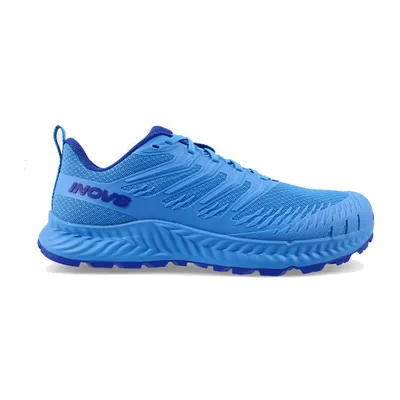
Inov-8 TrailFly V2
A trail shoe whose spec sheet lists every figure: 18 mm of midsole at the heel and 12 mm at the forefoot (a 6 mm drop), plus 4 mm lugs for dry, rocky trails.
View on Amazon (opens in a new tab)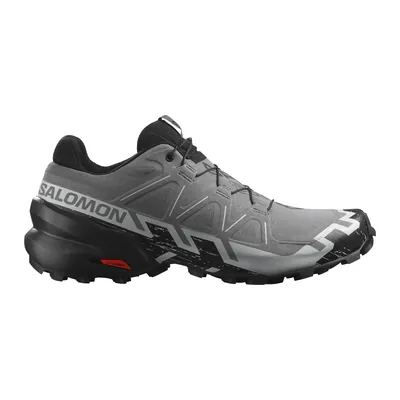
Salomon Speedcross 6
A trail shoe built for mud: deep, sharp 5 mm lugs, an outsole designed to shed mud fast, and a 10 mm drop. Men’s cut, also made for women and in a wide fit.
View on Amazon (opens in a new tab)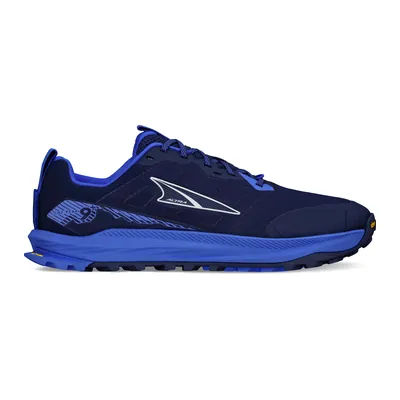
Altra Lone Peak 9+
A zero-drop trail shoe with 25 mm of midsole at both heel and forefoot, plus the brand’s roomiest toe box. Ease into it gradually. Men’s cut, also made for women.
View on Amazon (opens in a new tab)
Worth watching
Run4Adventure walks through sizing, toe-box width, traction for different and mixed terrain, cushioning, and weight, to help you match a trail shoe to your feet and the trails you run.
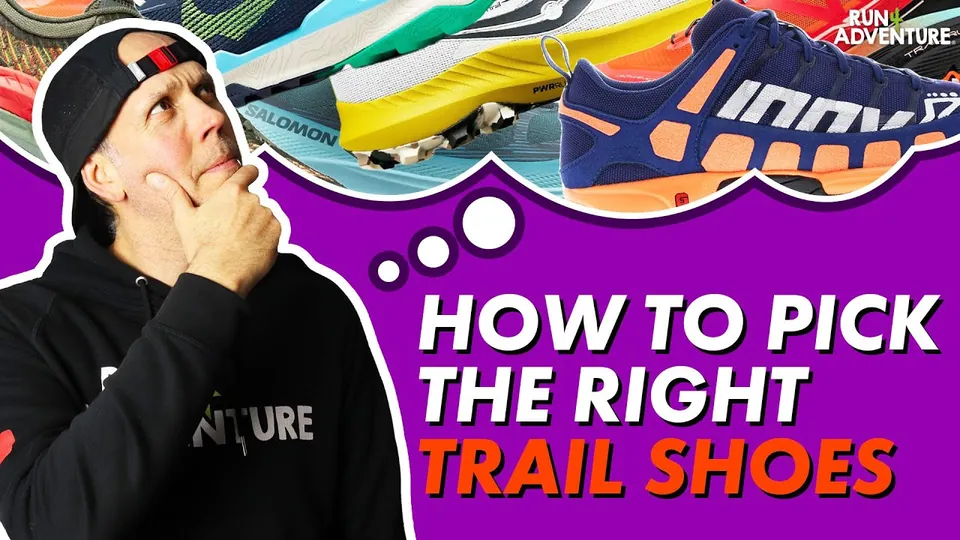
The video is hosted by YouTube (Google): nothing loads until you play it, and Google may then set cookies.
FAQ
What drop should I choose for my first trail shoes?
The brand On considers a moderate drop of 4 to 8 mm the most comfortable starting point for most runners. If you already run on roads, the safest approach is to stay close to the drop of your current shoes: a trial of 553 runners found more injuries among regular runners who switched to a low drop, and a very low drop places heavy demands on the calves if you switch too quickly.
Do I need waterproof trail shoes, such as Gore-Tex?
Not necessarily. A waterproof membrane stops moisture getting in through the sides and keeps your feet warmer in cold, wet weather, especially in snow. On the other hand, it breathes less, makes your feet sweat more and dries more slowly. In warm weather, or if you’ll be crossing streams, a quick-drying mesh upper is often more comfortable.
What lug depth do I need for mud?
For mud, snow or loose dirt, aim for lugs of at least 5 mm, widely spaced so that mud sheds instead of clogging the sole. Lugs of 2 to 4 mm are enough on dry, smooth paths and wear more slowly on pavement. Some British mountain races even require a minimum tread depth of 4 mm.
How many miles do trail running shoes last?
According to the brand On, between 300 and 500 miles, often closer to 300 to 400 miles on trails, which are more abrasive than roads. Decathlon estimates about 800 km (500 miles) for a training shoe and 400 km (250 miles) for a racing shoe. Replace them when the lugs are rounded or smooth, even if the upper still looks in good shape.
Can I run trails in road running shoes?
Yes, on wide, well-maintained dirt paths or fire roads. But a road shoe offers less grip, stability and protection than a trail shoe: as soon as the path turns muddy, rocky or steep on the way down, lugs and a more protective upper make the difference, for comfort as much as for safety.
Sources
- Malisoux L., Chambon N., Urhausen A., Theisen D., “Influence of the Heel-to-Toe Drop of Standard Cushioned Running Shoes on Injury Risk in Leisure-Time Runners: A Randomized Controlled Trial With 6-Month Follow-up,” The American Journal of Sports Medicine, November 2016, PubMed abstract, accessed October 23, 2026. pubmed.ncbi.nlm.nih.gov https://pubmed.ncbi.nlm.nih.gov/27501833/ ↩
- Decathlon, “Comment (bien) choisir ses chaussures de trail femme ou homme ?” (in French), accessed October 23, 2026. decathlon.fr https://www.decathlon.fr/c/htc/comment-choisir-une-chaussure-de-trail-running/_/R-a-3b93e93c-064f-4ea7-aef2-4be0a4eba047 ↩
- On, “How to choose trail running shoes: A definitive guide,” accessed October 23, 2026. on.com https://www.on.com/en-us/stories/choosing-the-best-trail-running-shoes ↩
- Malisoux L., Delattre N., Urhausen A., Theisen D., “Shoe Cushioning Influences the Running Injury Risk According to Body Mass: A Randomized Controlled Trial Involving 848 Recreational Runners,” The American Journal of Sports Medicine, February 2020, PubMed abstract, accessed October 23, 2026. pubmed.ncbi.nlm.nih.gov https://pubmed.ncbi.nlm.nih.gov/31877062/ ↩
- Welsh Fell Runners Association, “Info for runners,” Footwear section, accessed October 23, 2026. wfra.org.uk https://wfra.org.uk/info-for-runners ↩
- Saunders Lakeland Mountain Marathon, “Rules,” compulsory kit, accessed October 23, 2026. slmm.org.uk https://slmm.org.uk/rules/ ↩
- Jugend+Sport (Swiss Federal Office of Sport) and Swiss Athletics, “Ausrüstung im Trailrunning,” gear guide dated December 31, 2021 (in German), accessed October 23, 2026. tool.jugendundsport.ch https://tool.jugendundsport.ch/asset/61deacd3155ab50935051f84/download?lang=de ↩

Trail running, snow, water, nature and destinations
Nolwenn covers trail running, snow, water, nature and destinations for Outfarer. Curious about everything, from meteor showers to night-train schedules, she has a knack for digging up the one detail that changes everything, and nailing it in a single sentence.


 Julien de Jurquet