 Français (France)
 English (UK)
 English (US)
 Deutsch (Deutschland)

Contents
The rule: 100 m of climbing equals 1 km
277. That’s the km-effort score of the UTMB, the Ultra-Trail du Mont-Blanc: 177 km of racing, plus 10,000 m of elevation gain worth another 100 [1] [2]. The number looks abstract, but it sums up what trail running is about: the climbing counts as much as the distance.
The rule comes from the International Trail Running Association (ITRA), which uses it to measure how hard races are: 1 km of distance equals 1 km-effort, and 100 m of elevation gain also equals 1 km-effort [1]. The math fits on one line: add the elevation gain divided by 100 to the distance. So a 30 km race with 1,000 m of climbing scores 40 km-effort; a 15 km (9.3 mi) beginner race with 500 m (1,640 ft) of climbing, 20. The formula is metric through and through: for a race listed in miles and feet, convert first (1 mile is 1.61 km, and 328 ft is 100 m).

| Race | Distance | Elevation gain | Km-effort | ITRA points |
|---|---|---|---|---|
| MCC (Martigny-Combe-Chamonix) | 38.7 km | 2,300 m | 61.7 | 2 |
| OCC (Orsières-Champex-Chamonix) | 61.3 km | 3,342 m | 94.7 | 3 |
| CCC (Courmayeur-Champex-Chamonix) | 101.4 km | 6,015 m | 161.6 | 5 |
| UTMB (Ultra-Trail du Mont-Blanc) | 176.9 km | 10,000 m | 276.9 | 6 |
Distances and elevation gain from the route profile published on each race page; the banner on those pages gives rounded figures (174 km and 9,700 m for the UTMB). Km-effort and points calculated with the ITRA chart. In miles and feet: MCC 24.0 mi and 7,546 ft, OCC 38.1 mi and 10,965 ft, CCC 63.0 mi and 19,734 ft, UTMB 110 mi and 32,808 ft.
ITRA points: a race’s difficulty in a single number
Based on km-effort, ITRA rates every race from 0 to 6 points [1]. A race under 25 km-effort earns no points; from 210 up, it’s worth 6. These points tell you how much endurance a race demands: they say nothing about its beauty, its technical difficulty, or how long it’ll take you.
| ITRA points | Km-effort | Example |
|---|---|---|
| 0 | 0 to 24 | 15 km and 500 m of climbing (20 km-effort) |
| 1 | 25 to 44 | 30 km and 1,000 m of climbing (40 km-effort) |
| 2 | 45 to 74 | MCC (61.7 km-effort) |
| 3 | 75 to 114 | OCC (94.7 km-effort) |
| 4 | 115 to 154 | A 100 km (62.1 mi) race with 3,000 m (9,843 ft) of climbing (130 km-effort) |
| 5 | 155 to 209 | CCC (161.6 km-effort) |
| 6 | 210 and up | UTMB (276.9 km-effort) |
Chart published by ITRA. ITRA also notes that its distance categories (10 km, marathon, 100 km, 100 miles…) depend on course length alone.
Why 100 m? What hiking rules of thumb say
Hikers have known the principle for a long time, with different numbers. The French Hiking Federation (FFRandonnée) bases its hiking times on 4 km/h (2.5 mph) on the flat and 300 to 350 m (984 to 1,148 ft) of climbing per hour [3]: an hour of climbing then equals an hour on the flat, or 75 to 88 m (246 to 289 ft) of elevation gain per kilometer. The rule published in 1892 by the Scotsman William Naismith, the only one of these rules born in miles and feet, adds an hour for every 2,000 feet of climbing to an hour for every 3 miles of distance [4]: about 126 m (413 ft) per kilometer.
ITRA’s 100 m falls between the two. The number isn’t a law of physiology but a handy convention, accurate enough to compare races with each other, and easy to do in your head. Our guide to hiking time covers these hiking rules and their variations in detail, and the hiking time calculator applies them to your route.
Two races compared: shorter doesn’t mean easier
Take two trail races on the same weekend. The first is 42 km (26.1 mi) with 1,000 m of climbing: 52 km-effort. The second is only 30 km, but with 2,500 m (8,202 ft) of climbing: 55 km-effort. On the race flyer, the second one looks easier; in terms of effort, it’s a bit tougher, and its 2,500 m of descent, which the formula ignores, will hit your quads hard.
That’s the whole point of the tool: putting a long, runnable race and a short, steep one on the same scale. But two similar numbers don’t make two similar races. You’ll run the first one almost from start to finish; in the second, you’ll power hike the climbs for a long time, and the clock will show it.
What the rule can’t see: downhills, technical terrain, altitude
The formula only uses elevation gain [1]. So descents don’t count, even though they wear out your legs and slow runners down on steep or technical slopes. Hikers in Germany and Austria do factor them in: the German standard for trail signs counts descents at 500 m (1,640 ft) per hour, alongside its rates for climbing and for the flat [5].
Technical difficulty isn’t in there either: 40 km-effort on a wide forest road and 40 km-effort through a boulder field have nothing in common. And altitude and weather change everything on race day. ITRA knows it: to score runners’ performances, its algorithm accounts for distance, elevation gain, altitude, race conditions, technical difficulty, and finish time [1].

The ITRA Performance Index, trail running’s other number
Don’t confuse it with race points: the ITRA Performance Index measures how good runners are, on a scale that tops out at 1,000 points. It’s calculated as a weighted average of a runner’s five best results over the past 36 months; with no results in that window, the index goes inactive [1]. It’s mostly useful to race organizers and to runners who want to see where they stand.
Using it to pick your next race
Km-effort really earns its keep when you’re ready to step up. Instead of comparing distances, compare km-effort: going from a 20 km-effort race to a 40 km-effort race doubles the challenge, even if the listed distance changes by only a few kilometers. For a first trail race, our training plan starts from a short race without much climbing.
To progress, I recommend moving up one step at a time: from one ITRA points category to the next, rather than jumping straight from 20 to 60 km-effort. Your body handles longer efforts better when they come in stages, and each race teaches you something for the next one: pacing (heart rate zones can help), fueling, descending.
Here’s the detail that changes everything: read the elevation profile, not just the number. Of two 40 km-effort races, one may hide a long, steady climb, the other a string of short, punchy climbs and quad-busting descents. The profile, the race rules, and the cutoff times fill in what km-effort sums up.
And once you’ve picked your race, all that’s left is to find the ridgeline on the profile, and wonder what the view will be like from up there.
Gear related to this article
No affiliation: no commission, no sponsored products.
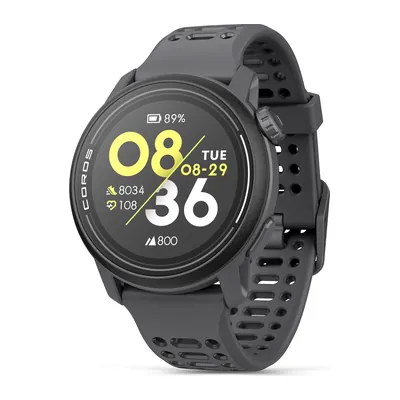
COROS PACE 3
A 1.1 oz GPS watch with a barometric altimeter: it records the distance and the elevation gain of every run, enough to track progress and km-effort.
View on Amazon (opens in a new tab)
FAQ
How do you calculate a trail race’s km-effort?
Add the elevation gain in meters divided by 100 to the distance in kilometers: 100 m of climbing equals 1 km-effort. So a 30 km race with 1,000 m of climbing scores 40 km-effort, and the UTMB, 177 km with 10,000 m of elevation gain, about 277. Descents don’t factor into the calculation used by ITRA, which applies this rule.
What do a race’s ITRA points mean?
They rate how much endurance a race demands, based on its km-effort, from 0 to 6 points: 0 points under 25 km-effort, 1 from 25 to 44, 2 from 45 to 74, 3 from 75 to 114, 4 from 115 to 154, 5 from 155 to 209, and 6 from 210 up. They don’t account for technical difficulty or altitude.
Does km-effort account for downhills?
No: ITRA’s formula only uses elevation gain. But descents wear out your legs and slow you down on steep or technical slopes. Some hiking methods do factor them in, like the German standard for trail signs, which counts 500 m of descent per hour. So always check the race’s elevation profile as well as its number.
What’s the difference between ITRA points and the Performance Index?
ITRA points, from 0 to 6, measure how hard a race is. The Performance Index, out of 1,000 points max, measures how good a runner is: it’s a weighted average of their five best race scores over the past 36 months, each scored by an algorithm that accounts for distance, elevation gain, altitude, conditions, and technical difficulty.
Sources
- International Trail Running Association (ITRA), “Discover Trail Running,” definition of km-effort, ITRA points, and the Performance Index, accessed October 22, 2026. itra.run https://itra.run/About/DiscoverTrailRunning ↩
- UTMB Mont-Blanc, official “UTMB” race page, distance and elevation gain for the 2026 edition (in French), accessed October 22, 2026 (the same data appear on the site’s CCC, OCC, and MCC pages). montblanc.utmb.world https://montblanc.utmb.world/fr/races/UTMB ↩
- French Hiking Federation (FFRandonnée), “Les itinéraires de randonnée” (in French), accessed October 22, 2026. ffrandonnee.fr https://www.ffrandonnee.fr/randonner/ou-pratiquer/les-itineraires-de-randonnee ↩
- William W. Naismith, “Cruach Ardran, Stobinian, and Ben More,” Scottish Mountaineering Club Journal, vol. 2, no. 3, September 1892, transcribed by the Glasgow Digital Library. gdl.cdlr.strath.ac.uk http://gdl.cdlr.strath.ac.uk/smcj/smcj009/smcj0090603.htm ↩
- Austrian Alpine Club (Österreichischer Alpenverein), “Wie berechnet man die Gehzeit auf Wanderwegen?” (in German), June 14, 2018, accessed October 22, 2026. alpenverein.at https://www.alpenverein.at/portal/news/aktuelle_news_kurz/2018/2018_06_14_wie-berechnet-man-die-gehzeit-auf-wanderwegen.php ↩

Trail running, snow, water, nature and destinations
Nolwenn covers trail running, snow, water, nature and destinations for Outfarer. Curious about everything, from meteor showers to night-train schedules, she has a knack for digging up the one detail that changes everything, and nailing it in a single sentence.

 Julien de Jurquet

