 Français (France)
 English (UK)
 English (US)
 Deutsch (Deutschland)

Contents
20 gallons of water weighs about 170 pounds and goes fast. The Caravan and Motorhome Club, Britain’s club for caravan and motorhome owners, counts a minimum of 23 liters (about 6 gallons) per person per day [1]: for two people, a 20-gallon fresh tank lasts 1.6 days, at best. After that you have to fill up, and above all dump. A camper van lives with three tanks: fresh water, the waste water from the sink and shower, collected in a separate tank, and the the tank or toilet cassette that holds toilet waste, along with any chemical added to it. Each has its own routine, its own places, and its own traps.
This guide picks up where the “Propane and water” step of our guide to your first camper van trip leaves off: how much water to carry, how to keep it clean, where to dump what, which products to choose, and what dumping in the wrong place can cost on public land.
How much water to carry, and for how many days?
Start with your rig’s spec sheet. Airstream lists 20 gallons of fresh water, 16 of gray, and 9 of black for its Interstate 19X touring coach, emptied by a macerator pump system [2]. Thor Motor Coach’s 2027 Sequence comes in three floor plans: 22, 27, or 35 gallons of fresh water, 13.3, 20, or 28 of gray, and 13.5 or 14 gallons of waste water, except on the 20U, which has a cassette toilet as standard and lists 4.75 gallons of waste capacity [3]. European vans fall in the same range: 100 or 110 liters (26.4 or 29.1 gal) on Hymer’s 2027 camper vans sold in France [4], and 110 liters on Volkswagen’s Grand California [5].
| Full tank | Weight of the water | 1 person | 2 people | 3 people | 4 people |
|---|---|---|---|---|---|
| 20 gal (Airstream Interstate 19X) | about 170 lb | 3.2 days | 1.6 days | 1 day | 0.8 day |
| 22 gal (Thor Sequence 20L) | about 180 lb | 3.6 days | 1.8 days | 1.2 days | 0.9 day |
| 35 gal (Thor Sequence 20Y) | about 290 lb | 5.7 days | 2.8 days | 1.9 days | 1.4 days |
Calculated by script from 23 liters (6.08 gal), rounded down; weight at 1 liter to 1 kilogram, as the club counts it. Since 23 liters is a minimum, these durations are maximums.
The math is quick, and sobering: with 20 gallons, 3 days solo, a day and a half for two, under a day for four. And those 23 liters are a floor, not an average [1]. Water has weight, too: 23 liters means 23 kilograms, about 51 pounds, carried from spigot to van per person per day, the club points out [1], and that weight rides along with you.
The detail that changes everything: Hymer counts only 20 liters (5.3 gal) of water in the published “mass in running order” of its camper vans, the “driving” level on its spec sheets [4]: on a full Yellowstone, the other 90 liters add about 90 kilograms (198 lb). LMC even fits a valve that caps its tank at about 10 liters (2.6 gal), which, the manufacturer writes, increases the RV’s payload [6]. Hence a simple habit: drive with little water, and fill up close to where you’ll camp.
Filling up and keeping your fresh water clean
“Fresh water becomes undrinkable in a short time!” That warning isn’t from a consumer group: it’s from LMC, in the manual for its Tourer RV, which we read in French [6]. The manufacturer asks you to disinfect the system before first use, to take water only from sources declared potable, and to use a fill hose and a tank approved for drinking water. The Caravan and Motorhome Club, for its part, calls for food-grade filler hose [1].
On how often to clean, manufacturers don’t agree. LMC puts cleaning and disinfecting the fresh tank on its monthly maintenance schedule [6]; Volkswagen recommends at least two cleanings a year, at the start and at the end of the season [7]; the Caravan and Motorhome Club says to flush the whole system with sterilizer when the vehicle has sat unused for several weeks [1]. Follow your van’s manual: it’s the only one that knows its lines and seals.
For products, Volkswagen lists tank cleaners based on hydrogen peroxide, chlorine dioxide, active oxygen, or fruit acids, plus a home remedy, citric acid: for a 100-liter (26.4 gal) tank, as a rule, 4 liters (about 1 gal) of water and five to ten heaping tablespoons, never heated [7]. It doesn’t recommend chlorine-based cleaners, which can damage the lines, or denture-cleaning tablets, whose residue can clog the pump and lines; vinegar essence works well on scale, but it’s so aggressive that it’s only for the inside of the tank, never the seals [7]. The Caravan and Motorhome Club rules out household bleach and points you to the instructions of a commercial sterilizer [1]. And white vinegar? We found no manufacturer’s manual that recommends it for disinfecting a tank.
Gray water: where to dump it, and where never to
Gray water is what drains from the shower and the kitchen into its own tank. “It’s just soapy water”? Not in Oregon: under state rules, gray water, bath water and kitchen wastewater included, is considered sewage, and it can’t be discharged to the ground surface, the state’s Department of Environmental Quality says [8]. LMC makes the same point in its manual: detergents, soaps, lotions, and cosmetics pollute the environment and contaminate groundwater [6].
So it goes where it’s meant to: at a dump station or a campground. LMC is blunt: never into street gutters, never out in nature, only at the stations provided at campgrounds or on specially equipped municipal sites, and when in doubt, ask the local authorities [6]. In national parks, federal rules prohibit draining refuse from a trailer or other vehicle except in facilities provided for that purpose [9]. And Oregon’s DEQ lists four approved ways to get rid of RV wastewater: a sewer connection where allowed, an authorized dump station, a licensed pumper, or an authorized hookup to a septic system [8]. A storm drain or a ditch isn’t one of them.
Free or paid? It depends on the station. At Zion National Park, the $5 fee covers a single use of the water fill and dump station at Watchman Campground for visitors who aren’t camping there; campers with a reservation already have it included [10]. The Oregon Department of Transportation lists the rest areas that have an RV sanitary dump station, such as Charles Reynolds, on I-84 9 miles east of La Grande, on the eastbound side [11], and Washington’s transportation department shows whether each rest area’s RV dumping station is open or closed [12]: check before you count on one.
To fight gray tank odors, Thetford sells, in its European range, an additive that, according to the maker, controls gray water odor, at 2.7 fl oz (80 ml) a dose, good for up to 7 days, and a tank cleaner to use two or three times a year [13]. LMC, more simply, plans on emptying and cleaning the waste water tank every month [6].
Black tank or cassette: the dump, the chemicals, and dumping at home
Of the four American floor plans whose specs we read, three hold toilet waste in a black tank, emptied by a macerator pump system on the Airstream Interstate 19X [2]. But the cassette, the most common toilet on British caravans and motorhomes according to the Caravan and Motorhome Club [14], exists here too: Thor fits one as standard on the Sequence 20U [3]. LMC’s manual gives the cassette routine: empty it at the latest when its indicator lights up, and completely if it might freeze or the living area isn’t heated; take it out through its outside hatch and, only once you’re at an official dump point, swivel the spout and unscrew its cap, hold down the vent button while it empties, rinse it under running water, slide it back in, and add toilet chemical [6]. Never in a toilet: in national forests, putting into any toilet, toilet vault, or plumbing fixture a substance that could damage it or interfere with its operation is prohibited [15].
The toilet chemical matters. In Thetford’s European range, each product has its own dose and duration, and only the green line is labeled septic tank safe, a claim missing from the Aqua Kem Blue [13]. The Caravan and Motorhome Club’s policy is that all chemical fluids should be biodegradable, to help the biological treatment of sewage, and it asks that you not use products that contain formaldehyde [14]; LMC calls for eco-friendly or biodegradable products, in small doses [6].
| Product | Standard dose | Stated duration | Septic tank |
|---|---|---|---|
| Aqua Kem Blue Concentrated, 26.4 fl oz (780 ml) | 2 fl oz (60 ml) | up to 5 days | not mentioned |
| Aqua Kem Blue, 67.6 fl oz (2 l) | 5.1 fl oz (150 ml) | up to 5 days | not mentioned |
| Aqua Kem Green Concentrated, 25.4 fl oz (750 ml) | 2.5 fl oz (75 ml) | up to 4 days | safe, according to the maker |
The maker’s doses and durations; its range varies by country, so follow the label of the product you buy.
Dumping the black tank or the cassette at home? Oregon’s DEQ explains why that’s no small thing: RV wastewater is generally stronger than other household wastewater, and because of that, and of the chemicals that may be used to treat it, connecting to a home septic system may harm the system; it takes an authorization from the DEQ or the county’s onsite septic program. Public sewer systems or dump facilities may not accept it either, because of its strength [8]. With a septic system at home, read the label: Thetford claims septic compatibility only for its green line [13].
Separating toilets: no water, but still a routine
A separating toilet keeps urine apart from solid waste, which lets it run without water and, according to Thetford, be emptied without depending on fixed disposal points [16]. The volumes are small: about 1.8 gallons (7 liters) for the solids bucket and about 2 gallons (7.5 liters) for the urine tank, on the maker’s models [17].
What do you do with what’s inside? Trelino, which sells its separating toilets as composting toilets for mobile use, answers in its manual: close the bag of solids tightly and put it in the household trash; ordinary composting is also possible, without the bag, if you use unbleached toilet paper with no dyes or chemical additives; empty the urine canister into a toilet connected to a sewer, ideally every two to three days. Trelino also recommends checking the local disposal regulations [18]. Away from the van, with a backpack on, it’s another story: see our guide to Leave No Trace hiking.
Dumping in the wrong place: what federal rules say
No federal text we read uses the words “gray tank” or “cassette,” but they leave little room. In national forests, it’s prohibited to place in or near a stream, lake, or other water any substance that does or may pollute it, and to fail to dispose of all garbage, sewage and waste water included, either by removing it or by depositing it in the receptacles or places provided [15]. On Bureau of Land Management land, unless otherwise authorized, no one may drain sewage or petroleum products, or dump refuse or waste other than wash water, from a trailer or other vehicle except in the places or receptacles provided [19].
| Rule | Where it applies | What it prohibits |
|---|---|---|
| 36 CFR 261.11 | national forests (Forest Service) | polluting a stream, lake, or other water; failing to dispose of sewage and waste water by removal or in the receptacles or places provided [15] |
| 43 CFR 8365.1-1 | public lands (Bureau of Land Management) | draining sewage, or dumping waste other than wash water, from a vehicle outside the places or receptacles provided; polluting water used for human consumption [19] |
| 36 CFR 2.14 | national parks (National Park Service) | draining refuse from a trailer or other vehicle except in facilities provided; polluting park waters or watercourses [9] |
On BLM land, wash water is exempted without being defined, and the same section bans polluting water supplies or water used for human consumption [19]. And at a campground or an RV park, the posted rules come on top of the regulations.
State rules, and a word on Europe
Each state has its own texts. Here are two examples, read at the source, and neither leaves waste water to anyone’s good will; Europe, for its part, gets one line.
That leaves the cold: frozen tanks and lines get their own chapter in our guide to camper vans in winter. For the rest, it all comes down to one routine at every stop: fresh water through a rinsed hose, gray and black water into the dump station inlet, and nowhere else. Fresh tank full, waste tanks empty: the road is yours, and the next coffee comes with a view.
Worth watching
A couple who travel in a Winnebago Revel show how they empty the cassette toilet of their camper van cleanly.
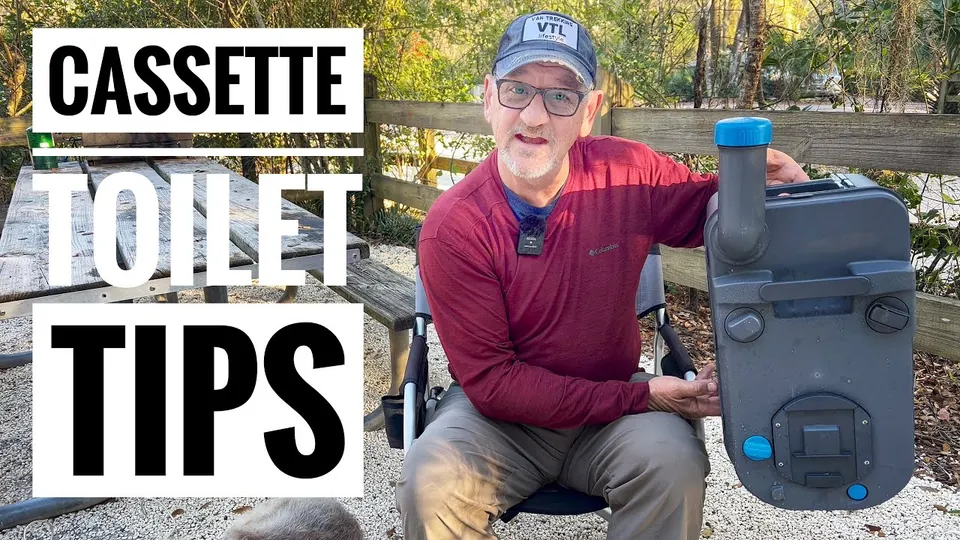
The video is hosted by YouTube (Google): nothing loads until you play it, and Google may then set cookies.
FAQ
Where can you dump RV tanks for free?
At a dump station or a campground, through the inlet provided. Some charge: at Zion National Park, the Watchman Campground station costs $5 a use for visitors who aren’t camping there, while campers with a reservation have it included. Some state rest areas have one, as the Oregon and Washington transportation departments show, but they can close. Never a storm drain, a ditch, or open ground.
Can you dump a black tank or a cassette at home?
Not without checking first. Oregon’s Department of Environmental Quality says RV wastewater is generally stronger than other household wastewater and that, with the chemicals that may be used to treat it, connecting to a home septic system may harm the system; it takes an authorization from the DEQ or the county. With a septic system, read the label: Thetford claims septic compatibility only for its green line.
How do you clean and sanitize a camper van’s fresh water tank?
With a tank product, following its instructions and your van’s manual: LMC plans a cleaning and disinfection every month, Volkswagen at least two a year. The UK’s Caravan and Motorhome Club rules out household bleach; Volkswagen mentions citric acid, doesn’t recommend chlorine-based cleaners, and keeps vinegar essence for the inside of the tank. Then flush with drinking water until no trace of the product shows at any faucet.
Is it illegal to dump gray water on the ground?
On national forest land, the rules require sewage and waste water to be removed or put in the receptacles or places provided; on BLM land, draining sewage or dumping waste other than wash water from a vehicle is banned outside the places provided. In Oregon, the Department of Environmental Quality says gray water counts as sewage under state rules and can’t be discharged to the ground surface.
What do you do with a composting toilet’s contents?
The maker Trelino advises closing the bag of solids tightly and putting it in the household trash; ordinary composting is possible without the bag, with unbleached toilet paper. The urine canister is emptied into a toilet connected to a sewer, ideally every two to three days. Trelino also recommends checking the local disposal regulations wherever you travel, before you empty anything.
How many days does a 20-gallon fresh tank last?
At best 3.2 days for one person, 1.6 days for two, and less than a day for four, using the Caravan and Motorhome Club’s minimum of 23 liters (about 6 gallons) per person per day. Every long shower or big batch of dishes cuts that down. And those 20 gallons weigh about 170 pounds, which add to the van’s load.
Sources
- The Caravan and Motorhome Club (UK), Freshwater tips whilst touring, accessed November 8, 2026. caravanclub.co.uk https://www.caravanclub.co.uk/advice-and-training/advice-for-beginners/freshwater-tips/ ↩
- Airstream, Interstate 19X, touring coach specifications (tank capacities and utility), accessed November 8, 2026. airstream.com https://www.airstream.com/explore-products/touring-coaches/interstate/interstate-19X/ ↩
- Thor Motor Coach, 2027 MY Sequence, specifications and standard features (PDF), accessed November 8, 2026. media-center.thormotorcoach.com https://media-center.thormotorcoach.com/asset/a55e75b6-e2ad-466a-bbc2-b30ead850cd4/2027-MY-Sequence.pdf ↩
- Hymer, HYMER CAMPER VANS 2027, Équipements et données techniques (equipment and technical data for France, valid from July 1, 2026, in French), accessed November 8, 2026. hymer.com https://www.hymer.com/hymer/drucksachen/preislisten/campervans/fr_fr_hymer_campervans_preisliste.pdf ↩
- Volkswagen Véhicules Utilitaires (Volkswagen Commercial Vehicles, France), Grand California (in French), accessed November 8, 2026. volkswagen-utilitaires.fr https://www.volkswagen-utilitaires.fr/fr/modeles/grand-california.html ↩
- LMC, Manuel d’utilisation for the LMC Tourer RV (FR-3748902), 2026 model year (in French), accessed November 8, 2026. lmc-caravan.com https://www.lmc-caravan.com/lmc/service/bedienungsanleitungen/mj-26/wohnmobil/3748902_bda_rm_lmc_tourer_fr.pdf ↩
- Volkswagen Véhicules Utilitaires, Nettoyer le réservoir d’eau d’un van : démonstration ! (cleaning a van’s water tank, in French), accessed November 8, 2026. volkswagen-utilitaires.fr https://www.volkswagen-utilitaires.fr/fr/univers-california/magazine-california/guides/nettoyer-reservoir-eau.html ↩
- Oregon Department of Environmental Quality, Guidance for Siting Recreational Vehicles and Wastewater Disposal, fact sheet, accessed November 8, 2026. oregon.gov https://www.oregon.gov/deq/Residential/Documents/onsite-RVsitingWWfs.pdf ↩
- Code of Federal Regulations, 36 CFR 2.14, Sanitation and refuse (National Park Service), eCFR, up to date as of November 5, 2026, accessed November 8, 2026. ecfr.gov https://www.ecfr.gov/current/title-36/chapter-I/part-2/section-2.14 ↩
- Zion National Park, Fees & Passes (RV dump station fee), National Park Service, last updated June 6, 2026, accessed November 8, 2026. nps.gov https://www.nps.gov/zion/planyourvisit/fees.htm ↩
- Oregon Department of Transportation, TripCheck, Rest Areas with RV Sanitary Dump Stations, accessed November 8, 2026. tripcheck.com https://tripcheck.com/Pages/Rest-Areas-RV-Dump-Stations ↩
- Washington State Department of Transportation, Rest areas (amenities and status of each rest area), accessed November 8, 2026. wsdot.wa.gov https://wsdot.wa.gov/travel/roads-bridges/rest-areas ↩
- Thetford, Toilet Care Products, 2027 European range table (07/2026), accessed November 8, 2026. thetford.com https://www.thetford.com/app/uploads/2024/07/Thetford_Overview_Toilet-Care-Products_2027_EN.pdf ↩
- The Caravan and Motorhome Club (UK), Toilets for caravans, technical advice, accessed November 8, 2026. caravanclub.co.uk https://www.caravanclub.co.uk/advice-and-training/technical-advice/sanitation/ ↩
- Code of Federal Regulations, 36 CFR 261.11, Sanitation (national forests), eCFR, up to date as of November 5, 2026, accessed November 8, 2026. ecfr.gov https://www.ecfr.gov/current/title-36/chapter-II/part-261/subpart-A/section-261.11 ↩
- Thetford, Separation Toilet and Separation Kit, accessed November 8, 2026. thetford.com https://www.thetford.com/en/bathroom/separation-toilets/ ↩
- Thetford, separation toilets and kits, overview and technical specifications, 2026 range, accessed November 8, 2026. thetford.com https://www.thetford.com/app/uploads/2025/12/11_Thetford_Overview_Separation_Toilets_2026_EN_LR.pdf ↩
- Trelino, operating instructions for Trelino composting toilets, in German and English, accessed November 8, 2026. cdn.shopify.com https://cdn.shopify.com/s/files/1/0521/3680/4501/files/BA_Trelino_generisch_1023.pdf ↩
- Code of Federal Regulations, 43 CFR 8365.1-1, Sanitation (Bureau of Land Management land), eCFR, up to date as of November 5, 2026, accessed November 8, 2026. ecfr.gov https://www.ecfr.gov/current/title-43/subtitle-B/chapter-II/subchapter-H/part-8360/subpart-8365/section-8365.1-1 ↩
- Oregon Department of Transportation, TripCheck, Rules of Use for ODOT Rest Areas (Oregon Administrative Rule 734-030-0010), accessed November 8, 2026. tripcheck.com https://www.tripcheck.com/Pages/Rest-Areas-Regulations ↩
- Service-Public.fr, the French government’s information site, Existe-il une amende pour abandon de déchets dans la rue ?, checked June 5, 2026 (in French), accessed November 8, 2026. service-public.gouv.fr https://www.service-public.gouv.fr/particuliers/vosdroits/F31963 ↩
- Wasserhaushaltsgesetz (German federal water act), section 103 (fines), gesetze-im-internet.de (in German), accessed November 8, 2026. gesetze-im-internet.de https://www.gesetze-im-internet.de/whg_2009/__103.html ↩

Trail running, snow, water, nature and destinations
Nolwenn covers trail running, snow, water, nature and destinations for Outfarer. Curious about everything, from meteor showers to night-train schedules, she has a knack for digging up the one detail that changes everything, and nailing it in a single sentence.

 Julien de Jurquet

 Arnaud Couderc
