 Français (France)
 English (UK)
 English (US)
 Deutsch (Deutschland)

Contents
In the listings, a camper van promises freedom, “fully equipped.” On paper, that’s true. On the road, that freedom is counted in pounds, amp-hours, and gallons of gray water, and that’s where first trips get complicated. Nothing discouraging, though: you just need to ask the right questions in the right order. Is the van legal, and does my license cover it? How much can I load? How many days will the power last? Where do I fill up, dump, and sleep? And what changes in winter? This guide takes them in turn, from the title to the first morning.
Its benchmarks come from official sources (federal regulations, state DMVs and transportation departments, the federal land agencies, the CDC), from manufacturers’ manuals, and from our own guides, each sourced on its own. They apply to a camper van or a light RV in the United States, with state examples wherever the rules change at the state line.
| When | What to do |
|---|---|
| A few months ahead | Rent a van for a few days before you buy one; for a van you’re converting yourself, find out how your state titles and registers it (as a housecar in California) |
| A few weeks ahead | Check your license, insurance, registration, and any state inspection; look up chain laws and propane rules for the bridges and tunnels on your route; weigh the van; check the battery, the propane, and the tires |
| The night before | Fill the fresh water, empty the gray and black tanks or the toilet cassette, fill the propane, and charge the battery; pick campgrounds and places to sleep |
| Departure day | Stow and secure everything, close the propane cylinders if the regulator has no crash sensor, read through the checklist, and go |
1Rent first, choose second
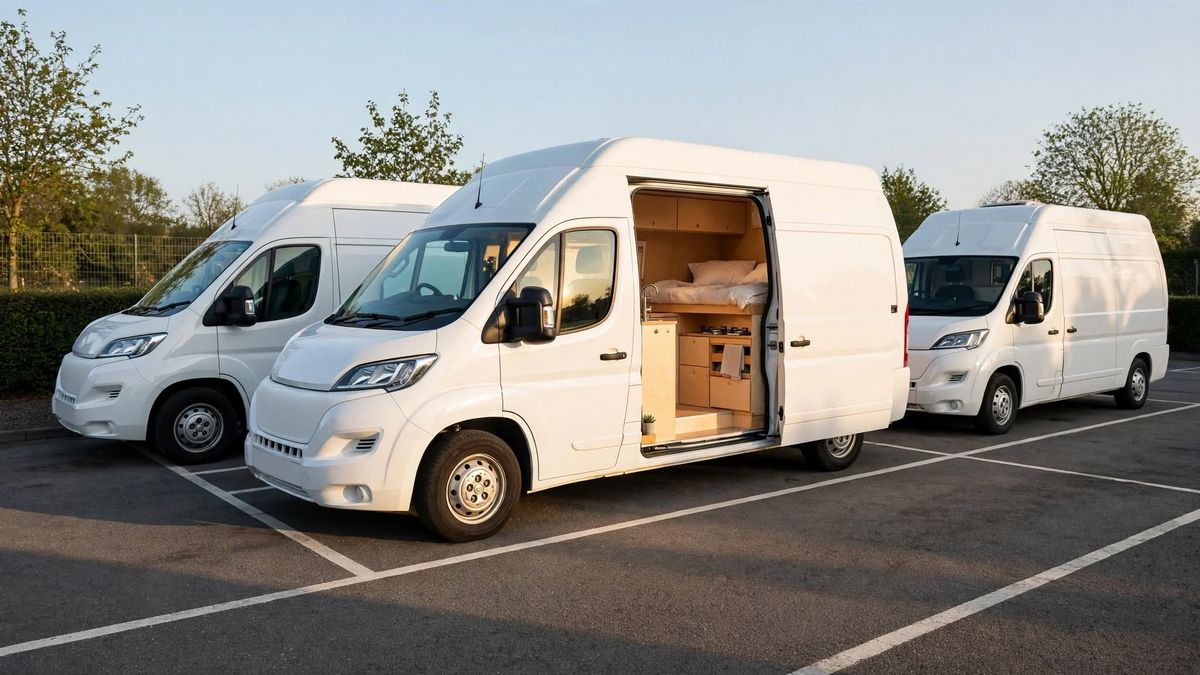
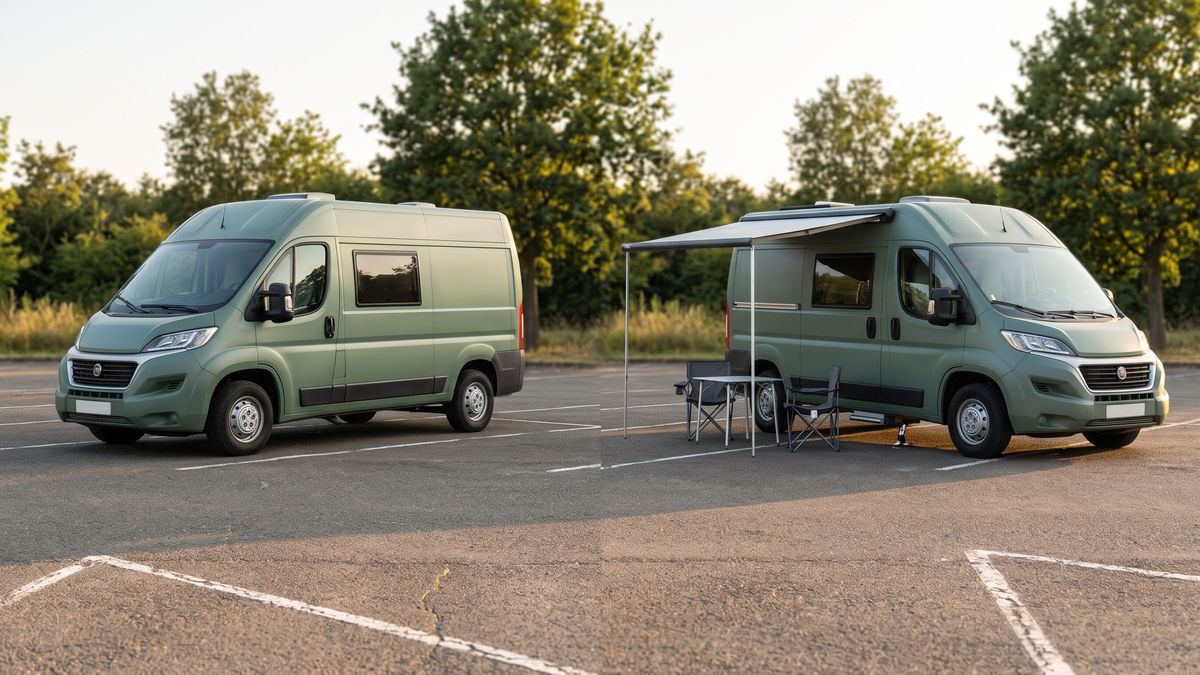
Before you buy, rent. A few days are enough to find out what you really want from a van: a fixed bed or one you make up every night, a shower or a bathroom corner you’ll never use, a van that fits in a regular parking space or a bigger RV that won’t clear the first parking garage. A rental costs less than a buying mistake, at $150 to $250 a day for a basic Sprinter according to The Vansmith, a builder of Sprinter conversions, and the gap between two builds is dizzying: interior work alone runs from $12,000 to more than $250,000, the same builder says, before the van itself [1].
The rest has a price too. Using listings and fuel prices from October 2026, our guide to the real cost of a camper van comes to about $13,100 to $15,200 a year before finance and the build, with depreciation and fuel explaining the whole gap with AAA’s average new vehicle. And before you fall for a model, look at two numbers: its length, and the Gross vehicle weight rating: the loaded weight the manufacturer specifies for the vehicle, passengers and cargo included. on the label in the driver’s door jamb. Together, they tell you whether your regular license covers it, as the next step shows.


2A van and a license that check out
A van doesn’t become an RV just because you sleep in it. In California, the paperwork follows the build: the DMV defines a housecar as a motor vehicle “originally designed, or permanently altered, and equipped for human habitation,” and registers van campers as housecars [2]. The application adds a Miscellaneous Certifications form, the REG 256 A, which the owner can fill out: its human habitation section counts closets, cabinets, kitchen units or fixtures, and bath or toilet rooms as living space, and it asks for the cost of the changes, labor included [2, 3]. The value of that added equipment then counts in the vehicle’s value for the vehicle license fee [2]. Other states have their own definitions and forms, so start with your DMV.
Buying a van that’s already built? Make sure its registration follows what it is: the same California form warns that if the living facilities are removed, a change in the vehicle’s type license is required and weight fees are due [3].
On the license side, the lines are drawn by length and weight, and each state draws its own. In California, a regular Class C license covers a standard vehicle for personal use; in New York, a regular Class D covers vehicles with a GVWR of 26,000 lb or less. Past the thresholds in the table below, an RV takes more [4, 5]. Measure your van, read the GVWR on its door label, and check your own state’s DMV.
| State | Regular license | Beyond that |
|---|---|---|
| California | Class C: a standard vehicle for personal use | Noncommercial Class B, with an endorsement, for a housecar or motorhome over 40 feet, up to 45 feet |
| New York | Class D: a GVWR of 26,000 lb or less | R endorsement for a recreational vehicle over 26,000 lb GVWR and/or 40 feet long |
That leaves two papers people forget. Insurance first: in California, it’s required on every vehicle operated or parked on the state’s roads, you keep proof of it in the vehicle, and the minimum liability coverage is $30,000 for injury or death to one person, $60,000 for more than one, and $15,000 for property damage [6]. Whether a policy covers the build itself is a question to put to your insurer, in writing. Then the inspection, which depends on the state: in New York, every registered vehicle needs a safety inspection once a year at a DMV-licensed station [7].
3Weight: count it up before you load
Payload starts with a label. Federal rules require one on the hinge pillar, door-latch post, or door edge next to the driver’s seat, with the GVWR and a gross axle weight rating, or GAWR, for each axle [8]. If a shop converted the van before its first retail sale, it must add its own label next to the original, with the new ratings if they changed [9]. The difference between the GVWR and what the van weighs ready to go is what’s left for you. Take a made-up example: a GVWR of 7,716 lb and a van that weighs 6,724 lb, so 992 lb.
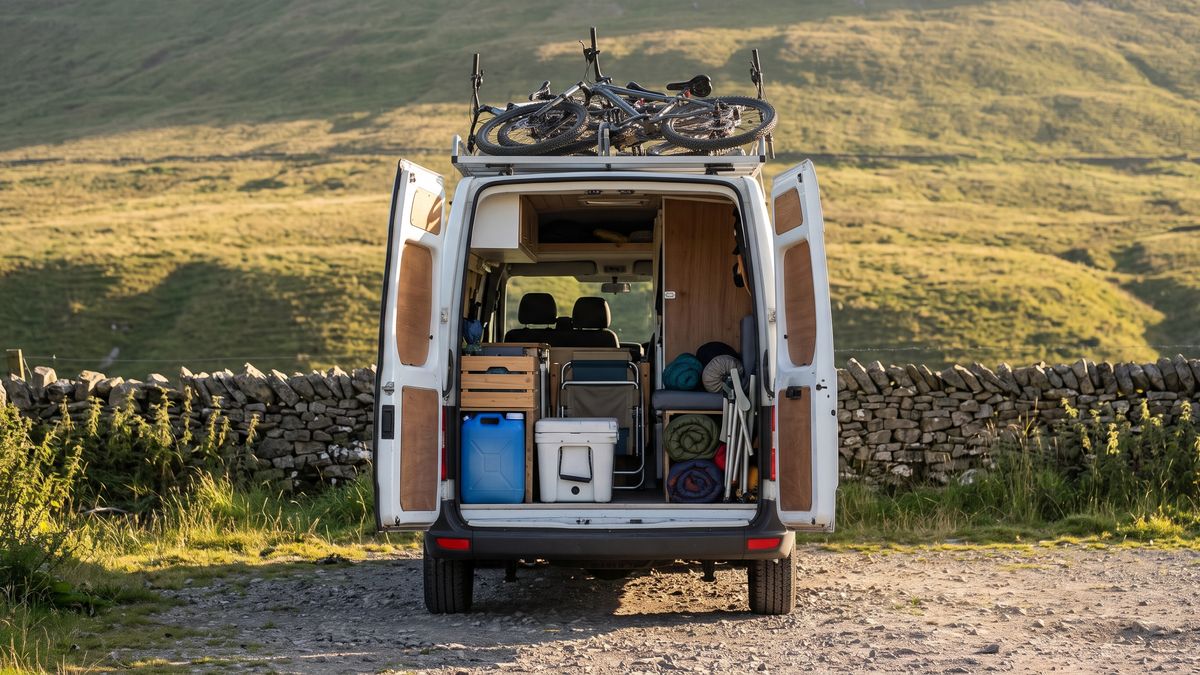
On the road, it gets tighter. Every passenger, every gallon of fresh water, which the federal motor home label counts at 8.3 lb, every propane cylinder, the bikes, everything in the cabinets, and the accessories added later come out of those 992 lb. The tire placard on the driver’s side puts it plainly: “The combined weight of occupants and cargo should never exceed” the figure it gives [10]. And each axle has its own rating on top of the total [8].
The rule to remember: load up as if you were leaving, tanks full and passengers aboard, roll onto a public truck scale, and set the tires to the cold inflation pressures on that same placard [10]. Only the scale tells you what’s left.

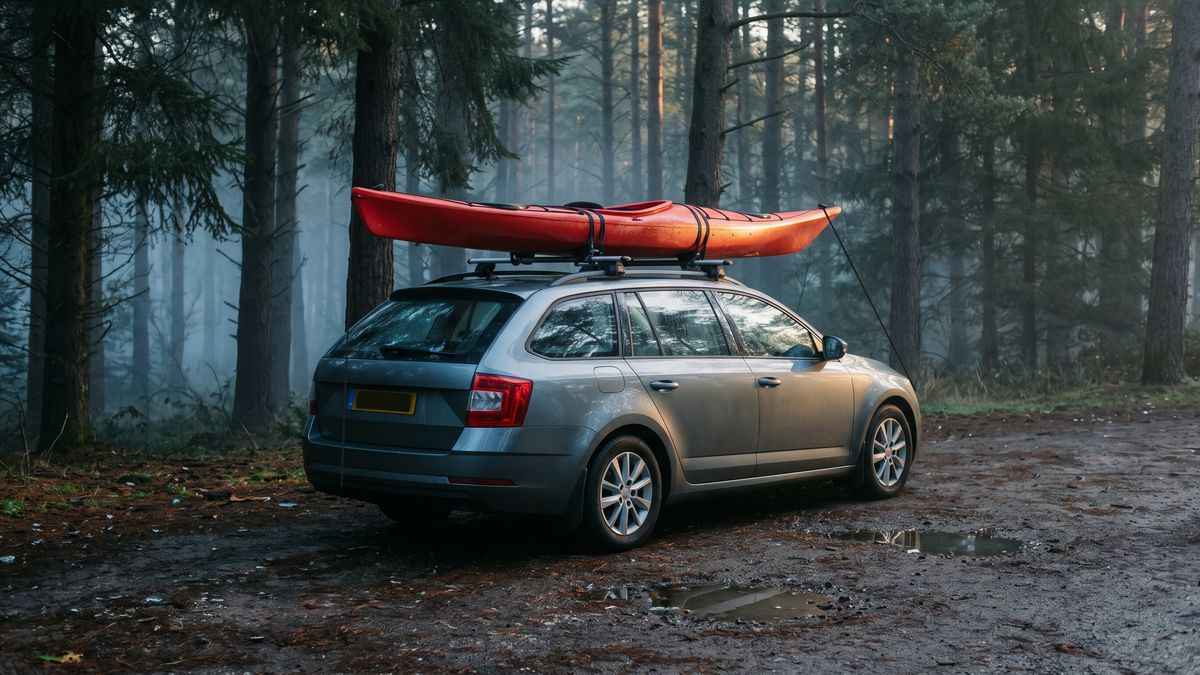
The roof has its own limit, and it’s often low. The load it can take is in the van’s owner’s manual, then in the instructions for the crossbars and the carrier: in a rack system, Thule notes, the component with the lowest weight capacity sets the maximum for the whole system [11]. Add up crossbars, carrier, and boat or cargo box, and stay under the lowest of the three, as our guide to transporting a kayak or paddle board explains.


4Power: a battery for the days without hookups
A house battery is sized in three steps: what you use each day, in watt-hours; times the number of days without recharging; then converted to amp-hours by dividing by the voltage. Then comes the label trap: an AGM lead-acid battery is only economical to use to 50% of its capacity, a lithium iron phosphate battery to 80% [12]. For the same amp-hours, the second gives you far more energy. In the example in our house battery guide, two days without recharging take about 100 Ah of lithium in summer, and nearly 190 Ah in winter, heater included.
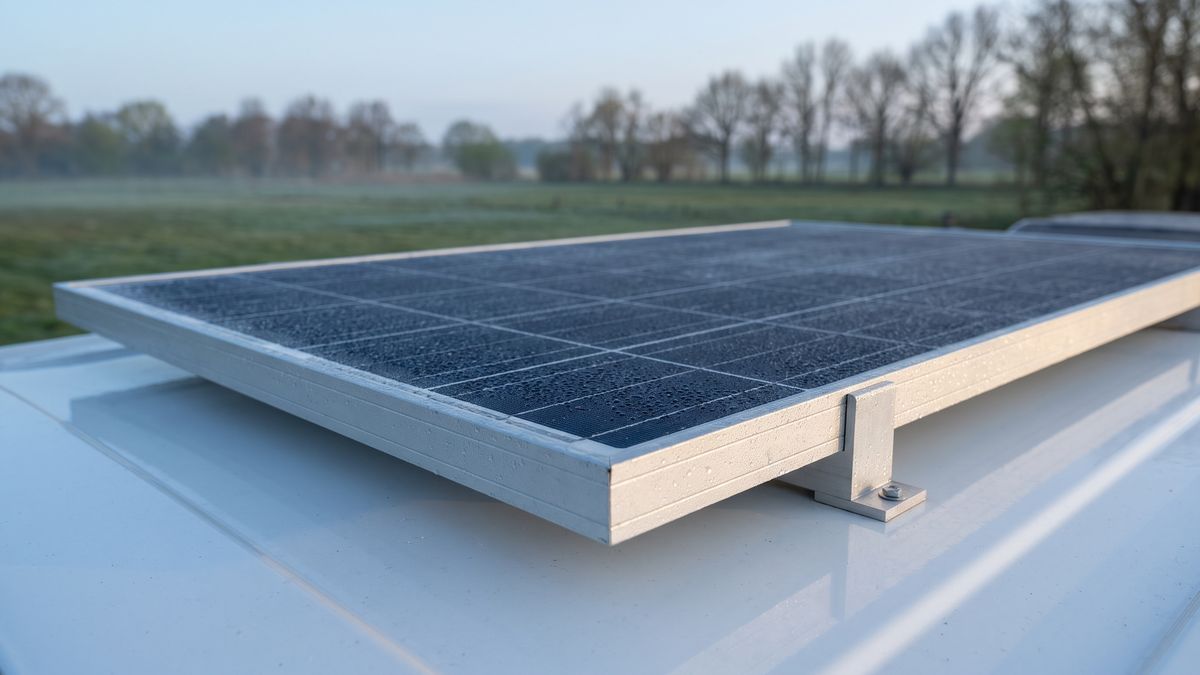
A solar panel, meanwhile, works mostly in summer. Lying flat on the roof, a 200 W panel produces about 920 to 1,280 Wh a day in June across five cities from Phoenix to Seattle, and only 130 to 530 Wh in December, according to PVWatts, the National Laboratory of the Rockies’ solar calculator [13], which our solar panel guide ran city by city. For 495 Wh used a day, 200 W covers the average from April to August, by its calculation; in winter, charging comes mostly from driving, or from shore power.


5Propane and water: fill, dump, shut off
Propane in a van cooks, sometimes heats the water and the cabin, and doesn’t forgive guesswork. Two gases come in cylinders: butane stops vaporizing around 32 °F (0 °C), while propane only stops at around -44 °F (-42 °C), its boiling point [14]. In winter, propane it is. A refillable cylinder holding 4 to 40 lb of propane must have an overfill prevention device, or OPD, which you can spot by its triangular handwheel: in most states since April 1, 2002, under the NFPA 58 propane code, a cylinder without one can’t be refilled until it’s retrofitted, as El Dorado County, in California, sums it up [15]. Check the date marked on the cylinder too: federal rules require periodic requalification, every 5 to 12 years for DOT 4B, 4BA, and 4BW cylinders, depending on the test [16]. And running the fridge or the heater on propane while you drive calls for a regulator with a crash sensor and hoses with rupture protection, according to Truma, a maker of RV heaters; without a crash sensor, it says, the cylinders stay closed on the road. Hoses age too: Truma suggests bending them slightly at every cylinder change, and replacing them as soon as they’re brittle or cracked [17].
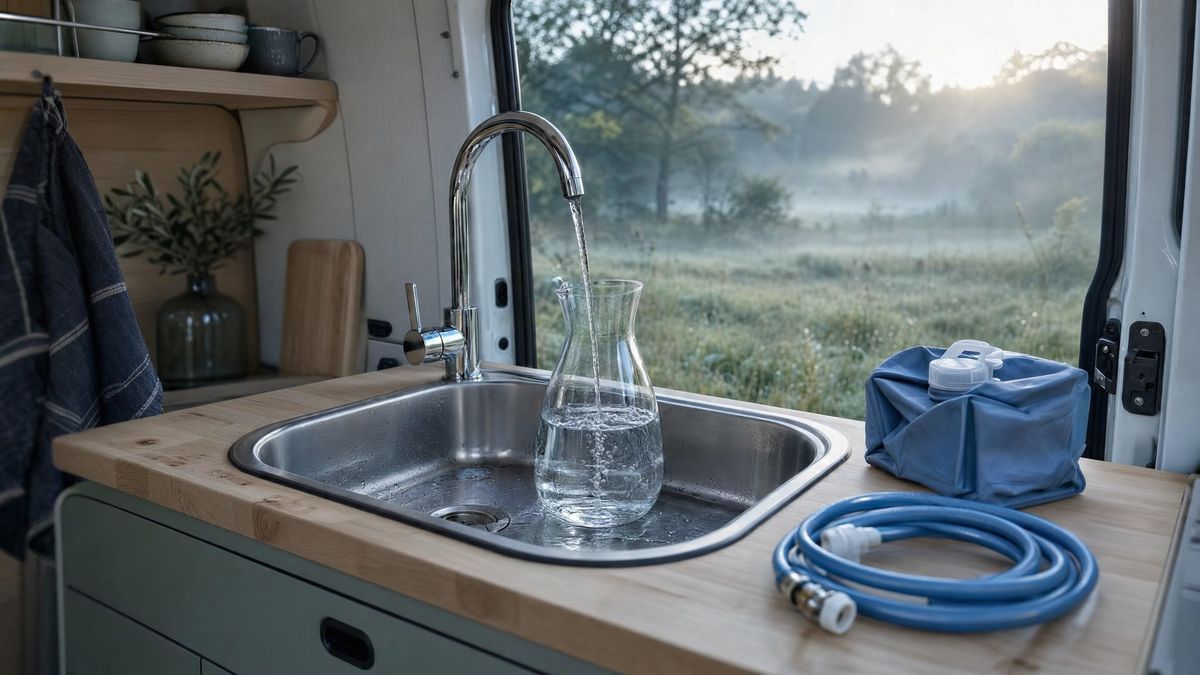
For water, three tanks, three habits. Fresh water fills at campground spigots and at dump stations, with a hose kept for drinking water only. Gray water, from the sink and shower, and the black tank or toilet cassette empty at a dump station, and some charge for it: at Zion National Park, the Watchman Campground station costs $5 a use for visitors who aren’t camping there [21]. Anywhere else, a storm drain, a ditch, or a patch of desert is not a dump station: in national parks, federal rules prohibit draining refuse from a trailer or other vehicle except in facilities provided for it [22], and in national forests, sewage and wastewater have to leave with you or go in the receptacles or places provided [23]. In winter, think about freezing too: our guide to camper vans in winter says what to drain.


6Where to sleep: parking isn’t camping
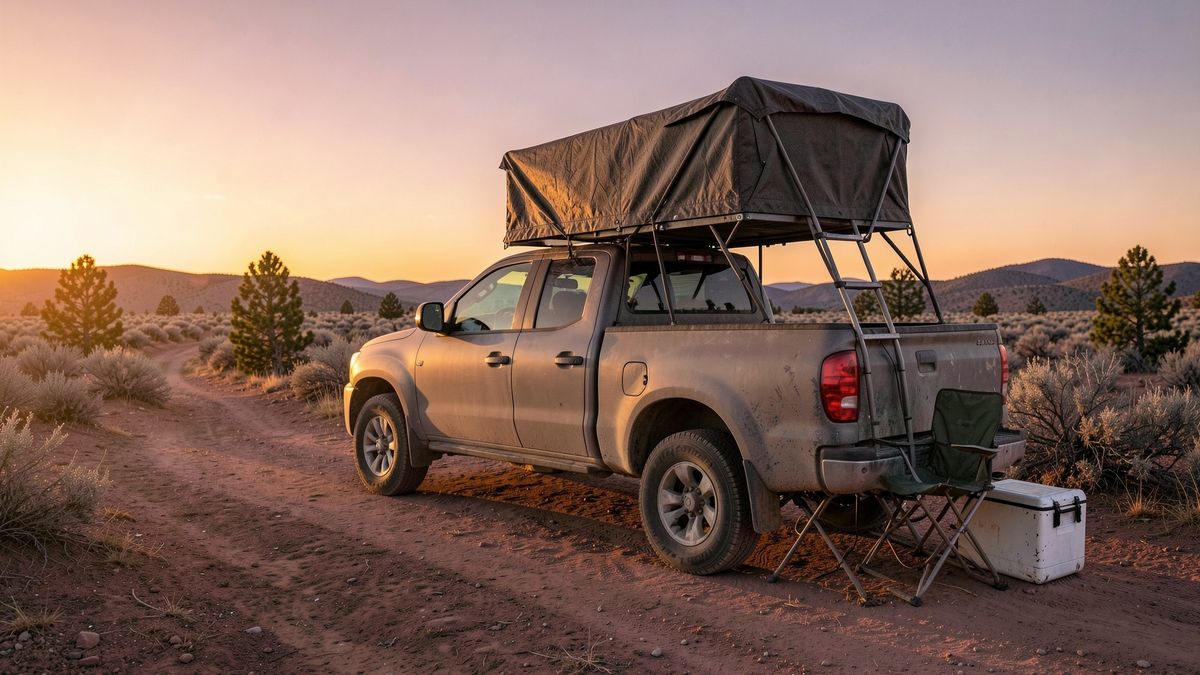
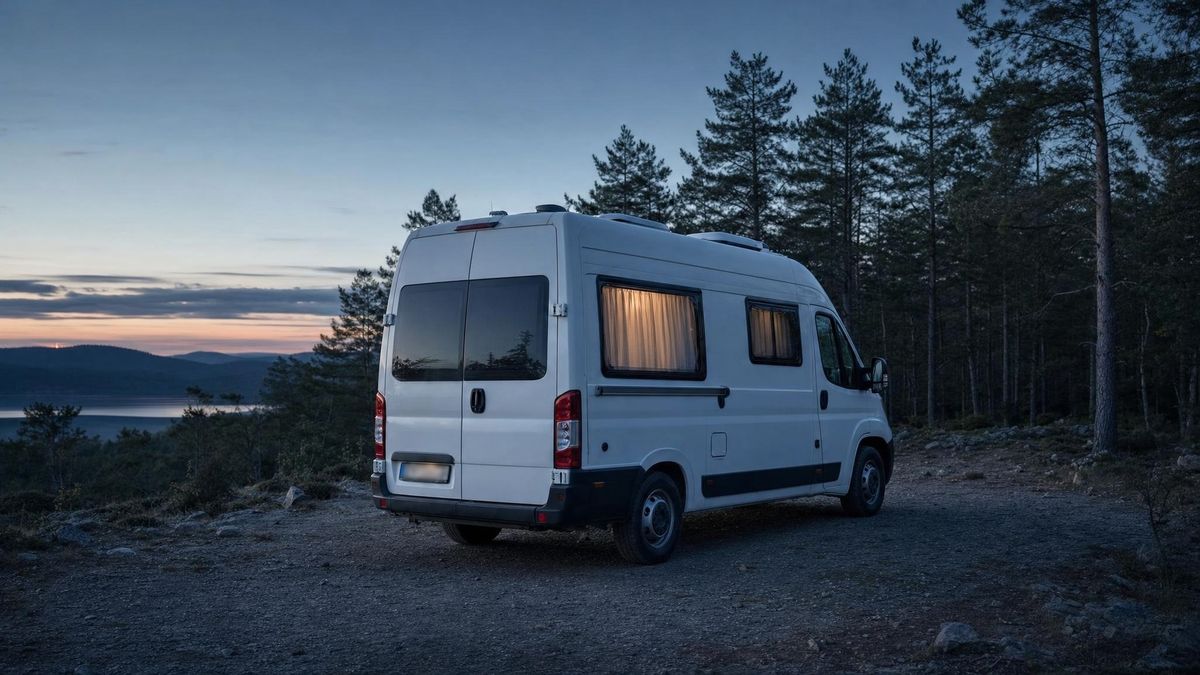
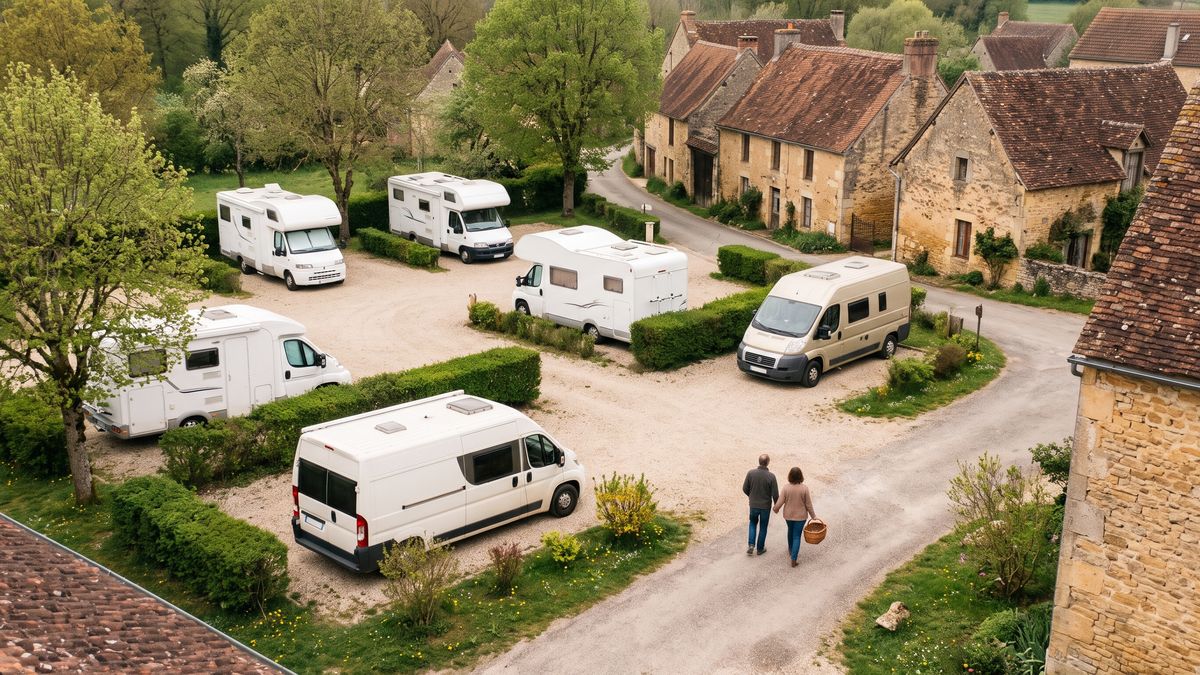
In the United States, the question comes down to one difference: parking isn’t camping. Stopping for the night on a road or at a rest area answers to the state and the town; camping answers to whoever manages the land. A rest area is for a break, not a campsite: in California, stays are limited to eight hours in any 24-hour period and camping is prohibited [24], and Washington sets the same eight hours and prohibits camping, including any tent or “other sleeping accommodation,” along its interstate and state highways [25]. In town, posted signs and city rules decide: read them, and when in doubt, ask.
Public land is where a van comes into its own. Most Bureau of Land Management land allows dispersed camping, away from developed facilities, unless it’s posted “Closed to Camping”; stays are generally limited to 14 days within any 28-day period, after which you move to a new spot, often at least 25 to 30 miles away, and dispersed camping is for short-term recreation, not long-term living, except in the long-term visitor areas of California and Arizona, where a winter permit covers up to seven months [26]. In national forests, the stay limit is whatever the local order sets [27], so ask the ranger district. In national parks, camping outside designated sites or areas is prohibited [28]: there, the van sleeps at the campground. Posted signs and closures always win, and our guide to the real cost of a camper van lists the fees for each.
Taking the van to Europe? Parking and camping follow other rules at every border, as our guides to sleeping in a van in France and in Europe explain.



7On the road: crossings and chain laws
Before the mountains, look at the crossings on your route, because propane isn’t welcome everywhere. On the Chesapeake Bay Bridge-Tunnel, in Virginia, a noncommercial vehicle can carry no more than two portable cylinders of up to 45 lb of LP gas each, or a single one of up to 60 lb; tanks have to meet Department of Transportation standards, be properly secured, and keep their valves closed for the crossing, and they’re subject to inspection at the toll plaza [29]. Other bridges and tunnels set their own rules: check the operator’s page before you leave.
In the mountains, winter shows up on signs. In California, Caltrans uses three levels of chain controls, summed up below; with chains on, the speed limit is 25 or 30 mph, and if you don’t stop to put them on when the signs say so, the California Highway Patrol can cite and fine you [30]. Read R-1 closely: the snow-tire exemption only covers passenger vehicles and light-duty trucks under 6,000 lb gross weight, so check where your van falls.
| Level | What’s required |
|---|---|
| R-1 | Chains on all vehicles, except passenger vehicles and light-duty trucks under 6,000 lb gross weight with snow tires on at least two drive wheels; vehicles on snow tires must carry chains |
| R-2 | Chains or traction devices on all vehicles, except four-wheel or all-wheel drive vehicles with snow-tread tires on all four wheels, which must carry traction devices |
| R-3 | Chains or traction devices on all vehicles, no exceptions |
Summary of Caltrans’s definitions; posted signs and instructions from Caltrans or the CHP at checkpoints take precedence. [30]
Colorado goes by tread depth. On I-70 between Morrison and Dotsero, its traction and chain laws can be enforced with fines from September 1 to May 31, or whenever conditions require, and the Colorado Department of Transportation can put them in effect on any state highway. Under the traction law, passenger vehicles need tires with 3/16 inch (4.8 mm) of tread, rated all-weather or winter, which means the mountain-snowflake symbol or an M+S or M/S marking, or else chains or an approved alternative traction device on board; under the chain law, the last step before a closure, every vehicle needs chains or an approved device. Not complying costs a $100 fine plus a $33 surcharge, and $500 plus $157 if it leads to a lane closure [31].
8Winter trips: heat, propane, and battery
In winter, the van changes jobs: it becomes a shelter you have to heat at night. A 7,000 BTU/h (2 kW) diesel air heater like the Webasto Air Top 2000 STC, which its maker has since replaced with a newer model, burns 0.4 to 0.8 gallons (1.5 to 3 liters) of diesel over a 12-hour night, and draws 15 to 29 Ah from the battery for its fans and electronics [32]. In theory, an electric space heater running off the house battery would do just as well, with no fuel at all. Let’s do the math: 2 kW for 12 hours is 24 kWh, and a 100 Ah lithium battery at 12.8 V stores 1.28 kWh. You’d need nearly 19 of them. That’s no longer a camper van; it’s a battery store with a steering wheel.
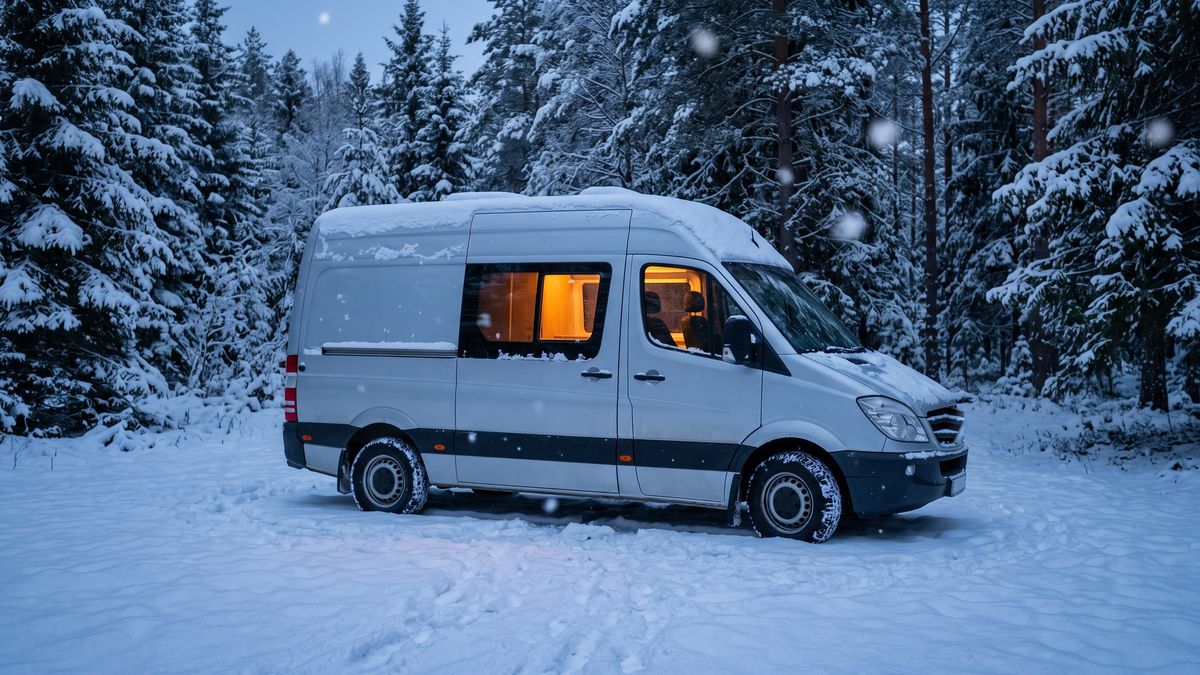
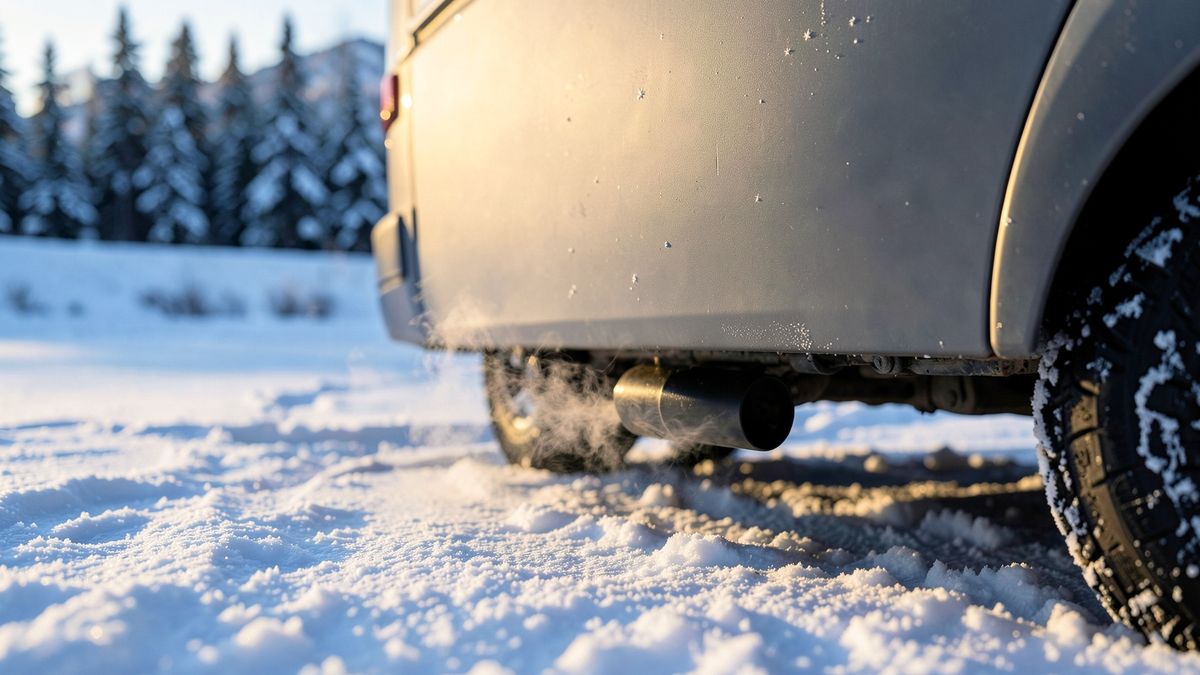
The cold also gets to whatever feeds the heater. Below freezing, of the bottled gases, only propane works; and some lithium batteries refuse to charge below 41 °F (5 °C), like Victron’s, whose battery management system blocks charging below that [33]: install yours inside the heated space. Add December’s solar output, 2.4 to 7 times lower than June’s from Phoenix to Seattle, and you have the equation of a winter in a van: stored energy, and a heater built for the job. Our guide to camper vans in winter covers insulation, condensation, and frozen water lines.



9Going further: boats, hiking, backcountry camping
The van is often just base camp. For a kayak or a paddle board on the roof: one cam strap around each crossbar, bow and stern lines, and never a bungee cord, as our guide to transporting a kayak explains. To head out on foot from the trailhead, our step-by-step guides to planning a hike and to a first backcountry camping trip take over, and in winter, snowshoes fit in the back. Heading for the national parks? Our guide to reservations and passes covers the fees.
Every trip, the rule stays the same, and it fits in one sentence: plan a van like a budget, counting everything that goes in, pounds, amp-hours, and gallons, before you count the miles.





The checklist before you head out
Check it off a few days before, then read it again the morning you leave. It follows the steps of this guide; adjust it to the season, the states you’ll cross, and the length of the trip.
- Title and registration in order (as a housecar in California for a converted van), and a license that covers your van’s GVWR and length
- Insurance current with proof on board, and the state inspection done if your state requires one
- Load under the GVWR and each axle rating, checked on a scale fully loaded; roof load under the lowest of the limits
- Tire pressure set to the placard on the driver’s side
- Route checked for bridges and tunnels that restrict propane
- Battery charged and the trip’s power use estimated
- Propane cylinders full, each with its OPD valve and a requalification date that’s still good; hoses neither brittle nor cracked
- Carbon monoxide alarm tested, vents clear
- Fresh water filled, gray and black tanks or toilet cassette emptied at a dump station
- Chain laws checked for the mountain passes on your route, in California, Colorado, and every other state you’ll cross
- On Colorado’s I-70 mountain corridor from September 1 to May 31: tires with 3/16 inch of tread, rated all-weather or winter, or chains on board
- Campgrounds and places to sleep picked, stay limits and posted rules checked on site
- Everything stowed and secured, cabinets latched, propane closed if the regulator has no crash sensor
Gear related to this article
No affiliation: no commission, no sponsored products.
 Victron Energy
Victron SmartSolar MPPT 100/20
A 20 A MPPT solar charge controller for 290 W of panels on a 12 V system, with Bluetooth and a 30-day history: a way to check your output against PVGIS.
View on Amazon (opens in a new tab) Victron Energy
Victron SmartShunt 500 A
A shunt battery monitor that shows current, amp-hours used, and state of charge on your phone, so your daily energy budget is measured rather than estimated.
View on Amazon (opens in a new tab)
Worth watching
A couple who travel full time by RV share their advice for a first trip, for beginners who want it to go smoothly.

The video is hosted by YouTube (Google): nothing loads until you play it, and Google may then set cookies.
FAQ
Do I need a special license to drive a camper van?
It depends on your state, and on your van’s length and weight. In California, a regular Class C license covers a standard vehicle for personal use, and only a motorhome over 40 feet, up to 45, calls for a noncommercial Class B with an endorsement. In New York, a regular Class D covers a GVWR of up to 26,000 lb; past that, or past 40 feet, an RV needs an R endorsement. Check your own DMV.
Can I sleep in my van anywhere in the US?
No: stopping for the night and camping follow different rules. Rest areas are for a break, and California and Washington cap a stay at eight hours in any 24-hour period and prohibit camping. On Bureau of Land Management land, dispersed camping is generally allowed for 14 days within any 28-day period; national forests set their own limits by order, and national parks allow camping only in designated sites or areas. Posted signs always win.
What size battery and solar panel does a camper van need?
Add up your watt-hours per day, multiply by the days without recharging, then divide by the voltage to get amp-hours. Lithium iron phosphate is usable to 80% of its capacity, AGM lead-acid to 50%. Lying flat, a 200 W panel produces about 920 to 1,280 Wh a day in June from Phoenix to Seattle, but 130 to 530 Wh in December: in winter, charging comes mostly from driving or shore power.
Where do I dump gray water and the black tank?
At a dump station, in a campground or elsewhere, sometimes for a fee: at Zion, visitors who aren’t camping pay $5 a use. Never in a storm drain, a ditch, or on the ground: in national parks, federal rules prohibit draining refuse from a vehicle except in facilities provided for it, and in national forests, sewage and wastewater must go in the receptacles or places provided, or leave with you.
Can I take a camper van out in winter?
Yes, with a heater built to run overnight in a vehicle, such as a diesel air heater, a carbon monoxide alarm, and vents that stay open. Below freezing, of the bottled gases, only propane works, and some lithium batteries won’t charge below 41 °F (5 °C). In the mountains, check the chain laws: in Colorado, the traction law can be enforced on I-70 from September 1 to May 31, and California posts three levels of chain controls.
How much does a camper van trip cost?
By our calculation, on October 2026 listings and fuel prices, a camper van costs about $13,100 to $15,200 a year to own and run at 15,000 miles, before finance and the build. On public land, nights run from free on suitable dispersed sites to $180 for a whole winter on a BLM long-term visitor area permit; private campgrounds cost more. Renting for a few days before you buy is still the best way to avoid the wrong van.
Sources
- The Vansmith, “Sprinter Van Cost 2026: New, Used + Camper Conversion Prices” (vehicle, interior, and rental price ranges), a builder of Sprinter conversions, accessed November 8, 2026. thevansmith.com https://thevansmith.com/blogs/beginners-guide-to-the-vanlife/what-is-the-cost-of-sprinter-van-and-its-conversion ↩
- California Department of Motor Vehicles, Vehicle Industry Registration Procedures Manual, “13.065 Housecars (VC §362),” accessed November 7, 2026. dmv.ca.gov https://www.dmv.ca.gov/portal/handbook/vehicle-industry-registration-procedures-manual-2/commercial-vehicles/housecars/ ↩
- California Department of Motor Vehicles, “Miscellaneous Certifications” form (REG 256 A, rev. 4/2024), section A, “Certification of Vehicle for Human Habitation,” accessed November 7, 2026. dmv.ca.gov https://www.dmv.ca.gov/portal/file/miscellaneous-certifications-reg-256a-pdf/ ↩
- California Department of Motor Vehicles, “Driver’s Licenses” (noncommercial license classes), accessed November 7, 2026. dmv.ca.gov https://www.dmv.ca.gov/portal/driver-licenses-identification-cards/driver-licenses-dl/ ↩
- New York State Department of Motor Vehicles, New York State Driver’s Manual, “Chapter 1: Driver Licenses,” accessed November 7, 2026. dmv.ny.gov https://dmv.ny.gov/new-york-state-drivers-manual-and-practice-tests/chapter-1-driver-licenses ↩
- California Department of Motor Vehicles, “Auto Insurance Requirements,” accessed November 7, 2026. dmv.ca.gov https://www.dmv.ca.gov/portal/vehicle-registration/insurance-requirements/ ↩
- New York State Department of Motor Vehicles, “New York State Inspections,” accessed November 7, 2026. dmv.ny.gov https://dmv.ny.gov/inspections ↩
- Code of Federal Regulations, 49 CFR 567.4, “Requirements for manufacturers of motor vehicles” (certification label), 2025 edition, govinfo.gov, accessed November 7, 2026. govinfo.gov https://www.govinfo.gov/content/pkg/CFR-2025-title49-vol6/xml/CFR-2025-title49-vol6-sec567-4.xml ↩
- Code of Federal Regulations, 49 CFR 567.7, “Requirements for persons who alter certified vehicles,” 2025 edition, govinfo.gov, accessed November 7, 2026. govinfo.gov https://www.govinfo.gov/content/pkg/CFR-2025-title49-vol6/xml/CFR-2025-title49-vol6-sec567-7.xml ↩
- Code of Federal Regulations, 49 CFR 571.110, Federal Motor Vehicle Safety Standard No. 110, “Tire selection and rims and motor home/recreation vehicle trailer load carrying capacity information for motor vehicles with a GVWR of 4,536 kilograms (10,000 pounds) or less,” 2025 edition, govinfo.gov, accessed November 8, 2026. govinfo.gov https://www.govinfo.gov/content/pkg/CFR-2025-title49-vol6/xml/CFR-2025-title49-vol6-sec571-110.xml ↩
- Thule, “Thule Rooftop Tent Guidelines” (5564366001), vehicle and roof rack compatibility, accessed November 8, 2026. thule.com https://www.thule.com:443/-/s/approved/std.lang.all/02/00/670200.pdf?rev=13.3 ↩
- Victron Energy, “Batteries: Lithium-ion vs AGM,” blog, March 30, 2015, accessed November 8, 2026. victronenergy.com https://www.victronenergy.com/blog/2015/03/30/batteries-lithium-ion-vs-agm/ ↩
- National Laboratory of the Rockies (NLR), “PVWatts V8 API,” developer documentation, accessed November 8, 2026. developer.nlr.gov https://developer.nlr.gov/docs/solar/pvwatts/v8/ ↩
- Deutscher Verband Flüssiggas (DVFG), “Informationsblatt zu chemisch-physikalischen Eigenschaften” (properties of propane and butane, in German), accessed November 8, 2026. dvfg.de https://www.dvfg.de/wp-content/uploads/2026/06/Factsheet-Flussiggas-2022-12.pdf ↩
- El Dorado County, California, “Propane Tanks and Overfill Prevention Device (OPD) Requirements,” accessed November 8, 2026. eldoradocounty.ca.gov https://www.eldoradocounty.ca.gov/Public-Safety-Justice/Waste-Disposal/Solid-Waste-Disposal/Propane-Tanks ↩
- Code of Federal Regulations, 49 CFR 180.209, “Requirements for requalification of specification cylinders,” 2025 edition, govinfo.gov, accessed November 8, 2026. govinfo.gov https://www.govinfo.gov/content/pkg/CFR-2025-title49-vol3/xml/CFR-2025-title49-vol3-sec180-209.xml ↩
- Truma, “How to find the right Truma gas pressure regulator,” accessed November 8, 2026. truma.com https://www.truma.com/truma-guides/how-to-find-the-right-truma-gas-pressure-regulator/ ↩
- Centers for Disease Control and Prevention (CDC), “Carbon Monoxide (CO) Poisoning Basics,” updated October 26, 2026, accessed November 8, 2026. cdc.gov https://www.cdc.gov/carbon-monoxide/about/index.html ↩
- Centers for Disease Control and Prevention (CDC), “What to Do to Protect Yourself During a Power Outage,” reviewed August 26, 2026, accessed November 8, 2026. cdc.gov https://www.cdc.gov/natural-disasters/response/what-to-do-protect-yourself-during-a-power-outage.html ↩
- National Institute for Occupational Safety and Health (NIOSH), CDC, “Carbon Monoxide Hazards at Work,” updated October 28, 2026, accessed November 8, 2026. cdc.gov https://www.cdc.gov/niosh/carbon-monoxide/about/index.html ↩
- Zion National Park, “Fees & Passes” (RV dump station fee), National Park Service, updated June 6, 2026, accessed November 8, 2026. nps.gov https://www.nps.gov/zion/planyourvisit/fees.htm ↩
- Code of Federal Regulations, 36 CFR 2.14, “Sanitation and refuse” (National Park Service), 2025 edition, govinfo.gov, accessed November 8, 2026. govinfo.gov https://www.govinfo.gov/content/pkg/CFR-2025-title36-vol1/xml/CFR-2025-title36-vol1-sec2-14.xml ↩
- Code of Federal Regulations, 36 CFR 261.11, “Sanitation” (Forest Service), 2025 edition, govinfo.gov, accessed November 8, 2026. govinfo.gov https://www.govinfo.gov/content/pkg/CFR-2025-title36-vol2/xml/CFR-2025-title36-vol2-sec261-11.xml ↩
- California Department of Transportation (Caltrans), Project Development Procedures Manual, chapter 29, “Landscape Architecture,” section 3, “Safety Roadside Rest Areas,” accessed November 8, 2026. dot.ca.gov https://dot.ca.gov/-/media/dot-media/programs/design/documents/pdpm-chapter29-a11y.pdf ↩
- Washington State Department of Transportation (WSDOT), Traffic Manual M 51-02.12, chapter 6, “Traffic Regulations” (rest area parking), July 2026, accessed November 8, 2026. wsdot.wa.gov https://wsdot.wa.gov/publications/manuals/fulltext/m51-02/chapter6.pdf ↩
- Bureau of Land Management, “Camping on Public Lands,” accessed November 8, 2026. blm.gov https://www.blm.gov/programs/recreation/camping ↩
- Code of Federal Regulations, 36 CFR 261.58, “Occupancy and use” (Forest Service prohibitions in areas designated by order), 2025 edition, govinfo.gov, accessed November 8, 2026. govinfo.gov https://www.govinfo.gov/content/pkg/CFR-2025-title36-vol2/xml/CFR-2025-title36-vol2-sec261-58.xml ↩
- Code of Federal Regulations, 36 CFR 2.10, “Camping and food storage” (National Park Service), 2025 edition, govinfo.gov, accessed November 8, 2026. govinfo.gov https://www.govinfo.gov/content/pkg/CFR-2025-title36-vol1/xml/CFR-2025-title36-vol1-sec2-10.xml ↩
- Chesapeake Bay Bridge-Tunnel, “Hazmat and Compressed Gas Regulations” (compressed gas regulations for noncommercial vehicles), accessed November 8, 2026. cbbt.com https://www.cbbt.com/regulations/ ↩
- California Department of Transportation (Caltrans), “Chain Controls / Chain Installation,” accessed November 8, 2026. dot.ca.gov https://dot.ca.gov/travel/winter-driving-tips/chain-controls ↩
- Colorado Department of Transportation, “Passenger Vehicle Traction and Chain Laws,” accessed November 8, 2026. codot.gov https://www.codot.gov/travel/winter-driving/tractionlaw ↩
- Webasto, “Air Top 2000 STC,” product page and technical specifications, accessed November 8, 2026. webasto.com https://www.webasto.com/en-us/heating/air-heaters/air-top-2000-stc.html ↩
- Victron Energy, “VictronConnect now with Smart Lithium battery update,” blog, November 28, 2018, accessed November 8, 2026. victronenergy.com https://www.victronenergy.com/blog/2018/11/28/victronconnect-now-with-smart-lithium-update/ ↩

Vans, RVs, biking and calculators
Julien de Jurquet writes for Outfarer about camper vans, RVs, biking, and calculators. He reads manuals cover to cover and never lets a number slide without its unit, so your choices rest on math, not promises.
 Arnaud Couderc