 Français (France)
 English (UK)
 English (US)
 Deutsch (Deutschland)

Contents
GVWR and the door label: what the numbers mean
9,050 lb, 7,595 lb, 1,455 lb. On its spec page, Airstream gives its Interstate 19X, built on a Mercedes-Benz Sprinter 2500, a GVWR of 9,050 lb, a unit base weight of 7,595 lb, and a net carrying capacity of 1,455 lb, the difference between the two [1]. One subtraction, and it looks generous. On paper, payload is arithmetic; on the road, it’s a scale ticket.
The numbers that count are on the van itself. Federal rules require a certification label on the hinge pillar, door-latch post, or door edge next to the driver’s seat, showing the Gross vehicle weight rating: the loaded weight of the vehicle as specified by its manufacturer, people and cargo included. and a gross axle weight rating, or GAWR, for each axle, front to rear [2]. The federal definition is short: the GVWR is the value specified by the manufacturer as the loaded weight of a single vehicle [3].
RVs add a second label. The final-stage manufacturer of every motor home must fit a yellow occupant and cargo carrying capacity label, or OCCC, on the inside of the forward-most passenger door on the right side, stating that “the combined weight of occupants and cargo should never exceed” a given figure [4]; heavier motor homes, over 10,000 lb, get the same label [5]. That’s your payload, already worked out for the van as delivered. The license, for its part, follows the rating: in New York, a regular Class D license covers vehicles with a manufacturer’s GVWR of 26,000 lb or less [6].
Dry weight: what the empty number already counts
Federal rules define the UVW: the weight of a vehicle with all the fluids it needs to run, but without cargo, occupants, or accessories that are usually removed when not in use. as the weight of a vehicle with maximum capacity of all fluids necessary for operation, but without cargo or occupants [3]. Nobody is aboard. Europe’s mass in running order counts a 75 kg (165 lb) driver [7]; the US figure leaves the driver out, so the payload has to carry everyone, the driver too.
What about water and propane? For motor homes, the federal label rule answers both: the weight of full propane tanks must be included in the unloaded weight, and on-board potable water must be treated as cargo [4]. Brochures are another matter. Thor Motor Coach, for one, warns that “all dry weights are based on standard model features and do not include optional features or equipment” [8]. Airstream’s spec page doesn’t say what its base weight includes [1]; in the example below, we treat it like the federal unloaded weight, with nobody aboard.
Brochure versus label: the real reason to weigh
In Europe, the law lets a motorhome weigh 5% more or less than its declared mass [7]; American rules work differently. The capacity on the yellow label must reflect the van as configured for delivery to the dealer, and the van must not exceed its GVWR when loaded with that capacity [4]. If weight is added between final certification and the first retail sale, more than 100 lb, or more than 1.5% of the GVWR when that’s lower, the label values must be corrected with a modification label [4].
So the label is a starting point, not a weighing. On the 19X’s 9,050 lb GVWR, 1.5% is about 136 lb, so the 100 lb threshold applies, and anything up to that can stay off the label. Nothing you add after you drive off the lot appears anywhere: the second battery, the roof rack, the cast-iron skillet. For a used van, or one modified since, only a scale will tell you.
Calculating payload: a worked example, from spec sheet to scale
Let’s do the math with this Interstate 19X: a GVWR of 9,050 lb, a base weight of 7,595 lb, belted seating for up to four, sleeping for up to two, and a 20-gallon fresh water tank [1]. On paper, 1,455 lb remain. Now let’s load it for two, at 150 lb a person, the federal allowance per seat [2], with water at 8.3 lb per gallon, the rate the federal label uses [4].
| Item | Weight | Left under the GVWR | Where the number comes from |
|---|---|---|---|
| Unit base weight | 7,595 lb | 1,455 lb | Airstream spec page [1] |
| Driver and one passenger | 300 lb | 1,155 lb | 150 lb each, the federal allowance per seat [2] |
| Fresh water: a full 20-gallon tank | 166 lb | 989 lb | 8.3 lb per gallon [4] |
| Hitch bike rack with two bikes, at its limit | 172 lb | 817 lb | Thule: about 52 lb and 120 lb at most [9] |
Our calculation, from Airstream’s spec page, the federal label rules, and Thule. A scale ticket replaces this whole table.
That leaves 817 lb for clothes, food, chairs, tools, and everything that piles up along the way. Comfortable for two. Now fill all four belted seats: two more people take 300 lb, and 517 lb remain, about 129 lb per person for everything else, before anyone buys a souvenir. And none of this counts what was bolted on after the van left the factory.
Propane works differently from Europe’s bottled gas. On a motor home, the federal label already counts the propane tanks full [4], so the built-in tank costs nothing extra on paper. A spare portable cylinder for the grill, though, comes off the payload in full, tank and all.
Axle ratings and tires: the limits below the GVWR
Staying under the GVWR isn’t the end of it. Each axle has its own rating, and on motor homes, federal rules only require the axle ratings to add up to at least the GVWR [4]. Winnebago’s Solis 59PX, on a Ram ProMaster, shows how it works: a GVWR of 9,350 lb, with 4,629 lb allowed on the front axle and 5,291 lb on the rear, 9,920 lb in all [10].
Physics does the rest. Together, the axles carry at least the GVWR, but one of them can be overloaded while the total stays under the limit. A load hung behind the rear axle, like a hitch bike rack, bears first on that axle, and even a little more than its own weight through leverage, while lightening the front. The roof has its limit too, as our guide to transporting a kayak or paddle board explains.
Tires have their own ceiling. On the sidewall, after the size, one or two numbers give the A coded number for the maximum load a tire can carry, under the conditions of use its manufacturer specifies.: the load the tire carries in single fitment, then, if there’s a second number, in dual [11]. A tire marked 109/107 carries 2,271 lb (1,030 kg) single and 2,150 lb (975 kg) dual; two tires with index 109 on an axle, 4,542 lb (2,060 kg) [11]. US rules also require light-vehicle tires to show their maximum load rating and, for LT tires, the letter of their load range [12].
| Load index | Maximum load per tire |
|---|---|
| 104 | 1,984 lb (900 kg) |
| 106 | 2,094 lb (950 kg) |
| 107 | 2,150 lb (975 kg) |
| 109 | 2,271 lb (1,030 kg) |
| 110 | 2,337 lb (1,060 kg) |
| 112 | 2,469 lb (1,120 kg) |
| 116 | 2,756 lb (1,250 kg) |
Source: Annex IV of UN Regulation No. 54 on commercial vehicle tires, in kilograms; pounds converted by us.
Weighing your RV: where, how, and with everyone aboard
With or without people? With. The yellow label speaks of the combined weight of occupants and cargo [4], so everyone who rides counts, the driver included. Weigh the van the way it will leave: tanks filled, everyone aboard, bikes on, gear loaded.

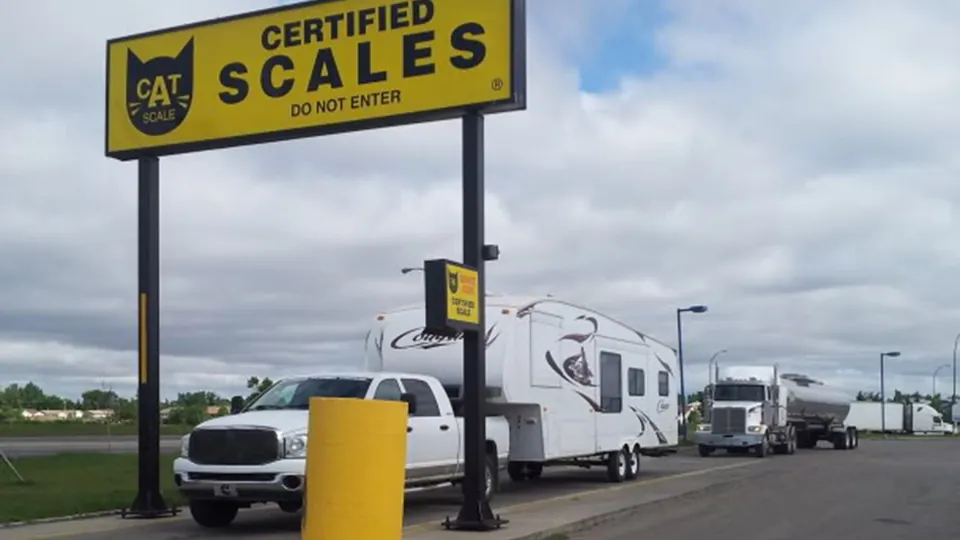
At a CAT Scale, one pass does it. The company’s instructions for a motorhome: the whole vehicle on the scale, the steer axle (front wheels) on platform 1 and the drive or rear axle on platform 2, with platform 3 likely empty. You get axle weights and a total gross weight, but not the weight at each wheel, which CAT doesn’t allow [14]. Compare each axle with its GAWR, and the total with the GVWR.
Where, and for how much? CAT Scales are certified in the state where each one stands and can weigh vehicles from 2,000 lb to 200,000 lb; the company’s FAQ lists $15.25 for a full-price weigh and $5.25 for a reweigh at the same scale within 24 hours [15]. Keep the ticket: it dates the weighing and puts a number on it.
Overweight RV: what the law checks in the US
The weight limits enforced on the road were written for trucks. On the Interstate System, federal rules set 20,000 lb on any one axle, 34,000 lb on tandem axles, and 80,000 lb gross [16]: a single axle may carry more than twice the whole GVWR of the van in our example. We found no state law that fines a privately owned camper van just for exceeding its own GVWR.
That doesn’t make the GVWR optional. It’s the loaded weight the manufacturer specified, the tires on each axle must together be rated for at least that axle’s GAWR [4], and in New York, the rating decides your license class [6]. Renting a motorhome in Europe is another story: there, overloading is an offense in itself, fined in France from the first kilogram and in Germany from more than 5% over [17] [18], and our guide to sleeping in an RV in Europe covers where you can park for the night.
| Limit | Weight | Where it comes from |
|---|---|---|
| Any one axle, Interstate System | 20,000 lb | federal rule [16] |
| Tandem axles, Interstate System | 34,000 lb | federal rule [16] |
| Gross vehicle weight, Interstate System | 80,000 lb | federal rule [16] |
| GVWR of our example camper van | 9,050 lb | Airstream [1] |
| Front and rear GAWR of a Ram ProMaster camper van | 4,629 lb and 5,291 lb | Winnebago, Solis 59PX [10] |
Interstate limits can be lower where the bridge formula applies; vehicle ratings from the manufacturers’ spec pages.
So the numbers that matter for a camper van are its own: the GVWR, the two GAWRs, and the tires’ maximum loads. Those are the ones to hold up against your scale ticket, axle by axle.
Raising the GVWR: only by relabeling the van
That leaves the temptation to raise the limit. Federal rules leave one route, and only before the van’s first sale. In federal terms, an alterer is a person who adds, swaps, or removes components, other than readily attachable ones, on a certified vehicle before its first purchase other than for resale [19]; it has a duty to determine that the altered van still conforms to federal standards and takes on legal responsibility for its certification [20]. We found no federal text that lets an owner rewrite the GVWR after buying the van.
And the license follows the rating. In New York, a regular Class D license covers a GVWR of 26,000 lb or less, and a recreational vehicle over 26,000 lb GVWR or 40 feet long needs the Personal Use Vehicle R endorsement [6]. Other states draw their own lines, so check yours. Weighing is also one of the steps in our guide to a camper van trip, along with the paperwork, power, and water.
The rule to remember: payload is printed on a label, but it’s read on a scale.
Worth watching
At a truck stop, an RV dealer shows how an RV is weighed on a CAT Scale, platform by platform, just like a big rig.
The video is hosted by YouTube (Google): nothing loads until you play it, and Google may then set cookies.
FAQ
How do you calculate a camper van’s payload?
Start from the yellow occupant and cargo carrying capacity label inside the front passenger door: it gives the payload of your van as delivered. Without it, subtract the unloaded weight from the GVWR on the driver’s door pillar. Then take off everyone aboard, driver included, water at 8.3 lb a gallon, bikes, and anything added since the factory. What’s left is for gear, and only a scale confirms it.
Does RV payload include the driver and passengers?
Yes, both. In the US, the unloaded vehicle weight is defined without occupants, so the payload on the yellow label has to carry everyone who rides, the driver too. Federal rules use 150 lb per seating position when they set the minimum GVWR, but on a scale, what counts is everyone’s real weight. Fill four seats at that rate and 600 lb of payload are gone before the first bag.
Should you weigh an RV with or without people?
With, and loaded as for the trip: tanks filled, everyone aboard, bikes and gear loaded. The yellow label counts the combined weight of occupants and cargo, so people are part of the load. At a CAT Scale, put the front wheels on platform 1 and the rear axle on platform 2: one pass gives both axle weights and the total. Compare them with the GAWRs and the GVWR.
Is there a tolerance on an RV’s weight?
Not in the sense Europe uses, where the law lets a motorhome weigh 5% more or less than its declared mass. In the US, the yellow label must reflect the van as configured for delivery to the dealer, and must be corrected if more than 100 lb, or 1.5% of the GVWR when that’s lower, is added before the first retail sale. Anything added after that is on no label.
Can you get a ticket for an overweight RV?
We found no state law that fines a privately owned camper van just for exceeding its own GVWR. Road weight limits are written for trucks: on the Interstate System, 20,000 lb on one axle and 80,000 lb gross. That doesn’t make the GVWR optional: it’s the loaded weight the manufacturer specified, the tires are rated to the axle ratings, and in New York it sets your license class.
Can you raise the GVWR of a camper van?
Federal rules leave one route: before the first retail sale, an alterer that changes the van, other than with readily attachable components, takes on legal responsibility for its certification and adds a label with any new GVWR or GAWRs. We found no federal text that lets an owner rewrite the rating afterward. New springs or air bags leave the label, and the rating on it, as they were.
Sources
- Airstream, Interstate 19X, product page and specifications (GVWR, unit base weight, net carrying capacity, fresh water tank, seating and sleeping capacity), accessed November 8, 2026. airstream.com https://www.airstream.com/explore-products/touring-coaches/interstate/interstate-19X/ ↩
- Code of Federal Regulations, 49 CFR 567.4, Requirements for manufacturers of motor vehicles (certification label), 2025 edition, govinfo.gov, accessed November 8, 2026. govinfo.gov https://www.govinfo.gov/content/pkg/CFR-2025-title49-vol6/xml/CFR-2025-title49-vol6-sec567-4.xml ↩
- Code of Federal Regulations, 49 CFR 571.3, Definitions (gross vehicle weight rating, unloaded vehicle weight), 2025 edition, govinfo.gov, accessed November 8, 2026. govinfo.gov https://www.govinfo.gov/content/pkg/CFR-2025-title49-vol6/xml/CFR-2025-title49-vol6-sec571-3.xml ↩
- Code of Federal Regulations, 49 CFR 571.110, Federal Motor Vehicle Safety Standard No. 110, Tire selection and rims and motor home/recreation vehicle trailer load carrying capacity information for motor vehicles with a GVWR of 4,536 kilograms (10,000 pounds) or less, S4.2.2, S4.3, S9, and S10, 2025 edition, govinfo.gov, accessed November 8, 2026. govinfo.gov https://www.govinfo.gov/content/pkg/CFR-2025-title49-vol6/xml/CFR-2025-title49-vol6-sec571-110.xml ↩
- Code of Federal Regulations, 49 CFR 571.120, Federal Motor Vehicle Safety Standard No. 120 (vehicles with a GVWR of more than 10,000 pounds), S10, 2025 edition, govinfo.gov, accessed November 8, 2026. govinfo.gov https://www.govinfo.gov/content/pkg/CFR-2025-title49-vol6/xml/CFR-2025-title49-vol6-sec571-120.xml ↩
- New York State Department of Motor Vehicles, New York State Driver’s Manual, Chapter 1: Driver Licenses, accessed November 8, 2026. dmv.ny.gov https://dmv.ny.gov/new-york-state-drivers-manual-and-practice-tests/chapter-1-driver-licenses ↩
- Commission Implementing Regulation (EU) 2021/535 of March 31, 2021, Annex XIII (masses and dimensions), Official Journal of the European Union, L 117, April 6, 2021, accessed November 8, 2026. eur-lex.europa.eu https://eur-lex.europa.eu/legal-content/EN/TXT/HTML/?uri=CELEX:32021R0535 ↩
- Thor Motor Coach, 2027 Sequence, model year brochure, legal notes on weights and capacities, accessed November 8, 2026. media-center.thormotorcoach.com https://media-center.thormotorcoach.com/asset/a55e75b6-e2ad-466a-bbc2-b30ead850cd4/2027-MY-Sequence.pdf ↩
- Thule, Thule T2 Pro XTR, 2-bike hitch rack (model 9034XTR), product page, accessed November 8, 2026. thule.com https://www.thule.com/en-us/bike-rack/hitch-bike-racks/thule-t2-pro-xtr-2---2-_-9034xtr ↩
- Winnebago, Solis, specifications (59P and 59PX floor plans), accessed November 8, 2026. winnebago.com https://www.winnebago.com/models/product/specifications/motorhomes/camper-van/solis ↩
- Regulation No. 54 of the United Nations Economic Commission for Europe (UNECE), pneumatic tyres for commercial vehicles and their trailers, Annex IV (load-capacity indices), Official Journal of the European Union, L 183, July 11, 2008, accessed November 8, 2026. eur-lex.europa.eu https://eur-lex.europa.eu/legal-content/EN/TXT/HTML/?uri=CELEX:42008X0711(01) ↩
- Code of Federal Regulations, 49 CFR 571.139, Federal Motor Vehicle Safety Standard No. 139, New pneumatic radial tires for light vehicles, S5.5 (tire markings), 2025 edition, govinfo.gov, accessed November 8, 2026. govinfo.gov https://www.govinfo.gov/content/pkg/CFR-2025-title49-vol6/xml/CFR-2025-title49-vol6-sec571-139.xml ↩
- ADAC, Wohnmobil überladen: Diese Strafen drohen in Europa, Christof Henn, August 19, 2026 (in German), accessed November 8, 2026. adac.de https://www.adac.de/fahrzeugwelt/magazin/reise-freizeit/gewicht-wohnmobil-tipps/ ↩
- CAT Scale, How To Weigh (motorhome positions on the scale), accessed November 8, 2026. catscale.com https://catscale.com/how-to-weigh/ ↩
- CAT Scale, FAQ (certification, reweigh policy and prices, California Weighmaster Certificate, weight range), accessed November 8, 2026. catscale.com https://catscale.com/contact-us/faq/ ↩
- Code of Federal Regulations, 23 CFR 658.17, Weight (National System of Interstate and Defense Highways), 2025 edition, govinfo.gov, accessed November 8, 2026. govinfo.gov https://www.govinfo.gov/content/pkg/CFR-2025-title23-vol1/xml/CFR-2025-title23-vol1-sec658-17.xml ↩
- French highway code (Code de la route), article R312-2, version in force since April 15, 2016, Légifrance (in French), accessed November 8, 2026. legifrance.gouv.fr https://www.legifrance.gouv.fr/codes/article_lc/LEGIARTI000032401231 ↩
- German federal catalog of fines (Bußgeldkatalog-Verordnung), appendix to numbers 198 and 199 of the annex, table 3, Gesetze im Internet (in German), accessed November 8, 2026. gesetze-im-internet.de https://www.gesetze-im-internet.de/bkatv_2013/anhang_2.html ↩
- Code of Federal Regulations, 49 CFR 567.3, Definitions (alterer, altered vehicle), 2025 edition, govinfo.gov, accessed November 8, 2026. govinfo.gov https://www.govinfo.gov/content/pkg/CFR-2025-title49-vol6/xml/CFR-2025-title49-vol6-sec567-3.xml ↩
- Code of Federal Regulations, 49 CFR 567.7, Requirements for persons who alter certified vehicles, 2025 edition, govinfo.gov, accessed November 8, 2026. govinfo.gov https://www.govinfo.gov/content/pkg/CFR-2025-title49-vol6/xml/CFR-2025-title49-vol6-sec567-7.xml ↩

Vans, RVs, biking and calculators
Julien de Jurquet writes for Outfarer about camper vans, RVs, biking, and calculators. He reads manuals cover to cover and never lets a number slide without its unit, so your choices rest on math, not promises.


 Joséphine Garand

 Nolwenn Bastide