 Français (France)
 English (UK)
 English (US)
 Deutsch (Deutschland)

Contents
Maximum authorised mass and the V5C: the weights on paper
2,915 kg, or 2,769, or 3,061. In its technical data for France, Hymer gives its Yellowstone 600 campervan a mass in running order of 2,915 kg, then states in brackets the range allowed: 2,769 to 3,061 kg [1]. That is a possible gap of 292 kg between two examples of the same model, all perfectly legal. On paper, payload is one subtraction; on the road, it is a weighing.
The weights on paper follow a European template. The EU directive that harmonised registration certificates lists three of them: F.1, the maximum technically permissible laden mass; F.2, the maximum permissible laden mass of the vehicle in service in the country of registration; and G, the mass of the vehicle in service [2]. In Britain, the limit goes by another name, the MAM: the weight of a vehicle including the maximum load it can carry safely on the road, also called gross vehicle weight., which GOV.UK says is listed in the owner’s manual and normally shown on a plate or sticker fitted to the vehicle [3]. To register a used or imported vehicle, DVLA’s guide asks for the maximum permissible mass and the mass in service, both taken from the certificate of conformity [4]: the same two figures to look for on your V5C log book.
F.1 and F.2 are often identical. They differ when a chassis designed for more is registered lower, what GOV.UK calls down-plating: a lower weight shown on the plate [3]. Hymer, for one, offers an option that brings the maximum authorised mass of its vans on a 4.25 t Fiat Ducato Maxi chassis down to 3.5 t [1]. It is the registered figure that counts for the law and for your licence: a car licence from a test passed on or after 1 January 1997 covers petrol and diesel vehicles up to 3,500 kg of maximum authorised mass [5].
Unladen weight: what the mass in running order already counts
GOV.UK describes the The weight of the vehicle ready for the road, as its manufacturer declares it on the data sheet and the certificate of conformity. as the weight of a vehicle empty and ready for the road, with the driver, the body, essential fluids and a full tank of fuel [3]. The EU regulation on masses and dimensions, under which European manufacturers approve their vehicles, is more precise: fuel tanks filled to at least 90%, the driver, fuel and liquids, the standard equipment specified by the manufacturer, and the spare wheel and tools if fitted [6]. The driver counts as 75 kg, whatever they really weigh. Passengers are not included. Nor are factory options: with them, the regulation speaks of the ‘actual mass of the vehicle’ [6].
And the water, and the gas? The regulation’s definition does not name them. The manufacturer decides, and that is where the figures part company. Hymer counts the fresh water tank filled as for driving, which is 20 litres, and one full aluminium gas cylinder weighing 16 kg [1]. Camping-Car Magazine, a French motorhome magazine, writes that the unladen mass includes a gas cylinder and 90% of the fresh water [7]. With a 110-litre tank, the gap between the two readings reaches 79 kg.
The 5% tolerance: the real reason to weigh
The same regulation allows a gap between the declared mass and the weighed mass of an individual vehicle. It is 3% for most vehicles, but 5% ‘as regards the permissible lower and upper deviations’ for special purpose vehicles [6]. And a motor caravan is one: the EU framework regulation lists it among special purpose vehicles, under the code SA [9]. Hymer spells it out: deviations of up to 5% of the mass in running order are permitted by law and possible [1].
On 2,915 kg, 5% is about 146 kg, either way. Hymer adds that it weighs every vehicle at the end of the production line and passes the result on to the dealer [1]: ask for that figure on delivery. For a used vehicle, or one converted since, only a weighbridge will tell you.
Working out payload: a worked example, from paper to road
Let’s do the sums with this Yellowstone 600: 3,500 kg of maximum authorised mass, 2,915 kg in running order, four seats, and a 110-litre water tank of which 20 litres are counted [1]. On paper, 585 kg remain. Now let’s load it for four, with the weights the manufacturers publish and water at 1 kg per litre.
| Item | Mass | Left under the maximum mass | Where the figure comes from |
|---|---|---|---|
| Mass in running order (driver, 20 l of water, one aluminium cylinder) | 2,915 kg | 585 kg | Hymer data sheet [1] |
| Awning, towbar and two solar panels fitted at the factory | 60 kg | 525 kg | Hymer data sheet: 24, 28 and 8 kg [1] |
| Three passengers | 225 kg | 300 kg | 75 kg each, the regulation’s standard mass [6] |
| Water: from 20 to 110 litres | 90 kg | 210 kg | 1 kg per litre |
| A 13 kg steel cylinder instead of the 16 kg aluminium one counted | 10 kg | 200 kg | Butagaz: about 13 kg empty and 13 kg of gas [10] |
| Bike carrier with two bikes, at its limit | 44.5 kg | 155.5 kg | Thule: 9.5 kg and 35 kg at most [11] |
Our calculation, from Hymer’s data sheet for France (2027), Butagaz (2025) and Thule. A weighing replaces this whole table.
That leaves 155.5 kg for the cases, food, crockery, chairs and everything else that joins the trip along the way. Already tight for four. Now redo the sum with a van that left the factory at the top of the tolerance, 3,061 kg: only 9.5 kg remain. Add 150 kg of luggage, and the van is about 140 kg over its maximum authorised mass, or 4%, without a single figure in the brochure being wrong.
Gas weighs more than its contents: a steel cylinder holding 13 kg of gas weighs about 26 kg full, according to Butagaz, a French supplier [10]. A spare cylinder therefore comes off the payload in its entirety. Choosing between propane and butane, and the cylinders country by country has a guide of its own.
Axle weights and tyres: the limits below the maximum mass
Staying under the maximum authorised mass is not the end of it. The Highway Code puts it plainly: you ‘MUST NOT overload your vehicle or trailer’ [12]. And each axle has a limit of its own. If you tour France, its highway code forbids driving a vehicle with an axle carrying more than the maximum weight authorised for that axle, and fines it separately [13]; Germany’s catalogue of fines applies the same scale to an overloaded axle as to an overloaded vehicle [14].
The regulation requires the axle limits to add up to at least the maximum laden mass [6]: front and rear together accept at least the maximum authorised mass. But either one can be exceeded while the total stays under the limit. A load hung behind the rear axle, like a bike carrier on the back door, bears first on that axle, and even a little more than its own weight through leverage, while lightening the front. The roof load has its limit too, as our guide to carrying a kayak or paddleboard explains.
Tyres have their own ceiling. On the sidewall, after the size, one or two numbers give the A coded number for the maximum load the tyre can carry, under the conditions of use set by its manufacturer.: the load the tyre can carry in single fitment, then, if there is a second number, in dual fitment [15]. A tyre marked 109/107 thus carries 1,030 kg single and 975 kg dual; two tyres with index 109 on one axle, 2,060 kg [15]. The regulation also provides for the marking ‘CP’ on tyres designed specifically for motor caravans [15].
| Load index | Maximum mass per tyre |
|---|---|
| 104 | 900 kg |
| 106 | 950 kg |
| 107 | 975 kg |
| 109 | 1,030 kg |
| 110 | 1,060 kg |
| 112 | 1,120 kg |
| 116 | 1,250 kg |
Source: Annex IV of UNECE Regulation No 54 on tyres for commercial vehicles.
Weighing your motorhome: where, how, and with passengers
With or without passengers? With. The maximum authorised mass is the weight of the vehicle including the load it carries on the road [3], and DVLA wants a converted van’s payload to cover as many passengers as it has seats [8]. As the section on fines shows, a check only looks at the result. So weigh the vehicle as it will leave: tanks filled, passengers aboard, bikes on, luggage loaded.

For the axles, two passes are enough if the platform allows. First the front wheels alone on the platform: that is the front axle load. Then the whole vehicle: that is the total. The rear axle is the difference between the two. Compare each axle with the manufacturer’s plate, and the total with the maximum authorised mass.
Where to weigh? GOV.UK has a weighbridge finder that works by postcode, and points out that most weighbridges are run by private businesses: contact the operator before you go to check the price, how to get there and the opening hours, and say so if your vehicle is very large [17]. Keep the ticket: it dates the weighing and puts a figure on it.
Overweight motorhome: fines and tolerances, country by country
In Great Britain, DVSA, whose roadside checks mainly concern commercial vehicles but whose examiners can deal with any vehicle on the road, sets graduated fixed penalties for excess weight: £100 below 10% over, £200 from 10% to under 15%, and £300 from 15%. Its examiners allow a 5% leeway before issuing a fixed penalty or a prohibition, unless the weight is exceeded by 1 tonne or more, and when they issue a penalty, they also prevent the vehicle from going any further [18].
Across the Channel, we found no written tolerance in France. For a vehicle of up to 3.5 t, exceeding the maximum authorised mass carries a fourth-class fine up to 0.5 tonne, then the same fine again for each further 0.5 tonne. An overloaded axle is fined separately, with the same fine for up to 0.3 tonne over. Beyond 5% over, the vehicle can be immobilised [13], which for 3,500 kg means beyond 175 kg too much. A fourth-class fine is a €135 fixed penalty, reduced to €90 if you pay quickly and raised to €375 if you pay late [19].
| Country | Tolerance | Fine | Beyond |
|---|---|---|---|
| Great Britain | a 5% leeway before a penalty, unless 1 tonne or more over | £100 below 10%, £200 from 10% to under 15%, £300 from 15% [18] | vehicle stopped; normally a court summons from 30% over |
| France | no written tolerance | fourth-class fine (€135 fixed penalty) up to 0.5 t, repeated for each further 0.5 t [13] [19] | immobilisation possible beyond 5% |
| Germany | no amount set up to 5% over | €10 from 5 to 10%, €30 up to 15%, €35 up to 20%, €95 over 20%, €140 over 25%, €235 over 30% [14] | one point on the driving register from more than 20% [20] |
| Italy | 5% deducted from the mass measured by static weighing instruments | €42 to €173 up to 5%, €87 to €345 up to 15%, €173 to €695 up to 25%, €431 to €1,734 beyond [21] | beyond 5%, the journey resumes only once the load is brought within the limits |
| Switzerland | a measurement margin set by the Federal Roads Office, deducted | CHF 100 up to 100 kg, CHF 200 above that and up to 5% [22] | beyond 5%, the list of fixed fines sets no amount |
| Spain, according to the ADAC | up to 5%, usually tolerated in practice | €301 to €400 from 6 to 15%, €801 to €1,000 up to 25%, €2,001 to €4,000 beyond [16] | the journey can be stopped until the vehicle is unloaded |
| Austria, according to the ADAC | none | up to €40 from about 2%, up to €170 from 5 to 10%, up to €300 from 10 to 15%, €300 to €10,000 from 15% [16] | the journey can be stopped from 2% |
| Belgium, according to the ADAC | no legal tolerance | €50 to €5,000 up to 500 kg over [16] | beyond 5%: journey banned, immobilisation, up to 8 days in prison possible |
Percentages over the maximum authorised mass. Texts and guidance read on 8 November 2026; for Spain, Austria and Belgium, the ADAC’s table of 19 August 2026, not cross-checked against the national texts.
The ‘5%’ you often hear about is therefore a margin, a threshold in a scale of fines or an enforcement practice: in Great Britain, the leeway DVSA examiners allow before a penalty [18]; in Italy, the law takes 5% off the mass measured by static weighing instruments [21]; in Switzerland, the fine is worked out after deducting a margin of error set by the Federal Roads Office [22]; in Germany, the scale for vehicles of up to 7.5 t starts above 5% [14]. We have read no text that allows you to exceed the maximum authorised mass. The ADAC sums it up: only a few countries grant a tolerance [16].
Uprating a motorhome: a weight certificate and a new V5C
That leaves the temptation to raise the limit, known as uprating. GOV.UK sets out the paperwork: you must update the V5C when you change the weight of a large vehicle such as a campervan [23], and DVLA wants either a plating certificate or a design weight certificate as evidence, without which the update is rejected [24]. The chassis has the last word, though: Hymer states, for example, that its 3.5 t Fiat Ducato chassis cannot have their maximum authorised mass increased [1]. Ask the base vehicle’s manufacturer first, then the converter, in writing.
And the licence follows the new mass. To drive a motorhome with a maximum authorised mass of between 3.5 and 7.5 tonnes, GOV.UK requires category C1 [26]; on licences issued before June 1990, the old group A became several categories, C1 among them [27], so check what yours covers before uprating. In Northern Ireland, nidirect sets the same thresholds [28]. The rules, and the EU’s future 4.25-tonne car licence, which does not apply in the UK, are covered in our guide to 4.25-tonne motorhomes. Weighing is also one of the steps in our guide Campervan trips, alongside the paperwork, power and water.
The rule to remember: payload is written in the log book, but it is read on a weighbridge.
Kit related to this article
No affiliation: no commission, no sponsored products.
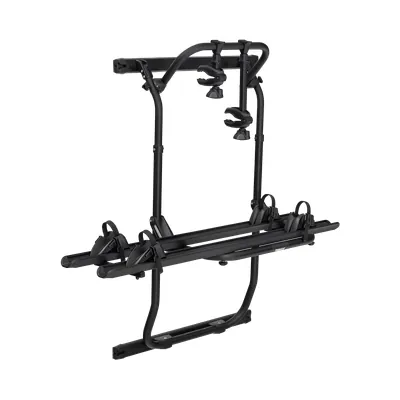
Thule Elite Van XT bike rack, Ducato, Jumper, Boxer
A two-bike rack for the rear door of the Fiat Ducato, Citroën Jumper and Peugeot Boxer from 2007: 35 kg maximum load and 9.5 kg empty, according to Thule.
View on Amazon (opens in a new tab)
Worth watching
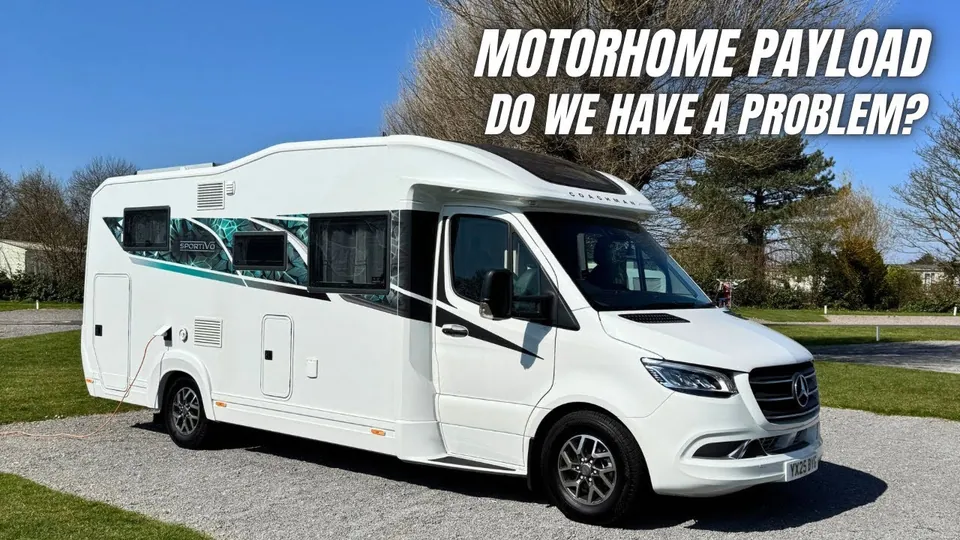
A UK couple take their 3,500 kg motorhome to a weighbridge to see how much payload is really left, and explain the option of uprating it on paper.
The video is hosted by YouTube (Google): nothing loads until you play it, and Google may then set cookies.
FAQs
How do you work out a motorhome’s payload?
Take the mass in service away from the maximum authorised mass. Then take off 75 kg per passenger, the driver being already counted, the options added, the water beyond what the manufacturer counts, a spare gas cylinder and the bikes. What is left is for luggage. As a vehicle may weigh 5% more or less than its declared mass, only a weighbridge gives you a figure you can rely on.
Does motorhome payload include the passengers and the driver?
The driver, no: the mass in running order already counts them at 75 kg, whatever they weigh. Passengers, yes: each one comes off the payload, at 75 kg in the EU regulation’s sums and at their real weight on the weighbridge. DVLA expects a conversion’s payload to carry as many passengers as it has seats. With three passengers, a four-seat motorhome loses 225 kg before the first suitcase.
Should you weigh a motorhome with or without passengers?
With, and loaded as for the trip: tanks filled, passengers aboard, bikes and luggage loaded. The maximum authorised mass includes everything the vehicle carries on the road. Put the front wheels alone on the platform first, then the whole vehicle: the rear axle is the difference. Compare each figure with the manufacturer’s plate and the maximum authorised mass. Most weighbridges are private, so check the price first.
Is there a tolerance for an overweight motorhome?
In Great Britain, DVSA examiners allow a 5% leeway before a fixed penalty, unless the vehicle is 1 tonne or more over. Italy takes 5% off the mass measured by static weighing, Switzerland deducts a measurement margin, and the German scale sets no fine up to 5%. In France, we found no written tolerance. These are margins or thresholds, not permission to overload.
What is the fine for an overweight motorhome in the UK?
DVSA’s graduated fixed penalties for excess weight are £100 below 10% over, £200 from 10% to under 15%, and £300 from 15%, after a 5% leeway unless the vehicle is a tonne or more over. The examiner also prevents the vehicle from going any further. Serious cases, such as 30% over, normally go to court instead. In Scotland, the penalty comes as a conditional offer.
Can you uprate a motorhome?
Only if the vehicle allows it: Hymer, for one, rules it out for its 3.5 t Fiat Ducato chassis. To change the weight of a campervan, GOV.UK requires you to update the V5C and send DVLA a plating certificate or a design weight certificate, or the update is rejected. Above 3,500 kg of maximum authorised mass, you need a category C1 licence, which some older licences already include.
Sources
- Hymer, Hymer Camper Vans 2027 : équipements et données techniques, valid from 1 July 2026 for France, Yellowstone 600 data sheet and legal notes on weight (in French), accessed 8 November 2026. hymer.com https://www.hymer.com/hymer/drucksachen/preislisten/campervans/fr_fr_hymer_campervans_preisliste.pdf ↩
- Council Directive 1999/37/EC of 29 April 1999 on the registration documents for vehicles, Annex I, Official Journal of the European Communities, L 138, 1 June 1999, accessed 8 November 2026. eur-lex.europa.eu https://eur-lex.europa.eu/legal-content/EN/TXT/HTML/?uri=CELEX:31999L0037 ↩
- GOV.UK, Vehicle weights explained, accessed 8 November 2026. gov.uk https://www.gov.uk/vehicle-weights-explained ↩
- DVLA, Guide to filling in the ‘Application for first vehicle tax and registration of a used motor vehicle’ (V55/5 form), V355/5, GOV.UK, accessed 8 November 2026. assets.publishing.service.gov.uk https://assets.publishing.service.gov.uk/media/68f62e57e8e4040c38a3d0c8/v355-5-guide-to-filling-application-for-first-vehicle-tax-and-registration-of-used-motor-vehicle.pdf ↩
- GOV.UK, Driving licence categories, accessed 8 November 2026. gov.uk https://www.gov.uk/driving-licence-categories ↩
- Commission Implementing Regulation (EU) 2021/535 of 31 March 2021, Annex II (statutory plate) and Annex XIII (masses and dimensions), Official Journal of the European Union, L 117, 6 April 2021, accessed 8 November 2026. eur-lex.europa.eu https://eur-lex.europa.eu/legal-content/EN/TXT/HTML/?uri=CELEX:32021R0535 ↩
- Camping-Car Magazine, PTAC : éviter la surcharge de son camping-car !, 6 January 2023 (in French), accessed 8 November 2026. camping-car.com https://www.camping-car.com/essais/guide-d-achat/28258-ptac-eviter-la-surcharge-de-son-camping-car/ ↩
- DVLA, Converting a vehicle into a motor caravan (motor home), GOV.UK, updated 6 November 2026, accessed 8 November 2026. gov.uk https://www.gov.uk/government/publications/converting-a-vehicle-into-a-motor-caravan/converting-a-vehicle-into-a-motor-caravan ↩
- Regulation (EU) 2018/858 of the European Parliament and of the Council of 30 May 2018, Annex I, Part A, point 5 (special purpose vehicles), Official Journal of the European Union, L 151, 14 June 2018, accessed 8 November 2026. eur-lex.europa.eu https://eur-lex.europa.eu/legal-content/EN/TXT/HTML/?uri=CELEX:32018R0858 ↩
- Butagaz, Guide du gaz en bouteille 2025, French bottled gas supplier (in French), accessed 8 November 2026. lp.butagaz.fr https://lp.butagaz.fr/media/3806/download/GUIDE_DU_GAZ_EN_BOUTEILLE_2025.pdf ↩
- Thule, Thule Elite Van XT, bike rack for the Fiat Ducato, Citroën Jumper, Peugeot Boxer and Ram ProMaster since 2007 (model 302013), UK product page, accessed 8 November 2026. thule.com https://www.thule.com/en-gb/rv-racks/rv-bike-racks/thule-elite-van-xt-bike-rack-for-vans-fiat-ducato-citroen-jumper-peugeot-boxer-ram-pro-master-black-_-302013 ↩
- GOV.UK, The Highway Code, rules for drivers and motorcyclists (89 to 102), rule 98 on vehicle towing and loading, accessed 8 November 2026. gov.uk https://www.gov.uk/guidance/the-highway-code/rules-for-drivers-and-motorcyclists-89-to-102 ↩
- French highway code (Code de la route), article R312-2, version in force since 15 April 2016, Légifrance (in French), accessed 8 November 2026. legifrance.gouv.fr https://www.legifrance.gouv.fr/codes/article_lc/LEGIARTI000032401231 ↩
- German federal catalogue of fines (Bußgeldkatalog-Verordnung), appendix to numbers 198 and 199 of the annex, table 3 (exceeding the permitted axle load or total weight), Gesetze im Internet (in German), accessed 8 November 2026. gesetze-im-internet.de https://www.gesetze-im-internet.de/bkatv_2013/anhang_2.html ↩
- Regulation No 54 of the United Nations Economic Commission for Europe (UNECE), pneumatic tyres for commercial vehicles and their trailers, Annex IV (load-capacity indices), Official Journal of the European Union, L 183, 11 July 2008, accessed 8 November 2026. eur-lex.europa.eu https://eur-lex.europa.eu/legal-content/EN/TXT/HTML/?uri=CELEX:42008X0711(01) ↩
- ADAC, Wohnmobil überladen: Diese Strafen drohen in Europa, Christof Henn, 19 August 2026 (in German), accessed 8 November 2026. adac.de https://www.adac.de/fahrzeugwelt/magazin/reise-freizeit/gewicht-wohnmobil-tipps/ ↩
- GOV.UK, Find a weighbridge, accessed 8 November 2026. gov.uk https://www.gov.uk/find-weighbridge ↩
- Driver and Vehicle Standards Agency (DVSA), DVSA roadside checks: fines and financial deposits, sections on legal regulations and excess weight offences, GOV.UK, updated 29 January 2019, accessed 8 November 2026. gov.uk https://www.gov.uk/government/publications/guide-to-graduated-fixed-penalties-financial-deposits/dvsa-roadside-checks-fines-and-financial-deposits ↩
- Service-Public.fr, the French government’s information site, Amende forfaitaire en cas de contravention au code de la route, checked 11 January 2025 (in French), accessed 8 November 2026. service-public.gouv.fr https://www.service-public.gouv.fr/particuliers/vosdroits/F18509 ↩
- German driving licence regulation (Fahrerlaubnis-Verordnung), annex 13, point 3.5.5 (offences carrying one point), Gesetze im Internet (in German), accessed 8 November 2026. gesetze-im-internet.de https://www.gesetze-im-internet.de/fev_2010/anlage_13.html ↩
- Italian highway code (Nuovo codice della strada, legislative decree no. 285 of 30 April 1992), article 167, text in force since 6 August 2022, Normattiva (in Italian), accessed 8 November 2026. normattiva.it https://www.normattiva.it/uri-res/N2Ls?urn:nir:stato:decreto.legislativo:1992-04-30;285~art167 ↩
- Swiss Federal Council, ordinance on fixed fines (Ordonnance sur les amendes d’ordre, SR 314.11) of 16 January 2019, as at 1 August 2026, annex 1, item 300 (in French), accessed 8 November 2026. res.cloudinary.com https://res.cloudinary.com/adminch/image/private/s--OIy0VoNM--/v1739331905/Bundespublikationen/314-11f.pdf ↩
- GOV.UK, Change vehicle details on a V5C registration certificate (log book), section ‘When you need to update your V5C’, accessed 8 November 2026. gov.uk https://www.gov.uk/change-vehicle-details-registration-certificate ↩
- GOV.UK, Change vehicle details on a V5C registration certificate (log book), section ‘What evidence to give’, accessed 8 November 2026. gov.uk https://www.gov.uk/change-vehicle-details-registration-certificate/what-evidence-to-give ↩
- GOV.UK, Change vehicle details on a V5C registration certificate (log book), section ‘How to update your V5C’, accessed 8 November 2026. gov.uk https://www.gov.uk/change-vehicle-details-registration-certificate/how-to-tell-dvla ↩
- GOV.UK, Driving a motorhome, accessed 8 November 2026. gov.uk https://www.gov.uk/driving-motorhome ↩
- GOV.UK, Compare old and new driving licence categories, accessed 8 November 2026. gov.uk https://www.gov.uk/old-driving-licence-categories ↩
- nidirect, the Northern Ireland government’s information site, Driving motorhomes, accessed 8 November 2026. nidirect.gov.uk https://www.nidirect.gov.uk/articles/driving-motorhomes ↩

Campervans, motorhomes, cycling and calculators
Julien de Jurquet writes for Outfarer about campervans, motorhomes, cycling and calculators. He reads instruction manuals to the very end and never lets a figure through without its unit, so that your choices rest on sums rather than promises.


