 Français (France)
 English (UK)
 English (US)
 Deutsch (Deutschland)

Contents
100 litres of water is heavy to carry and soon drunk. The Caravan and Motorhome Club counts at least 23 litres per person per day [1]: for two people, a 100-litre tank therefore lasts two days, at best. After that you have to fill up, and above all empty. A campervan lives with three tanks: fresh water, the waste water from the sink and the shower, collected in a separate tank and the toilet cassette, where the toilet waste, with the chemical fluid added to it ends up. Each has its own routine, its own places and its own pitfalls.
This guide takes the ‘Gas and water’ step of our guide to campervan trips further: how much water to carry, how to keep it clean, where to empty what, which products to choose, and what emptying in the wrong place can cost, at home and across the Channel.
How much water to carry, and for how many days?
Start with your vehicle’s data sheet. Hymer’s 2027 campervans sold in France carry 100 litres of fresh water (Redwood, Grand Canyon S) or 110 litres (Yellowstone), with 85 to 95 litres of grey water [2]. Volkswagen gives 110 litres of fresh water for its Grand California [3], and LMC about 100 litres for its Tourer motorhome [4]. The guide published by the Scottish Environment Protection Agency (SEPA), The Highland Council and Scottish Water gives similar orders of magnitude: a ‘typical’ grey water tank of 100 litres, and 20 litres for black water, rinse water included [5].
| Full tank | Weight of the water | 1 person | 2 people | 3 people | 4 people |
|---|---|---|---|---|---|
| 100 l (Hymer Redwood, LMC Tourer) | about 100 kg | 4.3 days | 2.1 days | 1.4 days | 1 day |
| 110 l (Hymer Yellowstone, VW Grand California) | about 110 kg | 4.7 days | 2.3 days | 1.5 days | 1.1 days |
Calculated by script, rounded down. As 23 litres is a minimum, these durations are maximums.
The sums are quickly done, and sobering: 4 days on your own, 2 days for two, a single day for four. And those 23 litres are a floor, not an average [1]. Water also has weight: 23 litres means 23 kilos carried from tap to vehicle, the club points out [1], and that weight travels with you.
The detail that changes everything: Hymer counts only 20 litres of water in the mass in running order of its campervans, the ‘driving’ level on its data sheets [2]: on a full Yellowstone, the other 90 litres weigh about 90 kilos more. LMC has even fitted a valve that limits the tank to about 10 litres, which, the manufacturer writes, increases the motorhome’s payload [4]. Hence a simple habit: drive with little water, and fill up near your stop.
Filling up and keeping the tank water clean
‘Fresh water becomes undrinkable in a short time!’ That warning does not come from a consumer group but from LMC, in the manual of its Tourer motorhome, which we read in French [4]. The manufacturer asks you to disinfect the system before first use, to take water only from points declared drinkable, and to use a filler hose and a tank approved for drinking water. The Caravan and Motorhome Club, for its part, talks of food-grade filler hose [1].
On how often to clean, the manufacturers disagree. LMC puts cleaning and disinfecting the fresh water tank in its monthly maintenance plan [4]; Volkswagen recommends at least two cleans a year, at the start and at the end of the season [6]; the Caravan and Motorhome Club asks you to flush the whole system with steriliser when the vehicle has stood unused for several weeks [1]. Follow your vehicle’s manual: only it knows its pipes and seals.
As for products, Volkswagen lists tank cleaners based on hydrogen peroxide, chlorine dioxide, active oxygen or fruit acids, and a home remedy, citric acid: for a 100-litre tank, as a rule, 4 litres of water and five to ten heaped tablespoons, never heated [6]. And vinegar? Volkswagen does not mention white vinegar but vinegar essence: very effective against limescale, but so aggressive that it only suits the inside of the tank, never the seals. It also advises against chlorine-based cleaners, which can damage the pipes, and denture-cleaning tablets, whose residues can clog the pump and pipes [6]. The Caravan and Motorhome Club rules out domestic bleach and refers you to the instructions of a proprietary steriliser [1]. We found no manufacturer’s manual that recommends white vinegar for disinfecting a tank.
Grey water: where to empty it, and where never to
Grey water is the water from showers, sinks and baths; black water contains toilet waste with a variety of added chemicals, and the two need different treatment, the Scottish guide explains [5]. ‘It’s only soapy water’? LMC answers in its manual: detergents, soaps, lotions and cosmetics pollute the environment and contaminate groundwater [4].
So it is emptied where that is provided for: at a service point or on a campsite, over the dedicated grid. LMC is blunt: never into street gutters, never in open countryside, only at the stations provided on campsites or on specially equipped municipal sites, and if in doubt, the local council will tell you [4]. A roadside drain is no fallback: ‘anything that is put down a roadside drain is likely to flow straight into a river’, the Environment Agency warned in 2016, after an oil pollution of the River Derwent at Derby; these drains, it added, are for rain water only [7].
Free or paid? It depends on the service point. In Scotland, Forestry and Land Scotland charges £5 to drop off chemical waste only, and £13 instead of £10 for a night in those of its car parks that have chemical waste disposal, such as Strone Hill or Bridge of Orchy [8]. On the Caravan and Motorhome Club’s Brighton site, a Camperclean machine empties and sanitises a cassette in around three minutes, for £3 a go [9]. In France, at Mayenne, the Euro-Relais service point sells drinking water in €2 tokens for 100 litres, from the tourist office, and emptying is free, with no token needed [10]. To find somewhere to spend the night there after filling up, see our guide to sleeping in a campervan in France.
Against smells from the grey water tank, Thetford sells an additive which, according to the manufacturer, controls grey water odours, at 80 ml a dose, effective for up to 7 days, and a tank cleaner to use two or three times a year [11]. LMC, more simply, plans to empty and clean the waste water tank every month [4].
The cassette: the disposal point, the fluids, and emptying it at home
The cassette is emptied at the latest when its indicator lights up, and completely in frosty weather or if the living area is not heated, according to LMC [4]. The routine takes a few steps: take the cassette out through its outside hatch and, only once you are at an official disposal point, swivel the emptying spout and unscrew its cap, keep the air vent button pressed while it empties, rinse it under running water, put it back, then add toilet fluid [4]. A point reserved for grey water never takes a cassette, the Scottish guide insists [5].
Toilet fluid is no detail. At Thetford, each product has its own dose and duration, and only the green range is labelled septic tank safe, a claim absent from the Aqua Kem Blue [11]. The Caravan and Motorhome Club’s policy is that all chemical fluids should be biodegradable, to assist the biological treatment of sewage, and it asks you not to use products that contain formaldehyde [9]; LMC asks for eco-friendly or biodegradable products, at low doses [4].
| Product | Standard dose | Stated duration | Septic tank |
|---|---|---|---|
| Aqua Kem Blue Concentrated, 780 ml | 60 ml | up to 5 days | not mentioned |
| Aqua Kem Blue, 2 l | 150 ml | up to 5 days | not mentioned |
| Aqua Kem Green Concentrated, 750 ml | 75 ml | up to 4 days | safe, according to the maker |
The manufacturer’s doses and durations; follow the label of the product you buy.
Emptying the cassette at home, down your own toilet? The clearest answer we have read comes from Bavaria: not everywhere, because the chemicals can harm the bacteria that small sewage treatment plants depend on. The Bavarian environment agency advises asking the municipality whether it accepts this waste water, and otherwise going to a larger treatment works or a campsite [12]. The Scottish guide makes the same point about the small public septic tanks serving some villages, and stresses that public toilets are no place for campervan waste [5]. With a septic tank at home, read the label: Thetford claims that compatibility only for its green range [11].
Separation toilets: no water, but still a routine
A separation toilet keeps urine apart from solid waste, which lets it work without water and, according to Thetford, be emptied without depending on fixed disposal points [13]. The volumes are small: 7 litres for the solids bucket and 7.5 litres for the urine tank, on the manufacturer’s models [14].
What do you do with the contents? The manufacturer Trelino answers in its manual: close the bag of solids tightly and put it in the household waste; ordinary composting is also possible, without the bag, with unbleached toilet paper free of dyes and chemical additives; the urine canister is emptied into a toilet connected to the sewer, ideally every two or three days. Trelino also recommends finding out about the local disposal rules [15]. Away from the van, rucksack on your back, it is another matter: see our guide to leaving no trace on a walk.
Dumping in the wrong place: the law in Britain and in France
No British text we read names grey water or the cassette. In England and Wales, the Environmental Permitting Regulations 2016 forbid anyone to cause or knowingly permit a ‘water discharge activity’ except under an environmental permit [16]. That covers the discharge or entry into inland freshwaters, coastal waters or relevant territorial waters of any poisonous, noxious or polluting matter, waste matter, or trade or sewage effluent [17]. Breaking that rule is an offence [18], punishable on summary conviction by a fine or imprisonment, or both, and on conviction on indictment by a fine or up to five years’ imprisonment, or both [19]. These regulations extend to England and Wales only [20]: Scotland and Northern Ireland have their own texts, which we have not covered here.
| Text | What it covers | Penalty |
|---|---|---|
| Environmental Permitting (England and Wales) Regulations 2016, regulations 12, 38 and 39 | a ‘water discharge activity’ without a permit, such as polluting matter or sewage effluent entering inland or coastal waters | a fine or prison, or both; on indictment, up to 5 years [19] |
| French Code pénal, article R634-2 | depositing, throwing or pouring ‘unsanitary liquids’, among other things, in a public or private place | €135 within 45 days, €375 after that, up to €750 before a judge [21] |
| French Code pénal, article R635-8 | the same acts, when the waste was carried with the help of a vehicle | up to €1,500, with the vehicle confiscated [21] |
In France, no text names grey water or the cassette either. The Code pénal speaks of ‘liquides insalubres’ (unsanitary liquids), alongside rubbish, waste and excrement: depositing, throwing or pouring them in a public or private place, without the consent of whoever has the use of it, falls under article R634-2, a 4th-class contravention [22]. When the waste was ‘transported with the help of a vehicle’, it is article R635-8: a 5th-class contravention, with possible confiscation of what was used to commit the offence [23]. The amounts come from Service-Public, the French government’s information site. And on a campsite or an aire, as on a British site, the posted rules come on top of the law.
Scotland and further afield: Germany, the United States
Each country has its own texts. Here are three examples, read at the source, and none leaves waste water to individual goodwill; for parking and sleeping, see our guide to sleeping in a campervan in Europe.
That leaves the cold: frozen tanks and pipes have a chapter of their own, in our guide to the campervan in winter. For the rest, it all comes down to one routine at every stop: fresh water through a rinsed hose, the grid for grey water, the disposal point for the cassette. Fresh tank full, waste tanks empty: the road is yours, and the next brew comes with a view.
Worth watching
In under a minute, the Caravan and Motorhome Club shows how to empty a motorhome’s waste water tank over a drain.
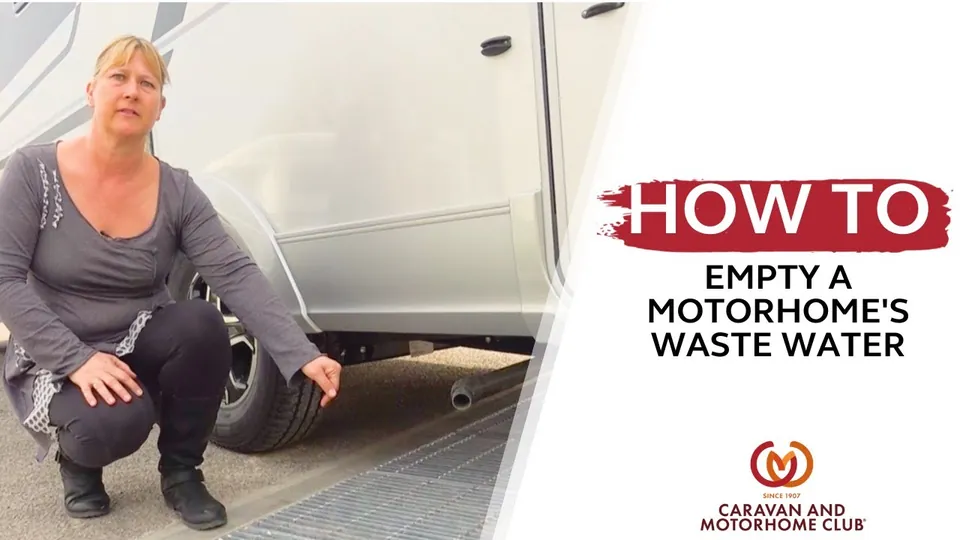
The video is hosted by YouTube (Google): nothing loads until you play it, and Google may then set cookies.
FAQs
Where can you empty a campervan’s grey water for free?
On a campsite or at a service point, over the grid provided. Some service points charge only for water: at Mayenne, in France, emptying is free and water costs €2 in tokens for 100 litres. Others charge for disposal: Forestry and Land Scotland asks £5 to drop off chemical waste only. Never into a gutter, a roadside drain, a ditch or the countryside: in England and Wales, letting polluting matter reach a river without a permit is an offence.
Can you empty a cassette toilet at home?
Not everywhere. Bavaria’s environment agency points out that the chemicals in a cassette can harm the bacteria that small treatment plants depend on, and advises asking the municipality whether it accepts this waste water, otherwise using a larger treatment works or a campsite. The Scottish guide says the same of small public septic tanks. With a septic tank at home, read the label: Thetford claims compatibility only for its green range.
How do you clean and sterilise a campervan’s fresh water tank?
With a tank product, following its instructions and your vehicle’s manual: LMC plans a clean and a disinfection every month, Volkswagen at least two a year. The Caravan and Motorhome Club rules out domestic bleach; Volkswagen mentions citric acid, advises against chlorine-based cleaners and keeps vinegar essence for the inside of the tank. Then flush with drinking water until no trace of the product can be detected at any tap.
What is the penalty for dumping grey water?
In England and Wales, causing polluting matter or sewage effluent to enter inland or coastal waters without a permit is an offence under the Environmental Permitting Regulations 2016: a fine or prison, up to five years on indictment. In France, pouring ‘unsanitary liquids’ in a public or private place carries a €135 fixed fine, and up to €1,500, with the vehicle confiscated, if a vehicle carried the waste.
What do you do with the contents of a separation toilet?
The manufacturer Trelino advises closing the bag of solids tightly and putting it in the household waste; ordinary composting is possible without the bag, with unbleached toilet paper. The urine canister is emptied into a toilet connected to the sewer, ideally every two or three days. Trelino also recommends finding out about the local disposal rules wherever you are, before you empty anything.
How many days does a 100-litre water tank last?
At best 4 days for one person, 2 days for two and 1 day for four, taking the Caravan and Motorhome Club’s minimum of 23 litres per person per day. Every generous shower or big washing-up shortens that count. And those 100 litres weigh about 100 kilos, which add to the vehicle’s load.
Sources
- The Caravan and Motorhome Club, Freshwater tips whilst touring, accessed 8 November 2026. caravanclub.co.uk https://www.caravanclub.co.uk/advice-and-training/advice-for-beginners/freshwater-tips/ ↩
- Hymer, HYMER CAMPER VANS 2027, Équipements et données techniques (equipment and technical data for France, valid from 1 July 2026, in French), accessed 8 November 2026. hymer.com https://www.hymer.com/hymer/drucksachen/preislisten/campervans/fr_fr_hymer_campervans_preisliste.pdf ↩
- Volkswagen Véhicules Utilitaires (Volkswagen Commercial Vehicles France), Grand California (in French), accessed 8 November 2026. volkswagen-utilitaires.fr https://www.volkswagen-utilitaires.fr/fr/modeles/grand-california.html ↩
- LMC, Manuel d’utilisation of the LMC Tourer motorhome (FR-3748902), 2026 model year (in French), accessed 8 November 2026. lmc-caravan.com https://www.lmc-caravan.com/lmc/service/bedienungsanleitungen/mj-26/wohnmobil/3748902_bda_rm_lmc_tourer_fr.pdf ↩
- SEPA, The Highland Council and Scottish Water, Campervan and motorhome waste disposal: a guide for independent developments, copy hosted by Argyll and Bute Council, accessed 8 November 2026. argyll-bute.gov.uk https://www.argyll-bute.gov.uk/sites/default/files/migrated_files/021220campervanwastedisposalguidance_1.pdf ↩
- Volkswagen Véhicules Utilitaires, Nettoyer le réservoir d’eau d’un van : démonstration ! (cleaning a van’s water tank, in French), accessed 8 November 2026. volkswagen-utilitaires.fr https://www.volkswagen-utilitaires.fr/fr/univers-california/magazine-california/guides/nettoyer-reservoir-eau.html ↩
- Environment Agency, Help sought to find source of Derwent pollution, press release of 27 July 2016, GOV.UK, accessed 8 November 2026. gov.uk https://www.gov.uk/government/news/help-sought-to-find-source-of-derwent-pollution ↩
- Forestry and Land Scotland, Stay the Night (vehicles, fees and rules), accessed 8 November 2026. forestryandland.gov.scot https://forestryandland.gov.scot/staythenight ↩
- The Caravan and Motorhome Club, Toilets for caravans, technical advice, accessed 8 November 2026. caravanclub.co.uk https://www.caravanclub.co.uk/advice-and-training/technical-advice/sanitation/ ↩
- En Pays de la Loire (regional tourist board), Borne camping-car Euro-Relais (service point in Mayenne, in French), accessed 8 November 2026. enpaysdelaloire.com https://www.enpaysdelaloire.com/hebergements/aires-de-camping-car/borne-camping-car-euro-relais ↩
- Thetford, Toilet Care Products, 2027 range table (07/2026), accessed 8 November 2026. thetford.com https://www.thetford.com/app/uploads/2024/07/Thetford_Overview_Toilet-Care-Products_2027_EN.pdf ↩
- Bayerisches Landesamt für Umwelt (Bavarian environment agency), Umweltbewusstes Camping für saubere Gewässer, press release no. 10 of 11 April 2025 (in German), accessed 8 November 2026. lfu.bayern.de https://www.lfu.bayern.de/pressemitteilungen/c/2077006/ ↩
- Thetford, Separation Toilet and Separation Kit, accessed 8 November 2026. thetford.com https://www.thetford.com/en/bathroom/separation-toilets/ ↩
- Thetford, separation toilets and kits, overview and technical specifications, 2026 range, accessed 8 November 2026. thetford.com https://www.thetford.com/app/uploads/2025/12/11_Thetford_Overview_Separation_Toilets_2026_EN_LR.pdf ↩
- Trelino, operating instructions for Trelino composting toilets, in German and English, accessed 8 November 2026. cdn.shopify.com https://cdn.shopify.com/s/files/1/0521/3680/4501/files/BA_Trelino_generisch_1023.pdf ↩
- The Environmental Permitting (England and Wales) Regulations 2016, regulation 12 (requirement for an environmental permit), legislation.gov.uk, up to date to 8 November 2026, accessed 8 November 2026. legislation.gov.uk https://www.legislation.gov.uk/uksi/2016/1154/regulation/12 ↩
- The Environmental Permitting (England and Wales) Regulations 2016, Schedule 21, paragraph 3 (meaning of ‘water discharge activity’), legislation.gov.uk, accessed 8 November 2026. legislation.gov.uk https://www.legislation.gov.uk/uksi/2016/1154/schedule/21/paragraph/3 ↩
- The Environmental Permitting (England and Wales) Regulations 2016, regulation 38 (offences), legislation.gov.uk, accessed 8 November 2026. legislation.gov.uk https://www.legislation.gov.uk/uksi/2016/1154/regulation/38 ↩
- The Environmental Permitting (England and Wales) Regulations 2016, regulation 39 (penalties), legislation.gov.uk, accessed 8 November 2026. legislation.gov.uk https://www.legislation.gov.uk/uksi/2016/1154/regulation/39 ↩
- The Environmental Permitting (England and Wales) Regulations 2016, regulation 1 (citation, commencement and extent), legislation.gov.uk, accessed 8 November 2026. legislation.gov.uk https://www.legislation.gov.uk/uksi/2016/1154/regulation/1 ↩
- Service-Public.fr, the French government’s information site, Existe-il une amende pour abandon de déchets dans la rue ?, checked 5 June 2026 (in French), accessed 8 November 2026. service-public.gouv.fr https://www.service-public.gouv.fr/particuliers/vosdroits/F31963 ↩
- French Code pénal, article R634-2 (depositing or abandoning rubbish, waste or unsanitary liquids), version in force since 14 December 2020, Légifrance (in French), accessed 7 November 2026. legifrance.gouv.fr https://www.legifrance.gouv.fr/codes/article_lc/LEGIARTI000042662252 ↩
- French Code pénal, article R635-8 (waste transported with the help of a vehicle), version in force since 21 June 2010, Légifrance (in French), accessed 7 November 2026. legifrance.gouv.fr https://www.legifrance.gouv.fr/codes/id/LEGISCTA000006165436 ↩
- Scottish Outdoor Access Code, Camping, NatureScot, accessed 8 November 2026. outdooraccess-scotland.scot https://www.outdooraccess-scotland.scot/practical-guide-all/camping ↩
- Wasserhaushaltsgesetz (German federal water act), section 54, gesetze-im-internet.de (in German), accessed 8 November 2026. gesetze-im-internet.de https://www.gesetze-im-internet.de/whg_2009/__54.html ↩
- Wasserhaushaltsgesetz, section 8 (permits) and section 9 (uses of waters), gesetze-im-internet.de (in German), accessed 8 November 2026. gesetze-im-internet.de https://www.gesetze-im-internet.de/whg_2009/__8.html ↩
- Wasserhaushaltsgesetz, section 103 (fines), gesetze-im-internet.de (in German), accessed 8 November 2026. gesetze-im-internet.de https://www.gesetze-im-internet.de/whg_2009/__103.html ↩
- Code of Federal Regulations, 36 CFR 261.11, Sanitation (national forests), eCFR, up to date as of 5 November 2026, accessed 8 November 2026. ecfr.gov https://www.ecfr.gov/current/title-36/chapter-II/part-261/subpart-A/section-261.11 ↩
- Code of Federal Regulations, 43 CFR 8365.1-1, Sanitation (Bureau of Land Management land), eCFR, up to date as of 5 November 2026, accessed 8 November 2026. ecfr.gov https://www.ecfr.gov/current/title-43/subtitle-B/chapter-II/subchapter-H/part-8360/subpart-8365/section-8365.1-1 ↩

Trail running, snow, water, nature and destinations
Nolwenn covers trail running, snow, water, nature and destinations for Outfarer. Curious about everything, from meteor showers to night-train timetables, she has a knack for unearthing the one detail that changes everything, and putting it in a single sentence.

 Julien de Jurquet

 Arnaud Couderc
