 Français (France)
 English (UK)
 English (US)
 Deutsch (Deutschland)

Contents
Diesel, gas or electricity: where the heat comes from
80%. That is the share of the propane supply that heating would swallow on a winter camping trip, according to an Eberspächer brochure [1]. The brochure doesn’t say how the figure was arrived at, and it comes from a firm that, as it happens, sells diesel heaters. Still, it asks the right question: before choosing a heater, choose which tank it will draw from. That is the question behind the ‘Winter’ stage of our guide to planning a campervan trip.
A diesel A self-contained heater, permanently fitted, that runs with the engine off; also called a parking heater., also known as a forced-air heater, takes its fuel from the vehicle’s tank: a metering pump feeds it to the burner, and a fan blows the air it has warmed into the living space [1]. A gas heater works on the same principle, supplied by propane cylinders. An electric heater, finally, has neither flame nor exhaust, but it needs a socket, and a leisure battery is no substitute, as we will see below.
What the spec sheets say: fuel, battery and noise
Let’s do the sums for a 10-hour night at constant output, from the lowest to the highest setting on each spec sheet. The thermostat switches the heater off and on again, so reality lies somewhere between the two, depending on the van’s insulation and the cold outside. Amp-hours are counted at 12 V.
| Heater | Heat output | Fuel per night | 12 V battery per night | Stated noise level |
|---|---|---|---|---|
| Diesel air heater: Autoterm Air 2D [2] | 0.8 to 2 kW | 1 to 2.4 l of diesel | 8 to 24 Ah | no figure |
| Diesel air heater: Eberspächer Airtronic S2 D2L [1] | 0.85 to 2.2 kW | 1 to 2.8 l of diesel | 5 to 23 Ah | no figure |
| Gas air heater: Truma VarioHeat comfort [3] | 1.3, 2.8 or 3.7 kW | 1 to 2.9 kg of gas | 6.5 to 54 Ah | night mode at low speed, no figure |
| Diesel heating and hot water: Truma Combi D 4 E [4] | 1 to 4 kW | 1 to 4 l of diesel | 4 to 81 Ah, hot water included | no figure |
| Electric on hook-up: the same Combi D 4 E, in electric mode [4] | 0.9 or 1.8 kW | none; 9 or 18 kWh from the hook-up | not stated for this mode | no figure |
Calculation: hourly figures from the spec sheets multiplied by 10 hours, running continuously. None of the spec sheets we read gives a noise level in decibels. Sources: Autoterm, Eberspächer and Truma spec sheets.
Two lines deserve a second look. Gas isn’t necessarily the most frugal on electricity: at full power, the VarioHeat draws 54 Ah in 10 hours, more than twice the Air 2D, admittedly for nearly twice the heat [2, 3]. These amp-hours go on top of the power budget for your leisure battery, where heating becomes one of the biggest items in winter.
As for noise, on paper it doesn’t exist. Eberspächer praises, for its Airtronic 3 heaters, a virtually silent fuel supply thanks to their new metering pump [1], Webasto the extremely quiet running of its Air Top Pro 25 [5], Truma a night mode in which the heater runs at low speed [3], and none of them publishes a figure in decibels. Their claims at least tell you where to listen: the metering pump, and how hard the heater works at night. My advice is to listen to an installed heater before you buy, and to check where the pump will go, well away from the head of the bed if possible.
On the money side, a night on diesel is easy to cost. At 198.58p a litre, the average UK pump price for diesel in the week beginning 2 November 2026 according to the Department for Energy Security and Net Zero [6], a night with the Air 2D costs between £1.99 and £4.77. For gas, the sum depends on the price of your cylinder, which varies with the supplier and the size: divide it by the weight of gas it holds, then multiply by 1 to 2.9 kg.
Electric heating: yes on the hook-up, no on the battery
On a hook-up, electricity heats without a flame, without exhaust and without fuel to top up. The supply still has to keep up. The normal supply on UK sites is 16 A, says the Caravan and Motorhome Club, but some sites limit each pitch to a lower figure, usually 10 A and sometimes 5 A or less, and the Club advises checking the maximum current on arrival [7]. At 230 V, that means 1,150 W to 3,680 W, for the whole van.
Truma’s spec sheet for the Combi D 4 E gives 3.9 A for its 900 W setting and 7.8 A for its 1,800 W setting [4]. The lower setting fits on a 5 A supply, with 250 W left for everything else; the higher one trips a 5 A supply, which only provides 1,150 W, and needs 10 A. The Club adds a detail that matters for a heater running for hours: the hook-up cable must be fully unwound, or it can overheat and even catch fire [7].
| Hook-up limit | Power available for the whole van | 900 W setting (3.9 A) | 1,800 W setting (7.8 A) |
|---|---|---|---|
| 5 A | 1,150 W | yes, 250 W to spare | too much |
| 10 A | 2,300 W | yes | yes, 500 W to spare |
| 16 A | 3,680 W | yes | yes |
Calculation: current limit multiplied by 230 V, compared with the current Truma’s spec sheet gives for each setting. Any other appliances plugged in at the same time add to the load. Sources: Caravan and Motorhome Club, Truma. [4, 7]
On the leisure battery, the maths is unforgiving. 900 W for an hour is 900 Wh: 70% of a 100 Ah lithium battery at 12.8 V, with a current of around 70 A. A 10-hour night would take seven of them. Our guide to the campervan in winter reaches the same conclusion with a 2 kW heater.
What each option costs
The manufacturers’ pages cited here show no prices, and retrofitting depends on the heater, the vehicle and the installer: it needs a quote. Van builders’ price lists, on the other hand, give dated orders of magnitude, here two European lists in euros. Malibu, a brand of the Carthago group, fits a Truma Combi 4 gas heater as standard across its Van 2026 range and offers two other heaters as options in its French list [8]; Vantourer fits a diesel heater as standard, the Truma Combi D 6, and offers an electric element as an extra in its Belgian list [9].
| Option | Energy | Recommended price | Builder and country |
|---|---|---|---|
| Truma Combi 6 E | gas and electricity | €900 | Malibu, France [8] |
| Truma Combi 6 D+E, altitude kit included | diesel and electricity | €1,505 | Malibu, France [8] |
| Truma Combi E 220 V element | electricity, on top of the standard diesel | €1,289 | Vantourer, Belgium [9] |
Recommended retail prices valid from 1 August 2025, including VAT (20% in France, 21% in Belgium), on new vans; ex works at Malibu. These lists give no UK prices.
Switching from gas to diesel, altitude kit included, therefore costs €605 more between Malibu’s two options, on a new van sold in France. For a retrofit, ask for a quote that spells out the heater, its fitting kit, the labour and its type approval.
What type approval requires of a combustion heater
The reference text is UN Regulation No. 122, which covers vehicle heating systems and their operational safety [10]. Autoterm and Webasto show this approval on their spec sheets [2, 5]. What it requires reads like an installation plan:
- combustion air is never drawn from the passenger compartment, and its inlet must not be able to be blocked by luggage or dirt;
- the exhaust outlet is placed where its fumes cannot get back in through the ventilators, the heated air inlets or open windows;
- the warm air blown into the living space must not be more polluted than the air taken in: in the test, no more than 20 Parts per million: 20 ppm means 20 volumes of gas in a million volumes of air. more carbon monoxide than at the intake point;
- the heater carries a label with the manufacturer’s name, the model, the output in kW and the fuel, and comes with operating instructions and, if it is not factory-fitted, fitting instructions;
- a visible tell-tale shows when it is on, and a safety device limits the fuel supply, to 4 minutes at most for liquid fuel, if the flame fails to light or goes out [10].
For gas, the same regulation refers, when the heater can run while driving, to two European standards: EN 624 for the appliance and EN 1949 for the vehicle’s gas installation [10]. Cylinders, regulators and heating on the move are covered in our guide to gas in a campervan.
My advice is to have it fitted by an installer trained by the brand. The manufacturers push in that direction too: Autoterm extends the Air 2D’s warranty to 3 years or 2,000 hours when the installation is registered by one of its certified service centres [2].
Diesel heaters turned away for want of instructions
In the UK, the Office for Product Safety and Standards has published several reports on imported Vevor-brand diesel heaters. In January 2023, a car parking heater, the WF-5001, was found to present a serious risk of asphyxiation because its installation instructions were inadequate: fumes could escape into a poorly ventilated vehicle. Import was refused, and an update in January 2024 states that the brand recalled the heater from its buyers [11].
In August 2023, another model, the XMZ-D1, was refused at the border and destroyed: inadequate instructions and warnings, and no warning to keep the exhaust pipe away from combustible or toxic materials [12]. In November 2025, it was the turn of a portable version, the XMZ-W-D3, supplied without any safety information. The report points out that a diesel heater should only be used where there is enough ventilation, otherwise the user can be exposed to potentially fatal levels of carbon monoxide [13].
Carbon monoxide: the alarm and the rules
In England and Wales, 47 deaths from accidental carbon monoxide poisoning were registered in 2022, 19 of them not linked to a fire, according to the Office for National Statistics [14]. The NHS explains that heating and cooking appliances can produce the gas if they are not installed properly, are faulty or are poorly maintained, gas and paraffin heaters included, and that it is colourless and has no smell [15]. A van’s diesel or propane heater burns fuel in just the same way. The NHS also advises having boilers, heaters and cookers serviced regularly by a qualified and registered engineer [15].
The NHS recommends a carbon monoxide alarm that makes a loud sound when the gas is present, one in each room with an appliance that burns gas, oil, coal or wood [15]. For a van, the European standard BS EN 50291-2 covers detectors fixed in place in recreational vehicles and pleasure craft [16]: that is the reference to look for on the packaging.
Which heater for which use
- Winter weekends. For two warm nights near the slopes, the diesel air heater is my pick: it draws from a tank you can fill at any filling station, takes no room in the gas locker, and its 8 to 24 Ah a night stay within reach of a well-sized leisure battery [2]. Just check the altitude on its spec sheet.
- Living on board. For weeks at a time, hot water matters as much as warm air. A combined diesel and electric unit such as the Combi D 4 E heats both, on diesel off-grid and on mains power at the campsite, but its water tank and 15.6 kg need space [4]. Gas remains an option, provided you count the cylinders: at 1 to 2.9 kg a night for a VarioHeat [3], winter is measured in trips to the gas supplier.
- Campsites with hook-up. If you mostly sleep plugged in, electricity is the simplest solution: no flame, no exhaust. Match the setting to the hook-up: 900 W works almost anywhere, 1,800 W needs at least 10 A [4, 7]. A combustion heater still earns its keep on nights without a hook-up.
For the nights themselves, a sleeping bag chosen for the right temperature lets you turn the thermostat down, and with it every figure in this guide.
The rule fits on one line: choose your heater by what you can fill up or plug into where you sleep, and fit it so that the air it burns and the fumes it gives off stay outside.
Kit related to this article
No affiliation: no commission, no sponsored products.

FireAngel FA6813 CO alarm
A carbon monoxide alarm that complies with EN 50291-2:2019, the standard for leisure vehicles, for wall mounting; it adds to open vents, never replaces them.
View on Amazon (opens in a new tab)
Worth watching
Bailey of Bristol, a British motorhome maker, shows how to use a Truma Combi diesel unit, which heats both the hot water and the living space.
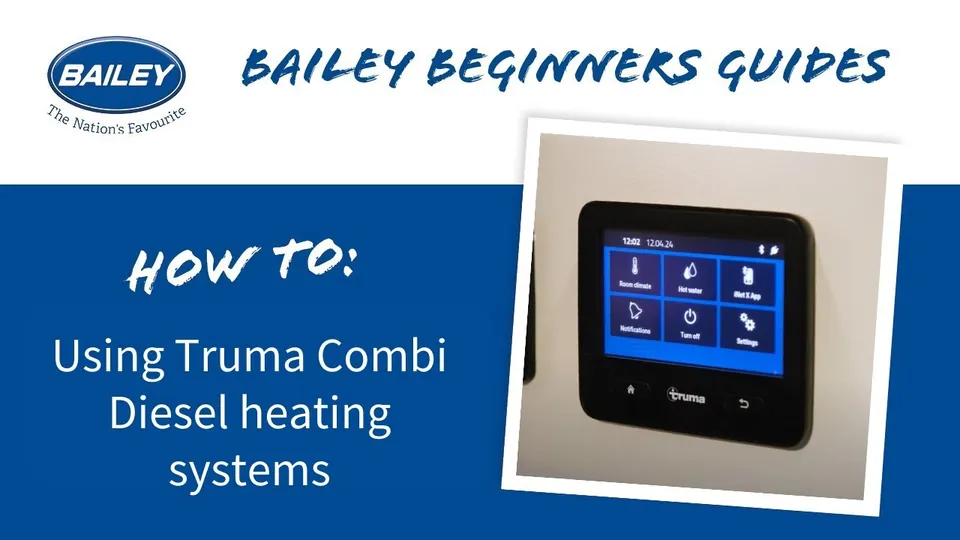
The video is hosted by YouTube (Google): nothing loads until you play it, and Google may then set cookies.
FAQs
How much fuel does a campervan diesel heater use per night?
For a 2 kW model, allow 1 to 2.4 litres of diesel over a 10-hour night, based on the spec sheet for the Autoterm Air 2D (0.10 to 0.24 litres an hour), and 8 to 24 Ah from the battery for its fan and electronics. The thermostat switches the heater off and on, so real consumption falls between these two figures, depending on the van’s insulation and the cold outside.
Can you use a portable diesel heater in a campervan?
The UK’s Office for Product Safety and Standards warns that a diesel heater should only be used in a sufficiently ventilated space, or the user can be exposed to potentially fatal levels of carbon monoxide. The NHS also advises keeping rooms well ventilated. A heater approved under UN Regulation No. 122 and installed in the vehicle according to its instructions takes its air from outside and releases its fumes there.
What hook-up does an electric heater need in a campervan?
Divide your appliances’ power by 230 V. A 900 W heater draws 3.9 A and a 1,800 W one 7.8 A, according to Truma’s spec sheet for the Combi D 4 E. UK sites normally supply 16 A, but some limit each pitch to 10 A, or 5 A or less, says the Caravan and Motorhome Club: on 5 A, or 1,150 W, the 1,800 W setting trips the supply. Check the limit on arrival.
Do you need a carbon monoxide alarm in a campervan?
The NHS recommends a carbon monoxide alarm that makes a loud sound, in each room with an appliance that burns gas, oil, coal or wood. In a van, look for the BS EN 50291-2 standard, which covers detectors fixed in place in leisure vehicles. The gas is colourless and has no smell, and an alarm is no substitute for regular servicing of the heater or for vents that are never blocked.
Does a diesel heater work at altitude?
Yes, within the limits stated on its spec sheet. Autoterm gives 4,200 m for its Air 2D; Webasto, 5,500 m for its Air Top Pro 25, with full power up to 3,000 m; Eberspächer, automatic adjustment up to 5,500 m depending on the version of its Airtronic 3 heaters. Truma regulates the combustion air of its Combi D 4 E with a pressure sensor. On other models, an altitude kit is an add-on.
Sources
- Eberspächer, Climate control systems: recreational vehicles, brochure of heaters for leisure vehicles, October 2021, accessed 8 November 2026. eberspaecher.com https://www.eberspaecher.com/fileadmin/data/corporatesite/pdf/en/2_fuel_operated_heaters/gp/eberspaecher-brochure-camping-cars-en.pdf ↩
- Autoterm, Air 2D, product page and technical data, accessed 8 November 2026. autoterm.com https://autoterm.com/heating-systems/air-series-heaters/air-2d-compact-air-heater ↩
- Truma, VarioHeat comfort, product page and technical details (in French), accessed 8 November 2026. truma.com https://www.truma.com/fr/produits/systemes-de-chauffage/chauffages-varioheat/truma-varioheat-comfort-gaz-extremement-compact/ ↩
- Truma, Combi D 4 E (prochaine génération), product page and technical details (in French), accessed 8 November 2026. truma.com https://www.truma.com/fr/produits/systemes-de-chauffage/chauffages-combi/combi-d-4-e/ ↩
- Webasto, Air Top Pro 25, data sheet (in Italian), August 2025, accessed 8 November 2026. webasto.com https://www.webasto.com/content/dam/webasto/region-specific/italy/products/air-heaters/datasheets/Datasheet_Air%20Top%20Pro%2025_IT-26-VIEW.pdf.coredownload.inline.pdf ↩
- Department for Energy Security and Net Zero, Weekly road fuel prices (CSV, 2018 onwards: average pump price of diesel for the week beginning 2 November 2026), released 3 November 2026, accessed 8 November 2026. assets.publishing.service.gov.uk https://assets.publishing.service.gov.uk/media/6ae897f2f4a6b3f59cf37575/CSV__2018_-__.csv ↩
- The Caravan and Motorhome Club, How caravan electrics work on site, technical advice, accessed 8 November 2026. caravanclub.co.uk https://caravanclub.co.uk/advice-and-training/technical-advice/mains-electrical-installation ↩
- Malibu, Liste de prix Malibu Van 2026, French price list valid from 1 August 2025 (recommended retail prices ex works, including 20% VAT; in French), accessed 8 November 2026. malibu-carthago.com https://www.malibu-carthago.com/wp-content/uploads/2025/08/FR_PL_Malibu_VAN_2026_1.pdf ↩
- Vantourer (Eurocaravaning), Données techniques / liste des prix, Belgian price list valid from 1 August 2025 (including 21% Belgian VAT; in French), accessed 8 November 2026. vantourer.de https://www.vantourer.de/fileadmin/data_vantourer/Dokumente/downloads/2026/eurocaravaning-vantourer-preisliste-01-2026-be-fr-web.pdf ↩
- Regulation No. 122 of the United Nations Economic Commission for Europe (UNECE), Uniform technical prescriptions concerning the approval of vehicles of categories M, N and O with regard to their heating systems, version published in the Official Journal of the European Union on 24 January 2020 (Supplement 5, in force from 15 October 2019), accessed 8 November 2026. eur-lex.europa.eu https://eur-lex.europa.eu/legal-content/EN/TXT/HTML/?uri=CELEX:42020X0110 ↩
- Office for Product Safety and Standards, Product Recall: Vevor Diesel Car Parking Heater (2212-0008), 3 January 2023, updated 11 January 2024, accessed 8 November 2026. gov.uk https://www.gov.uk/product-safety-alerts-reports-recalls/product-recall-vevor-diesel-car-parking-heater-2212-0008 ↩
- Office for Product Safety and Standards, Product Safety Report: Vevor Diesel Air Parking Heater (2302-0090), 25 August 2023, accessed 8 November 2026. gov.uk https://www.gov.uk/product-safety-alerts-reports-recalls/product-safety-report-vevor-diesel-air-parking-heater-2302-0090 ↩
- Office for Product Safety and Standards, Product Safety Report: Vevor Diesel Heater (2511-0300), 29 November 2025, accessed 8 November 2026. gov.uk https://www.gov.uk/product-safety-alerts-reports-recalls/product-safety-report-vevor-diesel-heater-2511-0300 ↩
- Office for National Statistics, user-requested data 1735, Number of deaths due to accidental poisoning by carbon monoxide, England and Wales, deaths registered in 2022, released 5 January 2024, accessed 8 November 2026. ons.gov.uk https://www.ons.gov.uk/peoplepopulationandcommunity/birthsdeathsandmarriages/deaths/adhocs/1735accidentalpoisoningbycarbonmonoxideenglandandwales2022 ↩
- NHS, Carbon monoxide poisoning, page last reviewed 16 December 2025, accessed 8 November 2026. nhs.uk https://www.nhs.uk/conditions/carbon-monoxide-poisoning/ ↩
- BSI, BS EN 50291-2:2019, listing of the European standard for carbon monoxide detectors fixed in place in recreational vehicles, 30 September 2019, accessed 8 November 2026. knowledge.bsigroup.com https://knowledge.bsigroup.com/products/electrical-apparatus-for-the-detection-of-carbon-monoxide-in-domestic-premises-electrical-apparatus-for-continuous-operation-in-a-fixed-installation-in-recreational-vehicles-and-similar-premises-including-recreational-craft-additional-test ↩

Campervans, motorhomes, cycling and calculators
Julien de Jurquet writes for Outfarer about campervans, motorhomes, cycling and calculators. He reads instruction manuals to the very end and never lets a figure through without its unit, so that your choices rest on sums rather than promises.


