 Français (France)
 English (UK)
 English (US)
 Deutsch (Deutschland)

Why butane gives up when it is cold
-0.5 °C against -42 °C. Those are the boiling points of butane and propane at atmospheric pressure, according to the German liquid gas association’s data sheet [1]. Below that, the liquid in the cylinder stops boiling: it releases no more gas, and the appliance goes out although the cylinder is not empty.
So butane does not ‘freeze’: it stays liquid and stops vaporising. The threshold shifts a little with the source: -0.5 °C for the pure substance [1], -2 °C for the British supplier Calor, which sees butane as better suited to indoor use [2], ‘above 0 °C’ for the Caravan and Motorhome Club [3]. Take ‘around zero’, and leave some margin: vaporising gas needs heat, about 380 kJ per kilogram at 0 °C [1], which the liquid takes from the cylinder and the surrounding air. A cylinder that is delivering a lot of gas cools itself.
Propane stays gaseous far lower: the club says it turns to gas down to -40 °C and can be used in winter, or all year round, while butane generally suits spring-to-autumn travellers [3]. Calor stresses that propane is not affected by the British cold [2].
| Propane | Butane | |
|---|---|---|
| Boiling point at atmospheric pressure | -42 °C | -0.5 °C |
| Net calorific value | 12.87 kWh/kg | 12.70 kWh/kg |
| Gas density, air = 1 | 1.55 | 2.09 |
| Winter use according to the British club | possible down to -40 °C | above 0 °C |
Let’s do the sum. At 12.87 and 12.70 kWh per kilogram, a kilogram of propane holds 1.3% more energy than a kilogram of butane. A cylinder holding 13 kg of gas, the content of Butagaz’s reference cylinder [6], is therefore about 167 kWh in propane and 165 kWh in butane, calculated from the data sheet [1]. For the same weight of gas, switching to propane for winter costs nothing in range.

In France, no official colour identifies the gas: each supplier picks its own [12]. On Butagaz’s Cube, butane (6 kg) carries a blue label and propane (5 kg) a red one [6], while, according to a comparison site, Leclerc’s Clairgaz sells red butane and purple propane [12]. Read the name of the gas on the label, never the colour alone.
The regulator: from 16 bar to 30 mbar, for both gases
A cylinder can hold up to 16 bar; the appliances in a campervan expect 30 mbar. The regulator bridges the gap [4]. Since the European standard EN 1949, one setting suits propane and butane: the Caravan and Motorhome Club dates the harmonisation to September 2003 in the UK, whereas before you needed a 28 mbar regulator for butane and a 37 mbar one for propane [3]. The German G 607 inspection criteria also give 30 mbar for vehicles [9].
Driving with the gas on, for the fridge or the heater, needs a regulator with a crash sensor. Truma describes a ball that closes the line in a crash from about 15 km/h, with a reset button if the sensor has tripped on a bad road [4]. Without a crash sensor, the cylinders must stay closed while driving [4]. The manufacturer adds that motorhomes built from January 2007 need a safety shut-off device to run a gas heater while driving, and that France only allows gas while driving in ‘type-tested’ vehicles first registered from 1 January 2007; in older ones it is forbidden, even with a shut-off device [5].
Cambridgeshire Fire and Rescue gives the opposite rule, without qualification: never use a cooker or heater while the vehicle is moving [11]. If in doubt, close the cylinders before you set off.
Truma also recommends a gas filter, which keeps out aerosols, the oily particles from contaminated cylinders that can block the regulator; the cartridge is checked at every cylinder change [4]. The British club reports regulators blocked by a yellow, oily fluid and then needing replacement [3].
In France: 13 kg, Cube or Viseo
If you need gas in France, you will mostly meet Butagaz. The ADAC writes that only the country’s own cylinders are exchanged or filled there, and that French cylinders can be borrowed at many campsites and petrol stations against a deposit of about €35, with an adaptor and the receipt kept safe [7]. The Butagaz range has four sizes [6]. The 13 kg is, according to the supplier, its reference cylinder; the Viseo weighs only 6.5 kg empty, against about 13 kg for a classic cylinder.
| Size | Gas | Content |
|---|---|---|
| 13 kg | butane or propane | 13 kg of gas |
| 35 kg | propane only | 35 kg of gas |
| Cube | butane or propane | 6 kg of butane, 5 kg of propane |
| Viseo | butane only | 10 kg of gas, 6.5 kg empty |
Two details matter for a campervan. The Viseo only exists in butane: outside in winter, it gives up like any butane. And the ‘clip’ regulator supplied with the Cube or Viseo only fits a Butagaz valve [6]. For the Cube, the supplier offers a ‘direct clip’, described as ideal for a motorhome, usable on devices that connect two cylinders to the same installation and switch from one to the other, with butane or propane [6].
Abroad: about 300 systems, at least one adaptor
The ADAC, the German motoring club, counts about 300 different connection systems in Europe, and recommends campers carry a set of filling and withdrawal adaptors, sold for about €15 in shops [7]. The principle is national: a cylinder is exchanged in its own country, and abroad with an adaptor. The table below is the ADAC’s view for its German members. For a British cylinder the rule of prudence is the same: find out about the country’s system before you leave.
| Country | What the ADAC says |
|---|---|
| Austria, Poland | same cylinders as in Germany |
| France | only the country’s own cylinders are exchanged or filled; loan against a deposit of about €35, with an adaptor, and keep the receipt |
| Spain | 6 kg cylinders at Repsol and 12.5 kg at Cepsa, lent against a deposit; Spanish regulator and hose needed; Repsol can adapt the fitting (‘X-Police’) for about €70 |
| Portugal | German cylinders are not filled |
| United Kingdom, Ireland | German cylinders are no longer filled; buy Calor or Flogas cylinders, with an adaptor |
| Italy | cylinders of 0.5, 2 or 3 kg, rarely 5 kg, no 11 kg; filling the fixed tanks of camping vehicles at gas stations is forbidden |
| Norway | LPG Norge stations fill German cylinders; AGA sells a Norwegian cylinder (about 1,200 NOK, gas included) and an adaptor (about 300 NOK) |
| Sweden, Finland | AGA hires out cylinders, with an adaptor; Norwegian, Swedish and Finnish cylinders are compatible |
| Slovenia | German cylinders and tanks are filled without difficulty |
The ADAC warns that the rules change often and that it does not guarantee its list to be complete or correct [7]: check before you leave, on the spot or with the supplier. On the British side, the club points out that local suppliers exist abroad, but you will probably need a different regulator, hose or adaptor, and it advises a spare regulator for a long stay, because a UK-specification replacement is not always quick to find [3].
Butane Campingaz cylinders can be bought in shops across Europe, but they are dear and small, 2,800 g at most, and connect to a vehicle with a safety cylinder valve, whose model differs for butane and propane [7]. The British club adds that Campingaz is the only British supplier that also sells the same cylinder in Europe [3]. In Spain, Repsol recommends propane for the cold, and counts a 12 kg cylinder for one to two weeks and a 6 kg one for a week at most [10].
Fixed tank or refillable cylinder: refill rather than exchange
Some campervans have a fixed tank of 50 to 100 litres, which a gas dealer or an LPG station fills, according to the ADAC. The advantage: more gas on board than with cylinders. The drawback: not every station fills, and not every country has them [7]. A container is only filled at a suitably equipped filling station, and only to 80% with liquid gas [7].
Refillable cylinders raise another problem. The British club finds the equipment expensive, so meant for heavy users, advises against refilling your own portable cylinder at autogas pumps, and warns against ever having a cylinder refilled abroad if it is not designed for owner refilling [3]. An exchange cylinder is exchanged, not refilled.
Checks: Germany requires one every two years
TÜV Nord explains that the gas system of a motorhome or caravan is inspected under the German DVGW worksheet G 607: before first use, then every two years, and after an appliance is replaced or fitted [8]. Only people with the required training may do it; a plaque on the vehicle shows when the next one is due, and TÜV Nord quotes €74.10 from January 2026 [8]. The G 607 inspection criteria also set the repeat inspection at 24 months at most [9].
According to the ADAC, the inspection has been compulsory since a 2024 change to Germany’s vehicle registration rules, with a deadline of 19 June 2025 for existing systems, separate from the roadworthiness test [7]. Some campsites ask for it, and an insurer may reduce or refuse a payout without it [7].
| Country | Check | Source |
|---|---|---|
| Germany | before first use, then every two years (G 607) | TÜV Nord, ADAC [8] [7] |
| United Kingdom | annual service by a competent person advised; Gas Safe registration only for a hired-out vehicle | Caravan and Motorhome Club [3] |
| Spain | installation certificate from the company that supplied the gas (ITC-ICG 10, Royal Decree 919/2006) | Repsol [10] |
Repsol also mentions the EN 1949:2022 standard, which replaces the 2011 version [10].
Gas smell, changing a cylinder, a frosty night: the routines
Gas has no smell of its own: the familiar smell is added to detect leaks, which most often occur at connections, the regulator, the valve or the hose [3]. It is heavier than air (1.55 times for propane, 2.09 times for butane [1]) and stays at floor level in a poorly ventilated space [7]. The check is done with soapy water brushed on the joint, or a leak-detector spray, never with a flame [3].
- Close the valve of the empty cylinder before disconnecting it, and only open the full one’s once the connection is tight [11].
- Keep cylinders upright, supported at the top and bottom, ventilated and protected from frost and direct sunlight [4] [11].
- Turn the cylinders off when no appliance is meant to run continuously, such as the fridge [11].
- Never let liquid gas touch your skin: it causes frostbite [7].
- In winter, connect two cylinders to a changeover valve, so you do not run out on a cold night [3].
The regulator is the part frost threatens: if water condenses in it and then freezes, it can fail, warns the British club [3]. Hence the value of a well-ventilated gas locker, a spare regulator for long trips and a filter.

Burnt gas produces carbon monoxide: heating, condensation and the alarm are the subject of our guide to the campervan in winter, and the camping stove that loses pressure in the cold of our guide to camping stove gas. The rule to remember: choose a campervan’s gas by the thermometer, and connect it according to the country.
Kit related to this article
No affiliation: no commission, no sponsored products.
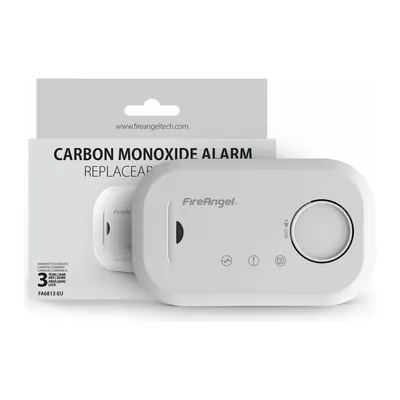
FireAngel FA6813 CO alarm
A carbon monoxide alarm that complies with EN 50291-2:2019, the standard for leisure vehicles, for wall mounting; it adds to open vents, never replaces them.
View on Amazon (opens in a new tab)
FAQs
Can you use butane in a campervan in winter?
Only if it stays above about 0 °C outside: butane stops vaporising between -2 °C and 0 °C depending on the source. Below that, the cylinder delivers no gas. Propane works down to -40 °C according to the Caravan and Motorhome Club, with almost the same energy per kilogram: it is the winter gas.
Do propane and butane use the same regulator?
Yes, since the EN 1949 standard: a 30 mbar regulator suits both gases in a leisure vehicle. Before, butane was regulated to 28 mbar and propane to 37 mbar. The connection between cylinder and regulator, though, changes with the brand and the country: some clip-on regulators only fit their maker’s valve.
Can you drive with the gas on?
Only with a crash-sensor regulator and hoses with rupture protection, according to Truma. Without a crash sensor, cylinders stay closed while driving. In France, Truma says gas while driving is only allowed in ‘type-tested’ vehicles first registered from 1 January 2007. Cambridgeshire Fire and Rescue advises against any use while moving.
Can you get a cylinder refilled abroad?
Rarely: the ADAC notes that in France only the country’s own cylinders are exchanged or filled, and that German cylinders are no longer filled in the UK or Portugal. The British club warns against having a cylinder refilled abroad if it is not designed for it. A fixed tank is filled at gas stations in many countries, but not all.
How long does a gas hose last?
Butagaz limits a rubber hose with screw fittings to 10 years and sets no limit for stainless steel flexible hoses. The Caravan and Motorhome Club advises replacing the hose every two to three years, and low-pressure hoses every three years. Read the date marked on yours, and replace it as soon as it cracks.
Sources
- Deutscher Verband Flüssiggas (DVFG), Informationsblatt zu chemisch-physikalischen Eigenschaften (properties of propane and butane), accessed 2 November 2026. dvfg.de https://www.dvfg.de/wp-content/uploads/2026/06/Factsheet-Flussiggas-2022-12.pdf ↩
- Calor, The difference between butane and propane, accessed 2 November 2026. calor.co.uk https://www.calor.co.uk/news-and-views/the-difference-between-butane-and-propane ↩
- Caravan and Motorhome Club, Liquefied Petroleum Gas, technical advice, accessed 2 November 2026. caravanclub.co.uk https://www.caravanclub.co.uk/advice-and-training/technical-advice/liquefied-petroleum-gas/ ↩
- Truma, How to find the right Truma gas pressure regulator, accessed 2 November 2026. truma.com https://www.truma.com/truma-guides/how-to-find-the-right-truma-gas-pressure-regulator/ ↩
- Truma, DuoControl CS, product page with regulatory information, accessed 2 November 2026. truma.com https://www.truma.com/products/gas-supply/gas-pressure-regulators/duocontrol-cs/ ↩
- Butagaz, Guide du gaz en bouteille 2025, accessed 2 November 2026. lp.butagaz.fr https://lp.butagaz.fr/media/3806/download/GUIDE_DU_GAZ_EN_BOUTEILLE_2025.pdf ↩
- PiNCAMP by ADAC, Gasversorgung beim Camping: Alles zum Thema Flüssiggasanlagen, 24 January 2026, accessed 2 November 2026. pincamp.de https://www.pincamp.de/magazin/ratgeber/tipps-tricks/gasflaschen-und-gasversorgung ↩
- TÜV NORD, Gasprüfung für Wohnwagen und Wohnmobil, accessed 2 November 2026. tuev-nord.de https://www.tuev-nord.de/de/privatkunden/verkehr/auto-motorrad-caravan/gasanlagenpruefung-wohnwagen ↩
- DVGW, worksheet G 607, Prüfkriterien for liquefied gas systems in vehicles, published by Rheingas, accessed 2 November 2026. rheingas.de https://www.rheingas.de/fileadmin/user_upload/rheingas/dokumente/Fluessiggas/Pruefkriterien_G_607.pdf ↩
- Repsol, Todos los usos de una bombona de gas para camper, accessed 2 November 2026. repsol.es https://www.repsol.es/particulares/asesoramiento-consumo/bombona-gas-camper-usos/ ↩
- Cambridgeshire Fire and Rescue Service, LPG cylinders, accessed 2 November 2026. cambsfire.gov.uk https://www.cambsfire.gov.uk/community-safety/outdoor-safety/lpg-cylinders/ ↩
- Selectra, “Y a-t-il un code couleur pour les bouteilles de gaz ?”, comparison site, accessed November 3, 2026. selectra.info https://selectra.info/energie/propane/bouteilles/comment-reconnaitre-bouteille ↩
Corrections
- Corrected : The caption of the cylinders photo presented red for propane and blue for butane as the usual convention: in France, the colour depends on the supplier. It has been corrected and a paragraph added.

Campervans, motorhomes, cycling and calculators
Julien de Jurquet writes for Outfarer about campervans, motorhomes, cycling and calculators. He reads instruction manuals to the very end and never lets a figure through without its unit, so that your choices rest on sums rather than promises.


 Guillaume Hoarau
