 Français (France)
 English (UK)
 English (US)
 Deutsch (Deutschland)

Contents
Does a motorhome need a Crit’Air sticker in France?
Not to cross France, but as soon as you enter a low emission zone. What the text says: the air quality certificate, the Crit’Air sticker, is compulsory only to drive and park in a An area, called a ZFE in France (zone à faibles émissions), where a local authority restricts the most polluting vehicles according to their Crit’Air sticker., and to drive when the prefect, the State’s representative in the département, orders A temporary restriction ordered by the prefect during a pollution episode: only vehicles with the permitted stickers may drive in the area it sets. during a pollution episode [1]. Outside these two cases, none of the texts we read requires it.
There are 6 stickers: the green one for electric and hydrogen vehicles, then classes 1 to 5, from the least to the most polluting; the oldest vehicles are not classified and cannot have one [1]. The classification is the same across France, but each local authority chooses which stickers it keeps out [2]. If you know London’s ULEZ, where a vehicle that falls short of the standard pays a daily charge [3], or England’s Clean Air Zones, which work on the same principle [4], the French logic is different: a ZFE bans the stickers it excludes, passes and exemptions aside, and fines the driver. Our guide to campervan trips puts this check in the road step; this page goes into the detail.
What this means for you, in a motorhome: the sticker must be displayed even when the vehicle is allowed in, and even if it has an exemption [2]. Parking in an active ZFE without a sticker, with a vehicle that could have one, is already an offence [1]: sleeping parked in a town with a ZFE means parking there, as our guide to sleeping in a campervan in France points out. The rule applies to every vehicle driving in the zone, wherever it comes from, and another country’s sticker, Germany’s Umweltplakette for example, does not exempt you: each country has its own classification [2].
Which sticker for a diesel or petrol motorhome?
It is read from the registration papers. The French order of 21 June 2016 first sorts the vehicle by category, as defined in article R311-1 of the Code de la route, the French highway code: a car is a category M1 vehicle, a light van an N1, and a heavy goods vehicle, bus or coach an M2, M3, N2 or N3. It then classifies it by fuel and Euro standard, entered in field V.9 of the registration certificate, or failing that by the date of first registration, in field B [6]. We found no line in it specific to motorhomes: their category decides.
On a UK log book, not everything is guaranteed to be there. The law lists what a V5C issued since 31 December 2020 must contain, unless the information is not available: among other things, the date of first registration in the UK and, where it applies, abroad, the make, type and model, the type approval number, the fuel type, the seating capacity, the unladen weight and the maximum authorised mass [7]. Neither the vehicle category nor the Euro standard is on that list, although the Secretary of State may specify other particulars [7].
So where do you find them? GOV.UK says your vehicle’s emission standard is in the log book or available from the manufacturer [4]. The Certificate of Conformity is the other place to look: it is where DVLA tells applicants registering a new vehicle to find its type approval category and its Euro status, generally shown as the exhaust emission level, for example Euro 6 [8]. DVLA describes the living features of a motor caravan as those of special purpose M category vehicles [9]. And if the Euro standard appears nowhere, the French form accepts ‘No EURO standard shown on the registration certificate’, and the date of first registration takes over [10, 6].
In France, for the contrôle technique, the French roadworthiness test, Service-Public files the motorhome of up to 3.5 t among category M1 vehicles, with the car, and cites the national Véhicule automoteur spécialement aménagé, a specially fitted motor vehicle: the national genre, entered in field J.1 of the French registration certificate, of vehicles converted for a particular use, such as motorhomes. genre in field J.1 of the French registration certificate [11]. An M1 motorhome follows the car table. In diesel, it gets Crit’Air 2 if it is Euro 5 or 6, registered since 2011; 3 if it is Euro 4, from 2006 to 2010; 4 if it is Euro 3, from 2001 to 2005; 5 if it is Euro 2, from 1997 to 2000 [12]. In petrol, Euro 5 or 6 gives Crit’Air 1, as do gas and plug-in hybrids, whatever their date [12].
| Sticker | Diesel car | Petrol car | Diesel light van | Petrol light van |
|---|---|---|---|---|
| Crit’Air 1 | - | Euro 5 and 6, from 2011 | - | Euro 5 and 6, from 2011 |
| Crit’Air 2 | Euro 5 and 6, from 2011 | Euro 4, 2006 to 2010 | Euro 5 and 6, from 2011 | Euro 4, 2006 to 2010 |
| Crit’Air 3 | Euro 4, 2006 to 2010 | Euro 2 and 3, 1997 to 2005 | Euro 4, 2006 to 2010 | Euro 2 and 3, October 1997 to 2005 |
| Crit’Air 4 | Euro 3, 2001 to 2005 | - | Euro 3, 2001 to 2005 | - |
| Crit’Air 5 | Euro 2, 1997 to 2000 | - | Euro 2, October 1997 to 2000 | - |
| Unclassified | Euro 1 and earlier, up to 1996 | Euro 1 and earlier, up to 1996 | Euro 1 and earlier, up to September 1997 | Euro 1 and earlier, up to September 1997 |
Electric and hydrogen: green sticker. Gas and plug-in hybrid: Crit’Air 1, whatever the date. A year means 1 January to 31 December; ‘-’: no vehicle with this fuel in this class, as in the official table [12].
Over 3.5 tonnes: does a motorhome become an HGV?
The Crit’Air order does not ask the question in tonnes: it classifies by category, those of article R311-1 of the Code de la route [6]. That article defines category M1 by the number of seats, eight at most in addition to the driver’s, with no mass ceiling; it sets a weight only for categories M2, M3 and N [13]. The EU regulation on vehicle type approval puts the The regulatory name for a motorhome: a category M vehicle with living accommodation, code SA. among category M vehicles [14]. The official order form, for its part, offers ‘Passenger cars (M1 category)’, with no mention of weight [10].
What this means for you: find the category before you look at the weight. If it is M1, the order puts you among cars, a category for which it sets no mass threshold; if it is N2, M2 or M3, you fall under the table for heavy goods vehicles, buses and coaches. The maximum authorised mass counts for your licence, as our guide to 4.25-tonne motorhomes explains; for the sticker, the category does. Do not expect it on every registration document: UK law does not require it on a V5C [7], and the EU directive on registration documents made it an optional entry, field J, like the Euro standard of field V.9 [15]. Fields J.1, the national genre, and J.3, the body in its national designation, are additions of the French registration certificate, absent from the directive [16, 15].
Where does the confusion come from? The same article R311-1 calls an M1 vehicle of 3.5 t at most a ‘voiture particulière’, a passenger car [13], Service-Public describes a heavy goods vehicle as one over 3.5 t [5], and in Paris, a ZFE plate shows a lorry marked ‘3,5t’ (photo below). But the Crit’Air order speaks of ‘cars’, meaning every category M1 vehicle [6]. We found no official page that deals separately with motorhomes over 3.5 t.
| Sticker | Diesel | Petrol |
|---|---|---|
| Crit’Air 1 | - | Euro VI, from 2014 |
| Crit’Air 2 | Euro VI, from 2014 | Euro V, October 2009 to 2013 |
| Crit’Air 3 | Euro V, October 2009 to 2013 | Euro III and IV, October 2001 to September 2009 |
| Crit’Air 4 | Euro IV, October 2006 to September 2009 | - |
| Crit’Air 5 | Euro III, October 2001 to September 2006 | - |
| Unclassified | Euro I, II and earlier, up to September 2001 | Euro I, II and earlier, up to September 2001 |
Heavy-vehicle standards are written in Roman numerals. Gas and plug-in hybrid: Crit’Air 1; electric and hydrogen: green sticker [12].
Where to order the sticker from the UK, and at what price?
On one site only: certificat-air.gouv.fr, which the French order of 29 June 2016 names as the only way to apply remotely [2]. For a vehicle registered in France, it costs €3.85, including €0.74 postage [5, 10]; for yours, both differ. The price covers the issuing service: it is not a tax [1]. GOV.UK’s checklist for driving abroad warns that emission stickers may have to be bought weeks before you go [18]: the ferry terminal is too late.
Vehicle registered in the UK or elsewhere outside France
- Online only, on the page for vehicles registered abroad [5]; the site exists in English [2].
- The price is €5.11 per vehicle: €3.11 plus €2 postage outside France [10].
- You need a legible photo or scan of the registration certificate, front and back, in PNG, JPG or PDF format, under 5 MB [10].
- The form asks for the category, for a motorhome one of ‘Passenger cars (M1 category)’, ‘Light utility vehicles (N1 category)’, ‘Buses and Coaches (M2 or M3 category)’ or ‘HGVs (N2 or N3 category)’; then the fuel, the Euro standard if the document shows it, and the date of first registration; one order covers 1 to 10 vehicles [10].
- The site announces a confirmation email within 4 hours, an emailed invoice showing the sticker, in effect a temporary certificate, within about 24 hours, then the sticker by post in around 10 days, to the address you give, with no separate time for delivery outside France [2].
Until the post arrives, the image on the emailed invoice proves the application and the vehicle’s classification, according to the official site [2]: keep it on board. For a hired motorhome, no text says who buys the sticker: the official site leaves it to the hire firm and its customer, and any penalty applies to the person driving [2]. Ask the hire firm before planning a stop in a town.
Where does it go? Inside, front visible from outside, on the lower right-hand corner of the windscreen [5, 2]; the official answer makes no exception for right-hand-drive vehicles. Clean the glass and let it dry: once stuck, the sticker tears if you try to move it [5].
Which cities restrict which stickers in November 2026?
First, the framework, which nearly disappeared. The abolition of the ZFE, voted in a law simplifying economic life, was struck down by the Constitutional Council on 21 May 2026, for a procedural reason and without a ruling on the substance [20]. Since then, a bill to abolish them was debated in the National Assembly on 8 October 2026, on a text the committee had rejected, with no adopted text in its file, and another has been in committee since 13 October [21, 22]. As of 8 November 2026, the ZFE therefore apply; a vote could change that, which is why their websites are worth re-reading just before you leave.
Today, 38 areas must have a ZFE, Paris and Lyon remain under the stricter regime, and elsewhere the minimum obligation targets unclassified vehicles; 25 ZFE are in force in mainland France [23]. The table covers the nine that keep out at least Crit’Air 4 cars, from each authority’s website, read on 8 November 2026. The Foreign Office’s travel advice for France, updated on 22 October 2026, names central Paris, Lyon and Grenoble, from 8am to 8pm, Monday to Friday [24]; on the authorities’ own sites, those are the Grand Paris hours for cars, while Lyon applies its zone around the clock and Grenoble from 7am to 7pm on weekdays [25, 26, 27].
| ZFE | Banned stickers | When | Pass for an occasional visit |
|---|---|---|---|
| Grand Paris (77 communes, inside the A86) | Crit’Air 3, 4, 5 and unclassified [25] | Cars, light vans, two-wheelers: Monday to Friday, 8am to 8pm, except public holidays. HGVs, buses, coaches: every day, 8am to 8pm [25] | Pass ZFE 24h: 24 days a year [28] |
| Lyon (Lyon, Villeurbanne, Caluire-et-Cuire, part of Bron and Vénissieux) | Crit’Air 3, 4, 5 and unclassified [26] | Every day, 24 hours a day, for driving and parking [26] | ‘Petit rouleur’ (low-mileage driver): up to 52 driving rights a year [29] |
| Grenoble (13 communes) | Cars and two-wheelers: Crit’Air 3, 4, 5 and unclassified [19] | Monday to Friday, 7am to 7pm [27] | Not stated on the pages read |
| Strasbourg (Eurométropole) | Crit’Air 4, 5 and unclassified; Crit’Air 3: teaching phase until January 2027 [30, 31] | Every day, 24 hours a day [30] | Pass ZFE 24h: 24 passes a year [32] |
| Montpellier (the whole metropolitan area since 1 July 2026, according to the city) | Crit’Air 3, 4, 5 and unclassified [31, 33] | Every day, 24 hours a day [33] | Pass of 52 days per calendar year [33] |
| Rouen (13 communes) | Crit’Air 4, 5 and unclassified; ban on Crit’Air 3 suspended [34] | Not stated on the page read | 24-hour pass: 24 days a year, free [35] |
| Toulouse (inside the ring road, western bypass included) | Crit’Air 4, 5 and unclassified; ban on Crit’Air 3 suspended [36] | Not stated on the page read | Pass ZFE: 52 days a year [36] |
| Marseille (centre, inside the boulevards) | Crit’Air 4, 5 and unclassified [37] | Every day, 24 hours a day [37] | Day pass: 52 a year, requested by email [37] |
| Reims (city centre and a stretch of the A344) | Crit’Air 4, 5 and unclassified, except two-wheelers [31] | Not stated on the ministry’s list | See the Grand Reims website |
In the Grand Paris, the order puts cars, category M1, under the weekday hours, and heavy goods vehicles, categories N2 and N3, under the every-day hours [25]. The ministry’s national list, used here for Reims, is undated [31].
And motorways? There is no single rule. In the Grand Paris, the A86 and its interchanges are excluded from the ZFE [25]; in Strasbourg, the A4 and the A35 north of the Vendenheim interchange, the M35 and the M353 let you bypass the zone [30]; in Marseille, the A55 flyover and the tunnels remain open to all [37]. In Lyon, on the other hand, the M6 and M7 and the ring roads are part of the zone [26], and the ministry includes the national network (A1, A25 and others) in the Lille ZFE [31]. A route that skirts a city is therefore checked on each ZFE’s map.
Exemptions and passes: what a motorhome can apply for
A banned sticker is not always a closed door. Several authorities provide an exemption for vehicles whose French registration certificate carries the VASP genre, and three name motorhomes. Strasbourg lists ‘street washers, sweepers and motorhomes’ among the VASP vehicles that can get an exemption of 3 years at most, on application [32]; Montpellier gives the example of ‘a van converted into a motorhome’, with VASP in field J.1 [33]. Toulouse lets VASP motorhomes and vans drive ‘for 3 years from the date on which the restrictions concerning them came into force’ [36]; as those restrictions date from 2022 and 2023, ask the Métropole whether yours still runs. The Métropole du Grand Paris grants private individuals a renewable 3-year exemption for VASP vehicles, on presentation of the registration certificate [25].
These exemptions rest on the VASP entry, a field of the French registration certificate. We found nothing on these pages that says whether a motorhome registered abroad can claim one: ask the authority before you drive in.
For an occasional visit, most offer a pass, to obtain before driving in. The Métropole du Grand Paris grants 24 days a year, provided you register the vehicle at least 15 days before its first use, then declare each date at least 24 hours ahead [28]. Strasbourg allows 24 passes of 24 hours a year [32], Rouen 24 days per calendar year, free [35]. Lyon grants up to 52 driving rights a year with its ‘petit rouleur’ exemption, Toulouse and Montpellier up to 52 days a year, Marseille up to 52 day passes, requested by email [29, 36, 33, 37]. None of the pages we read says whether these platforms accept a vehicle registered abroad: check when you register.
Pollution peaks: when the prefect restricts traffic
A ZFE is permanent; differentiated traffic lasts only as long as a pollution episode. The order of 7 April 2016 allows the prefect to restrict the most polluting vehicles according to the Crit’Air classification, over the area set by the prefect’s order, an inter-prefectoral one when the episode covers several départements [38]. We read no text that limits this measure to cities with a ZFE.
While the measure lasts, the sticker is compulsory to drive in the area, and ignoring the restriction costs the same fine as in a ZFE [5]; driving without a sticker is also an offence there [2]. The measure is announced by the media the day before, before 7pm [5], and the Vigilance atmosphérique map (in French), which the ministry points to, lists the procedures in force [1].
Fines and checks: what you risk, city by city
The Code de la route punishes ignoring a ZFE or differentiated traffic as a 3rd-class offence with a category M1, N1 or L vehicle, and as a 4th-class offence with an M2, M3, N2 or N3, and the vehicle can be immobilised [39]. The fixed fine is €68 for a light vehicle and €135 for a heavy goods vehicle, whether you drive with a banned sticker or with none; displaying a sticker that does not match the vehicle costs €135 [1]. The fine can go up to €450, and the vehicle can be impounded [5]. Here again, the category counts: an M1 motorhome falls into the 3rd class.
In practice, enforcement moves at different speeds, and automated number-plate checking is not announced as operational on any of the pages we read. In Toulouse, the Métropole warns that the fine for a missing sticker and the one for a banned vehicle can be combined [36].
| ZFE | Enforcement | Automated checks |
|---|---|---|
| Grand Paris | Occasional, information-only checks until 31 December 2026, penalties from 1 January 2027 [28, 40] | No effective roll-out in 2026, according to the order [40] |
| Lyon | Municipal and national police, for driving and parking [26] | Planned ‘in due course’ [26] |
| Grenoble | Teaching period without fines until 30 June 2027; a missing sticker can still be fined [19] | Not stated |
| Strasbourg | Crit’Air 4, 5 and unclassified can be fined; Crit’Air 3 without a fine until January 2027 [30] | Planned ‘at a later stage’ [30] |
| Montpellier | Fines postponed to 2027 [33] | Not stated |
| Toulouse | Fine of €68 or €135 [36] | ‘Not yet installed’ [36] |
A teaching period suspends the fine for a banned vehicle, not necessarily the one for a missing sticker: Grenoble says so.
Before driving into a city: the five checks
- Find the category, the fuel and the Euro standard (or the date of first registration) on the V5C or the Certificate of Conformity, then check the class with the official simulator.
- Order the sticker on certificat-air.gouv.fr only, early enough to receive it, and keep the emailed invoice on board in the meantime.
- List the cities on your route and open each ZFE’s website: banned stickers, hours, excluded roads.
- If your sticker is banned: request the pass before driving in, ask about an exemption, or park outside the zone.
- The day before, check whether differentiated traffic has been announced in the départements you cross.
Check before you leave, then: the website of each ZFE on your route, the day before rather than the month before. We re-read these texts on 8 November 2026; a bill under discussion or a local order can change them, and a rule is always read with its date.
Worth watching
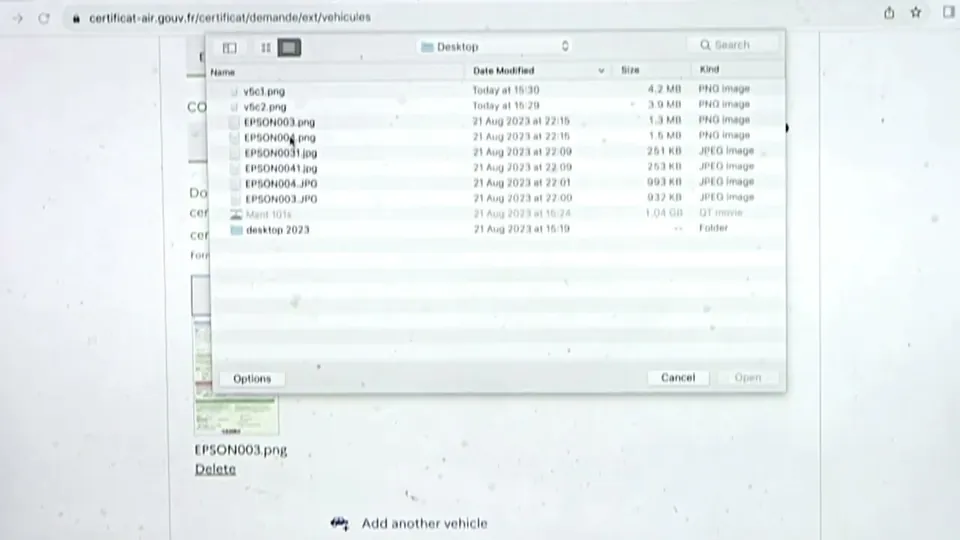
A UK motorhome owner goes through the official application for a Crit’Air sticker, screen by screen, including the upload of the registration document.
The video is hosted by YouTube (Google): nothing loads until you play it, and Google may then set cookies.
FAQs
Which Crit’Air sticker does a diesel motorhome get?
It depends on its category and its Euro standard. For a category M1 diesel motorhome, Euro 5 or 6 (registered since 2011) gives Crit’Air 2, Euro 4 (2006 to 2010) gives 3, and Euro 3 (2001 to 2005) gives 4. A V5C does not always show the Euro standard: GOV.UK points to the log book or the manufacturer, and the official simulator confirms the class.
Does a motorhome over 3.5 tonnes need an HGV sticker?
The Crit’Air order classifies by European category, not by weight. If the motorhome is category M1, it follows the car table; if it is N2, M2 or M3, the table for heavy goods vehicles, buses and coaches. We found no official rule specific to motorhomes over 3.5 t: if in doubt, the issuing service answers on +33 800 970 033.
How much is the sticker, and where do I buy it from the UK?
Only on certificat-air.gouv.fr: €5.11 for a vehicle registered outside France, against €3.85 for one sent within France, postage included. For a UK vehicle, the order is online only, with a photo or scan of the registration certificate, front and back. Third-party sites sell it for much more, with no link to the French ministry.
My sticker hasn’t arrived: can I drive into a ZFE?
The official site announces an emailed invoice showing an image of the sticker, in effect a temporary certificate, within about 24 hours of the order, then the sticker by post in around 10 days. That image serves as proof of the application and of the vehicle’s classification until the post arrives. Keep it on board, and drive into the zone only if your vehicle’s class is allowed there.
Does a hired motorhome need a Crit’Air sticker?
Yes, if it enters a ZFE or drives during differentiated traffic. No text says who must buy it: the official site leaves it to the agreement between the hire firm and its customer, and points out that any penalty applies to the person driving. Ask the hire firm whether the vehicle carries one, and which, before planning a stop in a town.
Are motorways part of the ZFE?
It depends on the city. In the Grand Paris, the A86 and its interchanges are excluded; in Strasbourg, roads to the north and south let you bypass the zone; in Marseille, the A55 flyover and the tunnels stay open. In Lyon, on the other hand, the M6, the M7 and the ring roads are inside the zone. Each ZFE’s map is what counts.
Sources
- French Ministry for Ecological Transition, Certificats qualité de l’air : Crit’Air, updated 2 February 2026 (in French), accessed 8 November 2026. ecologie.gouv.fr https://www.ecologie.gouv.fr/politiques-publiques/certificats-qualite-lair-critair ↩
- certificat-air.gouv.fr, the official Crit’Air website (French Ministry for Ecological Transition), frequently asked questions, English version from the site’s language menu, accessed 8 November 2026. certificat-air.gouv.fr https://www.certificat-air.gouv.fr/foire-aux-questions ↩
- Transport for London, Ultra Low Emission Zone, accessed 8 November 2026. tfl.gov.uk https://tfl.gov.uk/modes/driving/ultra-low-emission-zone ↩
- GOV.UK, Clean Air Zones, updated 12 February 2026, accessed 8 November 2026. gov.uk https://www.gov.uk/guidance/driving-in-a-clean-air-zone ↩
- Service-Public.fr, the French government’s information site, Vignette ou pastille Crit’Air (certificat qualité de l’air), checked 1 January 2026 (in French), accessed 8 November 2026. service-public.gouv.fr https://www.service-public.gouv.fr/particuliers/vosdroits/F33371 ↩
- French order (arrêté) of 21 June 2016 establishing the classification of vehicles by their level of air pollutant emissions, articles 1 and 2 (article 2 and annex I in force since 22 July 2023, after the order of 5 July 2023), Légifrance (in French), accessed 8 November 2026. legifrance.gouv.fr https://www.legifrance.gouv.fr/loda/id/JORFTEXT000032749723 ↩
- The Road Vehicles (Registration and Licensing) Regulations 2002 (SI 2002/2742), regulation 10A (registration document), paragraph (2) as substituted with effect from 31 December 2020, legislation.gov.uk, accessed 8 November 2026. legislation.gov.uk https://www.legislation.gov.uk/uksi/2002/2742/regulation/10A ↩
- DVLA, Guide to filling in the ‘Application for first vehicle tax and registration of a new motor vehicle’ (V55/4), leaflet V355/4, GOV.UK, accessed 8 November 2026. assets.publishing.service.gov.uk https://assets.publishing.service.gov.uk/media/6825c920940c028bcf34e02e/guide-to-filling-in-the-application-for-first-vehicle-tax-and-registration-of-a-new-motor-vehicle.pdf.pdf ↩
- DVLA, Converting a vehicle into a motor caravan (motor home), GOV.UK, updated 6 November 2026, accessed 8 November 2026. gov.uk https://www.gov.uk/government/publications/converting-a-vehicle-into-a-motor-caravan/converting-a-vehicle-into-a-motor-caravan ↩
- certificat-air.gouv.fr, home page and order process for a vehicle registered abroad, English version, accessed 8 November 2026. certificat-air.gouv.fr https://www.certificat-air.gouv.fr/ ↩
- Service-Public.fr, Contrôle technique d’une voiture (catégorie M1), checked 1 January 2026 (in French), accessed 8 November 2026. service-public.gouv.fr https://www.service-public.gouv.fr/particuliers/vosdroits/F2878 ↩
- French Ministry for Ecological Transition, Classification des véhicules en application des articles L. 318-1 et R. 318-2 du code de la route, annex 1 to the order of 21 June 2016, document of 5 June 2023 published on certificat-air.gouv.fr (in French), accessed 8 November 2026. certificat-air.gouv.fr https://www.certificat-air.gouv.fr/files/tableaux_classement.pdf ↩
- French highway code (Code de la route), article R311-1 (vehicle categories), version in force since 25 July 2026, Légifrance (in French), accessed 8 November 2026. legifrance.gouv.fr https://www.legifrance.gouv.fr/codes/article_lc/LEGIARTI000054478354 ↩
- Regulation (EU) 2018/858 of the European Parliament and of the Council of 30 May 2018 on the approval and market surveillance of motor vehicles, Article 4 and Annex I (Part A, point 5.1), original version, EUR-Lex, accessed 8 November 2026. eur-lex.europa.eu https://eur-lex.europa.eu/legal-content/EN/TXT/HTML/?uri=CELEX:32018R0858 ↩
- Council Directive 1999/37/EC of 29 April 1999 on the registration documents for vehicles, Annex I, original version, EUR-Lex, accessed 8 November 2026. eur-lex.europa.eu https://eur-lex.europa.eu/legal-content/EN/TXT/HTML/?uri=CELEX:31999L0037 ↩
- French order of 9 February 2009 on vehicle registration procedures, annex III, version in force since 30 June 2024, Légifrance (in French), accessed 8 November 2026. legifrance.gouv.fr https://www.legifrance.gouv.fr/loda/article_lc/LEGIARTI000049860510 ↩
- certificat-air.gouv.fr, ‘Contact us’ page (telephone support), accessed 8 November 2026. certificat-air.gouv.fr https://www.certificat-air.gouv.fr/contact ↩
- GOV.UK, Driving abroad, accessed 8 November 2026. gov.uk https://www.gov.uk/driving-abroad ↩
- Grenoble Alpes Métropole, ZFE website, home page (in French), accessed 8 November 2026. zfe.grenoblealpesmetropole.fr https://zfe.grenoblealpesmetropole.fr/ ↩
- French Constitutional Council, decision no. 2026-903 DC (law simplifying economic life), made public on 21 May 2026 (in French), accessed 8 November 2026. conseil-constitutionnel.fr https://www.conseil-constitutionnel.fr/decision/2026/2026903DC.htm ↩
- French National Assembly, file of bill no. 2970 to abolish low emission zones, tabled on 23 June 2026 and debated in the chamber on 8 October 2026 (in French), accessed 8 November 2026. assemblee-nationale.fr https://www.assemblee-nationale.fr/dyn/17/dossiers/abroger_ZFE-m_17e ↩
- French National Assembly, file of bill no. 3320 to abolish low emission zones, tabled on 13 October 2026 and referred to committee (in French), accessed 8 November 2026. assemblee-nationale.fr https://www.assemblee-nationale.fr/dyn/17/dossiers/_abroger_les_zones_a_faible_emission_17e ↩
- Service-Public.fr (business section), Circuler en zone à faibles émissions mobilité (ZFE ou ZFE-m), checked 5 October 2026 (in French), accessed 8 November 2026. service-public.gouv.fr https://www.service-public.gouv.fr/entreprendre/vosdroits/F38025 ↩
- Foreign, Commonwealth & Development Office, France travel advice: safety and security, GOV.UK, updated 22 October 2026, accessed 8 November 2026. gov.uk https://www.gov.uk/foreign-travel-advice/france/safety-and-security ↩
- Métropole du Grand Paris, order no. AP/2024/415 of 20 December 2024 establishing a low emission zone, articles 2 to 5 and annex 1 (in French), accessed 8 November 2026. metropolegrandparis.fr https://www.metropolegrandparis.fr/sites/default/files/media/document/Arr%C3%AAt%C3%A9_ZFE_C3_MGP.pdf ↩
- Métropole de Lyon, ZFE website, Tout savoir sur la ZFE (in French), accessed 8 November 2026. zfe.grandlyon.com https://zfe.grandlyon.com/zfe-grand-lyon/ ↩
- Grenoble Alpes Métropole, La ZFE, qu’est-ce que c’est ? (in French), accessed 8 November 2026. zfe.grenoblealpesmetropole.fr https://zfe.grenoblealpesmetropole.fr/683-la-zfe-qu-est-ce-que-c-est-.htm ↩
- Métropole du Grand Paris, La Zone à Faibles Emissions métropolitaine (in French), accessed 8 November 2026. metropolegrandparis.fr https://metropolegrandparis.fr/fr/la-zone-faibles-emissions-metropolitaine ↩
- Métropole de Lyon, ZFE website, ‘Particulier’ page (the ‘petit rouleur’ exemption, in French), accessed 8 November 2026. zfe.grandlyon.com https://zfe.grandlyon.com/particulier/ ↩
- Eurométropole de Strasbourg, ZFE-m Strasbourg : périmètre, calendrier et aides à la conversion (in French), accessed 8 November 2026. strasbourg.eu https://www.strasbourg.eu/la-zfe-m ↩
- French Ministry for Ecological Transition, Mieux respirer en ville, Les ZFE françaises, undated page (in French), accessed 8 November 2026. mieuxrespirerenville.gouv.fr https://mieuxrespirerenville.gouv.fr/fiches-thematique/se-deplacer/zfe-francaises ↩
- Eurométropole de Strasbourg, ZFE Strasbourg : dérogations, Pass 24h et démarches en ligne (in French), accessed 8 November 2026. strasbourg.eu https://www.strasbourg.eu/zfe-derogations ↩
- Montpellier Méditerranée Métropole and Ville de Montpellier, Circuler dans la Zone à Faibles Émissions (ZFE) (in French), accessed 8 November 2026. montpellier.fr https://www.montpellier.fr/vie-quotidienne/vivre-ici/se-deplacer/je-me-deplace-en-voiture/circuler-dans-la-zone-a-faibles-emissions ↩
- Métropole Rouen Normandie, ZFE-m website, Quel véhicule, quand et où ? (in French), accessed 8 November 2026. zfe.metropole-rouen-normandie.fr https://zfe.metropole-rouen-normandie.fr/quel-vehicule-quand-et-ou ↩
- Métropole Rouen Normandie, ZFE-m website, Dérogations (in French), accessed 8 November 2026. zfe.metropole-rouen-normandie.fr https://zfe.metropole-rouen-normandie.fr/derogations ↩
- Toulouse Métropole, FAQ qualité de l’air et ZFE, updated 4 September 2026 (in French), accessed 8 November 2026. metropole.toulouse.fr https://metropole.toulouse.fr/faq-qualite-de-lair-et-zfe ↩
- Métropole Aix-Marseille-Provence, Zone à faibles émissions mobilité (ZFE-m) (in French), accessed 8 November 2026. ampmetropole.fr https://ampmetropole.fr/missions/environnement/qualite-de-lair/zone-a-faibles-emissions-mobilite-zfe-m/ ↩
- French order of 7 April 2016 on the triggering of prefectoral procedures during air pollution episodes, articles 5 and 12 and annex, Légifrance (in French), accessed 8 November 2026. legifrance.gouv.fr https://www.legifrance.gouv.fr/loda/id/JORFTEXT000032376671/ ↩
- French highway code (Code de la route), articles R411-19 (differentiated traffic) and R411-19-1 (low emission zones), version in force since 1 July 2017, Légifrance (in French), accessed 8 November 2026. legifrance.gouv.fr https://www.legifrance.gouv.fr/codes/section_lc/LEGITEXT000006074228/LEGISCTA000006177117 ↩
- Métropole du Grand Paris, order no. AP/2025/501 of 16 December 2025 extending the teaching period (in French), accessed 8 November 2026. metropolegrandparis.fr https://www.metropolegrandparis.fr/sites/default/files/media/document/Arr%C3%AAt%C3%A9%20ZFE%20Ann%C3%A9e%20Pedagogique%202026%20sign%C3%A9.pdf ↩

Fact-checking, regulations and safety
Arnaud Couderc reviews our contributors’ articles and writes for Outfarer about regulations, safety, fishing, the sea and outdoor pursuits. He traces every rule back to its official text and every figure to its source, so that you set off with sound benchmarks.

 Julien de Jurquet

