 Français (France)
 English (UK)
 English (US)
 Deutsch (Deutschland)

Contents
The rule: four winter tyres, or chains in the boot
Do you need winter tyres to drive up to a French ski resort? What the text says, first of all: from 1 November to 31 March, in the mountain communes designated by the prefect, every car, van or motorhome must either run on four winter tyres or carry snow chains or snow socks able to fit at least two driven wheels [1]. The rule applies throughout that period, whether it snows or not. That is the big difference from Germany and Austria, as we will see below.
The requirement has applied since 1 November 2021 [2]. In practice: with four winter tyres, you need nothing more. With ordinary tyres, the chains or socks must be on board, the right size and ready to use, but you only fit them when the road calls for it; with no snow or ice, they stay in the boot [3].
Where does it apply? 34 départements, but not everywhere
The law covers neither the whole of the mountains nor necessarily a whole département. In the 48 départements that take in part of a mountain range (the Alps, Corsica, the Massif Central, the Jura, the Pyrenees and the Vosges), the prefect consulted local councillors and the range’s mountain committee, then issued a list of communes [5]. In the end, 34 of them designated communes. The national list published by the Sécurité routière in October 2022 runs to 4,173 communes, 156 of them only in part; the two Corsican départements designated none at all [6]. In the Loire, 193 of the 323 communes are covered [5].
To find out whether your route enters a zone, the official tool is the Sécurité routière map, run by France’s road safety agency: it shows which communes are wholly or partly covered and links to each département’s order [3]. Check the date on the order, because the lists change. Isère, for example, issued a new order on 12 January 2026, at a commune’s request, to regulate access to parts of Claix and Varces-Allières-et-Risset [7].
On the road, two signs are what count. B58, white with a red border, marks the start of a zone; beneath it is a plate reading ‘du 01/11 au 31/03’ (from 1 November to 31 March), and sometimes a second one, ‘sur l’ensemble du département’ (throughout the département). B59, crossed by a black diagonal bar, marks the end [4]. Without them, the requirement cannot be enforced against you: the signs are needed for the rule to apply [1]. One detail that catches people out: the end of a zone is not always signposted, for instance at the boundary between two départements when the zone carries on across it [4].
Alpine symbol, M+S, all-season tyres, snow socks: what is accepted
Under the decree, a winter tyre bears the A three-peaked mountain enclosing a snowflake, moulded into the sidewall. It is also called 3PMSF, for Three Peak Mountain Snow Flake. together with one of the markings M+S, M.S or M&S [2]. The symbol rests on a standardised European traction test on snow or ice [1]. M+S on its own, by contrast, mainly signals a chunky tread and says nothing about grip on snow, as the Swiss motoring club TCS points out [8].
Until 31 October 2024, a tyre marked only M+S was enough. Since 1 November 2024, it no longer counts as a winter tyre; the decree had planned this change as far back as 2020 [2]. You can still drive on such tyres, but you then need chains or socks on board, just as with summer tyres [9]. The same goes for all-season tyres, which have no legal definition: only those bearing the alpine symbol count as winter tyres [3].
For removable devices, the rules let you choose between metal chains and ‘textile chains’, in other words snow socks. The Sécurité routière recommends chains for frequent use, as they grip better in heavy snow or on ice but are harder to fit, and socks for occasional use [3]. Either way, you need enough for at least two driven wheels, in the size of your tyres and compatible with the clearance between wheel and bodywork. Studded tyres exempt you from everything else [1].
| Your tyres | Legal? | What else you need |
|---|---|---|
| Four tyres with the alpine symbol and M+S (winter or all-season) | Yes | Nothing |
| Tyres marked only M+S | No | Chains or socks on board, for two driven wheels |
| All-season tyres without the alpine symbol | No | Chains or socks on board, for two driven wheels |
| Summer tyres | No | Chains or socks on board, for two driven wheels |
| Studded tyres | Yes | Nothing: the vehicle is exempt |
Article D. 314-8 of the French Highway Code, as worded since 1 November 2024. Checked on 23 October 2026.
Campervans, motorhomes, over 3.5 tonnes: what the paperwork changes
The decree mentions neither campervans nor motorhomes: it works by European vehicle category, the one shown on the vehicle’s registration papers [2]. The official texts nevertheless list motorhomes among the vehicles that may choose between chains and winter tyres, without distinguishing by weight [1] [5]. What changes from one category to another is mainly where the winter tyres must go:
- Car, campervan, motorhome (category M1) and light van (N1): chains or socks for two driven wheels, or winter tyres on at least two wheels of each axle.
- Lorry or van over 3.5 tonnes without a trailer (N2, N3), coach or bus (M2, M3): the same choice, but the winter tyres must be on at least two steered wheels and two driven wheels.
- Lorry over 3.5 tonnes with a trailer or semi-trailer: chains on board in every case, even with winter tyres.
For a caravan towed by a car or motorhome, the text adds nothing: the requirement to carry chains whatever the tyres applies only to lorries with trailers [2]. That leaves one practical point, which matters more on big vehicles: check that chains or socks exist in your tyre size and fit inside the wheel arch [1]. On weight itself, and what a standard car driving licence covers in France, see our feature on 4.25-tonne motorhomes.
What you risk today if you are stopped
It is the question that comes back every autumn, and the answer comes as a surprise: the requirement exists, but no penalty of its own goes with it for now. In an answer published on 12 February 2026, the French interior ministry wrote that the rule has been applied ‘in an educational way, without sanctions’ from the start, that a penalty requires a decree, and that the decree ‘could not be published in 2025’ [10]. As of our check, we found no trace of one, and Service-Public’s page on winter 2026-2027 mentions no fine [1].
There is, however, a penalty that already exists, and it does not depend on the time of year. The round blue B26 sign requires chains fitted to the wheels on a snowy road, not merely carried in the boot, even outside the winter period. Winter tyres are accepted instead, unless a plate reading ‘chaînes à neige obligatoires’ (snow chains compulsory) accompanies the sign [4]. Ignoring a B26 is a second-class offence, with a fine of up to €150 [12].
Finally, the prefect or the road operator can, during a snowfall, close a road or bar certain vehicles from it: the decree states that the equipment requirement applies without prejudice to such restrictions [2].
Skiing in Germany, Austria, Switzerland or Italy
Cross a border and the logic changes. France thinks in dates and communes; Germany and Austria in road conditions; Switzerland imposes nothing general; Italy decides road by road. As for tyres marked only M+S, they no longer count as winter tyres in France, Germany or Switzerland, but still do in Austria and Italy.
| Country | Period | When it applies | Tyres accepted | Alternative | Penalty |
|---|---|---|---|---|---|
| France | 1 November to 31 March | In signposted communes (B58), even without snow | Alpine symbol plus M+S, on all four wheels | Chains or socks on board, for two driven wheels | None specific so far; B26 sign: up to €150 |
| Germany | All year | Black ice, snow, slush, ice or frost | Alpine symbol, on every wheel | None | €60 to €80 and a point |
| Austria | 1 November to 15 April | Snow, slush or ice on the road | M+S or alpine symbol, 4 mm of tread, every wheel | Chains on two driven wheels, on a covered road | Around €100, up to €10,000 |
| Switzerland | None | No general requirement; chains under the sign | Free choice; M+S alone no longer counts as a winter tyre | Metal chains under the sign | Fine and insurer’s claim possible after an accident |
| Italy | 15 November to 15 April, road by road | Roads designated by ordinance and signs | M+S | Compliant chains or socks on board | €87 to €344 outside built-up areas |
National rules in force on 23 October 2026; signs, local ordinances and road closures come on top. Sources are cited in the text.
Check before you go
It all comes down to a few checks, best done at home rather than at the foot of the pass. And if the drive worries you, the mountains can also be reached by train and bus; if you are sleeping up there, our guide to campervans in winter covers heating, freezing and the battery.
- The commune and the road: the Sécurité routière map, then the département’s order, with its date.
- The sidewalls of all four tyres: the alpine symbol and M+S. If not, chains or socks on board, in the right size, for two driven wheels.
- A trial fitting at home, with gloves and a head torch, since you will often need them after dark.
- The category on your registration papers, if your motorhome weighs more than 3.5 tonnes and you are driving through Austria.
- The rules in the country you are heading for: road conditions in Germany and Austria, until 15 April in Austria, and road-by-road ordinances in Italy.
A rule should always be read with its date: since 2021, the list of communes and the accepted markings have already changed, and the penalty is waiting for its decree. Last winter’s rule will not necessarily cover you this winter.
Kit related to this article
No affiliation: no commission, no sponsored products.
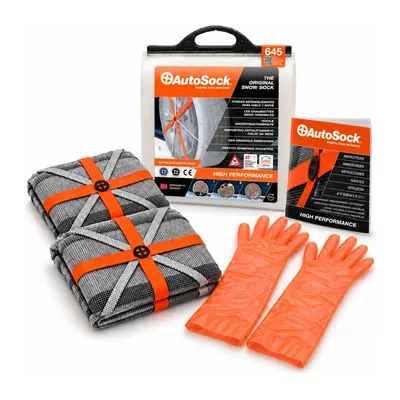
AutoSock HP snow socks
Snow socks certified to EN 16662-1, sized to your tyres: they meet France’s Loi Montagne, but not the “snow chains compulsory” sign in Switzerland or Austria.
View on Amazon (opens in a new tab)
FAQs
Are all-season tyres accepted under the Loi Montagne?
Yes, if they bear the alpine symbol, a three-peaked mountain with a snowflake, together with an M+S, M.S or M&S marking, and are fitted to all four wheels. All-season tyres have no legal definition: without that symbol, they count as ordinary tyres, and you then need snow chains or snow socks on board in the zones concerned.
Do snow chains need to go on two wheels or four in France?
On at least two driven wheels: that is what the decree requires for chains and snow socks alike. Winter tyres, on the other hand, go on at least two wheels of each axle, which means all four wheels on an ordinary car or motorhome. So one pair of chains is enough, as long as it matches your tyre size.
Are snow socks legal in France?
Yes. In Loi Montagne zones, the rules put metal chains and ‘textile chains’, in other words snow socks, on an equal footing. The Sécurité routière recommends socks for occasional use and chains for frequent use. Outside France, check: in Switzerland and Austria, under the ‘snow chains compulsory’ sign, only metal chains count.
What is the fine for having no winter tyres or chains in France?
For the Loi Montagne requirement itself, none so far: according to the French interior ministry, the decree setting the penalty could not be published in 2025, and we found no trace of it in 2026. Ignoring a B26 sign, however, which requires chains fitted on a snowy road, is a second-class offence, with a fine of up to €150.
How do I know if a town is covered by the Loi Montagne?
Look at the Sécurité routière map, which shows the communes wholly or partly covered, then at the prefect’s order for the département, linked from the same site. On the ground, the B58 sign marks the start of the zone, with the plate ‘du 01/11 au 31/03’. Check the date of the order: Isère, for example, changed its own in January 2026.
Does the Loi Montagne apply when there is no snow?
Yes: in signposted zones, you must have the equipment from 1 November to 31 March, whatever the weather. But having it does not mean fitting it: with no snow or ice, chains and socks stay in the boot. That is the difference from Germany and Austria, where the requirement only applies when the road is snowy or icy.
Sources
- Service-Public.fr (French government information service), ‘Pneus hiver, chaînes : quelles sont vos obligations jusqu’au 31 mars 2027 ?’ (in French), published 20 October 2026, accessed 23 October 2026. service-public.gouv.fr https://www.service-public.gouv.fr/particuliers/actualites/A14389 ↩
- France, Decree no. 2020-1264 of 16 October 2020 on the equipment requirement for certain vehicles in the winter period (article D. 314-8 of the Code de la route), Journal officiel of 18 October 2020, Légifrance (in French), accessed 23 October 2026. legifrance.gouv.fr https://www.legifrance.gouv.fr/jorf/id/JORFTEXT000042434406 ↩
- Sécurité routière (French road safety agency), ‘Nouveaux équipements hivernaux’ (in French): map of communes, equipment by vehicle category and the B26 sign, accessed 23 October 2026. securite-routiere.gouv.fr https://www.securite-routiere.gouv.fr/chacun-son-mode-de-deplacement/dangers-de-la-route-en-voiture/equipement-de-la-voiture/nouveaux ↩
- France, Order of 23 June 2021 amending road signage (signs B58, B59 and B26), Journal officiel, Légifrance (in French), accessed 23 October 2026. legifrance.gouv.fr https://www.legifrance.gouv.fr/jorf/id/JORFTEXT000043775737 ↩
- French National Assembly, written question no. 3039 from Dino Cinieri, interior ministry’s answer published in the Journal officiel on 31 January 2023 (in French), accessed 23 October 2026. assemblee-nationale.fr https://www.assemblee-nationale.fr/dyn/16/questions/QANR5L16QE3039 ↩
- Sécurité routière, list of communes subject to winter equipment requirements and summary by mountain range, file dated 22 October 2022 (in French), accessed 23 October 2026. securite-routiere.gouv.fr https://www.securite-routiere.gouv.fr/sites/default/files/2022-10/221022_liste_communes_equipements_hivernaux.xlsx ↩
- Prefect of Isère, order no. 38-2026-01-12-00005 of 12 January 2026 on the equipment requirement for certain vehicles in the winter period, published by the Sécurité routière (in French), accessed 23 October 2026. securite-routiere.gouv.fr https://www.securite-routiere.gouv.fr/sites/default/files/2026-03/2026_ap_pneuhiver_038.pdf ↩
- Touring Club Suisse (TCS), ‘A-t-il besoin de pneus d’hiver pour le camping-car et la caravane ?’ (in French), accessed 23 October 2026. tcs.ch https://www.tcs.ch/fr/camping-voyages/camping-insider/conseils/voyager-en-toute-securite/pneus-d-hiver-pour-le-camping-car-et-la-caravane.php ↩
- Institut national de la consommation (French national consumer institute), ‘Pneus neige, quelle règlementation pour l’hiver 2024-2025 ?’ (in French), checked 14 January 2025, accessed 23 October 2026. inc-conso.fr https://www.inc-conso.fr/content/pneus-neige-quelle-reglementation-pour-lhiver-2024-2025 ↩
- French Senate, written question no. 06613 from Sylviane Noël, interior ministry’s answer published in the Senate’s Journal officiel on 12 February 2026 (in French), accessed 23 October 2026. senat.fr https://www.senat.fr/questions/base/2025/qSEQ251106613.html ↩
- ADAC, ‘Winterreifen- und Schneeketten-Pflicht in 21 europäischen Ländern’ (in German), as of October 2025, accessed 23 October 2026. adac.de https://www.adac.de/verkehr/recht/verkehrsvorschriften-ausland/winterreifen-schneekette/ ↩
- French National Assembly, written question no. 3489 from Émilie Bonnivard, interior ministry’s answer published in the Journal officiel on 21 March 2023 (in French), accessed 23 October 2026. assemblee-nationale.fr https://www.assemblee-nationale.fr/dyn/16/questions/QANR5L16QE3489 ↩
- Germany, Road Traffic Regulations (Straßenverkehrs-Ordnung, StVO), section 2(3a), gesetze-im-internet.de (in German), accessed 23 October 2026. gesetze-im-internet.de https://www.gesetze-im-internet.de/stvo_2013/__2.html ↩
- Germany, Road Traffic Licensing Regulations (Straßenverkehrs-Zulassungs-Ordnung, StVZO), section 36(4), gesetze-im-internet.de (in German), accessed 23 October 2026. gesetze-im-internet.de https://www.gesetze-im-internet.de/stvzo_2012/__36.html ↩
- ADAC, ‘Winterreifenpflicht: Wann Sie in Deutschland Reifen wechseln müssen’ (in German), accessed 23 October 2026. adac.de https://www.adac.de/rund-ums-fahrzeug/ausstattung-technik-zubehoer/reifen/sicherheit/winterreifenpflicht-deutschland/ ↩
- Germany, Fines Catalogue Regulation (Bußgeldkatalog-Verordnung, BKatV), annex, items 5a, 5a.1 and 213a, gesetze-im-internet.de (in German), accessed 23 October 2026. gesetze-im-internet.de https://www.gesetze-im-internet.de/bkatv_2013/anlage.html ↩
- Germany, StVO, annex 2, sign 268 ‘Schneeketten vorgeschrieben’, gesetze-im-internet.de (in German), accessed 23 October 2026. gesetze-im-internet.de https://www.gesetze-im-internet.de/stvo_2013/anlage_2.html ↩
- Germany, StVO, section 3(4), gesetze-im-internet.de (in German), accessed 23 October 2026. gesetze-im-internet.de https://www.gesetze-im-internet.de/stvo_2013/__3.html ↩
- Austria, Motor Vehicles Act 1967 (Kraftfahrgesetz, KFG), section 102(8a) and (9), RIS, current version (in German), accessed 23 October 2026. ris.bka.gv.at https://www.ris.bka.gv.at/NormDokument.wxe?Abfrage=Bundesnormen&Gesetzesnummer=10011384&Paragraf=102 ↩
- ÖAMTC, ‘Winterreifenpflicht in Österreich’ (in German), accessed 23 October 2026. oeamtc.at https://www.oeamtc.at/thema/vorschriften-strafen/winterreifenpflicht-in-oesterreich-74581857 ↩
- Austria, Kraftfahrgesetz 1967, section 134(1), RIS, version in force since 1 October 2026 (in German), accessed 23 October 2026. ris.bka.gv.at https://www.ris.bka.gv.at/NormDokument.wxe?Abfrage=Bundesnormen&Gesetzesnummer=10011384&Paragraf=134 ↩
- Touring Club Suisse (TCS), ‘La période de transition pour les pneus d’hiver marqués “M+S” a expiré en Suisse !’ (in French), accessed 23 October 2026. tcs.ch https://www.tcs.ch/fr/tests-conseils/conseils/pneus/periode-de-transition-pour-pneus-m-s-en-circulation-expire.php ↩
- Touring Club Suisse (TCS), ‘Comment monter les chaînes à neige ?’ (in French), accessed 23 October 2026. tcs.ch https://www.tcs.ch/fr/tests-conseils/conseils/pneus/chaine-a-neige.php ↩
- Ministero delle Infrastrutture e dei Trasporti (Italian transport ministry), directive no. 1580 of 16 January 2013 on road traffic in winter and in snow (in Italian), accessed 23 October 2026. mit.gov.it https://www.mit.gov.it/normativa/decreto-ministeriale-protocollo-1580-del-16012013 ↩
- Automobile Club d’Italia, L’Automobile, ‘Gomme invernali 2026, dal 15 ottobre si possono montare: obbligo, date e multe’ (in Italian), 6 October 2026, accessed 23 October 2026. lautomobile.aci.it https://www.lautomobile.aci.it/attualita/gomme-invernali-2026-dal-15-ottobre-si-possono-montare-obbligo-date-e-multe/ ↩
- Italy, Highway Code (Codice della strada), article 6(14), text published by the Automobile Club d’Italia (in Italian), accessed 23 October 2026. aci.gov.it https://aci.gov.it/codice-della-strada/art-6/ ↩
- GOV.UK, Foreign, Commonwealth and Development Office, ‘Safety and security - France travel advice’, updated 22 October 2026, accessed 23 October 2026. gov.uk https://www.gov.uk/foreign-travel-advice/france/safety-and-security ↩

Fact-checking, regulations and safety
Arnaud Couderc reviews our contributors’ articles and writes for Outfarer about regulations, safety, fishing, the sea and outdoor pursuits. He traces every rule back to its official text and every figure to its source, so that you set off with sound benchmarks.


 Julien de Jurquet

 Nolwenn Bastide