 Français (France)
 English (UK)
 English (US)
 Deutsch (Deutschland)

Contents
On some cars, the rails running along the roof carry nothing at all. One Kia owner’s manual puts it in black and white: its roof rails are purely decorative, and nothing should be loaded on the roof [1]. On another model from the same maker, the roof takes 100 kg, evenly spread [2]. So before dreaming of a glassy lake at dawn, the first question gets settled in the glovebox, page by page: what can your roof actually take?
After that, a kayak or paddleboard travels on roof bars, on a bare roof, on a trailer, in a van or deflated in the boot. And once it sticks out beyond the car, the rules of the road take over.
On roof bars: flat, in a cradle or on its side
Roof bars are the starting point. They fix onto roof rails, onto mounting points provided by the car maker or, on a bare roof, with clamp feet: a roof without rails does not rule them out, as the roof bar maker Thule points out [3].
A canoe travels upside down, hull to the sky, so the bottom is not damaged as the straps are tightened, and the bars go as far apart as possible, advises Swiss Canoe, the Swiss canoeing federation [4]. Every carrier has its own instructions, with a maximum load and speed: at Thule, 40 kg and 130 km/h (80 mph) for a flat carrier, and 34 kg for an upright carrier that itself weighs 6.8 kg [5, 6].
Roof load: three manuals and a sum
How much weight on the roof? No single figure fits every car. The limit starts in the car’s handbook: this is the The load the roof can take while driving. It is lower than the static load, which applies when parked, because bumps, braking and acceleration add extra forces., the load it takes while driving [7]. The static load, which applies when parked, matters mostly for roof tents; Thule puts it at three times the dynamic figure for its own bars [7, 8]. For a kayak on the move, only the dynamic load counts.
The bars then have their own limit, and the carrier has its own: in a roof bar system, Thule notes, the weakest component sets the capacity of the whole [8]. All that remains is to add up what sits on the roof, as the maker does for a roof box [7]:
The result never exceeds the limit of the bars, nor that of the carrier. Take Thule’s own example: a roof rated at 75 kg and bars weighing 5 kg [7]. With an upright carrier of 6.8 kg, 63 kg remain; but that carrier only takes 34 kg [6], so it sets the limit.
Strapping the boat down: cam straps, bow and stern lines, checks
On the bars, the boat is held by straps looped around each bar and tightened with a cam buckle: enough that it no longer moves, without crushing the hull or the bars, says the roof rack maker Rhino-Rack [10]. Swiss Canoe prefers two separate straps to one long one, never hooked to the boat’s rubber or fabric carry loops, and asks for a light touch with laminated hulls and folding kayaks [4]. Bungee cords are not suitable, for the federation as for the roof carrier maker Malone [4, 11].
A kayak is a long load, and a long load is held at both ends too. Rhino-Rack says the front and back must be anchored so the boat cannot rock, which could damage car, boat and bars [10]; Malone makes it a condition of any roof transport with its kit [11]. The lines run from towing eyes or from anchor straps tucked under the bonnet and tailgate [10], and drop roughly vertically to the bumpers [4].
Loose strap ends get rolled up and tied so they do not flap in the wind [4, 10]. Before setting off, shake the boat from the front, then from the back: if the car moves with it, it is properly secured [10]. Then stop after a few miles, because new straps stretch and road vibration loosens buckles [10]. Five minutes or five hours on the road, the strapping is the same: an emergency stop gives no warning [4].
Without roof bars: what the manuals say
Without bars, the set-up comes down to two foam blocks or two inflatable pads, and straps that run through the car, doors open, before the doors close on them. What one maker says about it comes as a surprise: the instructions for Malone’s inflatable roof rack describe it as a temporary system, limited to 80 kg, point to the car’s handbook, whose limit may be lower, and advise against using it in the rain, as water can run down the straps into the car [11].
The detail that changes everything is curtain airbags: the same instructions warn that the system is not suitable for cars fitted with them, because the straps can stop them deploying properly [11]. Bow and stern lines are still required [11].
The car has its say too: if its handbook forbids loading the roof, like the Kia manual mentioned above [1], foam blocks change nothing. A roof without rails often takes bars with clamp feet anyway [3]. My view: a bare roof is not decided from a photo in a car park, but in two manuals, the car’s and the system’s.
Trailer, van, estate or boot: the other options
The trailer
A trailer spares you lifting the boat overhead. In France, a standard car licence covers a trailer of up to 750 kg gross weight, or more if car and trailer together stay within 3,500 kg [12], weights that read just as they do for a motorhome on a car licence; in Great Britain, if you got your licence from 1 January 1997, you can tow a trailer of up to 3,500 kg maximum authorised mass [27]. Swiss Canoe advises loading heavy boats low, tying paddles together and clipping the safety cable to the proper eye [4]. Overhang limits apply to the trailer too [13].

In a van or an estate
Inside, the boat escapes the wind, but not the laws of physics. France’s Code de la route requires that a load cannot cause damage or danger [14], and the Highway Code puts it more bluntly: in a collision, heavy objects that are not secured might hit someone inside the vehicle and cause serious injury [15]. In a campervan as in an estate car, the kayak is therefore strapped to the lashing points, so it cannot slide, even under braking [4].
The inflatable in the boot
Good news for inflatable paddleboards: deflated, they travel in the boot, rolled up in their bag, which the maker Hala Gear recommends because a deflated board is most easily damaged in transit [16]. That heavy bag gets wedged in like any other load; our guide to reading an inflatable paddleboard’s spec sheet gives its real weight. Inflated on the roof, the board has to stand up to the wind [4], and its pressure rises with heat as well as altitude, over a mountain pass [16].
What sticks out: the rules, country by country
The rules change from one country to the next, right down to the point you measure from: the end of the vehicle in France and Great Britain, the rear reflectors for the German marking rule, the centre of the steering and of the rear axle in Switzerland.
In France, a load must not stick out more than 3 m beyond the rear of the vehicle or its trailer (article R312-21 of the Code de la route, a fourth-class offence) [13]. Beyond 1 m, a 1954 order requires, at the end of the load, a non-dazzling red light visible at night from 150 m, and a reflector, by day and night, between 0.40 and 0.90 m from the ground [17]; neither article mentions a flag. Any load that may spill over the outline of the vehicle must also be firmly secured (article R312-19, a third-class offence) [14].
In Great Britain, a rearward projection of more than 1 m must be made clearly visible; beyond 2 m, it needs a regulation end marker, lit at night; beyond 3.05 m, you must give the police two working days’ notice and take an attendant [18, 19]. A separate column covers racing boats ‘propelled solely by oars’: a kayak, moved by a paddle, falls under the general rule on our reading [18].
In Germany, section 22 of the road traffic regulations (StVO) is stricter at the front: up to a height of 2.5 m, the load must not stick out at all. At the rear, it may stick out 1.5 m, or 3 m on a journey of no more than 100 km (62 miles); more than 1 m behind the rear reflectors, it needs a light-red flag of at least 30 × 30 cm held open by a crossbar, or a sign, or a cylinder, no higher than 1.5 m above the road, and a red light when lights are required [20].
Austria limits the load to a quarter of the vehicle’s length and marks any overhang of more than 1 m with a white board with a red border [21, 22]. Switzerland allows 3 m at the front and 5 m at the rear, measured from the steering and the rear axle respectively [23]. In the United States, the rule varies by state: in Washington, for example, beyond 4 feet (1.2 m), a red or orange fluorescent flag at least 18 inches (46 cm) square is required [24, 25].
| Country | At the front | At the rear, at most | Rear marking | Legal text |
|---|---|---|---|---|
| France | No figure in these texts | 3 m | Beyond 1 m: red light at night, reflector | Code de la route, R312-21; order of 16 July 1954, art. 40 and 41 |
| Great Britain | Free up to 2 m | 3.05 m without notifying the police | 1 to 2 m: clearly visible; 2 to 3.05 m: end marker | Construction and Use Regulations 1986, reg. 82, Sch. 12 |
| Germany | None below a height of 2.5 m | 1.5 m; 3 m within 100 km | Beyond 1 m: light-red flag, 30 × 30 cm | StVO, § 22 |
| Austria | A quarter of the vehicle’s length in total | A quarter of the vehicle’s length in total | Beyond 1 m: white board with red border, 25 × 40 cm | KFG, § 101; KDV, § 59 |
| Switzerland | 3 m from the steering | 5 m from the rear axle | Beyond 1 m: clearly marked | OCR (VRV), art. 58 and 73 |
| United States (Washington) | 3 feet (91 cm) from the bumper | 15 feet (4.6 m) from the last axle | Beyond 4 feet (1.2 m): 18-inch (46 cm) flag | RCW 46.44.034 and 46.37.140 |
Legal requirements for a private car, in force on 24 October 2026; lights and reflectors at night as well, depending on each text. Each US state has its own rules.
Before you set off: the checks
- The car’s handbook: roof load, decorative rails or not, curtain airbags [1, 11].
- The bar and carrier instructions: maximum load and speed [5, 8].
- The sum: bars, carriers and boats within the lowest limit, 50 kg in Switzerland unless the registration says otherwise [9].
- The strapping: one cam strap per bar, a line at each end, no bungee cords [4, 10].
- The check: the boat shaken before setting off, then a stop after a few miles [10].
- What sticks out: measured, and marked to suit each country you drive through [13, 20].
At the water’s edge, other rules take over: the rules for paddling at sea, on lakes and on canals. If the boat is still to be chosen, our guide to canoe or kayak helps you decide, and a two-day river trip awaits those who already have one.
The rest is the road unspooling towards the lake, the boat sitting stock-still above the windscreen, and that small joy, once the straps are finally off, of feeling it slide into water that is still cold.
Kit related to this article
No affiliation: no commission, no sponsored products.
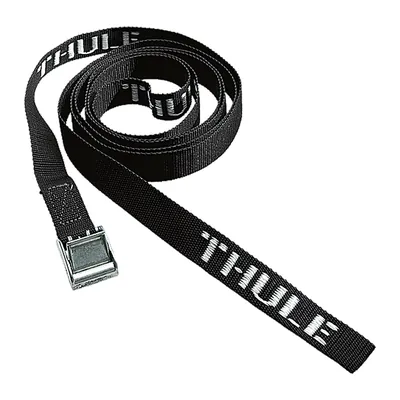
Thule 523 load straps, 2 x 400 cm
Two 400 cm straps with metal cam buckles and a 300 kg tension rating according to Thule: one per roof bar, instead of the elastic bungees to avoid.
View on Amazon (opens in a new tab)
Worth watching
Paddling shop Alder Creek explains what bow and stern lines are for and the options for rigging them on a kayak carried on the roof: the step the strapping section describes.
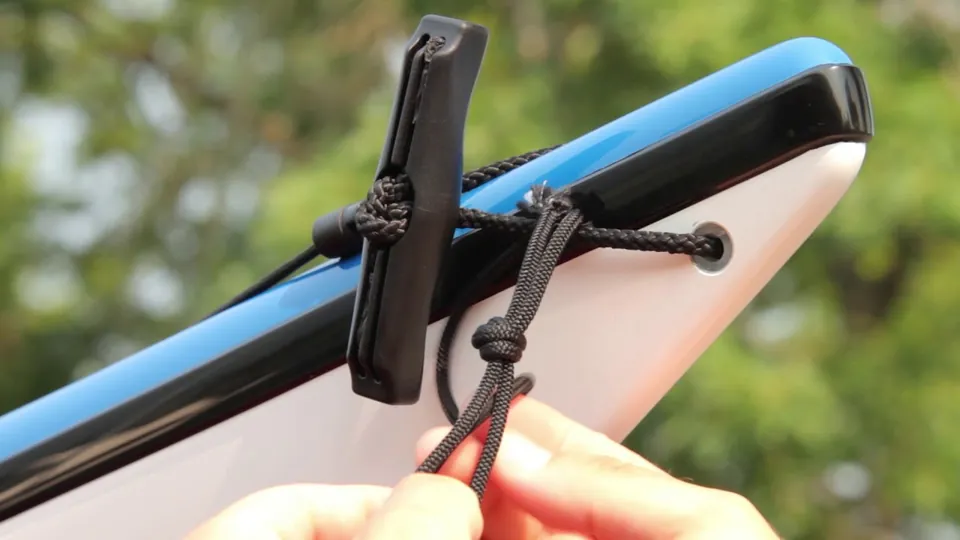
The video is hosted by YouTube (Google): nothing loads until you play it, and Google may then set cookies.
FAQs
Can you carry a kayak on a car without roof bars?
Foam blocks or an inflatable roof rack, held by straps through the cabin, make it possible on paper. Their instructions still set limits: 80 kg at most for one maker, not in the rain, not on a car with curtain airbags, and bow and stern lines required. If the car’s handbook forbids loading the roof, foam blocks change nothing.
How far can a kayak overhang the back of a car?
In Great Britain, beyond 1 m it must be clearly visible, beyond 2 m it needs an end marker, and beyond 3.05 m the police must be notified. France allows 3 m at the rear, with a red light at night and a reflector beyond 1 m. Germany limits rear overhang to 1.5 m, or 3 m on trips of up to 100 km.
Do you need a red flag on a kayak that sticks out?
It depends on the country. In Germany, beyond 1 m behind the rear reflectors, a light-red flag of at least 30 × 30 cm is required. Austria asks for a white board with a red border, 25 × 40 cm. France’s 1954 order requires a red light at night and a reflector, without mentioning a flag. In Italy and Spain, the Touring Club Suisse reports a 50 × 50 cm striped panel.
How much weight can roof bars take?
The lowest of three limits: the car’s dynamic roof load, the bars’ rating and the carrier’s rating. Then take off the weight of the bars and carriers. With a 75 kg roof, 5 kg of bars and a 6.8 kg carrier, 63 kg remain, but a carrier rated at 34 kg is the real limit. In Switzerland, 50 kg in all, unless the registration allows more.
How do you carry an inflatable paddleboard in a car?
The simplest way: deflated, rolled up in its bag, in the boot, and wedged or strapped like any heavy load. The maker Hala Gear recommends the bag, because a deflated board is most easily damaged in transit. Inflated on the roof, a paddleboard catches the wind, and its pressure rises with heat and altitude, over a mountain pass for instance.
Sources
- Kia, online owner’s manual, model KY1, 2023 model year, UK edition, ‘Roof rack’, accessed 24 October 2026. ownersmanual.kia.com https://ownersmanual.kia.com/full_webhelp/KY1/2023/en_GB/topics/chapter4_25_1.html ↩
- Kia, online owner’s manual, model MQ4, 2021 model year, UK edition, ‘Roof rack’, accessed 24 October 2026. ownersmanual.kia.com https://ownersmanual.kia.com/full_webhelp/MQ4/2021/en_GB/topics/chapter4_31_1.html ↩
- Thule, Trouvez le meilleur support de toit pour SUP, planche de surf ou kayak pour votre voiture !, maker’s guide (French page, also published in English), accessed 24 October 2026. thule.com https://www.thule.com/fr-fr/articles/guides/find-the-best-kayak-roof-rack-for-your-car ↩
- Swiss Canoe (Swiss canoeing federation), Ladungssicherung und Strassenverkehrsregeln, Paddle Level guidance sheet, 21 February 2020 (in German), accessed 24 October 2026. swisscanoe.ch https://www.swisscanoe.ch/download/pictures/2d/j6wodpgzwtqnz3qzd60ngtf2n067mv/paddle_level_merkblatt_ladungssicherung_und_strassenverkehrs_regeln_2020_02_21.pdf ↩
- Thule, instructions for the DockGrip 895000 flat kayak carrier (506-7226-04), 2018, accessed 24 October 2026. thule.com https://www.thule.com/-/s/approved/std.lang.all/58/58/555858.pdf?rev=3.7 ↩
- Thule, instructions for the Hull-a-Port Aero 849000 upright kayak carrier (506-7341_02), accessed 24 October 2026. thule.com https://www.thule.com/-/s/approved/std.lang.all/37/77/653777.pdf?rev=3.4 ↩
- Thule, Comment charger un coffre de toit en toute sécurité, maker’s advice (French page, also published in English as ‘How to pack safely with a roof box’), accessed 24 October 2026. thule.com https://www.thule.com/fr-fr/articles/tips/how-to-pack-safely-with-a-roof-box ↩
- Thule, Thule Rooftop Tent Guidelines (5564366001), vehicle and roof rack compatibility, accessed 24 October 2026. thule.com https://www.thule.com:443/-/s/approved/std.lang.all/02/00/670200.pdf?rev=13.3 ↩
- Swiss Confederation, Ordinance on the Technical Requirements for Road Vehicles (OETV/VTS, SR 741.41), art. 43, as of 1 October 2026 (French version), accessed 24 October 2026. fedlex.admin.ch https://www.fedlex.admin.ch/eli/cc/1995/4425_4425_4425/fr ↩
- Rhino-Rack, Safely Securing a Kayak, maker’s blog, 30 January 2017, accessed 24 October 2026. rhinorack.com https://www.rhinorack.com/en-au/blog/2017/01/30/safely-securing-a-kayak ↩
- Malone, HandiRack MPG452 inflatable roof rack instructions, revision 10/16 (English and French), accessed 24 October 2026. maloneautoracks.com https://maloneautoracks.com/dealerimages/pdf/MPG452.pdf ↩
- Service-Public.fr, Quels véhicules peut-on conduire avec le permis B ?, checked 9 March 2026 (in French), accessed 24 October 2026. service-public.gouv.fr https://www.service-public.gouv.fr/particuliers/vosdroits/F2827 ↩
- France, Code de la route, article R312-21, version in force since 1 June 2001, Légifrance, accessed 24 October 2026. legifrance.gouv.fr https://www.legifrance.gouv.fr/codes/article_lc/LEGIARTI000006841608 ↩
- France, Code de la route, article R312-19, version in force since 27 August 2020, Légifrance, accessed 24 October 2026. legifrance.gouv.fr https://www.legifrance.gouv.fr/codes/article_lc/LEGIARTI000042266036 ↩
- GOV.UK, The Highway Code, rules for drivers and motorcyclists (89 to 102), rule 98, accessed 24 October 2026. gov.uk https://www.gov.uk/guidance/the-highway-code/rules-for-drivers-and-motorcyclists-89-to-102 ↩
- Hala Gear, Inflatable Stand Up Paddleboard Owner’s Manual, accessed 24 October 2026. cdn.shopify.com https://cdn.shopify.com/s/files/1/0144/0192/9270/files/Hala_Gear_Manual.pdf ↩
- France, order of 16 July 1954 on vehicle lighting and signalling, articles 40 and 41, consolidated text as of 4 August 2026, Légifrance, accessed 24 October 2026. legifrance.gouv.fr https://www.legifrance.gouv.fr/loda/id/JORFTEXT000000283739/2026-08-04 ↩
- The Road Vehicles (Construction and Use) Regulations 1986, regulation 82 (projecting loads), legislation.gov.uk, accessed 24 October 2026. legislation.gov.uk https://www.legislation.gov.uk/uksi/1986/1078/regulation/82 ↩
- The Road Vehicles (Construction and Use) Regulations 1986, Schedule 12 (conditions and marking), legislation.gov.uk, accessed 24 October 2026. legislation.gov.uk https://www.legislation.gov.uk/uksi/1986/1078/schedule/12 ↩
- Germany, Straßenverkehrs-Ordnung (StVO), § 22 Ladung, gesetze-im-internet.de, accessed 24 October 2026. gesetze-im-internet.de https://www.gesetze-im-internet.de/stvo_2013/__22.html ↩
- Austria, Kraftfahrgesetz 1967 (KFG), § 101 Beladung, version in force since 30 July 2026, RIS, accessed 24 October 2026. ris.bka.gv.at https://www.ris.bka.gv.at/eli/bgbl/1967/267/P101/NOR40279594 ↩
- Austria, Kraftfahrgesetz-Durchführungsverordnung 1967 (KDV), § 59 Beladung, version in force since 2 September 2006, RIS, accessed 24 October 2026. ris.bka.gv.at https://www.ris.bka.gv.at/eli/bgbl/1967/399/P59/NOR40081761 ↩
- Swiss Confederation, Traffic Rules Ordinance (OCR/VRV, SR 741.11), art. 58 and 73, as of 1 October 2026 (French version), accessed 24 October 2026. fedlex.admin.ch https://www.fedlex.admin.ch/eli/cc/1962/1364_1409_1420/fr ↩
- Washington State, Revised Code of Washington, RCW 46.37.140 (lamps, reflectors and flags on projecting load), accessed 24 October 2026. app.leg.wa.gov https://app.leg.wa.gov/RCW/default.aspx?cite=46.37.140 ↩
- Washington State, Revised Code of Washington, RCW 46.44.034 (front and rear protrusions), accessed 24 October 2026. app.leg.wa.gov https://app.leg.wa.gov/RCW/default.aspx?cite=46.44.034 ↩
- Touring Club Suisse, Panneau d’avertissement sur le porte-vélo en cas de dépassement du chargement, Camping Insider advice (in French), accessed 24 October 2026. tcs.ch https://www.tcs.ch/fr/camping-voyages/camping-insider/conseils/voyager-en-toute-securite/panneaux-d-avertissement-pour-depassement-en-longueur.php ↩
- GOV.UK, Towing with a car, licence rules for trailers, accessed 24 October 2026. gov.uk https://www.gov.uk/towing-with-car ↩

Trail running, snow, water, nature and destinations
Nolwenn covers trail running, snow, water, nature and destinations for Outfarer. Curious about everything, from meteor showers to night-train timetables, she has a knack for unearthing the one detail that changes everything, and putting it in a single sentence.


 Arnaud Couderc
