 Français (France)
 English (UK)
 English (US)
 Deutsch (Deutschland)

Contents
Same length, 10′6″ (3.20 m). Same width, 32″ (81 cm). Same thickness, 6″ (15 cm). Same volume, 310 litres, and the same manufacturer. These two inflatable boards from Jobe look like twins; yet the spec sheet of the first gives a paddler of 100 kg at most, that of the second up to 140 kg [1, 2]. The detail that changes everything sits on a line most people skim: the construction.
An inflatable paddleboard’s spec sheet usually lists seven things: length, width, thickness, volume, maximum load, construction and pressure. None of them alone tells you whether the board will suit you. Together, they say a good deal about how it will float, whether it will stay stiff underfoot and how much it will weigh on your back on the way to the water.
Stated figures, with no common standard
With a head torch, one logo is enough to know how the run time was measured. With a paddleboard, there is nothing of the sort. Board sports have their standards, just not this one: EN ISO 21853:2020, for instance, covers the release system on kitesurfing kites [3], and we found no published European or international standard specific to stand-up paddleboards.
In Germany, a group of testing bodies approved a test programme in 2022 for inflatable boards intended for leisure use by no more than two adults [4]. Stiftung Warentest, the German consumer testing organisation, drew on it in 2025 to check ten boards for resistance to overpressure and heat, and for airtightness [5]. TÜV Rheinland, which presents the programme, publishes only its scope. For anyone reading a spec sheet, the upshot is simple: every figure is the manufacturer’s own statement, and two boards from the same brand compare more reliably than two boards from different brands.
Length, width, thickness: the shape of the board
Length sets the glide. The longer the board, the faster it goes; the shorter it is, the more easily it turns, as the American manufacturer ISLE puts it [6]. The ten beginner boards in Stiftung Warentest’s test all measured between 10 and 11 feet, or 3.07 to 3.31 m [5].
Width brings stability. ISLE recommends 32 to 34″ (81 to 86 cm) for beginners [6], and France’s canoe-kayak federation says much the same: for learning and leisurely outings, boards are long and wide, for maximum comfort and stability [7]. Narrower and longer, a 30″ (76 cm) board at 12′6″ (3.81 m) glides better and holds its line better: that is how Red Paddle Co describes its own, designed for touring [8].
Thickness, on the other hand, divides manufacturers. For ISLE, an inflatable board is generally 6″ (15 cm) thick, and anything thinner deserves suspicion [6]. Red Paddle Co nevertheless builds its all-round board at 4.7″ (12 cm): sitting low on the water, it is easier to climb back onto, and the manufacturer says it is stiffer thanks to a denser fabric [9]. Children’s boards also go below 6″: Jobe’s is 4.75″ (12 cm), for a recommended rider weight of up to 80 kg [10]. My own rule of thumb: for the same construction, thickness adds volume and stiffness; a thinner board has to find them in its materials.
| On the spec sheet | In metres or centimetres | What it tells you |
|---|---|---|
| Length 8′6″ | 2.59 m | Short board, often for children |
| Length 10′ to 11′ | 3.05 to 3.35 m | All-round board, the usual size for beginners |
| Length 12′6″ | 3.81 m | Touring: more glide, a steadier line |
| Width 30″ | 76 cm | Faster, less stable |
| Width 32 to 34″ | 81 to 86 cm | Stable, recommended for beginners |
| Thickness 4.7 to 4.75″ | 12 cm | Sits low on the water: a children’s board, or a denser material |
| Thickness 6″ | 15 cm | The most common thickness for inflatables |
Conversions: 1 foot = 30.48 cm, 1 inch = 2.54 cm. Uses based on ISLE, Red Paddle Co, Jobe and the Stiftung Warentest test (sources at the end of the article).
Volume in litres: buoyancy, and a way to cross-check
Volume tells you how much the board floats. ISLE gives some benchmarks: under 91 kg (200 lb), any standard board will carry you; up to 107 kg (235 lb), aim for at least 175 litres; over 125 kg (275 lb), 242 litres; over 136 kg (300 lb), 272 litres. For a beginner’s inflatable, its ideal range is 220 to 280 litres. The same manufacturer warns, though, that there is no single equation for inflatable boards [6].
This is nothing like surfing, where volume is worked out closely from weight and ability (our guide to surfboard volume). And with the two twins above, buoyancy is not what sets the stated load: their volume is identical, their loads differ by 40 kg.
You cannot check volume at home, but you can cross-check it. Multiply length, width and thickness in centimetres and divide by 1,000: that gives the volume of the box that encloses the board. On four Jobe inflatables, the stated volume is 74 to 82% of it, by our calculations [1, 2, 11, 12]; the rounded rails, nose and tail account for the rest. A stated volume larger than the box is impossible; one far below it deserves a question to the manufacturer.
| Board | Dimensions | Stated volume | Share of box | Stated load |
|---|---|---|---|---|
| Aero Nera 10′6″, single layer | 320 × 81 × 15 cm | 310 L | 79% | 100 kg max |
| Aero Yarra 10′6″, reinforced | 320 × 81 × 15 cm | 310 L | 79% | up to 140 kg |
| Aero Varna 11′, single layer | 335 × 76 × 15 cm | 315 L | 82% | 100 kg max |
| Aero Neva 12′6″, reinforced | 381 × 76 × 15 cm | 320 L | 74% | up to 150 kg |
Figures stated by Jobe on its spec sheets, checked on 24 October 2026. Share of box calculated by us: stated volume divided by length × width × thickness. ‘Max’ is Jobe’s ‘max rider weight’; ‘up to’ is its ‘recommended rider weight: up to’.
Maximum load: a ceiling, not a target
Maximum load is the most important figure for a larger paddler, and the least standardised. Spec sheets talk of ‘max rider weight’, ‘recommended rider weight: up to’ or ‘capacity’, and Jobe uses the first two within its own range [1, 2]. At Red Paddle Co, the 10′6″ all-rounder, 32″ wide, is rated for 100 kg at most; its big sister, the 10′8″ (3.25 m), 34″ (86 cm) wide, for 120 kg [9, 13].
That figure covers everything that goes on the board: you, but also the child or dog along for the ride, as ISLE points out, advising you to keep a margin below the stated capacity. A board too small for your weight, it warns, becomes slow and unstable [6]. BOTE puts a number on its margin: if your weight comes within 23 kg (50 lb) of the stated capacity, the American manufacturer recommends a bigger board. For its 10′6″ rated at 113 kg (250 lb), that means staying under 91 kg (200 lb) [14].
Tests go well beyond normal use: Stiftung Warentest loaded each board with one and a half times its stated rider weight, which is 150 kg for a board rated at 100 kg [5]. My advice: read maximum load as a ceiling, never as a target.
Construction: what is inside the board
An inflatable board keeps its shape thanks to A double fabric: two layers joined by thousands of very fine threads, which pull taut as the board is inflated and set its thickness., two layers of fabric joined by a multitude of very fine threads. This fabric is not airtight: it has to be covered with PVC, glued or laminated, on top and underneath [15]. After that, it is up to each manufacturer to trade lightness against durability.
BOTE’s range shows the three main families: a fused double layer of PVC, for durability; a lighter single layer, made possible by a composite drop stitch; and heat-welded TPU, with no glue, for fewer weak points [16]. At Jobe, that is where the two twins part company: vertical single-layer drop stitch for the board rated at 100 kg; cross-woven drop stitch, stringers top and bottom and heat-bonded layers for the one rated up to 140 kg, which is 1 kg heavier [1, 2].
Two more lines deserve a look. Strips or battens running along the board, on top, underneath or in the rails, so that it flexes less in the middle., first, are there for stiffness: Red Paddle Co claims up to 30% more stiffness with the battens slid into the rails of some of its boards [8]. Then the number of air chambers: the ten boards in the Stiftung Warentest test had only one. The organisation considers that enough for a gentle paddle, and sees a second chamber as an extra safety margin for more demanding outings [5].
Pressure in PSI: the recommended range and the ceiling
Spec sheets give pressure in Pounds per square inch, the imperial unit of pressure. 1 bar is 14.5 PSI., and a gauge marked in bar is easy to convert: one bar is 14.5 PSI, so 15 PSI is roughly 1 bar and 20 PSI 1.4 bar. As with mountain bike tyres, the right figure depends on the model, and it is in its manual.
The recommended range varies with construction: 10 to 15 PSI from BOTE for a single-layer board [14], 12 to 15 PSI and never more than 15 in Hala Gear’s manual [17], 14 to 20 PSI from Jobe [2], while Red Paddle Co says its fibres are designed to withstand more than 22 PSI [9]. Maximum pressure is therefore also a clue to construction. And it matters on the water: according to Airhead, the difference in stiffness between 10 and 20 PSI is dramatic, but above 25 PSI you will not see much difference [15].
What the spec sheet leaves out: stiffness, bag weight, set-up
Good news: a spec sheet’s blind spots can partly be read between the lines. Stiffness first. No spec sheet puts a figure on it, yet it is what you feel underfoot: in the Stiftung Warentest test, one board bent like a banana even when fully inflated, and pushed a bow wave ahead of it [5]. Construction, stringers and maximum pressure give you an idea; trying a board on the water, hired or at a club, settles it. Our guide canoe or kayak also covers stand-up paddleboarding and ways to try before you buy.
Then the real weight of the bag. The boards cited here weigh 6 to 11 kg on their own, but the full rucksack, with paddle and pump, reaches 14 kg at Jobe [2]. In the German test, the rucksacks weighed up to 15 kg, and complete set-up took more than 25 minutes on average [18]. Nor can you read what touches your feet: one board in the test failed because of harmful substances in the surface you stand on [5].

Reading a spec sheet in five minutes
- Start from your total weight on board, passenger and kit included, and look for a stated load well above it, noting whether it is a maximum or a recommended weight.
- Choose the width for stability, 32 to 34″ for beginners according to ISLE, and the length for the use: 10 to 11 feet for an all-rounder, more for touring.
- Cross-check the volume against the dimensions: on the Jobe boards checked here, it is 74 to 82% of the box.
- Read construction and maximum pressure together: a thin or very light board needs to explain where its stiffness comes from.
- Weigh the full bag, not just the board, if you have to carry it to the water.
A well-read spec sheet does not promise a perfect board, only one that fits you. The rest you discover at water level, at the hour when the lake is still glassy and the board, pumped to the pressure in its manual, wants nothing more than to glide.
Worth watching
SupBoardGuide lines up inflatable boards from its test locker to show what length, width, thickness, volume and maximum weight look like in practice, one figure at a time.
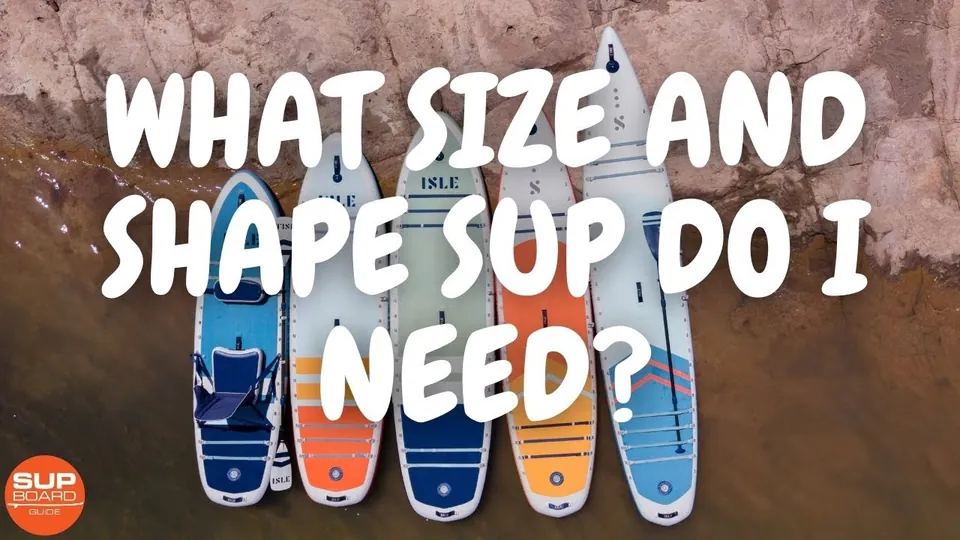
The video is hosted by YouTube (Google): nothing loads until you play it, and Google may then set cookies.
FAQs
What size inflatable paddleboard should a beginner choose?
The ten beginner boards in the Stiftung Warentest test measured 10 to 11 feet, or 3.07 to 3.31 m. The manufacturer ISLE recommends a width of 32 to 34 inches (81 to 86 cm) for stability. Then check that the stated load is well above your total weight on board, passenger and kit included.
What PSI should an inflatable paddleboard be?
The pressure in its manual, never above its maximum. It varies with construction: 10 to 15 PSI from BOTE for a single-layer board, 12 to 15 PSI from Hala Gear, 14 to 20 PSI from Jobe. One bar is 14.5 PSI: 15 PSI is roughly 1 bar, 20 PSI 1.4 bar. Heat raises the pressure.
What is the weight limit of an inflatable paddleboard?
The one on its spec sheet, which varies a great deal: 100 kg for a single-layer 10′6″ from Jobe, up to 140 kg for its reinforced twin with the same dimensions. The figure covers everything on board. BOTE recommends a bigger board if your weight comes within 23 kg (50 lb) of the stated capacity.
Should an inflatable paddleboard be 6 inches thick?
Both exist. For ISLE, an inflatable is generally 6 inches (15 cm) thick, and thinner boards deserve suspicion. Red Paddle Co nevertheless builds boards 4.7 inches (12 cm) thick, sitting lower on the water, which it says are stiff thanks to a denser fabric. For the same construction, thickness adds volume and stiffness.
Is there a standard for inflatable paddleboards?
We found no published European or international standard specific to stand-up paddleboards; EN ISO 21853:2020 covers the release system on kitesurfing kites. In Germany, a test programme for inflatable boards has existed since 2022, and Stiftung Warentest drew on it. The figures on a spec sheet remain the manufacturer’s own statements.
Sources
- Jobe, Jobe Aero Nera SUP Lite Board 10.6 Package, product page, accessed 24 October 2026. jobesports.com https://www.jobesports.com/en/jobe-aero-nera-sup-lite-board-106-package-486425011/ ↩
- Jobe, Jobe Aero Yarra SUP Board 10.6 Package Steel Blue, product page, accessed 24 October 2026. jobesports.com https://www.jobesports.com/en/jobe-aero-yarra-sup-board-106-package-steel-blue-486425009/ ↩
- BSI, BS EN ISO 21853:2020, Kite boarding. Release system. Safety requirements and test methods, 31 March 2020, accessed 24 October 2026. knowledge.bsigroup.com https://knowledge.bsigroup.com/products/kite-boarding-release-system-safety-requirements-and-test-methods ↩
- TÜV Rheinland, EU - New test requirements for the safety of Inflatable SUP Boards (test programme EK2/AK2.4 22-01:2022), accessed 24 October 2026. tuv.com https://www.tuv.com/regulations-and-standards/en/eu-new-test-requirements-for-the-safety-of-inflatable-sup-boards.html ↩
- Stiftung Warentest, SUP-Boards im Test, test of ten inflatable boards, 15 May 2025 (free section: method), in German, accessed 24 October 2026. test.de https://www.test.de/SUP-Board-Test-6024484-0/ ↩
- ISLE Paddle Boards, What Size Paddle Board Do I Need?, manufacturer’s blog, 2 January 2019, accessed 24 October 2026. islesurfandsup.com https://islesurfandsup.com/blog/what-size-paddle-board-do-i-need ↩
- Fédération française de canoë-kayak et sports de pagaie (French canoe-kayak federation), Eau calme, in French, accessed 24 October 2026. ffck.org https://www.ffck.org/pratiquer/loisirs/eau-calme/ ↩
- Red Paddle Co, 12′6″ Sport MSL 800 Inflatable Stand Up Paddle Board Package, product page, accessed 24 October 2026. red.equipment https://red.equipment/products/12-6-sport-msl-800-inflatable-stand-up-paddle-board-package ↩
- Red Paddle Co, 10′6″ Ride MSL Inflatable Paddle Board Package, product page, accessed 24 October 2026. red.equipment https://red.equipment/products/106-ride-msl-inflatable-paddle-board-package-1 ↩
- Jobe, Jobe Aero Sava Sup Lite Board 8.6 Package, product page, accessed 24 October 2026. jobesports.com https://www.jobesports.com/en/jobe-aero-sava-sup-lite-board-86-package-486425010/ ↩
- Jobe, Jobe Aero Varna SUP Lite Board 11.0 Package, product page, accessed 24 October 2026. jobesports.com https://www.jobesports.com/en/jobe-aero-varna-sup-lite-board-110-package-486425017/ ↩
- Jobe, Aero Neva SUP Board 12.6 Package, product page, accessed 24 October 2026. jobesports.com https://www.jobesports.com/en/jobe-aero-neva-sup-board-126-package-486425002/ ↩
- Red Paddle Co, 10′8″ Ride MSL Inflatable Paddle Board Package, product page, accessed 24 October 2026. red.equipment https://red.equipment/products/108-ride-msl-inflatable-paddle-board-package-1 ↩
- BOTE, Breeze Aero Inflatable Paddle Board, product page and care advice, accessed 24 October 2026. boteboard.com https://www.boteboard.com/products/breeze-aero-inflatable-paddle-board ↩
- Airhead, An Inside Look At the Technology of Inflatable Paddle Boards, manufacturer’s blog, 12 September 2014, accessed 24 October 2026. airhead.com https://www.airhead.com/blogs/news/an-inside-look-at-the-technology-of-inflatable-paddle-boards ↩
- BOTE, Aero Inflatable Technology, overview of its constructions, accessed 24 October 2026. boteboard.com https://www.boteboard.com/pages/inflatable-technology ↩
- Hala Gear, Inflatable Stand Up Paddleboard Owner’s Manual, accessed 24 October 2026. cdn.shopify.com https://cdn.shopify.com/s/files/1/0144/0192/9270/files/Hala_Gear_Manual.pdf ↩
- Stiftung Warentest, Stand-up-Paddle-Boards im Test: Wasserratten stehen drauf, press release, 15 May 2025, in German, accessed 24 October 2026. test.de https://www.test.de/presse/pressemitteilungen/Stand-up-Paddle-Boards-im-Test-Wasserratten-stehen-drauf-6220503-0/ ↩

Trail running, snow, water, nature and destinations
Nolwenn covers trail running, snow, water, nature and destinations for Outfarer. Curious about everything, from meteor showers to night-train timetables, she has a knack for unearthing the one detail that changes everything, and putting it in a single sentence.

 Arnaud Couderc

