 Français (France)
 English (UK)
 English (US)
 Deutsch (Deutschland)

Contents
23 to 50 psi, or 1.6 to 3.4 bar. That is the range printed on the sidewall of a 29 × 2.40-inch mountain bike tyre, the Kryptotal Re, in Continental’s 2026/27 catalogue [1]. On paper, anything between those two figures will do. In practice, the right pressure depends mostly on you: your weight, the tyre’s width, how it is set up and the terrain of the day. Manufacturers’ charts give you a starting point, provided you know what they assume, because they do not all say the same thing.
What sets the pressure: weight, width and set-up
The ‘right’ pressure depends largely on the weight the tyre carries, Schwalbe points out: that of the rider and their luggage, with the bike itself counting for little [2]. The narrower the tyre and the heavier the load, the more air you need; a wide tyre makes do with less, and a Without an inner tube: the tyre seals against the rim thanks to a liquid sealant, which also plugs small punctures. set-up can be run a little lower [2].
Inflating is a trade-off. Higher pressure cuts rolling resistance on the road, wear and the risk of punctures; lower pressure brings comfort and grip [2]. Kept too low for too long, it wears the tyre out early and cracks its sidewalls [2]. With an inner tube, it also exposes you to a A puncture caused by an impact: the inner tube is pinched between the rim and an obstacle, leaving two small parallel cuts, hence its nickname, ‘snakebite’., and Michelin then advises raising the pressure [3]. A tubeless tyre, DT Swiss notes, can be run softer without the risk of pinching [4].
Then there is the question of which weight to enter in a chart, and here manufacturers do not agree. ENVE, the wheel maker, starts from the rider’s weight with all their kit, on a bike of average weight [5]. SILCA’s calculator, from the pump maker, asks for the total weight: rider, bike and luggage [6]. With an electric mountain bike, much heavier than a standard one, the gap between the two ways of counting widens. Before reading a chart, check what ‘weight’ means.
Mountain bikes: ENVE’s chart for a 2.4-inch tyre
ENVE publishes a chart broken down by weight, with front and rear given separately. Its figures assume a tubeless set-up; those reproduced here are for a 2.4-inch (61 mm) tyre on a rim with a 30 mm internal width [5]. The chart does not distinguish wheel diameter, 27.5 or 29 inches, which sometimes depends on the frame size.
| Rider weight with kit | Front | Rear |
|---|---|---|
| Under 54 kg | 1.0 to 1.3 bar (15 to 19 psi) | 1.1 to 1.3 bar (16 to 19 psi) |
| 54 to 64 kg | 1.1 to 1.3 bar (16 to 19 psi) | 1.2 to 1.4 bar (17 to 20 psi) |
| 64 to 73 kg | 1.2 to 1.4 bar (17 to 20 psi) | 1.2 to 1.4 bar (17 to 21 psi) |
| 73 to 82 kg | 1.2 to 1.4 bar (18 to 21 psi) | 1.2 to 1.5 bar (18 to 22 psi) |
| 82 to 91 kg | 1.3 to 1.6 bar (19 to 23 psi) | 1.3 to 1.7 bar (19 to 24 psi) |
| 91 to 100 kg | 1.4 to 1.7 bar (20 to 24 psi) | 1.4 to 1.7 bar (21 to 25 psi) |
| 100 to 109 kg | 1.5 to 1.8 bar (22 to 26 psi) | 1.5 to 1.9 bar (22 to 27 psi) |
Source: ENVE, 2026 ‘Mountain’ chart, in psi, in 20 lb bands (from under 120 lb to 240 lb), converted to kilograms; pressures converted to bar and rounded to one decimal place.
Two caveats from ENVE change how you read it. Its rims have built-in pinch-flat protection, and its figures allow for that: on other wheels, you may need more air [5]. With a reinforced casing, double-ply or downhill, it suggests trying the bottom of the range instead [5]. And inner tubes? Its charts do not cover them. Among tyre makers, two simple rules: tubeless can be run a little lower, says Schwalbe, and a pinch flat is a sign you need more air, says Michelin [2, 3].
Gravel: three manufacturers, three answers
For Riding on unpaved roads and tracks (gravel, dirt, forest roads) on a drop-bar bike with wide tyres, somewhere between road cycling and mountain biking., ENVE gives a single figure per row, with no split between front and rear, again for tubeless. Here are its figures for a rim with a 25 mm internal width [5].
| Rider weight with kit | 38 to 42 mm tyre | 42 to 45 mm tyre | 47 to 55 mm tyre |
|---|---|---|---|
| 59 kg (130 lb) | 1.9 bar (27 psi) | 1.7 bar (24 psi) | 1.2 bar (18 psi) |
| 68 kg (150 lb) | 2.1 bar (30 psi) | 1.9 bar (27 psi) | 1.4 bar (20 psi) |
| 77 kg (170 lb) | 2.3 bar (34 psi) | 2.0 bar (29 psi) | 1.5 bar (22 psi) |
| 86 kg (190 lb) | 2.5 bar (36 psi) | 2.2 bar (32 psi) | 1.7 bar (24 psi) |
| 95 kg (210 lb) | 2.6 bar (38 psi) | 2.3 bar (34 psi) | 1.7 bar (25 psi) |
| 104 kg (230 lb) | 2.8 bar (40 psi) | 2.4 bar (35 psi) | 1.8 bar (26 psi) |
Source: ENVE, 2026 ‘Gravel’ chart, every other row (it runs from 90 to 250 lb in 10 lb steps); pressures converted to bar and rounded to one decimal place.
SILCA’s calculator works differently. It looks for the fastest pressure on a given surface: the point beyond which impacts from the ground cost more energy than the tyre’s flexing [8]. So it asks for the total weight, the surface, the tyre’s measured width, the speed, the weight distribution and the type of casing [6].
| Total weight (rider, bike, luggage) | Tubeless, front / rear | Butyl inner tube, front / rear |
|---|---|---|
| 70 kg | 2.4 / 2.5 bar (34.5 / 36.5 psi) | 2.3 / 2.45 bar (33.5 / 35 psi) |
| 80 kg | 2.45 / 2.55 bar (35.5 / 37 psi) | 2.35 / 2.5 bar (34.5 / 36 psi) |
| 90 kg | 2.5 / 2.6 bar (36.5 / 38 psi) | 2.4 / 2.55 bar (35 / 37 psi) |
| 100 kg | 2.55 / 2.65 bar (37 / 39 psi) | 2.5 / 2.6 bar (36 / 37.5 psi) |
| 110 kg | 2.6 / 2.75 bar (38 / 39.5 psi) | 2.55 / 2.65 bar (36.5 / 38.5 psi) |
Figures obtained on 23 October 2026 with the settings ‘Recreational’ (speed), ‘47/53 (Gravel Bikes)’ and a mid-range casing; the calculator rounds to the nearest half psi and 0.05 bar.
Two surprises. Weight counts for little: from 70 to 110 kg, the pressure rises by only about 0.2 bar. And a butyl inner tube lowers the suggested figure rather than raising it. SILCA makes clear that its calculation aims at speed, not pinch-flat protection, and warns that a wide tyre on rough ground puts a standard inner tube at risk of pinching; the answer is then to go tubeless, or to pump it harder and give up a little efficiency [8].
Let’s do the sums for one rider: 77 kg with kit, a 10 kg bike, a 40 mm tubeless tyre. ENVE suggests 2.3 bar (34 psi) [5]. SILCA, on category 2 gravel and for 87 kg in total, 2.5 bar at the front and 2.6 bar at the rear (36 and 37.5 psi) [6]. Finally, the tyre maker WTB puts the best setting for a 40 mm gravel tyre at around 40 to 45 psi, or 2.8 to 3.1 bar, without giving a weight, and invites riders to adjust it to their style, terrain and weight [7]. Nearly 0.8 bar separates the lowest from the highest: each assumes a different rim, tyre and goal.
Dry, muddy, rocky or tarmac: fine-tuning for the terrain
Weight gives you the starting point; terrain does the fine-tuning. SILCA’s calculator shows it clearly: for 90 kg in total and a 40 mm tubeless tyre, the suggested pressure falls by nearly 1 bar between new tarmac and the roughest of its gravels, which SILCA describes as the worst surface in its calculator [6, 8].
| Surface (SILCA’s categories) | Front | Rear |
|---|---|---|
| New tarmac | 3.0 bar (44 psi) | 3.15 bar (46 psi) |
| Worn tarmac, some cracks | 2.85 bar (41.5 psi) | 3.0 bar (43.5 psi) |
| Category 1 gravel | 2.75 bar (40 psi) | 2.9 bar (41.5 psi) |
| Poor tarmac, chippings | 2.65 bar (38 psi) | 2.75 bar (40 psi) |
| Category 2 gravel | 2.5 bar (36.5 psi) | 2.6 bar (38 psi) |
| Category 3 gravel | 2.25 bar (32.5 psi) | 2.35 bar (34 psi) |
| Category 4 gravel | 2.05 bar (29.5 psi) | 2.15 bar (31 psi) |
Figures obtained on 23 October 2026, settings ‘Recreational’ and ‘47/53 (Gravel Bikes)’, mid-range casing. SILCA grades its gravel from 1 to 4, from the smoothest to the roughest.
On a mountain bike, Michelin notes that a very stony course may call for a different pressure, and that a higher pressure rolls better on kinder ground [3]. WTB gives the warning sign to watch for: if the tyre compresses all the way to the rim on big hits, or folds in corners, it needs more air [7]. On very grippy ground (loam, sandstone, tacky trails), ENVE adds that the top of its range may not be enough, and advises going up 5 to 10% at a time [5].
In mud or sand, the logic is reversed. Michelin observes that a lower pressure can help you keep moving on very loose ground [3], and SILCA admits that its own figure, 40 psi (2.8 bar) for a 33 mm cyclocross tyre on its worst gravel, would be far too high in a muddy race: grip is then what limits speed [8]. On tarmac, finally, a harder tyre rolls more easily, Schwalbe reminds us [2]: that is the first row of the table.

Front and rear: why the rear takes a little more
Sitting on the bike, you put more weight on the rear wheel. SILCA’s calculator assumes 47% of the weight at the front and 53% at the rear on a gravel bike, 46.5% and 53.5% on a mountain bike; from that it lowers the front pressure by 2.5 to 3% and raises the rear by 2 to 3% [6]. On a 40 mm gravel tyre, that comes to about 0.1 bar.
ENVE’s mountain bike chart points the same way, with up to 1 psi (0.07 bar) more at the rear [5]. Michelin advises always running the front of a mountain bike slightly softer, but generally using the same pressure in both wheels of a road bike [3]. For gravel, its guide does not say: ENVE’s chart gives a single figure, SILCA’s calculator two.
Bar and psi: converting and measuring accurately
ENVE’s, SILCA’s and WTB’s charts use psi, pounds per square inch; Schwalbe uses bar, and Continental’s catalogue psi. The conversion fits on one line, but the decimals soon trip you up: 2 bar is 29 psi, 2.5 bar 36.3 psi, 3 bar 43.5 psi.
You still need to read it accurately. The thumb test is not worth much: from about 2 bar, Schwalbe warns, every tyre feels fairly firm [2]. ENVE adds that pump gauges vary a great deal from one model to another, and that a valve core clogged with sealant skews the reading [5]. As for how often: at least once a month, according to Schwalbe, which considers a loss of about 1 bar a month normal, faster at high pressure [2]. With tubeless, WTB recommends checking every time you ride [7].
The ceilings: sidewall, rim and hookless rims
Charts give you a starting point; limits are not up for negotiation. The tyre’s sidewall carries a minimum and maximum: 34 to 72 psi (2.3 to 5.0 bar) for the 700 × 40 Terra Trail gravel tyre, 23 to 50 psi (1.6 to 3.4 bar) for the 29 × 2.40 Kryptotal Re [1]. The rim has its own maximum too, often lower: at ENVE, 60 psi (4.1 bar) for the G23 gravel rim with a 32 to 40 mm tyre, 40 psi (2.8 bar) for the G27 with a 42 to 50 mm tyre [5]. When the two differ, the lower one applies [9].
A rim whose edges lack the small lip that holds the tyre’s bead. The ETRTO calls it TSS, for Tubeless Straight Side. rims add a ceiling of their own. Schwalbe publishes the table, drawn up, it says, in accordance with the European Tyre and Rim Technical Organisation, which sets the dimension and usage standards for tyres and rims in Europe.: it falls as the tyre gets wider, and applies even if the sidewall promises more [10]. According to this table, a 40 mm gravel tyre must not exceed 3.5 bar (50.8 psi) on a hookless rim, even if its sidewall says 72 psi, and a 2.4-inch (61 mm) mountain bike tyre 2.5 bar (36.3 psi) [10].
| Tyre width | Maximum pressure |
|---|---|
| 25 to 29 mm | 5 bar (72.5 psi) |
| 30 to 34 mm | 4.5 bar (65.3 psi) |
| 35 to 39 mm | 4 bar (58.0 psi) |
| 40 to 44 mm | 3.5 bar (50.8 psi) |
| 45 to 54 mm | 3 bar (43.5 psi) |
| 55 to 64 mm | 2.5 bar (36.3 psi) |
| 65 to 74 mm | 2 bar (29.0 psi) |
Extract from Schwalbe’s table for its TLE and TLR tyres, in bar; psi converted. If the rim’s maximum is lower, that is the one that applies. For a tyre from another brand, Continental refers you to the wheel’s instructions and the tyre’s packaging.
SILCA’s calculator even displays a warning above 70 psi: in its view, a hookless rim should not be used above 72 psi [6]. That is, to within half a psi, the maximum the ETRTO and ISO set for a 28 mm road tyre on this type of rim, 5 bar or 72.5 psi, ENVE points out [11]. For a gravel or mountain bike tyre, the ceiling is much lower, as the diagram below shows.
The rule to remember fits in one sentence: the chart gives you the starting point, the terrain adjusts it, and the lower of the tyre’s and the rim’s maximums is never crossed.
Kit related to this article
No affiliation: no commission, no sponsored products.
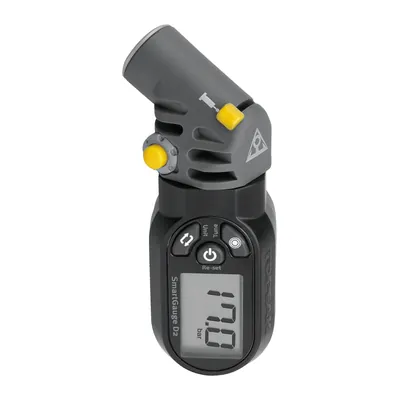
Topeak SmartGauge D2
A digital gauge for Presta and Schrader valves, reading in bar or psi up to 17 bar, with a bleed button: the digital reading WTB advises you to note before each ride.
View on Amazon (opens in a new tab)
Worth watching
GMBN Tech goes through what tyre pressure changes on the trail, from traction, cornering and comfort to rider weight, terrain, tyre width and weather, to help you settle on your own figure.
The video is hosted by YouTube (Google): nothing loads until you play it, and Google may then set cookies.
FAQs
What pressure should I run in a 29-inch mountain bike tyre?
ENVE does not distinguish by diameter: its chart depends on the tyre’s width, the rim’s width and your weight. For a 2.4-inch tubeless tyre on a 30 mm rim, it gives 1.2 to 1.4 bar at the front and 1.2 to 1.5 bar at the rear for a rider of 73 to 82 kg with kit. Stay within the sidewall range, and add air if your rims lack pinch-flat protection.
What pressure for a 700 × 40 gravel tyre?
For a rider of 77 kg with kit, ENVE suggests 2.3 bar tubeless on a 25 mm rim; SILCA’s calculator, on medium gravel and 87 kg in total, 2.5 bar at the front and 2.6 bar at the rear; WTB puts a 40 mm tyre at around 2.8 to 3.1 bar. Start from one of these, adjust for the terrain, and do not exceed 3.5 bar on a hookless rim.
Do I need more pressure with an inner tube?
Generally, yes: tubeless can be run a little lower, according to Schwalbe, and a pinch flat is a sign you need more pressure, according to Michelin. SILCA’s calculator, which aims at speed, is the exception: it suggests a slightly lower figure with a butyl inner tube, while warning that a wide tyre on rough ground is then at risk of pinch flats.
What pressure for riding a gravel bike on the road?
Higher than on gravel: a harder tyre rolls more easily on a smooth surface, Schwalbe reminds us. For 90 kg in total and a 40 mm tubeless tyre, SILCA’s calculator suggests 3.0 bar at the front and 3.15 bar at the rear on new tarmac, against 2.5 and 2.6 bar on medium gravel. Stay below your rim’s maximum.
What pressure for an electric mountain bike?
Start from the same chart, with your weight including kit, then adjust. Manufacturers do not count the bike the same way: Schwalbe considers its weight has little effect on pressure, while SILCA’s calculator includes it in the total. If the tyre bottoms out on the rim over impacts or folds in corners, add air, as WTB advises, within the sidewall limits. In winter, look after the battery too.
Sources
- Continental Reifen Deutschland, Tire Range 2026/27, bicycle tyre catalogue (Kryptotal Re and Terra Trail pages), accessed 23 October 2026. continental-tires.com https://www.continental-tires.com/content/dam/conti-tires-cms/continental/b2c/products/bicycle-tires/CON_TireRange_2026-27_digit.pdf.coredownload.pdf ↩
- Schwalbe, Pression d’air des pneus de vélo, technical FAQ (French website, in French), accessed 23 October 2026. schwalbe.com https://www.schwalbe.com/fr/technique-faq/pression-d-air/ ↩
- Michelin, Le guide Michelin de pression des pneus de vélo, 13 November 2024, updated 28 April 2025 (French website, in French), accessed 23 October 2026. michelin.fr https://www.michelin.fr/bicycle/conseils-velo/pression-pneus-de-velo/guide-michelin-pression-pneus-velo ↩
- DT Swiss, Technologie tubeless (French website, in French), accessed 23 October 2026. dtswiss.com https://www.dtswiss.com/fr/roues/technologie-roues/technologie-tubeless ↩
- ENVE, Tire Pressure, 2026 ‘Mountain’ and ‘Gravel’ charts and rim maximum pressures, accessed 23 October 2026. enve.com https://enve.com/pages/tire-pressure ↩
- SILCA, Pro Tire Pressure Calculator, online calculator, accessed 23 October 2026. silca.cc https://silca.cc/pages/pro-tire-pressure-calculator ↩
- WTB, Frequently Asked Questions, answer ‘What pressures should I run in my WTB tubeless tires?’, accessed 23 October 2026. wtb.com https://www.wtb.com/pages/frequently-asked-questions ↩
- SILCA, Tire Pressure Calculator Explained, 20 January 2022, updated 8 June 2026, accessed 23 October 2026. silca.cc https://silca.cc/blogs/silca/tire-pressure-calculator-explained ↩
- ENVE, Maximum Tire Pressure - What It Means, 10 February 2020, accessed 23 October 2026. enve.com https://enve.com/blogs/journal/maximum-tire-pressure-what-it-means ↩
- Schwalbe, Exigences roue tubeless, hookless rims and maximum pressures in accordance with the ETRTO (French website, in French), accessed 23 October 2026. schwalbe.com https://www.schwalbe.com/fr/exigences-roue-tubeless ↩
- ENVE, Hookless Rim Technology 101, 4 April 2024, accessed 23 October 2026. enve.com https://enve.com/blogs/journal/hookless-rim-technology-101 ↩
- ETRTO, Recommendations, edition of 7 May 2026, chapter ‘Rims and Tyres for Bicycles’, p. 79. etrto.org https://www.etrto.org/media/tozj1aqi/english-version-etrto-recommendations-edition-7-may-2026.pdf ↩
- Michelin, Comment gonfler un pneu de vélo pour des performances optimales, 13 November 2024, updated 5 December 2024 (French website, in French), accessed 23 October 2026. michelin.fr https://www.michelin.fr/bicycle/conseils-velo/pression-pneus-de-velo/gonfler-un-pneu-de-velo ↩

Campervans, motorhomes, cycling and calculators
Julien de Jurquet writes for Outfarer about campervans, motorhomes, cycling and calculators. He reads instruction manuals to the very end and never lets a figure through without its unit, so that your choices rest on sums rather than promises.


