 Français (France)
 English (UK)
 English (US)
 Deutsch (Deutschland)

Contents
‘520% range’ is SRAM’s selling point for its 10-52 tooth cassette [1]. The figure is accurate, and it tells you neither how many metres you roll with each turn of the cranks nor whether you will reach the pass with your panniers on. For that you need a calculation: one division and one multiplication, which we take step by step.
Gear ratio, development, gear inches: three ways of saying the same thing
The terms get mixed up. The The number of teeth on the chainring divided by the number on the sprocket in use: 50 at the front and 11 at the back make a ratio of 4.55. is the number of wheel turns for one turn of the cranks; the The distance the bike travels in one full turn of the cranks, in metres (sometimes called rollout). is the distance covered in that same turn [2]. The first depends only on tooth counts; the second adds the size of the wheel.
Cycling UK explains an older measure, The diameter, in inches, of a directly driven wheel that would travel the same distance per turn of the pedals., a legacy of the penny-farthing, where the size of the wheel was the size of the gear [3]. A bike geared at 72 gear inches goes as far with each turn of the pedals as a 72-inch wheel would [4].
| Measure | What it expresses | Unit | Value for the 50×11 |
|---|---|---|---|
| Gear ratio | Wheel turns per turn of the cranks | none | 4.55 |
| Development | Distance per turn of the cranks | metres | 9.70 m |
| Gear inches | Diameter of the equivalent wheel | inches | 122 |
| Gain ratio | Like the gear ratio, crank length included | none | 8.95 |
Our calculations; 2.135 m circumference from the Schwalbe table, gain ratio by Sheldon Brown’s method.
The calculation step by step, from chainring to road
Take a 50-tooth chainring and an 11-tooth sprocket. The ratio is 50 ÷ 11, or 4.545: the rear wheel turns 4.5 times for each turn of the cranks. With a circumference of 2.135 m, the bike moves 4.545 × 2.135 = 9.70 m. Let us run the same sum for the lowest ratio of a double chainset, 34 teeth in front and 32 behind: 34 ÷ 32 × 2.135 = 2.27 m. Between the two, a factor of 4.3.
To turn development into speed you need the The number of pedal turns per minute (rpm).: speed (km/h) = development (m) × cadence (rpm) × 60 ÷ 1,000. At 90 rpm the 50×11 gives 52 km/h; the 34×32 at 60 rpm gives 8.2 km/h. Sheldon Brown puts a typical easy cadence between 75 and 90 rpm, and warns that pedalling slower than your ideal cadence wastes energy and puts knees and hips at risk [5].
The same sum on other wheels shows the effect of diameter. Decathlon, the French retailer, takes a 46×16 ratio: with a 26-inch mountain bike wheel (0.65 m) the development is 5.87 m; with a 29-inch wheel (0.74 m), 6.68 m [2]. At the same ratio, the bigger wheel goes 0.8 m further per turn of the cranks.
Which circumference should go in the formula?
It is the one number the spec sheet does not give you. The ETRTO size of the tyre (25-622, for example: 25 mm wide, 622 mm bead seat diameter) points to an approximate value in Schwalbe’s table [6]. The maker says itself that it cannot give an exact circumference: it varies with the rim, the pressure and the load. For a cycle computer, it recommends a simple roll-out test with the rider on the saddle.
| Common tyre | ETRTO size | Circumference |
|---|---|---|
| 26 × 2.10 or so | 54-559 | 2,100 mm |
| 700 × 25 | 25-622 | 2,135 mm |
| 700 × 32 | 32-622 | 2,170 mm |
| 700 × 40 | 40-622 | 2,220 mm |
| 27.5 × 2.25 or so | 57-584 | 2,215 mm |
| 29 × 2.25 or so | 57-622 | 2,330 mm |
| 29 × 2.4 or so | 60-622 | 2,340 mm |
Source: Schwalbe, Tech Info 2015, approximate values. The inch equivalents are indicative.
The difference is not trivial. Going from a 25 mm to a 40 mm tyre on the same 622 mm rim lengthens the development by about 4%; going to a 29 × 2.25, by about 9%. Our article on tyre pressure for mountain bikes and gravel bikes covers those widths. For a calculation good to 1%, measure: mark the valve and the ground, roll forward one wheel turn with someone on the saddle, then measure the distance.
Gear inches, metres and gain ratio: moving between them
One gear inch equals π × 0.0254 m, or about 0.0798 m of development. Wikipedia gives three landmarks: low gearing is around 20 gear inches (1.6 m per turn), medium around 70 (5.6 m), high around 125 (10 m) [4]. Cycling UK works through a 48×16 on a 700 × 28 tyre (26.69 inches in diameter): 80 gear inches, or 6.39 m [3].
Both measures ignore one thing: crank length. Sheldon Brown proposes the The distance the bike travels divided by the distance the pedal travels around its circle in one turn. It is the gear ratio multiplied by the ratio of wheel radius to crank length. to account for it: with 175 mm cranks instead of 170 mm, the same drivetrain is about 3% lower [7]. Our 50×11, with a 172.5 mm crank, comes to 8.95: (wheel radius of 339.8 mm ÷ crank of 172.5 mm) × 4.545.
The gain ratio is also a reminder that very different combinations can come out the same. Sheldon Brown cites the 39×14 and the 53×19, which both make 2.79 [7]. In the same way, 30×21, 40×28 and 50×35 on a 30/40/50 triple all give a ratio of 1.43.
Reading a cassette: range and gaps between gears
The tooth count of each sprocket is on the cassette or in the maker’s spec. Two numbers sum it up. The The ratio of the highest to the lowest development of a drivetrain, as a percentage: 52 ÷ 10 = 5.2, or 520% for a 10-52 cassette with a single chainring. gives the breadth: the eight-speed cassette above spans 32 ÷ 11, or 291%. The gap between two consecutive gears gives the fineness: from 11 to 13 teeth it is 18%; from 28 to 32, 14%.
| Drivetrain | Sprocket teeth | Range | Gap between gears |
|---|---|---|---|
| 8-speed 11-32 cassette (photo) | 11, 13, 15, 18, 21, 24, 28, 32 | 291% | 14 to 20% |
| SRAM XX Eagle T-Type, 12-speed | 10, 12, 14, 16, 18, 21, 24, 28, 32, 38, 44, 52 | 520% | 12.5 to 20% |
| Rohloff Speedhub 500/14, hub gear | 14 internal gears | 526% | 13.6% throughout |
Gaps calculated from tooth counts; SRAM and Rohloff: the makers’ technical pages. The range of a double chainset uses both chainrings.
SRAM says its 520% range equals that of two-chainring, 11-sprocket drivetrains, and that the 38 and 44 tooth sprockets tighten the gaps at the big end [1]. Rohloff quotes fourteen gears spaced 13.6% apart, for a range of 526% [8]: the sum holds, since 1.136 to the power of 13 is 5.25. A wide range and even gaps can therefore go together; they just cost money.
What lowest development for which terrain?
The benchmarks come from sources aimed at different audiences. For touring bikes, the ADFC, Germany’s cyclists’ association, calls a development climb-friendly (bergtauglich, in its text) up to just over 2 m, and gives the example of a 26-inch bike with a Rohloff hub, a 44-tooth chainring and a 15-tooth sprocket: 1.70 m in the lowest gear, 8.92 m in the highest [9]. The German retailer fahrrad-xxl ranks developments under 2.5 m as best for mountains, around 5 m for rolling country, about 7 m on the flat, and more for sporty riders or descents [10].
For gravel, BikeRadar notes that these groupsets typically have a lowest gear below 1:1, meaning a smaller chainring than the biggest sprocket [11]. Cycling UK puts that 1:1 at about 27 gear inches on a 700C wheel, or 2.15 m, and cites a single-chainring gravel groupset configurable from 25 to 98 gear inches, or 2.0 to 7.8 m [12].
| Drivetrain | Lowest | Highest | Range | Speed in lowest gear, at 60 then 75 rpm |
|---|---|---|---|---|
| Road: 50 and 34 chainrings, 11-32 cassette, 700 × 25 tyre | 2.27 m (28 in) | 9.70 m (122 in) | 428% | 8.2 then 10.2 km/h |
| Gravel: 40 single ring, 11-42 cassette, 700 × 40 tyre | 2.11 m (26.5 in) | 8.07 m (101 in) | 382% | 7.6 then 9.5 km/h |
| Mountain bike: 32 single ring, 10-52 cassette, 29 × 2.4 tyre | 1.44 m (18 in) | 7.49 m (94 in) | 520% | 5.2 then 6.5 km/h |
| Touring: 48 and 26 chainrings, 11-34 cassette, 700 × 40 tyre | 1.70 m (21 in) | 9.69 m (121 in) | 571% | 6.1 then 7.6 km/h |
Worked examples, neither recommendations nor products; circumferences from the Schwalbe table (2.135, 2.22 and 2.34 m).
The table reads both ways. The mountain bike at 1.44 m climbs at 5 km/h at a relaxed cadence, but barely tops 40 km/h at 90 rpm: 7.49 m × 90 × 60 ÷ 1,000. The road bike at 2.27 m climbs faster, provided the legs keep up. None of the four is ‘the right one’: each is right for its terrain.
Comparing two drivetrains: 1x, 2x and cross-chaining
To compare two drivetrains, calculate the lowest and highest development, work out the range, then look at the gaps. A single chainring drops a derailleur, a shifter mechanism and a cable: Cycling Weekly puts the saving at 200 to 250 g on average [13]. In return, a very wide cassette with only one chainring means bigger jumps between gears, whereas a double chainset can use closer-spaced sprockets without losing range [13].
Even with two chainrings, several combinations give almost the same development. Decathlon advises against cross-chaining, that is a big chainring with a big sprocket or the reverse: instead of a 46×21, it prefers a 42×18 or a 42×19, which keep the chain straighter [2]. The sum bears it out: 46 ÷ 21 = 2.19 and 42 ÷ 19 = 2.21, a 1% difference.
Choosing your gears for the mountains or a loaded bike
A cyclist touring with a load does not need to win a sprint: they need to stay on the bike. Cycling UK puts it this way: a really low gear can make the difference between cycling up a hill and getting off to push, and you get one with a smaller chainring, a bigger sprocket, or both [12]. The reverse of the opening formula does the job.
Example: you want 1.7 m, the lowest development of the touring bike the ADFC cites, on 700 × 40 tyres (2.22 m), with a 32-tooth chainring. The sprocket is 32 × 2.22 ÷ 1.7 = 41.8, so 42 teeth, which give 1.69 m. With a 28-tooth chainring, you need 37 teeth. It remains to check in the manual that the rear derailleur accepts a sprocket that size.
For the loaded bike, our guide to the Loire à Vélo shows what the stages look like, and the bikepacking kit list what you carry. Those two pages describe the load; the developments in the table above give what your legs will have to do with it. The rule to remember: fix the lowest development you will need on a climb first, calculate the sprocket that gives it, and only check the highest at the end.
Worth watching
GCN Tech goes back to basics to show how bike gears work and why they help on hills and different terrain: a visual companion to the sums in this guide.
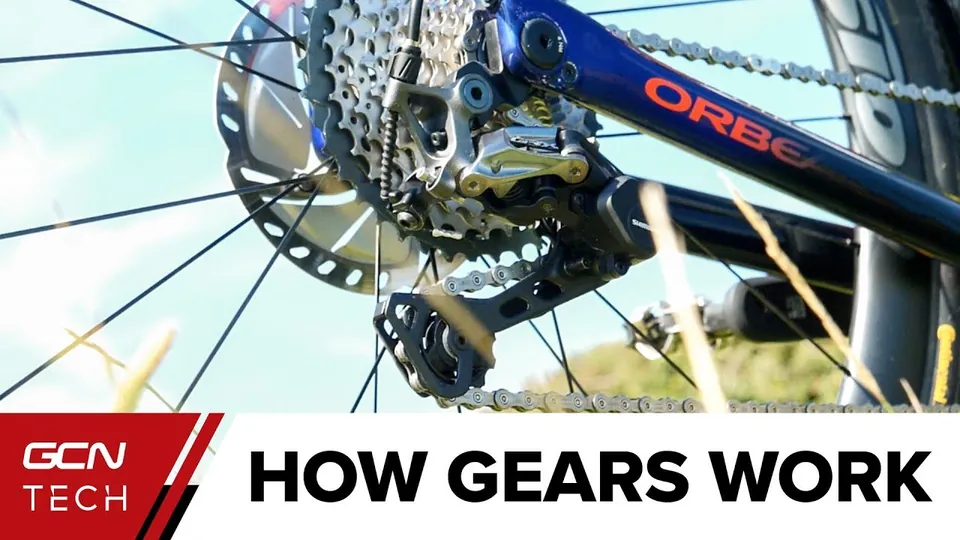
The video is hosted by YouTube (Google): nothing loads until you play it, and Google may then set cookies.
FAQs
What does a 50×11 gear mean?
It means a 50-tooth chainring at the front and an 11-tooth sprocket at the back. The gear ratio is 50 ÷ 11, or 4.55: the rear wheel turns 4.55 times for each turn of the cranks. For distance, multiply the ratio by the wheel circumference: about 9.70 m with a 700 × 25 tyre.
Which wheel circumference should I use?
Take the value from your tyre maker’s table for the ETRTO size on the sidewall, such as about 2.135 m for a 25-622. It stays approximate, because it depends on the rim, the pressure and the load. For accuracy of about 1%, measure one wheel turn by rolling, sitting on the saddle.
What is the difference between development and gear inches?
Both describe the same thing, how far the bike goes per turn of the cranks, but in different units. Development is in metres, gear inches are the inches of an equivalent wheel. Multiply by about 0.0798 to go from one to the other: 80 gear inches is 6.39 m.
What lowest development do I need to climb with a load?
There is no single rule. The ADFC calls a development up to just over 2 m climb-friendly for a touring bike; its example goes down to 1.70 m. It depends on the gradient, the load and the cadence you can sustain. Work out the speed your lowest gear gives at 60 rpm.
Does a single chainring have less range than a double?
Not necessarily. SRAM quotes 520% for its 10-52 cassette with one chainring, which it compares with two-chainring, 11-sprocket drivetrains. The difference lies mostly in the gaps between gears: bigger with one chainring, finer with two for the same range.
Sources
- SRAM, ‘XS-1297 Eagle Transmission Cassette’, product page (10-52 teeth, 12-speed, 520% range), accessed 6 November 2026. sram.com https://www.sram.com/en/sram/models/cs-xs-1297-a1 ↩
- Decathlon Conseil Sport, ‘Braquets et développements en VTT, quelques explications’ (in French), accessed 6 November 2026. conseilsport.decathlon.fr https://conseilsport.decathlon.fr/braquets-et-developpements-en-vtt-quelques-explications ↩
- Cycling UK, ‘How do you measure gears on a bike?’, Cycle magazine, accessed 6 November 2026. cyclinguk.org https://www.cyclinguk.org/cycle-magazine/how-do-you-measure-gears-bike ↩
- Wikipedia, ‘Gear inches’, accessed 6 November 2026. en.wikipedia.org https://en.wikipedia.org/wiki/Gear_inches ↩
- Sheldon Brown and John Allen, ‘How To Shift Your Bicycle’s Gears’, accessed 6 November 2026. sheldonbrown.com https://www.sheldonbrown.com/gears.html ↩
- Schwalbe, ‘Tech Info’ 2015, ‘Reifenmaße’ page (approximate circumferences by ETRTO size, in German), accessed 6 November 2026. schwalbe.com https://www.schwalbe.com/media/86/e4/25/1618839387/TechInfo-2015_DE.pdf ↩
- Sheldon Brown, ‘Gain Ratios: A New Way to Designate Bicycle Gears’, accessed 6 November 2026. sheldonbrown.com https://www.sheldonbrown.com/gain.html ↩
- Rohloff, ‘Technical Data’, SPEEDHUB 500/14 handbook (14 gears, 13.6% steps, 526% range), accessed 6 November 2026. rohloff.de https://www.rohloff.de/en/service/handbook/speedhub/technical-data ↩
- ADFC, ‘Reiseräder’ (‘Das richtige Rad für die Reise’, in German), accessed 6 November 2026. adfc.de https://adfc.de/artikel/das-richtige-rad-fuer-die-reise ↩
- fahrrad-xxl.de, ‘Die richtige Übersetzung für mein Fahrrad’ (in German), accessed 6 November 2026. fahrrad-xxl.de https://www.fahrrad-xxl.de/beratung/fahrrad/uebersetzung/ ↩
- BikeRadar, ‘Gravel bike groupsets explained: which is the right one for you?’, accessed 6 November 2026. bikeradar.com https://www.bikeradar.com/advice/buyers-guides/gravel-bike-groupsets ↩
- Cycling UK, Richard Hallett, ‘Does your bike need lower gears?’, Cycle magazine, accessed 6 November 2026. cyclinguk.org https://www.cyclinguk.org/cycle-magazine/feature-does-your-bike-need-lower-gears ↩
- Cycling Weekly, ‘Gravel bike gearing: should you run 1x or 2x?’, accessed 6 November 2026. cyclingweekly.com https://www.cyclingweekly.com/news/product-news/gravel-bike-gearing-should-you-run-1x-or-2x-463457 ↩

Campervans, motorhomes, cycling and calculators
Julien de Jurquet writes for Outfarer about campervans, motorhomes, cycling and calculators. He reads instruction manuals to the very end and never lets a figure through without its unit, so that your choices rest on sums rather than promises.


