 Français (France)
 English (UK)
 English (US)
 Deutsch (Deutschland)

Contents
5 kg. That is the maximum load Ortlieb and Topeak quote for their largest saddle packs, at 15 to 16.5 litres [1, 2]. Yet Canyon, which makes gravel bikes, advises against putting more than 5 to 7 lb in that same bag, or 2.3 to 3.2 kg [3]. The two figures do not contradict each other: the first says what the fabric and straps can bear, the second what the bike can carry without wagging its tail. All of Travelling self-supported by bike over several days, with bags strapped directly to the handlebars, frame, seatpost or fork, usually without a rack. lies in that gap: what you take matters, and where you pack it matters almost as much. So here are the mounting points and their limits, the physics of loading, the lights the law requires and then the list, section by section, ready to print.
Handlebars, frame, saddle, fork: what each bag should carry
A bikepacking bike offers five places to carry kit, not counting your back. Typical volumes run from under 1 litre on the top tube to 16.5 litres under the saddle, and every bag has a maximum load, quoted by its maker.
| Position | Typical volume | Maximum load quoted | What goes in it |
|---|---|---|---|
| Handlebars | 9 to 15 litres [4, 5, 6] | 5 kg [4, 6] | Light, bulky kit: sleep system, warm clothes |
| Top tube | 0.75 to 1 litre [7, 8] | 1 kg [7] | Quick access: snacks, phone, sun cream |
| Frame (half triangle) | 3 to 6 litres [9, 10] | 3 to 6.5 kg [9, 10] | Heavy, dense kit: water, food, tools, stove |
| Saddle | 6 to 16.5 litres [1, 2, 11] | 3 to 5 kg [1, 2] | Mid-weight kit that squashes down: clothes, waterproof jacket |
| Fork, each side | 4 to 6 litres [12] | 3 kg [12, 13] | Water bottles, compact kit |
Based on the technical data sheets of Ortlieb, Topeak and Apidura (bags) and Salsa (fork cage), accessed 24 October 2026. These are the bags’ maximum loads: the bike, the fork and the handlebars have their own. Where things go follows the advice of Apidura and Canyon.
The logic is simple enough: heavy kit goes where it gets in the way least. Apidura and Canyon both keep the frame bag for heavy, dense items, water, food, tools and the stove, because it sits in the middle of the bike and fairly low [3, 14]. The handlebars take light, bulky kit, typically the sleep system, and the top tube bag works as a drawer within reach [14].
Spreading the weight: low, central, and never at the end of a lever
A loaded bike has a centre of gravity, and every kilo moves it. Canyon sums up the rule in a line: heavy items low and centred [3]. Two positions need more care than the rest, because they work as levers: the saddle pack and the handlebars.
The saddle pack sits highest on the bike and furthest from the centre of gravity, Canyon points out; overloaded, it sways from side to side, especially on descents and technical ground [3]. Topeak talks of the pendulum effect of large rear loads [2]. The bag hangs from just two points, the saddle rails and the seatpost, and reaches a long way behind them: up to 67 cm long, according to Topeak, for its 15-litre pack [2].
Let’s do the maths for 2 kg packed in a saddle pack. At 10 cm behind the seatpost, they put a torque of about 2 N·m on the mounting; at the tail of the bag, 40 cm back, about 8 N·m, the same as 8 kg placed at 10 cm. Torque grows with distance, and inertia, which makes the load resist each movement and then carry it on, grows with the square of the distance: four times further back means sixteen times the inertia. Hence the advice from Apidura and Canyon: heaviest items first, closest to the seatpost, light ones at the tail [3, 14].
At the front, the physics moves on. Whatever is strapped to the handlebars turns with them, and every steering correction has to set it moving. Apidura’s observation is that weight added to the bars affects handling more than anywhere else, and that a light front end keeps the steering responsive and predictable [14, 15]. Canyon offers a rule of thumb for balance: a handlebar bag of roughly the same weight as the saddle pack, and an even load left and right [3].
That leaves your back. A rucksack takes weight off the bike, not off the rider: the load rides at its highest point and bears on your shoulders and your saddle. Apidura notes that added weight, whether on your back or in bags, means revisiting your tyre pressure and suspension settings [15]. In my view, a small hydration pack is plenty on your back; everything else belongs on the bike.
Tyre clearance, dropper posts, forks: the limits to check
A saddle pack needs space beneath the rails. For its 6 to 15-litre packs, Topeak requires at least 22 cm between the saddle rails and the tyre, and 12 cm of exposed seatpost between the collar and the rails [16]; Apidura has you measure the same distances before choosing a size [11]. On a small frame, those centimetres soon run out.
On a full-suspension mountain bike, the rear wheel rises towards the saddle as the shock compresses, so clearance has to be checked with the suspension compressed, not at rest. For these frames Apidura has designed bags shaped to clear the rear wheel, and an adapter that limits dropper post travel to keep a gap above the tyre [15]. A dropper post that goes down takes the saddle pack with it: Ortlieb declares its hook-mounted saddle pack compatible only with the adapter supplied, on posts of 22 to 26 mm, and with about 3 cm of free seatpost [17].
On the handlebars, two distances count: the gap between the brake and gear levers, which limits the width of the bag on drop bars, and the height between the bars and the tyre [5]. Apidura recommends its 9-litre bag for bars of 42 cm or narrower [5], and spacers between the bars and the bag leave room for the cables [14]. Nothing should interfere with the steering or the brake cables [3].
On the fork, cages and bags bolt to threaded mounts or, in Ortlieb’s case, clamp onto a fork leg of constant diameter. Ortlieb and Salsa quote 3 kg per side for theirs, and Ortlieb only accepts a carbon fork if it has threaded mounts [12, 13]: the load the fork itself will take is in its manual. The whole bike has a ceiling too, the maximum total weight, rider and luggage included, and it varies a great deal from one model to another: 100 kg for a racing road bike from Canyon, 136 kg for an urban e-bike from Trek [18, 19]. An 80 kg rider on a 9 kg bike has just 11 kg of margin under the first of those ceilings. Beyond what bags can take, a rack changes the scale: Ortlieb quotes 20 kg for its lightweight model [20].
Lights, reflectors, bell: compulsory equipment country by country
Bags create a problem the law has already thought of: they hide your lights. In France, the rear light must be clearly visible from behind [21]; in Great Britain, lamps must be kept ‘lit and unobscured’ [22]; in Germany, lighting must be neither covered nor dirty [23, 24]. A saddle pack often covers a light fitted to the seatpost, so some makers provide a mount to move it onto the bag [1, 11]. In Germany, it must then sit between 250 and 1,200 mm above the ground and be of an approved type [23]. For the other countries, see Legal cycling kit, country by country.
| Territory | When lights are needed | What the bike must carry | Legal text |
|---|---|---|---|
| France | At night, and by day when visibility is poor | Yellow or white front light, steady red rear light; reflectors: white at the front, red at the rear, amber on the wheels (or reflective tyres) and pedals; two brakes; a bell audible at 50 m; outside built-up areas at night, a high-visibility vest | Code de la route, art. R313-1 to R313-35 and R431-1 to R431-12, as listed by Service-Public [21] |
| Great Britain (England, Wales, Scotland) | Between sunset and sunrise, and in seriously reduced visibility | White front and red rear lights lit; red rear reflector; amber pedal reflectors on a bike made after 1 October 1985 | Highway Code, rule 60; Road Vehicles Lighting Regulations 1989, reg. 24 [25, 22] |
| California (one US state, as an example) | When it is dark | White front lamp visible from 300 feet (91 m); at the rear, a red reflector or red light with built-in reflector visible from 500 feet (150 m); reflectors on pedals, shoes or ankles; side reflectors or reflective tyres; working brakes | California Vehicle Code, § 21201, as presented by the California DMV [26] |
| Germany | At dusk, in darkness or when visibility requires | White front lamp and red rear lamp, not flashing, of an approved type, removable but fitted whenever lights are needed; reflectors: white at the front, red at the rear, yellow on pedals, side reflectors; a bell; two independent brakes | StVZO, § 64a, 65 and 67; StVO, § 17 [27, 28, 23, 24] |
| Austria | Except by day in good visibility | White or pale yellow front lamp of at least 100 cd, fixed to the bike, and red rear lamp of at least 1 cd; reflectors: white at the front, red at the rear, yellow on pedals, side reflectors; an audible warning device; two independent brakes | Fahrradverordnung, § 1 [29] |
| Switzerland | From nightfall to daybreak, in poor visibility and in tunnels | White front and red rear lights, not flashing, visible at 100 m, fixed or removable; front and rear reflectors permanently fitted; pedal reflectors, except on racing or safety pedals; two brakes | VTS/OETV, art. 214, 216 and 217; VRV/OCR, art. 30 [30, 31] |
Only the requirements we read in the texts cited are listed; other rules apply to riders themselves (helmets for children, behaviour on the road). The 1989 regulations cover England, Wales and Scotland; Northern Ireland is not covered here. In the United States, each state has its own rule: California’s is only an example. In France, Légifrance could not be consulted directly: the articles are those Service-Public gives.
These rules apply to the bike on the road. Where you may sleep is another question, which depends on the country and the land: we have covered it for the UK and for France.
The kit list, section by section
This list is for two to four nights self-supported, in mild weather, with a tent or a tarp. It can be ticked off at a glance and printed; add what your trip demands and strike out what it makes unnecessary. In brackets, the position the loading logic gives each item.
Sleeping
- Sleeping bag chosen for its comfort temperature, in a dry bag (handlebars)
- Sleeping mat with an R-value suited to the season (handlebars)
- Inflatable pillow, or a bag of clothes (saddle)
Shelter
- Tent, tarp or bivvy bag depending on the forecast (fabric on the handlebars, poles in the frame bag)
- Pegs and guylines (frame)
- Lightweight groundsheet (saddle)
Clothing
- Base layer, warm layer and waterproof jacket, following the three-layer system (saddle)
- Spare cycling shorts and socks (saddle)
- Gloves, hat or neck tube depending on the season (top tube or saddle)
- A dry set of clothes kept for camp (saddle)
Cooking and water
- Bottles or a hydration bladder: water is one of the heaviest things you carry (frame or fork) [14]
- Filter or treatment to make water safe to drink, depending on the sources along the route (frame)
- Stove, fuel, lighter, pot and cutlery (frame); never a gas stove inside the tent, where carbon monoxide can build up very quickly [32]
- Food for each day, plus a reserve (frame, with snacks in the top tube bag)
- A bag to carry your rubbish home (saddle)
Repairs
- Spare inner tube or tubeless repair kit (frame)
- Tyre levers and pump (frame)
- Multi-tool with chain tool, and a quick link (top tube or frame)
- Spare derailleur hanger for your frame, brake pads (frame)
- Cable ties, tape, a spare strap (frame)
- Chain lube and a rag (frame)
Navigation and lights
- Route saved for offline use, on a phone or GPS unit (handlebars)
- Power bank and cables (top tube)
- Paper map of the area (frame)
- Front and rear lights that meet the rules of each country you ride through, charged and not hidden by bags
- Head torch for camp (top tube)
Hygiene and first aid
- First aid kit, and the training to use it (frame)
- Sun cream, toothbrush, soap (top tube or saddle)
- Toilet paper and a bag to carry it out (saddle)
- Charged phone, emergency numbers written down (top tube)
Documents
- Identity document valid in the countries on your route (top tube)
- Bank card and some cash (top tube)
- Proof of insurance, third-party liability and assistance (frame, in a waterproof pouch)
- Name and number of someone to contact, written on paper (frame)
- Route and return time left with someone close to you
The rule to remember fits in one sentence: heavy kit low and central, light kit at the ends, and nothing that touches a wheel or hides a light.
Kit related to this article
No affiliation: no commission, no sponsored products.
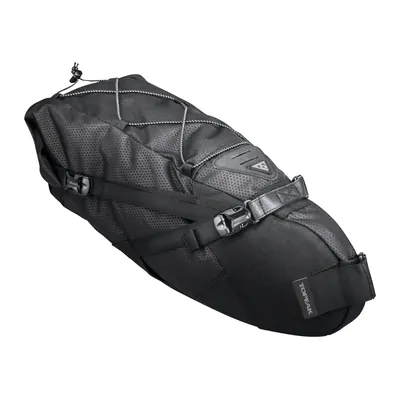
Topeak BackLoader
A 6, 10 or 15 L seat pack rated for 5 kg, with a waterproof inner bag and a rear light clip; check for 22 cm of clearance under the saddle rails first.
View on Amazon (opens in a new tab)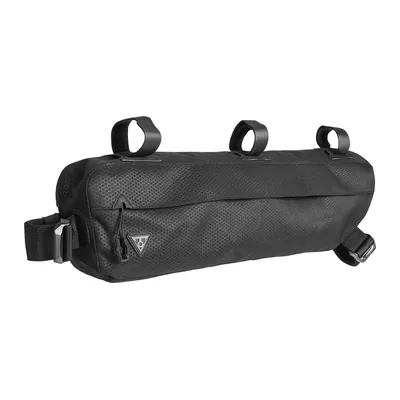
Topeak MidLoader
A 3, 4.5 or 6 L frame bag to suit your frame triangle, rated for 6.5 kg, with zips: the home for heavy items such as water, tools and food, low and central.
View on Amazon (opens in a new tab)
Worth watching
Tom Hill of Restrap shows where kit can go on the bike, from bar bag to frame bag to saddle pack, with tips for packing it compact and keeping what you need within easy reach.
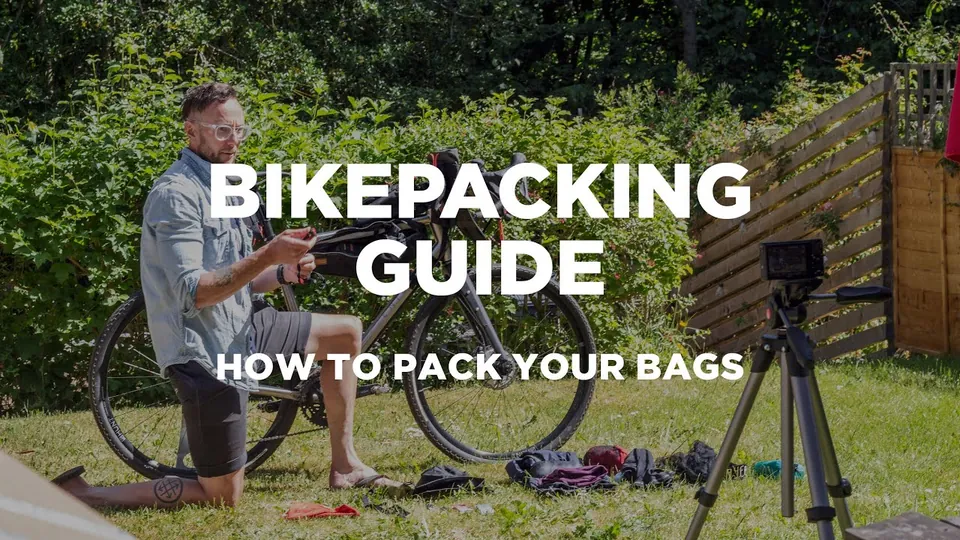
The video is hosted by YouTube (Google): nothing loads until you play it, and Google may then set cookies.
FAQs
Saddle pack or rack for bikepacking?
It depends on the load. Large saddle packs take 3 to 5 kg according to Ortlieb and Topeak, and Canyon advises no more than 2.3 to 3.2 kg to keep the bike stable. Beyond that, a rack changes the scale: Ortlieb quotes 20 kg for its lightweight model. Either way, check your bike’s maximum total weight, rider included, in its manual.
Where should you carry water when bikepacking?
In the frame bag or in cages on the fork. Water is one of the heaviest things you carry, and Apidura and Canyon both put it in the middle of the bike, low and central. Fork cages and bags take 3 kg per side at Ortlieb and Salsa, if the fork allows it: its manual has the final say. Avoid the handlebars and the tail of the saddle pack, where weight affects handling most.
Can you fit a saddle pack with a dropper post?
Yes, with a model designed for it. Ortlieb declares its hook-mounted saddle pack compatible with the adapter supplied, on posts of 22 to 26 mm, and Apidura offers an adapter that limits dropper travel to keep a gap above the tyre. Measure clearance with the post down and the suspension compressed: Topeak asks for at least 22 cm between the saddle rails and the tyre.
Are bike lights a legal requirement?
Yes, at night and in poor visibility, in every territory we checked: France, Great Britain, Germany, Austria, Switzerland and California. Reflectors and brakes are also part of the required equipment. In the United States, the rules vary from state to state. A bag must never hide your rear light: in Great Britain, lamps must be kept lit and unobscured.
What should go in a handlebar bag?
Light, bulky kit: your sleeping bag, sleeping mat and warm clothes. Apidura suggests keeping it for the sleep system and points out that a light front end keeps the steering precise; Canyon suggests loading it roughly as heavily as the saddle pack. Check that it leaves room for your hands, the brake cables and the tyre, especially on drop bars.
Sources
- Ortlieb, Seat-Pack, technical data sheet, accessed 24 October 2026. downloads.ortlieb.com https://downloads.ortlieb.com/datasheet/en/seat_pack.pdf ↩
- Topeak, BackLoader, product page, accessed 24 October 2026. topeak.com https://www.topeak.com/global/en/product/969-BACKLOADER ↩
- Canyon, ‘How to pack for bikepacking: Build the perfect setup’, 14 June 2022, updated 13 July 2026, accessed 24 October 2026. canyon.com https://www.canyon.com/en-hr/blog-content/gravel-bike-news/how-to-pack-bikepacking-bags/b14062022.html ↩
- Ortlieb, Handlebar-Pack, technical data sheet, accessed 24 October 2026. downloads.ortlieb.com https://downloads.ortlieb.com/datasheet/en/handlebar_pack.pdf ↩
- Apidura, Expedition Handlebar Pack, product page and compatibility, accessed 24 October 2026. apidura.com https://www.apidura.com/shop/expedition-handlebar-pack/ ↩
- Topeak, FrontLoader, product page, accessed 24 October 2026. topeak.com https://www.topeak.com/us/en/product/1290-FRONTLOADER ↩
- Ortlieb, Fuel-Pack, technical data sheet, accessed 24 October 2026. downloads.ortlieb.com https://downloads.ortlieb.com/datasheet/en/fuel_pack.pdf ↩
- Topeak, TopLoader, product page, accessed 24 October 2026. topeak.com https://www.topeak.com/us/en/product/966-TOPLOADER ↩
- Ortlieb, Frame-Pack, technical data sheet, accessed 24 October 2026. downloads.ortlieb.com https://downloads.ortlieb.com/datasheet/en/frame_pack.pdf ↩
- Topeak, MidLoader, product page, accessed 24 October 2026. topeak.com https://www.topeak.com/global/en/product/967-MIDLOADER ↩
- Apidura, Expedition Saddle Pack, product page and compatibility, accessed 24 October 2026. apidura.com https://www.apidura.com/shop/expedition-saddle-pack/ ↩
- Ortlieb, Fork-Pack, technical data sheet, accessed 24 October 2026. downloads.ortlieb.com https://downloads.ortlieb.com/datasheet/en/fork_pack.pdf ↩
- Salsa Cycles, EXP Series Anything Cage HD, product page, accessed 24 October 2026. salsacycles.com https://www.salsacycles.com/products/exp_series_anything_cage_hd ↩
- Apidura, ‘How to Pack Your Bike for a Bikepacking Trip’, 17 March 2025, accessed 24 October 2026. apidura.com https://www.apidura.com/journal/how-to-pack-your-bike-for-a-bikepacking-trip/ ↩
- Apidura, ‘Apidura Guide to MTB Bikepacking’, accessed 24 October 2026. apidura.com https://www.apidura.com/journal/apidura-guide-to-mtb-bikepacking/ ↩
- Topeak, BackLoader, fitting instructions, March 2023, ‘Minimum clearance’ diagram, accessed 24 October 2026. topeak.com https://www.topeak.com/storage/app/media/product/bikepacking/backloader/M_BACKLOADER_ML_202303.pdf ↩
- Ortlieb, Seat-Pack QR, technical data sheet, accessed 24 October 2026. downloads.ortlieb.com https://downloads.ortlieb.com/datasheet/en/seat_pack_qr.pdf ↩
- Canyon, frequently asked questions, answer on the Aeroad’s maximum weight, accessed 24 October 2026. canyon.com https://www.canyon.com/en-us/customer-service/faq/?fdid=sf-bike-models ↩
- Trek, Charter+ FAQ, answer on the weight limit, accessed 24 October 2026. trekbikes.com https://www.trekbikes.com/us/en_US/FAQ/charter-plus/ ↩
- Ortlieb, Quick-Rack, technical data sheet, accessed 24 October 2026. downloads.ortlieb.com https://downloads.ortlieb.com/datasheet/en/quick_rack.pdf ↩
- Service-Public, Équipements obligatoires à vélo, checked 10 June 2026, French government legal information service (in French), accessed 24 October 2026. service-public.gouv.fr https://www.service-public.gouv.fr/particuliers/vosdroits/F34169 ↩
- The Road Vehicles Lighting Regulations 1989, regulation 24, legislation.gov.uk, accessed 24 October 2026. legislation.gov.uk https://www.legislation.gov.uk/uksi/1989/1796/regulation/24 ↩
- Germany, Straßenverkehrs-Zulassungs-Ordnung (StVZO), § 67, gesetze-im-internet.de (in German), accessed 24 October 2026. gesetze-im-internet.de https://www.gesetze-im-internet.de/stvzo_2012/__67.html ↩
- Germany, Straßenverkehrs-Ordnung (StVO), § 17, gesetze-im-internet.de (in German), accessed 24 October 2026. gesetze-im-internet.de https://www.gesetze-im-internet.de/stvo_2013/__17.html ↩
- Department for Transport, The Highway Code, rules for cyclists (59 to 82), updated 22 October 2025, accessed 24 October 2026. gov.uk https://www.gov.uk/guidance/the-highway-code/rules-for-cyclists-59-to-82 ↩
- California DMV, ‘Bicyclist and Pedestrian Safety’, accessed 24 October 2026. dmv.ca.gov https://www.dmv.ca.gov/portal/driver-education-and-safety/special-interest-driver-guides/bicyclists-pedestrians/ ↩
- Germany, StVZO, § 64a (bell), gesetze-im-internet.de (in German), accessed 24 October 2026. gesetze-im-internet.de https://www.gesetze-im-internet.de/stvzo_2012/__64a.html ↩
- Germany, StVZO, § 65 (brakes), gesetze-im-internet.de (in German), accessed 24 October 2026. gesetze-im-internet.de https://www.gesetze-im-internet.de/stvzo_2012/__65.html ↩
- Austria, Fahrradverordnung, § 1, current version (RIS, in German), accessed 24 October 2026. ris.bka.gv.at https://www.ris.bka.gv.at/NormDokument.wxe?Abfrage=Bundesnormen&Gesetzesnummer=20001272&Paragraf=1 ↩
- Switzerland, Ordinance on the Technical Requirements for Road Vehicles (VTS/OETV, SR 741.41), art. 214 to 217, as at 1 October 2026, Fedlex (in French), accessed 24 October 2026. fedlex.data.admin.ch https://fedlex.data.admin.ch/filestore/fedlex.data.admin.ch/eli/cc/1995/4425_4425_4425/20261001/fr/html/fedlex-data-admin-ch-eli-cc-1995-4425_4425_4425-20261001-fr-html.html ↩
- Switzerland, Road Traffic Ordinance (VRV/OCR, SR 741.11), art. 30, as at 1 October 2026, Fedlex (in French), accessed 24 October 2026. fedlex.data.admin.ch https://fedlex.data.admin.ch/filestore/fedlex.data.admin.ch/eli/cc/1962/1364_1409_1420/20261001/fr/html/fedlex-data-admin-ch-eli-cc-1962-1364_1409_1420-20261001-fr-html-1.html ↩
- nidirect (Northern Ireland), ‘Carbon monoxide dangers if camping, caravanning or boating’, 2 April 2026, accessed 24 October 2026. nidirect.gov.uk https://www.nidirect.gov.uk/news/carbon-monoxide-dangers-if-camping-caravanning-or-boating ↩

Campervans, motorhomes, cycling and calculators
Julien de Jurquet writes for Outfarer about campervans, motorhomes, cycling and calculators. He reads instruction manuals to the very end and never lets a figure through without its unit, so that your choices rest on sums rather than promises.


