 Français (France)
 English (UK)
 English (US)
 Deutsch (Deutschland)

Contents
644 km, 783 m of climbing: what are we talking about?
A figure first: 783 m of total ascent over 644 km (400 miles) of route. That is barely more than 1 m of climbing per kilometre, and the highest point does not reach 185 m [1]. Nobody complains about the hills on La Loire à Vélo. The difficulties lie elsewhere: in the number of days, in the bed to book each night, and in the train that takes you back to the car.
The official site presents the route as running from Saint-Brevin-les-Pins, on the Atlantic, to Cuffy, near Nevers, in the Cher département [2]. Cuffy is kilometre zero: La Loire à Vélo starts there, at the Bec d’Allier, where the Allier meets the Loire [3]. The France Vélo Tourisme planner splits the route into 36 stages numbered up to 37, and adds up to 644 km from Nevers, which is 13 km (8 miles) before Cuffy [1]. Adding the stages one by one from Cuffy to Saint-Brevin, I get 631 km (392 miles), and that is the figure I use from here on.
La Loire à Vélo is also a stretch of EuroVelo 6, the cycle route of more than 4,400 km (2,730 miles) from the Atlantic to the Black Sea, whose section from Nantes to Nevers follows the same river [4]. That is why the waymarking is continuous and why maps in several languages exist.
| Measure | Value |
|---|---|
| Length shown (Nevers to Saint-Brevin) | 644 km (400 miles) |
| Length from Cuffy to Saint-Brevin (sum of the stages) | 631 km (392 miles) |
| Total ascent | 783 m |
| Total descent | 909 m |
| Highest point | 185 m |
| Separate cycle paths | 239 km (149 miles), 37% |
| Roads shared with cars | 400 km (249 miles), 62% |
| Smooth surface | 557 km (346 miles), 86% |
| Rough surface | 32 km (20 miles), 5% |
Data from the France Vélo Tourisme planner (English version), accessed 29 October 2026 [1]. The total includes the Nevers to Cuffy stage (13 km). For the remaining 9%, no surface is recorded.
The figure that changes how you organise a day is the second one: 62% of the route is on shared roads. There, you ride on the carriageway with the cars, with nothing but a sign to mark the route. It is not dangerous in itself, but it is not a greenway (a car-free path), and with children or a loaded bike you notice the difference after a few kilometres.
Which section should you choose for three or four days?
Nobody has to start from Cuffy. The planner gives each stage one of two levels, ‘I begin’ or ‘I cycle often’. Counting them shows that the effort is not spread at random: of the seven stages from Pouilly-sur-Loire to Jargeau, six are graded ‘I cycle often’, against none between Orléans and Saumur [1]. The stages from Gien to Sully-sur-Loire, for example, have ‘several stretches of the route along roads, with some significant slopes’ [1].
| Section | Distance | Announced level |
|---|---|---|
| Cuffy to Sancerre | 51 km (32 miles) | Easy, mostly greenways (one stage graded ‘I cycle often’) |
| Sancerre to Orléans | 134 km (83 miles) | The hilliest: five of seven stages graded ‘I cycle often’ |
| Orléans to Blois | 64 km (40 miles) | ‘I begin’ throughout |
| Blois to Tours | 70 km (43 miles) | ‘I begin’ throughout |
| Tours to Saumur | 85 km (53 miles) | ‘I begin’ throughout |
| Saumur to Angers | 59 km (37 miles) | ‘I begin’ throughout |
| Angers to Nantes | 106 km (66 miles) | One stage graded ‘I cycle often’ (Chalonnes to Saint-Florent), one with no level shown |
| Nantes to Saint-Brevin-les-Pins | 62 km (39 miles) | Two stages out of three graded ‘I cycle often’ |
Distances: sum of the stage lengths in the France Vélo Tourisme planner [1]. The levels are those the site gives each stage, not a measure of ascent.
The official Loire à Vélo site itself suggests a four-day split from Orléans to Tours: the first three days are 29 km (18 miles) to Beaugency, 44 km (27 miles) to Blois via Chambord, then 44 km to Amboise [5]. Those are comfortable days at about 15 km/h (9 mph), the pace implied by the times displayed (22 km, or 14 miles, in 1 hour 27 minutes between Tours and Villandry, for example) [1].
For three or four days without effort, I would pick one of two: Orléans to Tours, 134 km (83 miles) of châteaux, or Saumur to Nantes, 165 km (103 miles) in three stages of 50 to 60 km (31 to 37 miles), with only one stage graded ‘I cycle often’. Either way, stations are frequent, which matters for the return.
How many days, and how many kilometres a day?
The sum is simple: 631 km divided by your kilometres per day, rounded up to the next whole day. The planner’s times assume an average of about 15 km/h (9 mph): a 30 km (19 mile) stage (Saumur to Saint-Rémy-la-Varenne) takes 1 hour 59 minutes [1]. Add the stops, the visits and the wind yourself.
| Pace | Number of days | Who for |
|---|---|---|
| 40 km (25 miles) a day | 16 days | Families, long visits |
| 60 km (37 miles) a day | 11 days | Relaxed touring |
| 80 km (50 miles) a day | 8 days | Sporty riders with few visits |
Our calculation from 631 km, with no rest days.
One useful rule for the season: the Train Loire à Vélo runs from 1 May to 30 August with at least 50 bike spaces on board [6], and the Saint-Nazaire shuttle runs only from 4 July to 30 August in 2026 [7]. Seasonal services therefore cluster between May and September: outside those months, plan a different way back.
How do you get back to your starting point?
A one-way route always raises the same question: where is the car? On La Loire à Vélo the answer is the train, and the booking rules change with the time of year. The Train Loire à Vélo, a train fitted out for bikes, links Orléans, Blois, Amboise, Tours, Saumur, Angers, Ancenis and Nantes, and at weekends Saint-Nazaire, La Baule, Pornichet and Le Croisic [6]. It runs 3 return trips a day from Monday to Friday between Orléans and Nantes, and 2 at weekends as far as Le Croisic [6].
Booking costs €1 on top of the ticket (every price here is in euros, because you pay it in France), and it is compulsory for everyone from 1 May 2026 to 27 September 2026, on veloabord.fr, the national booking site of the regional TER trains (TER is short for Transport Express Régional) [6] [8]. The practical rules are blunt: take the panniers off, no cargo bikes, and folded trailers and tandems go in the dedicated room [6].
| Option | Bike | Booking |
|---|---|---|
| Train Loire à Vélo (Orléans, Nantes, Le Croisic) | Dedicated space | €1, compulsory from 1 May to 27 September 2026 [6] |
| Ordinary TER | Free, hung up or in the space provided | Not needed, except at weekends on Paris to Les Aubrais, Orléans to Bourges, Paris to Montargis to Nevers and Orléans to Tours to Saumur (€1) [9] |
| TER Angers to Le Croisic | Free | €1, compulsory every day from 8 June to 22 September [9] |
| Loiret ‘Vélos-Cars’ (coaches) | Coach with bike space | Weekends and public holidays all year, every day from April to September [9] |
The dates are for 2026: check those for the year of your trip on loirebybike.co.uk and veloabord.fr.
Luggage, accommodation and bike services
Travelling light takes planning: the official site lists companies that move luggage, bikes and people along the route [10]. Rêve de Vélo covers the whole stretch from Nevers to Saint-Brevin; Les Vélos Verts, Orléans to Nantes; Loire Vélo Nature, Blois to Angers; Vélo Val de Loire, Nevers to Orléans; and Arnotours, around Tours, Amboise and Montlouis-sur-Loire [10]. The site gives no prices and tells you to ask for a quote, so I will not invent any.
For a bed, the national ‘Accueil Vélo’ label (literally ‘cyclist welcome’) covers more than 800 professionals along the route. Each promises to stand within 5 km (3 miles) of the route and to offer a secure bike store and a repair kit [11]. For the lock you carry, here is how to read lock ratings. A dozen or so places also offer tent-bivouacs on stilts, which save you carrying camping kit [11]. That figure comes from the French page: the English page still says ‘more than 600’.
A few practical services: the Loire à Vélo passport costs €9.95 from one of the 38 tourist offices and can be stamped in 43 places, and trailers are allowed despite chicanes (staggered barriers) on some stretches [12]. Electric bikes can be recharged at charging points or with Accueil Vélo businesses [13].
Saint-Brevin and Saint-Nazaire: what about the bridge?
The route ends at Saint-Brevin-les-Pins, on the south bank of the estuary, while the railway station is at Saint-Nazaire, on the other side. The official site strongly recommends not crossing the bridge by bike [7]. There are three alternatives.
| Option | Capacity | Price | Period |
|---|---|---|---|
| Road shuttle with trailer | 8 people and 8 bikes | €5 per passenger | 4 July to 30 August 2026, 9 return trips a day |
| ALEOP bus, line 317 | 8 standard bikes | €2.90 per person with a bike | All year, booking required the day before |
| Saint-Brevin taxi | 4 people and 4 bikes | Not stated | Weekdays before 8am and after 5pm, daytime at weekends |
The shuttle does not take tandems or cargo bikes [7]. The line 317 timetable shown on the site covers 23 February to 3 July 2026 [7]. The English page gives the bus fare as €2.60, the French page as €2.90: the French figure is the one used here, so confirm the fare when you book.
What La Loire à Vélo costs: the figures you can source
I will not give an overall budget: no official source publishes prices for nights and meals, and they change with the season. The fixed logistics costs, on the other hand, are known, and they are small.
| Item | Amount |
|---|---|
| Bike reservation, Train Loire à Vélo | €1 [6] |
| Loire à Vélo passport | €9.95 [12] |
| Shuttle from Saint-Brevin to Saint-Nazaire | €5 per passenger [7] |
| Bus 317 with a bike | €2.90 per person [7] |
| Luggage transfer | On quote [10] |
Prices for accommodation, food, bike hire and the train ticket itself are not on the pages consulted: check them when you book.
Kit related to this article
No affiliation: no commission, no sponsored products.
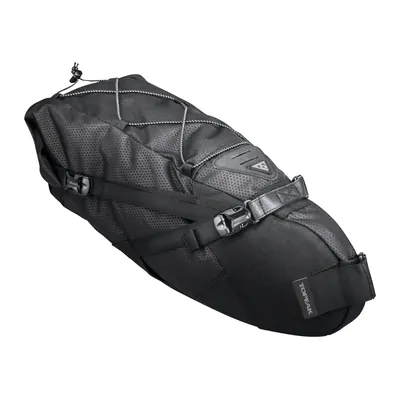
Topeak BackLoader
A 6, 10 or 15 L seat pack rated for 5 kg, with a waterproof inner bag and a rear light clip; check for 22 cm of clearance under the saddle rails first.
View on Amazon (opens in a new tab)
Worth watching
Two cycle tourers walk through the Loire à Vélo: a well-signed mix of quiet roads and cycle paths, very little climbing, and the châteaux and wine country along the way.
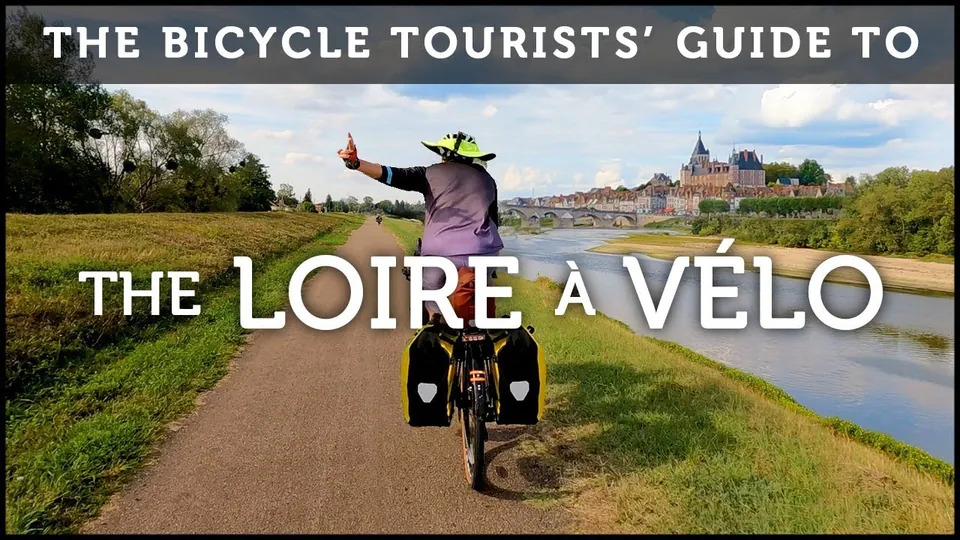
The video is hosted by YouTube (Google): nothing loads until you play it, and Google may then set cookies.
FAQs
How long does it take to ride the whole of La Loire à Vélo?
From Cuffy to Saint-Brevin, count on 631 km (392 miles), the sum of the France Vélo Tourisme planner’s stages: about 11 days at 60 km (37 miles) a day, or 16 days at 40 km (25 miles) a day. The planner’s times assume roughly 15 km/h (9 mph), before any stops or visits.
Is La Loire à Vélo hard?
Not for the hills: 783 m of total ascent over 644 km, with a high point of 185 m. The most demanding stages are those from Pouilly-sur-Loire to Jargeau, with stretches on roads and a few climbs. Every stage between Orléans and Saumur is graded ‘I begin’.
Can you ride La Loire à Vélo with children?
The official site rates it suitable for families, with a waymarked route and many equipped rest areas. Bear in mind that 62% of the route is on roads shared with cars: choose the greenway stages, and check for chicanes (staggered barriers) if you tow a trailer.
How do I get my luggage moved?
The official site lists seven companies that move luggage, bikes and people, such as Rêve de Vélo from Nevers to Saint-Brevin or Loire Vélo Nature from Blois to Angers. It publishes no prices: ask for a quote with your dates and stages. Some Accueil Vélo hosts also offer transfers.
Do I need to reserve a bike space on the train?
On the Train Loire à Vélo, yes: booking costs €1 and is compulsory for everyone from 1 May to 27 September 2026. On an ordinary TER regional train, a bike travels free without booking, except at weekends on four routes and every day in summer on Angers to Le Croisic.
Sources
- France Vélo Tourisme, “La Loire à Vélo” route planner (English version): 36 stages, 644 km, profile and surfaces, accessed 29 October 2026. en.francevelotourisme.com https://en.francevelotourisme.com/itineraire/planifier/29/86/122 ↩
- La Loire à Vélo, official site of the Centre-Val de Loire and Pays de la Loire regions, English home page, accessed 29 October 2026. loirebybike.co.uk https://www.loirebybike.co.uk/ ↩
- La Loire à Vélo, suggestion “1 week from Cuffy, Kilometre Zero, to Blois”, accessed 29 October 2026. loirebybike.co.uk https://www.loirebybike.co.uk/suggestion/1-week-from-cuffy-kilometre-zero-to-blois/ ↩
- EuroVelo, “EuroVelo 6, Atlantic to Black Sea”, route page, accessed 29 October 2026. en.eurovelo.com https://en.eurovelo.com/ev6 ↩
- La Loire à Vélo, suggestion “Nicolas d’Orléans à Tours en 4 jours” (in French), accessed 29 October 2026. loireavelo.fr https://www.loireavelo.fr/suggestion/nicolas-dorleans-a-tours-en-4-jours/ ↩
- La Loire à Vélo, “Train Loire à Vélo”: conditions, timetables and 2026 booking, accessed 29 October 2026. loirebybike.co.uk https://www.loirebybike.co.uk/travelling-along-the-itinerary/train-velo-loire-2/ ↩
- La Loire à Vélo, “How to cross the bridge of Saint Nazaire?”: shuttle, bus 317, taxis, accessed 29 October 2026. loirebybike.co.uk https://www.loirebybike.co.uk/travelling-along-the-itinerary/crossing-the-saint-nazaire-bridge/ ↩
- SNCF TER, “Réservation vélo sur les lignes TER en régions”, national portal (in French), accessed 29 October 2026. veloabord.fr https://www.veloabord.fr/ ↩
- La Loire à Vélo, “TER et cars régionaux”: bikes on trains, Loiret Vélos-Cars, weekend and summer reservation rules (in French), accessed 29 October 2026. loireavelo.fr https://www.loireavelo.fr/se-deplacer-sur-litineraire/ter-et-cars-regionaux/ ↩
- La Loire à Vélo, “Transfer your luggage in Loire”: luggage, bike and passenger transfers, accessed 29 October 2026. loirebybike.co.uk https://www.loirebybike.co.uk/bike-services/luggage-bikes-and-passenger-transport/ ↩
- La Loire à Vélo, “Accueil Vélo : marque nationale professionnels du tourisme” (in French; the English page gives an older count), accessed 29 October 2026. loireavelo.fr https://www.loireavelo.fr/la-marque-accueil-velo/ ↩
- La Loire à Vélo, “Faq Archive”: passport and trailers (in French), accessed 29 October 2026. loireavelo.fr https://www.loireavelo.fr/faq/ ↩
- La Loire à Vélo, English FAQ: families, electric bike charging, the Saint-Nazaire bridge, accessed 29 October 2026. loirebybike.co.uk https://www.loirebybike.co.uk/practical-information-for-cycling-routes-in-the-loire-valley/faq/ ↩

Campervans, motorhomes, cycling and calculators
Julien de Jurquet writes for Outfarer about campervans, motorhomes, cycling and calculators. He reads instruction manuals to the very end and never lets a figure through without its unit, so that your choices rest on sums rather than promises.


