 Français (France)
 English (UK)
 English (US)
 Deutsch (Deutschland)

Lumens and lux: two numbers, two questions
Let’s do the sums. The unit of luminous flux: the total amount of light a source puts out, in every direction. tell you how much light leaves the lamp; The unit of illuminance: the amount of light reaching a surface, measured at one point and at a given distance. tell you how much arrives at one particular spot. The first number describes the lamp, the second what you actually see.
A rough order of magnitude: a 270-lumen light whose beam spreads over about 7 m wide and 70 m long gives, on average, around 0.55 lux on the road, so under 1 lux, according to an analysis by a site specialising in bicycle lighting measurements. [1] That has little to do with the figure on a spec sheet: a lux reading taken at the brightest point of a wall 10 m away is not what you will see on the tarmac as you ride.
The same site points out a classic bias: manufacturers favour high colour-temperature LEDs, which give the most lumens and look the brightest, though those figures do not guarantee you see better. [1] A British guide sums it up: lux and lumens cannot be compared directly, and brightness is not the deciding factor in seeing the road or in dazzling other people. [2]

Germany: the country that talks in lux
Germany is the country whose lighting standard everyone quotes, the famous StVZO. Its paragraph 67 describes what a bicycle needs: a white headlight, a red rear lamp, a white reflector at the front, a red category Z reflector at the back, yellow pedal reflectors, and side marking on the wheels (continuous white rings, reflective spokes or two yellow reflectors per wheel). [3]
The same text allows a dynamo, a battery or a rechargeable cell to power the lights, so a dynamo is not compulsory, contrary to what a recent guide on a specialist site says, which also puts a ceiling of 205 lumens on the front light. [4] We found neither that ceiling nor any lumen figure in paragraph 67; what it does contain is a ban on dazzling other road users.
The figure that turns up in every guide is a minimum of 10 lux at 10 m, measured on a wall, with a sharp cut-off beam that keeps most of the light on the road. [4] [2] We did not read it in the text of paragraph 67 itself: according to those guides it belongs to type approval, whose trace is the Kraftfahrt-Bundesamt mark, a wavy line, a capital K and a number. Without that mark, a consumer test says bluntly, the light should not be fitted to the bike. [5]
Two other rules surprise a visitor: flashing headlights and rear lamps are banned, and paragraph 67, amended in 2013 on the power source, was rewritten in full in 2017. [3] [6] A headlight is mounted between 400 and 1,200 mm above the ground, a rear light between 250 and 1,200 mm. [3]
France: a colour, a mode, no power rating
Service-public, the French government’s information site, sums up the French rules: a white or yellow position light at the front, non-dazzling, and a red light at the back, not flashing, at night or by day when visibility is poor. [7] Compulsory lights must be steady; only optional direction indicators may flash. [7] The page gives no visibility distance for lights, and no power threshold.
Reflectors complete the set-up: a white one at the front, one or more red ones at the back, orange ones on the wheels (unless the tyres are approved reflective ones) and on the pedals. [7] Breaking these rules is punishable by a fine of up to €38, the usual fixed fine being €11. [7] For the full list (bell, helmet, hi-vis vest), our article on compulsory cycling equipment by country covers it.
Great Britain: flashing is allowed, within limits
In Great Britain, any cycle used between sunset and sunrise must show a white light at the front, a red light at the back, a red rear reflector and amber pedal reflectors. [8] The Highway Code says the same: at night, a bicycle must have a white front light and a red rear light, both switched on. [9]
Lights can be steady, flashing or a mix, but a purely flashing light must flash between 60 and 240 times a minute, at regular intervals, with an intensity of at least 4 candelas. [8] A steady light must meet British Standard BS 6102/3 and carry its marking, even when used in flashing mode; a purely flashing light is exempt. [8] The guides recommend a steady front light wherever street lighting is missing. [8] [9]

United States: feet of visibility, state by state
At federal level, the Consumer Product Safety Commission (CPSC) rule only covers reflectors: a colourless one at the front, a red one at the back, colourless or amber ones on the pedals, and side marking on the wheels. The text says nothing about lamps. [10] Lighting is therefore left to the states, and it is counted in distance, not in lumens.
In California, a bicycle ridden at night needs a white lamp that lights the way ahead and can be seen from 300 feet (91 m) from the front and sides, plus a red reflector, or a steady or flashing red light with a built-in reflector, visible from 500 feet (152 m) behind. [11] In Washington State, the white front lamp must be seen from 500 feet (152 m), the rear reflector from 600 feet (183 m), and a flashing red LED rear light is allowed in addition to the reflector. [12] In Florida, at night, a white lamp at the front must be visible from 500 feet (152 m), and a red lamp and reflector at the rear from 600 feet (183 m). [13]
The four countries at a glance
| Country | What the rule measures | Flashing light | When to switch on |
|---|---|---|---|
| Great Britain | Colour; BS 6102/3 for a steady light, 4 candelas for a purely flashing one | Allowed, 60 to 240 flashes a minute | Sunset to sunrise |
| Germany | Lux at 10 m (as reported by the guides) and a cut-off beam, K mark | Banned, front and rear | In the dark, at dusk or in poor visibility |
| France | Colour (white or yellow at the front, red at the back), non-dazzling | Compulsory lights must be steady | At night, or by day if visibility is poor |
| United States | Visibility distance in feet, varying by state | Depends on the state: allowed at the rear in California and Washington State | At night, depending on the state (sunset to sunrise in Florida) |
Sources: paragraph 67 of the StVZO, Service-public (checked 10 June 2026), GOV.UK, the California, Washington State and Florida codes. For Germany, ‘in the dark, at dusk or in poor visibility’ comes from a consumer test.
What this changes when you buy
First habit: look for the beam shape before the power figure. A cut-off beam, as Germany requires, puts most of the light on the road, below the eyes of oncoming drivers; a round beam spreads light in every direction, and a wider, flatter beam dazzles less, according to the same guide. [2] The drawback, noted by the specialist press: this kind of beam leaves little light right in front of the wheel, and it suits a dark track less well. [4]
Second habit: check legality where you ride, not where the light is sold. A light with a steady, non-flashing, non-dazzling beam meets the French requirements described by Service-public. [7] In Great Britain, a steady light must carry the marking of the British Standard or of an equivalent standard from another country. [8] For battery life and reading spec sheets, our article on head torch lumens and runtime goes through the FL1 standard.
Third habit: aim the light once it is fitted, at a wall or a garage door, so that the cut-off falls below a driver’s eye level. That is what stops you dazzling people, and what the German and French texts both ask for before anything else.

The rule to remember: for bike lights, the shape of the beam and the law of the country count, not the lumens printed on the box.
Kit related to this article
No affiliation: no commission, no sponsored products.
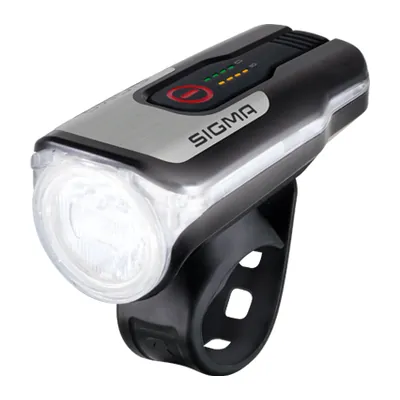
Sigma Sport Aura 80 USB
A rechargeable 80 lux front light with a 90 m beam range and a StVZO cut-off beam: a steady, non-dazzling light you aim against a wall.
View on Amazon (opens in a new tab)
FAQs
How many lumens do I need to ride at night?
None of the texts we read sets a number of lumens. In a lit town, the law mostly asks you to be seen: colour and mode matter more than power. Away from street lighting, what helps you see is the beam shape and how far it reaches the ground, which lumens do not tell you: a 270-lumen light gives only about 0.55 lux on the road on average, in one specialist site’s example.
Is a German-standard light legal in Britain or France?
Broadly yes in France: Service-public asks for a white or yellow, non-dazzling front light and a red, non-flashing rear one, and a steady, cut-off beam meets that. In Great Britain, a steady light must carry the BS 6102/3 marking or an equivalent, so check the box. No text we read makes the K mark compulsory outside Germany.
Can I ride with a flashing light?
It depends on the country. In Great Britain it is allowed at 60 to 240 flashes a minute, with at least 4 candelas for a purely flashing light. In France, compulsory lights must be steady. In Germany, flashing headlights and rear lamps are banned. In the United States, each state sets its own rule.
Do I need lights in daylight?
In Great Britain, the rule applies from sunset to sunrise, but GOV.UK advises using lights by day in fog or poor visibility. In France, by day only when visibility is poor. In Germany, at dusk or in poor visibility as well. In the United States, it depends on the state.
Sources
- WHS reviews, “Bicycle lighting analysis: Headlamps, taillamps, dynamos, and more”, last change noted 27 January 2024, page accessed 9 November 2026. swhs.home.xs4all.nl https://swhs.home.xs4all.nl/fiets/tests/verlichting_analyse/index_en.html ↩
- road.cc, “Are bike lights too bright?”, by Liam Cahill, 19 November 2021, page accessed 9 November 2026. road.cc https://road.cc/content/feature/are-bike-lights-too-bright-287937 ↩
- Gesetze im Internet, StVZO § 67 “Lichttechnische Einrichtungen an Fahrrädern”, page accessed 9 November 2026. gesetze-im-internet.de https://www.gesetze-im-internet.de/stvzo_2012/__67.html ↩
- BikeRadar, “StVZO bike lights: everything you need to know”, by Paddy Maddison, 16 October 2026, page accessed 9 November 2026. bikeradar.com https://www.bikeradar.com/advice/buyers-guides/stvzo-bike-lights/ ↩
- Stiftung Warentest, “Fahrradbeleuchtung im Test”, 8 September 2020, page accessed 9 November 2026. test.de https://www.test.de/Fahrradbeleuchtung-im-Test-5423684-5644224/ ↩
- Buzer.de, history of amendments to § 67 StVZO, page accessed 9 November 2026. buzer.de https://www.buzer.de/67_StVZO.htm ↩
- Service-public.gouv.fr, “Équipements obligatoires à vélo” (sheet F34169), checked 10 June 2026, page accessed 9 November 2026. service-public.gouv.fr https://www.service-public.gouv.fr/particuliers/vosdroits/F34169 ↩
- GOV.UK, “Pedal cycles: lighting”, page accessed 9 November 2026. gov.uk https://www.gov.uk/government/publications/pedal-cycles-lighting/pedal-cycles-lighting ↩
- GOV.UK, “The Highway Code: rules for cyclists (59 to 82)”, page accessed 9 November 2026. gov.uk https://www.gov.uk/guidance/the-highway-code/rules-for-cyclists-59-to-82 ↩
- Legal Information Institute (Cornell), 16 CFR § 1512.16, “Reflectors”, page accessed 9 November 2026. law.cornell.edu https://www.law.cornell.edu/cfr/text/16/1512.16 ↩
- California Vehicle Code, section 21201 (text updated 1st January 2026), page accessed 9 November 2026. california.public.law https://california.public.law/codes/ca_veh_code_section_21201 ↩
- Washington State Legislature, RCW 46.61.780 “Lamps and other equipment on bicycles”, page accessed 9 November 2026. app.leg.wa.gov https://app.leg.wa.gov/rcw/default.aspx?cite=46.61.780 ↩
- Florida Legislature, Florida Statutes, section 316.2065, page accessed 9 November 2026. leg.state.fl.us http://www.leg.state.fl.us/statutes/index.cfm?App_mode=Display_Statute&URL=0300-0399/0316/Sections/0316.2065.html ↩

Campervans, motorhomes, cycling and calculators
Julien de Jurquet writes for Outfarer about campervans, motorhomes, cycling and calculators. He reads instruction manuals to the very end and never lets a figure through without its unit, so that your choices rest on sums rather than promises.

 Damien Poirier-Boucard

