 Français (France)
 English (UK)
 English (US)
 Deutsch (Deutschland)

Contents
The method: watt-hours per day
285 Ah on the label, 96 Ah you can actually use. That’s not coming from someone with a grudge against lead-acid batteries, but from a post on the blog of Victron, a company that makes batteries and chargers: applied to the AGM batteries in a nearly new RV, the 50% discharge rule, the effect of a high current, and an aging factor bring 3.4 kWh of stored energy down to 1.15 kWh that’s truly available [1]. So before you choose a battery, you need to know what you’ll ask of it, and what it can really deliver.
The method comes down to three steps. First, the budget: for each appliance, its power multiplied by how long it runs each day, in watt-hours. Next, the share of the battery you can really use, which depends on its chemistry. Finally, the number of days you want to go without recharging. To convert the result to amp-hours, divide by the voltage: 12 V in most setups.
The energy budget, appliance by appliance
The fridge is the biggest load, because it runs day and night. Dometic publishes a very useful number: average consumption in amp-hours per hour, at a stated outside and inside temperature. For its CFX3 35, a 9.5-gallon (36-liter) compressor cooler, that’s 0.98 Ah per hour at 12 V, with 90 °F (32 °C) outside and 39 °F (4 °C) inside [2]. Over 24 hours, that’s about 24 Ah, or roughly 280 Wh. In cooler weather, the compressor cycles on less often.
In winter, the heater takes over. A 7,000 BTU/h (2 kW) diesel air heater like the Webasto Air Top 2000 STC draws 14 to 29 W for its fans and electronics [3], or up to 348 Wh over a 12-hour night. A Truma Combi 4 propane heater lists an average current draw of about 1.2 A [4], or about 14 amp-hours over a 12-hour night. Our guide to camper vans in winter breaks these numbers down.
Everything else works the same way. Four 3 W LED lights on for 4 hours: 48 Wh. A laptop whose charger puts out 45 W, plugged in for 3 hours a day: 135 Wh at most. Two phones whose batteries each hold about 15 Wh: 30 Wh. These are just examples: your devices’ power ratings are printed on their labels or their chargers.
| Appliance | Power or consumption | Time per day | Summer | Winter |
|---|---|---|---|---|
| 9.5-gallon (36 L) compressor cooler | 0.98 Ah per hour at 90 °F (32 °C) | 24 h | 282 Wh | 282 Wh |
| LED lighting | 12 W | 4 h in summer, 8 h in winter | 48 Wh | 96 Wh |
| Laptop | 45 W max | 3 h | 135 Wh | 135 Wh |
| Two phones | 15 Wh per charge | one charge each | 30 Wh | 30 Wh |
| 7,000 BTU/h (2 kW) diesel air heater | 14 to 29 W | 12 h overnight | 0 Wh | 348 Wh |
| Total | 495 Wh | 891 Wh |
Just an example: your appliances and run times change everything. Cooler: Dometic spec sheet at 90 °F (32 °C), kept for winter to stay on the safe side. Heater: Webasto spec sheet, at its maximum electrical draw.
Lead or lithium: the capacity you can really use
You don’t run a battery all the way down. For AGM lead-acid, the most economical depth of discharge is generally set at 50%; for lithium iron phosphate (LiFePO4), Victron goes with 80% [5]. Dometic goes further, treating lithium iron phosphate as usable to nearly 100% [6]. Sticking with 80% builds in a margin.
The reason fits on one line of a spec sheet. A Victron AGM battery is rated for 600 cycles at 50% discharge, but only 400 at 80% [7]: running it all the way down wears it out faster. The same company’s SuperPack lithium batteries are rated for 2,500 cycles at 80% discharge, at 77 °F (25 °C) [8].
The number on the label also assumes 77 °F (25 °C) and a slow discharge, over 20 hours [7]. Colder, older, or worked harder, a battery delivers less: Victron’s AGM spec sheet shows capacity dropping sharply at low temperatures [7], and in the blog’s example, a high current alone knocks about 16% off the capacity, before an aging factor of 0.8 [1].
Two days without recharging: a worked example
Let’s do the math with the budget above and two days without recharging, because of bad weather or because you’re staying put. In summer: 495 Wh a day, or 990 Wh for two days. With lithium, at 80% usable, you need 1,238 Wh of capacity, or 103 Ah at 12 V. With AGM lead-acid, at 50%, it’s 1,980 Wh, or 165 Ah.
In winter, with the heater at its maximum draw: 891 Wh a day, 1,782 Wh for two days. That takes 186 Ah of lithium or 297 Ah of lead-acid. In this example, a 100 Ah lithium battery just about covers two days in summer; in winter, you’d need two of them.
| Season | Energy used over two days | Lithium iron phosphate (80% usable) | AGM lead-acid (50% usable) |
|---|---|---|---|
| Summer | 990 Wh | 103 Ah | 165 Ah |
| Winter, heater included | 1,782 Wh | 186 Ah | 297 Ah |
Calculation: two days of energy divided by the usable share, then by 12 V. A minimum, before the effects of cold, high currents, and aging.
The same reasoning answers the most common question: how long will the cooler run on its own? Dometic recommends dividing the battery’s usable capacity by the appliance’s hourly consumption [6]. With a 100 Ah lithium battery used to 80%, the CFX3 35 runs about 82 hours at 90 °F (32 °C), almost three and a half days; with 100 Ah of lead-acid used to 50%, about 51 hours.
The inverter and the other loads people forget
An inverter, which turns the battery’s 12 V into household AC power, draws current even with nothing plugged in. Victron’s datasheet covers its 230 V models, 230 V being the standard household voltage in Europe, along with 120 V versions. For its 12 V models, no-load consumption runs from 4.2 W for the smallest to 10 W for the 1,200 VA model, with maximum efficiency of 87 to 91% across that range [9]. Left on day and night, an inverter that draws 6 W with no load costs 144 Wh a day: more than the lighting and the phones in our example combined. Its ECO mode, which puts it to sleep when there’s no load, cuts that loss [9].
Efficiency counts too: a laptop charged through an inverter running at 90% uses 150 Wh for 135 Wh of useful energy. Small devices on standby, the water pump, and the roof fan add up the same way, a few watt-hours each. An honest budget lists them all, then adds a margin.

That leaves the number of days without recharging. I recommend planning for two days with a van that’s often on the road, and three for a winter stay parked in one spot: it’s the setting to adjust to the way you travel, and the one that changes the capacity the most.
Recharging, the factor that changes everything
The number of days without recharging matters as much as the budget. A van that’s driven every day recharges its house battery from the alternator; a van that stays parked depends on solar or shore power. In winter, short days and a low sun cut a panel’s output just when the heater and the lights use the most: the season is what sets the capacity. To run the numbers with your own battery, panels, fridge, and region, Best Batteries’ off-grid calculator estimates how many days you can go without plugging in, on cloudy days as well as sunny ones.

One last winter trap, specific to lithium: some batteries refuse to charge below 41 °F (5 °C), such as Victron’s Smart lithium batteries, whose battery management system cuts off charging below that temperature [10]. Installed inside the heated living space rather than in an outside compartment, the battery avoids that lockout. Beyond that, installation and wiring are a job for a professional: this guide stops at sizing.
You size a house battery by multiplying the watt-hours you use by the days without recharging, then dividing by the share you can use: everything else is just a number on a sticker.
Gear related to this article
No affiliation: no commission, no sponsored products.
 Victron Energy
Victron SmartShunt 500 A
A shunt battery monitor that shows current, amp-hours used, and state of charge on your phone, so your daily energy budget is measured rather than estimated.
View on Amazon (opens in a new tab)
Worth watching
A walk-through of what amp-hours actually measure and how to turn a day of power use into the house battery capacity your van needs, the same calculation this guide lays out.
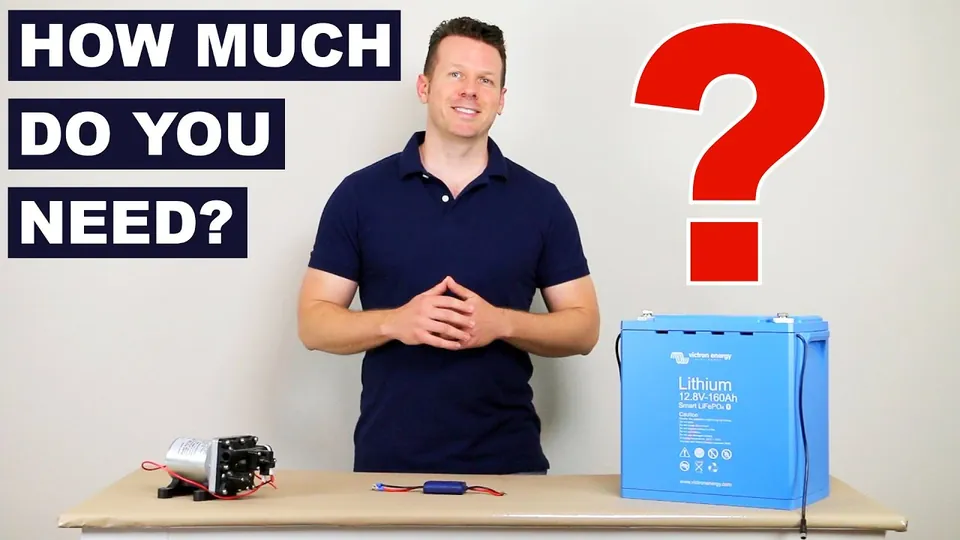
The video is hosted by YouTube (Google): nothing loads until you play it, and Google may then set cookies.
FAQ
What size house battery does a camper van need?
You have to calculate it. In our example, two people with a compressor cooler, LED lighting, a laptop, and two phones use about 495 Wh a day in summer. For two days without recharging, that means about 103 Ah of lithium or 165 Ah of AGM lead-acid. In winter, with a diesel heater running, those numbers climb to 186 and 297 Ah.
Lithium or lead-acid for a camper van?
Lithium iron phosphate can be used to 80% of its capacity and beyond, AGM lead-acid to about 50%: for the same use, you need almost half as many amp-hours with lithium. It also lasts more cycles: Victron rates its SuperPack lithium batteries for 2,500 cycles at 80% discharge, versus 400 for one of its AGM batteries at the same depth.
How long will a compressor cooler run on a battery?
Divide the battery’s usable capacity by the cooler’s hourly consumption, as Dometic recommends. Its CFX3 35 uses 0.98 Ah per hour at 90 °F (32 °C): with a 100 Ah lithium battery used to 80%, it runs about 82 hours; with 100 Ah of lead-acid used to 50%, about 51 hours. In cooler weather, it runs longer.
How do you convert amp-hours to watt-hours?
Multiply the amp-hours by the battery voltage. A 100 Ah battery at 12 V stores 1,200 Wh; the same battery at 24 V stores 2,400 Wh. For a budget, work in watt-hours, then divide the total by your system’s voltage to get back to amp-hours, factoring in the share of the battery you can actually use.
Sources
- Victron Energy, Bigger batteries: More Ah needed?, blog, March 20, 2019, accessed October 22, 2026. victronenergy.com https://www.victronenergy.com/blog/2019/03/20/bigger-batteries-more-ah-needed/ ↩
- Dometic, Dometic CFX3 35, product page and technical specifications, accessed October 22, 2026. dometic.com https://www.dometic.com/en/product/dometic-cfx3-35-9600026964 ↩
- Webasto, Air Top 2000 STC, product page and technical specifications, accessed October 22, 2026. webasto.com https://www.webasto.com/en-us/heating/air-heaters/air-top-2000-stc.html ↩
- Truma, Combi 4, product page and technical details (in French), accessed October 22, 2026. truma.com https://www.truma.com/fr/produits/systemes-de-chauffage/chauffages-combi/combi-4-chauffage-au-gaz/ ↩
- Victron Energy, Batteries: Lithium-ion vs AGM, blog, March 30, 2015, accessed October 22, 2026. victronenergy.com https://www.victronenergy.com/blog/2015/03/30/batteries-lithium-ion-vs-agm/ ↩
- Dometic, How do I calculate how much power a CFX3 will draw?, online help, accessed October 22, 2026. support.dometic.com https://support.dometic.com/en/cfx-coolers/How-do-I-calculate-how-much-power-a-CFX3-will-draw-c6cc ↩
- Victron Energy, GEL and AGM Batteries, spec sheet, accessed October 22, 2026. victronenergy.com https://www.victronenergy.com/upload/documents/Datasheet-GEL-and-AGM-Batteries-EN.pdf ↩
- Victron Energy, Lithium SuperPack batteries: an all in one solution, blog, February 26, 2019, accessed October 22, 2026. victronenergy.com https://www.victronenergy.com/blog/2019/02/26/lithium-superpack-batteries-an-all-in-one-solution/ ↩
- Victron Energy, datasheet for the Inverter VE.Direct range from 250 to 1,600 VA, 230 V and 120 V versions, accessed October 22, 2026. victronenergy.com https://www.victronenergy.com/upload/documents/Datasheet-Inverter-VE.Direct-250VA-1600VA-EN.pdf ↩
- Victron Energy, VictronConnect now with Smart Lithium battery update, blog, November 28, 2018, updated January 23, 2023, accessed October 22, 2026. victronenergy.com https://www.victronenergy.com/blog/2018/11/28/victronconnect-now-with-smart-lithium-update/ ↩

Vans, RVs, biking and calculators
Julien de Jurquet writes for Outfarer about camper vans, RVs, biking, and calculators. He reads manuals cover to cover and never lets a number slide without its unit, so your choices rest on math, not promises.


