 Français (France)
 English (UK)
 English (US)
 Deutsch (Deutschland)

Kayak: what length for your height and the width of the boat?
‘220 cm’: that is the length almost every seller of kayak paddles quotes. Let’s do the maths and see what it hides. Two figures decide: the width of the boat and your height. The wider the boat, the longer the paddle must be, because you have to reach the water beyond the side without barking your knuckles on the deck. A shorter paddler in a wide boat can therefore need the same length as a taller one in a narrow boat [1].
Manufacturers publish charts. The Werner one, as reproduced by REI for a low-angle paddle, crosses the paddler’s height with the width of the kayak: height in feet and inches, boat width in inches and paddle length in centimetres [2]. I have converted it to metric units.
| Paddler’s height | Width under 58 cm | 58 to 71 cm | 71 to 81 cm | Over 81 cm |
|---|---|---|---|---|
| Under 152 cm | 210 | 220 | 230 | 240 |
| 152 to 168 cm | 215 | 220 | 230 | 240 |
| 168 to 183 cm | 220 | 220 | 230 | 250 |
| Over 183 cm | 220 | 230 | 240 | 250 |
Werner chart, as reproduced by REI (accessed 12 November 2026): heights of 5 ft, 5 ft 6 in and 6 ft, widths of 23, 28 and 32 in, converted and rounded. Check the brand’s website before you buy.
The French retailer Decathlon gives a chart in two columns: kayaks under 70 cm wide, or over 70 cm, which is the case for inflatables [3]. For heights of 1.60 to 1.85 m it lists 215 to 220 cm for the narrower boats and 225 to 230 cm for the wider ones; below 1.60 m, 210 and 220 cm; above 1.85 m, 225 and 235 cm. The German retailer Camping Wagner offers one with three widths [4]: for 1.70 to 1.80 m, it gives 216 to 220 cm for a boat up to 60 cm wide and 221 to 225 cm for one 61 to 68 cm wide. Let’s compare them for one and the same paddler, 1.75 m tall.
For a paddler of 1.75 m, the three charts nearly agree: 215 to 225 cm for a narrow kayak, 225 to 230 cm from 70 cm wide. The gap widens on very wide boats: beyond 81 cm, Werner goes up to 250 cm while Decathlon and Camping Wagner stay near 230 cm. These are not the same paddles, nor the same stroke angles, so the disagreement is normal.
The step-by-step calculation for a kayak
- Measure the outside width of the kayak at the cockpit; failing that, look it up in the manufacturer’s spec sheet [5].
- Find your height and the nearest width column in one chart, or in all three if you want to cross-check.
- Read off the length; between two values, take the shorter, unless your torso is short: then the extra reach will serve you [2].
- Adjust for your stroke style: a high-angle stroke, with the shaft more upright, calls for a shorter paddle than a low-angle one [2] [1].
A worked example. You are 1.75 m tall and your kayak is 62 cm wide. Werner gives 220 cm (1.68 to 1.83 m tall, 58 to 71 cm wide); Decathlon gives 215 to 220 cm (1.60 to 1.85 m, under 70 cm wide); Camping Wagner gives 2.21 to 2.25 m (1.70 to 1.80 m, 0.61 to 0.68 m wide). All three overlap around 220 cm: that is the starting length, to be confirmed on the water.

Low angle or high angle: should you lengthen or shorten?
The Werner chart above applies to a low-angle stroke: the shaft stays at a shallow angle, the top hand below shoulder height, which suits a relaxed outing on flat water. A high-angle stroke tilts the shaft more steeply and brings the blade close to the boat; it calls for a shorter paddle and a wider blade [2]. For the same paddler in the same boat, a high-angle stroke is therefore set slightly shorter, a low-angle one slightly longer [1].
The height of the seat relative to the side matters too: two paddlers of the same height in the same kayak can need different paddles if their seats are not at the same height [1]. One more reason to treat the chart as a starting point.
SUP: height plus 20 to 25 cm, and then what?
On a stand-up paddleboard, the rule comes down to a sum. For a relaxed outing on flat water, add 20 to 25 cm (8 to 10 inches) to your height. Aqua-Bound gives the example of someone 1.73 m (5 ft 8 in) tall, who should aim for 193 to 198 cm (76 to 78 inches) [5]. For surf, Bending Branches adds less: 15 to 20 cm (6 to 8 inches); for racing, it adds more: 25 to 30 cm (10 to 12 inches) [6].
Camping Wagner also distinguishes between uses, with slightly lower values for leisure: 15 to 20 cm more than your height, 20 to 30 cm for long tours and racing, 6 to 15 cm for surf [4]. For someone 1.75 m tall, that gives the following ranges.
| Use | Addition to height (Bending Branches) | Addition to height (Camping Wagner) | For 1.75 m |
|---|---|---|---|
| Leisure, flat water | 20 to 25 cm | 15 to 20 cm | 190 to 200 cm |
| Long tours | not specified | 20 to 30 cm | 195 to 205 cm |
| Racing | 25 to 30 cm | 20 to 30 cm | 195 to 205 cm |
| Surf | 15 to 20 cm | 6 to 15 cm | 181 to 195 cm |
Sources: Bending Branches (stand-up paddle sizing guide) and Camping Wagner, accessed 12 November 2026. Additions given in inches were converted, then added to 175 cm.
You can also check on the water. Surf-Magazin advises plunging the blade fully in front of you, forearm outstretched: the grip should then sit between nose height and just above the head, the paddle vertical when seen from behind. The same magazine notes that riders of hard boards use paddles up to 10 cm (4 inches) shorter than on an inflatable board [7]. If in doubt, an adjustable paddle saves you from deciding at the till.
Canoe: the seated measure, and the gap between straight and bent shafts
In a canoe, it is the torso that counts. The general rule from Bending Branches: the shortest paddle that reaches the water comfortably is the right one, with the top hand at nose height in the middle of the stroke and the throat, the junction between blade and shaft, at water level. To measure, sit up straight on a flat, unpadded chair and measure the distance between the seat and your nose [8].
In practice, simply rest the grip between your legs, seated: the throat of a straight paddle should reach your hairline, that of a bent-shaft paddle your nose. And the bent one is chosen about 10 cm (4 inches) shorter than the straight one, because of its shorter stroke [8]. Cliff Jacobson’s guide, published by Paddling.com, speaks of about 5 cm (2 inches) less: the sources differ, hence a range of 5 to 10 cm [9].
Another method is Cliff Jacobson’s, published by Paddling.com: with the canoe on the water, measure from your chin to the surface of the water to get the shaft length, then add the length of the blade, 51 to 64 cm (20 to 25 inches). Add an inch or two (2.5 to 5 cm) if you paddle kneeling, and lean towards longer rather than shorter if you steer with J-strokes: the extra reach gives more blade time in the water [9].
| Torso (shoulder to seat) | Straight shaft | Bent shaft |
|---|---|---|
| 60 to 65 cm | 130 to 136 | 120 to 126 |
| 66 to 70 cm | 137 to 141 | 127 to 131 |
| 71 to 75 cm | 142 to 146 | 132 to 136 |
| 76 to 80 cm | 147 to 151 | 137 to 141 |
| 81 to 85 cm | 152 to 157 | 142 |
| 86 to 90 cm | 158 to 162 | not given |
| 91 to 95 cm | over 163 | not given |
Camping Wagner, ‘Paddel’ section, accessed 12 November 2026. This chart starts from the shoulder, not the nose: do not mix it with the Bending Branches measure. The 10 cm gap between straight and bent shafts is constant throughout.
How do you check a length without a boat?
Paddling.com suggests two quick checks for a kayak. First check: hold the paddle as if paddling, elbows at right angles; your hands should sit at two thirds of the distance between the centre of the shaft and the shoulder of the blade. Second check: stand the paddle upright, stretch your arm up and hook the first joint of your fingers over the tip; if you clear it easily, or can’t reach it, change the length [1]. Decathlon gives a variant: with the paddle upright and your arm stretched overhead, your fingers should just touch the end. For a canoe paddle, stand the blade on the ground: the palm grip should reach your chin [3].
No check beats a trial: Paddling.com says it bluntly, the best method is to get out on the water, in the kayak you will use, with good technique [1]. The rule to remember: start from the chart value, check on the water, and between two lengths take the shorter, unless your torso is short.
Kit related to this article
No affiliation: no commission, no sponsored products.
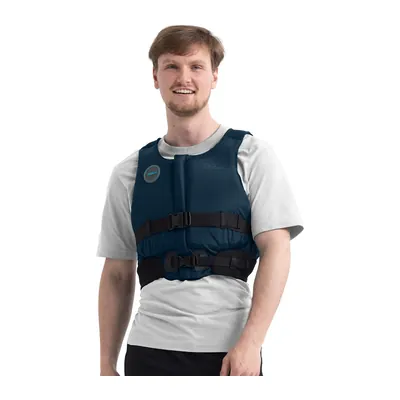
Jobe Adventure
An ISO-certified 50-newton buoyancy aid, cut short to stay comfortable when sitting in a kayak or canoe, with a zip and two buckles. Unisex, several sizes.
View on Amazon (opens in a new tab)
Worth watching
A long-running paddling channel devotes nine minutes to choosing the right kayak paddle size, which complements the charts and the calculation of this guide.
The video is hosted by YouTube (Google): nothing loads until you play it, and Google may then set cookies.
FAQs
What paddle length for a kayak 60 cm wide?
The charts give 210 to 230 cm depending on height: Werner has 220 cm up to 1.83 m and 230 cm above; Decathlon 215 to 220 cm from 1.60 to 1.85 m, and 210 cm under 1.60 m; Camping Wagner 216 to 220 cm for 1.70 to 1.80 m. For 1.75 m, 220 cm is a good starting point to confirm on the water.
Do you need a longer paddle for an inflatable kayak?
Usually yes, because an inflatable is wider. Decathlon recommends a take-apart paddle of about 220 cm, and its chart adds 10 cm to every height beyond 70 cm of width: 225 to 230 cm instead of 215 to 220 cm for 1.60 to 1.85 m. An adjustable paddle helps you fine-tune the length.
What SUP paddle length for a person 1.75 m tall?
For a relaxed outing, count your height plus 20 to 25 cm, so 195 to 200 cm, according to Bending Branches and Aqua-Bound. Camping Wagner gives 15 to 20 cm more for leisure, so 190 to 195 cm. Check on the water: with the blade immersed, the grip sits between your nose and just above your head.
Straight or bent canoe paddle: what difference in length?
Bending Branches counts about 10 cm (4 inches) less for a bent-shaft paddle than for a straight one, because of its shorter stroke; Paddling.com cites about 5 cm (2 inches). Camping Wagner’s chart shows a 10 cm gap. So start from 5 to 10 cm less for the bent-shaft paddle.
How do you check a paddle’s length without a boat?
For a kayak, stand the paddle upright and stretch your arm: your fingers should just touch the tip, according to Decathlon. Or hold it as if paddling, elbows at right angles, hands at two thirds from the centre towards the blade, according to Paddling.com. For a canoe, blade on the ground, the palm grip reaches your chin. A trial on the water remains the most reliable.
Sources
- Paddling.com, Tom Watson, ‘Kayak Paddle Length: How to Pick the Right Size’, accessed 12 November 2026. paddling.com https://paddling.com/learn/kayak-paddle-length-how-to-pick-the-right-size ↩
- REI, ‘Kayak Paddles: How to Choose’ (Werner chart), accessed 12 November 2026. rei.com https://www.rei.com/learn/expert-advice/kayak-paddle.html ↩
- Decathlon, ‘Comment choisir une pagaie de kayak ?’ (in French), accessed 12 November 2026. decathlon.fr https://www.decathlon.fr/c/htc/comment-choisir-une-pagaie-de-kayak_1ee2758f-3dd4-47aa-b139-d9f5dc8aa66d ↩
- Camping Wagner, ‘Paddel’, buying guide (in German), accessed 12 November 2026. campingwagner.de https://www.campingwagner.de/de/c/paddel/ ↩
- Aqua-Bound, ‘How to Size Kayak & SUP Paddles from Home’, accessed 12 November 2026. aquabound.com https://aquabound.com/blogs/resources/how-to-size-kayak-sup-paddles-from-home ↩
- Bending Branches, ‘Stand-Up Paddle Sizing Guide’, accessed 12 November 2026. bendingbranches.com https://bendingbranches.com/blogs/resources/stand-paddle-sizing-guide ↩
- Surf-Magazin, ‘SUP paddle: three steps to the right length and size’, 7 April 2026, accessed 12 November 2026. surf-magazin.de https://www.surf-magazin.de/en/sup/sup-paddle/sup-paddle-three-steps-to-the-right-length-and-size/ ↩
- Bending Branches, ‘How to Size a Canoe Paddle’, accessed 12 November 2026. bendingbranches.com https://www.bendingbranches.com/blogs/resources/how-size-canoe-paddle ↩
- Paddling.com, Cliff Jacobson, ‘How to Size a Canoe Paddle’, accessed 12 November 2026. paddling.com https://paddling.com/learn/how-to-size-a-canoe-paddle ↩

Campervans, motorhomes, cycling and calculators
Julien de Jurquet writes for Outfarer about campervans, motorhomes, cycling and calculators. He reads instruction manuals to the very end and never lets a figure through without its unit, so that your choices rest on sums rather than promises.

 Nolwenn Bastide

