 Français (France)
 English (UK)
 English (US)
 Deutsch (Deutschland)

Contents
What you can really see, step by step
A little 70 mm (2.8 in) telescope gathers about 100 times as much light as your naked eye, whose pupil opens to 7 mm (0.28 in) at best [1]. A hundred times as much, and a galaxy will still look like a faint smudge. Britain’s Society for Popular Astronomy warns that Andromeda may show up as a fuzzy oval of light rather than a dramatic spiral, yet you’re seeing with your own eyes light that has been on its way for some 2.5 million years [2, 1]. Good news: that’s a view worth stepping outside for.
What you see depends on the instrument, and on the sky. The table below follows what NASA, Royal Museums Greenwich, Sky & Telescope, and the Planetary Society say at each step up [3, 4, 5, 6]. Under a bright sky, no telescope can work miracles: a galaxy’s faint outer regions drown in the glow of light pollution, and only its small, bright core shines through [1].
| Step | What you can see |
|---|---|
| Naked eye | Bright planets such as Jupiter [4]; the Orion Nebula, one of a handful of deep-sky objects visible to the unaided eye [7]; under a dark sky, the Milky Way, which most people in the industrialized world have never seen [1] |
| Binoculars, 7x35 to 10x50 | The Moon’s craters 6 miles (10 km) across and larger, a moon or two of Jupiter, the whole Pleiades; from a dark site, Andromeda and the Orion Nebula. Probably not Saturn’s rings [3, 4] |
| Refractor or small reflector, 2.8 to 3.5 in (70 to 90 mm) | The phases of Venus, Jupiter’s cloud bands and four moons, Saturn’s rings, Mars’s polar cap when the planet is close [5, 4]; the Trapezium, four tight stars in the Orion Nebula, from 3 inches (76 mm) at 40x or 50x [7]. The Cassini Division in Saturn’s rings is only just visible at 80 mm (3.1 in) [2] |
| Telescope of 6 to 8 in (150 to 200 mm) | The Cassini Division is clear from about 5 in (130 mm) [2]; finer planetary detail, and the fainter clusters, nebulae, and galaxies that call for more than 4 or 5 inches [6] |
Reference points published by the sources cited, under a decent sky. Photos mislead: the crimson of the Orion Nebula is hard to see by eye, and some observers see it only in shades of gray [7].
Should you start with binoculars? Sources disagree, and it’s worth knowing before you spend. NASA calls a good pair the surprising first instrument of choice for many stargazers: easy to use, more versatile than most telescopes [3]. The Planetary Society suggests them if you’re not sure the hobby will stick [6], and Andrew Fraknoi, an astronomer, notes that many amateurs recommend starting there [8]. Astronomy magazine used to give that advice and now says no: the view through binoculars, especially from a light-polluted site, often disappoints beginners [9]. Its Celestron-sponsored supplement says no as well [10]. Britain’s BAA adds that unmounted binoculars show little detail on planets or the Moon [11]. The sky explains the split: under dark skies, binoculars shine on big targets like the Pleiades [3]; for planets, you need a telescope. Our article on 8x42 vs. 10x42 binoculars helps you decide.
Aperture: the one number that really counts
Aperture is the diameter of the main lens or mirror. It sets both how much light the scope gathers, so how bright the image looks, and how fine the detail gets [1]. Sky & Telescope lists beginner apertures from 2.8 inches (70 mm) up to 10 inches [1]. And light follows the square of the diameter: a mirror twice as wide captures four times as much [10].
Do the math. Against a 7 mm pupil, a 2.8-inch (70 mm) scope gathers about 100 times the light, a 3.5-inch (90 mm) about 165 times, a 4.5-inch (114 mm) about 265 times, a 6-inch (150 mm) about 460 times, and an 8-inch (200 mm) about 815 times (our calculation, from the square-of-the-diameter rule [1]). For the Moon and planets, 70 mm is the minimum named by Which?, the British consumer group, with an expert from the Royal Observatory Greenwich, and by Sky & Telescope; for fainter galaxies, 100 mm (3.9 in) or more is better [12, 1]. The Planetary Society says 4- or 5-inch scopes are great for the planets and the Moon, and that fainter objects call for more [6].
Magnification: a division and a limit
Magnification isn’t a feature of the telescope itself: it depends on the eyepiece, the lens you put your eye to. Divide the telescope’s focal length by the eyepiece’s. With a 1,000 mm focal length and a 25 mm eyepiece, you get 40x [1]. Swap the eyepiece and the magnification changes, while the telescope stays the same.
Then comes the limit. Sky & Telescope gives the usual rule of thumb: top useful magnification is about 50 times the aperture in inches, or twice the aperture in millimeters, and only if the optics are perfect and the air is unusually steady [1]. Sky-Watcher, a telescope maker, gives the same rule [13]. That’s 140x for a 2.8-inch (70 mm) scope and 300x for a 6-inch (150 mm) one. S&T adds that even large telescopes are often held to 250x or 300x on all but the steadiest nights [1], and the Planetary Society says anything above 200x won’t do much for a beginner scope [6]. At the other end, deep-sky observers often drop to about 4x per inch of aperture to get the widest field [1]: roughly 11x for a 2.8-inch scope (our calculation).
One last number: field of view. Crank up the magnification and the field narrows, the image dims, and you have to nudge the scope more often to keep a target in view, Which? warns [12]. Andromeda spans about six Moon-widths under a dark sky, which stretches any telescope’s wide-field capability to the utmost [1], and NASA points out that most telescopes can’t fit the whole Pleiades or Andromeda into the eyepiece [3]. That’s why you start at low power, with a decent finder.
Refractor, Newtonian, Dobsonian, compound: four families
A telescope pairs optics, which form the image, with a mount, which holds it. On the optics side, four families cover nearly every first purchase. Sky & Telescope counts three classes (refractors, reflectors, and catadioptrics); we split out the Dobsonian because it’s the one beginners keep asking about. The sources agree on the broad strokes and quarrel over the details [1, 6, 10].
| Family | Strengths | Drawbacks |
|---|---|---|
| Refractor (lenses) | Rugged, low maintenance, sharp and contrasty, and ready to use almost as soon as you carry it out [1, 10] | False color around bright objects; the price climbs steeply past 4 or 5 inches [1, 6] |
| Newtonian reflector (mirrors) | The most aperture for the money [1] | Mirrors need collimation from time to time, the open tube lets dust in, and the mirror needs recoating every 10 to 20 years [1, 6] |
| Dobsonian (a Newtonian on a swivel base) | By far the brightest, most detailed images per dollar, according to Sky & Telescope [1]; simple to set up and use | Bulky: a 6-inch Dobsonian that Planetary Society members recommend weighs 34 pounds [6] |
| Compound (Schmidt-Cassegrain, Maksutov) | A short, transportable tube holding a large aperture [1] | Slowest to cool to the night air, a narrow widest field, and a higher price than a Newtonian of the same aperture [1] |
Collimation: aligning the mirrors, needed from time to time, sometimes months apart, according to Sky & Telescope [1].
Two disagreements to know about. Tabletop telescopes, with no tripod, tempt with low prices, and Sky & Telescope says models based on the Dobsonian design come with many of the best scopes under $150 [1]. Britain’s BAA advises against them: a telescope has to stand on the ground, not on a table that’s probably unstable [11]. And on collimation, Sky & Telescope says the mirrors of the average Newtonian may go months without tweaking [1], while Astronomy’s supplement says many skygazers collimate before each session [10], which fits a scope that gets carried around, since mirrors can drift when it’s moved or jostled [1, 10].
The mount: where most disappointment starts
The best telescope in the world is useless on a wobbly mount. Sky & Telescope calls low-quality mounts by far the most common problem with budget scopes. That’s especially true of “toy” telescopes sold in department stores, but even reputable vendors sometimes pair a good optical tube with an undersized mount [1]. And the bigger and heavier the instrument, the sturdier the mount has to be [12].
Two kinds of mounts dominate. The alt-az mount moves up and down, left and right, like the pan-and-tilt head of a camera tripod, and it’s the simplest to use [6, 1]. The equatorial mount follows the sky by turning around a single axis, but you have to point that axis at Polaris, the North Star, to set it up [6], and it’s heavier and bulkier than an alt-az [1]. The Planetary Society recommends sticking with alt-az [6], and Britain’s BAA doesn’t recommend equatorial mounts for beginners [11].
And Go-To, the computerized mount that finds objects for you? Opinions split there too. Britain’s BAA tells beginners to avoid it and learn to point by hand [14], and the Society for Popular Astronomy worries it takes the fun out of finding your way around the sky [2]. Sky & Telescope notes that most entry-level Go-To scopes still need an alignment on specific stars every time, and that a tight budget may do better on good optics and a sturdy manual mount [1]. The Planetary Society finds Go-To easy for beginners and handy under light-polluted skies, though not the best way to learn the sky [6]. Fraknoi says it can help if you can’t identify most of the constellations [8]. Astronomy, for its part, says yes: even experienced observers prefer go-to [9, 10].
Why to skip the department-store telescope
The American Astronomical Society doesn’t mince words. Its eclipse task force tells buyers to steer clear of telescopes sold in department stores, drug stores, and toy stores, especially ones that promise high magnification, because their optics are often poor and their mounts shaky. Its advice: buy from a knowledgeable dealer, in a specialty store or online, who can help you pick [15].
The mechanics of the promise are simple. Which? lists a 60 mm (2.4 in) refractor with a 900 mm (35 in) focal length, sold with 4 mm, 12.5 mm, and 20 mm eyepieces and a 3x Barlow lens, an add-on that multiplies an eyepiece’s magnification. With the 4 mm eyepiece, you get 900 ÷ 4 = 225x; with the Barlow, 675x. Yet Which? gives that very scope a maximum magnification of 120x: the box’s promise is 5.6 times the limit (our calculation, from the specifications Which? published [12]). The example is British, but the trick isn’t: Sky-Watcher describes the same 600x ads [13].
- A huge advertised magnification, 300x or 600x, on a 60 mm (2.4 in) aperture [1, 13].
- A Barlow lens in the box, which multiplies the magnification: a 3x one takes 225x to 675x in the Which? example [12].
- A flimsy tripod and mount: shaky mounts are the AAS’s complaint [15] and, for Sky & Telescope, the most common problem of budget scopes [1].
- A 5x finderscope, most of which are very poor quality [1].
- A solar filter that threads into the eyepiece: dangerous (see the last section) [16].
- A seller with no advice to give; the AAS says to buy from a knowledgeable dealer [15].
What to budget
Prices move fast and sources age quickly, so here are published ranges, in dollars, with their year. Keep the order of magnitude: under $100, a scope may be too frustrating to use, and a good beginner scope starts around $200 to $400 [6].
| Source | Price point | Year |
|---|---|---|
| Sky & Telescope | A decent scope for $150 or less, with very modest aperture; the cheapest scope with no serious compromises is a 6- or 8-inch Dobsonian, roughly $300 to $500 [1] | 2021 |
| The Planetary Society | $200 to $400 for a good beginner telescope, the top of the range going to computerized mounts; under $100 may be too frustrating to use [6] | 2020, prices updated 2023 |
| Planetary Society members’ picks | A 6-inch Dobsonian at $469.99; a tabletop Dobsonian at $129.99; an 80 mm (3.1 in) refractor on an equatorial mount at $159.99; a computerized Schmidt-Cassegrain from $679 [6] | Prices updated 2023 |
| Andrew Fraknoi | From a few hundred to thousands of dollars [8] | 2025 |
Prices as the sources printed them; dealers’ prices change often, so check a current price before you decide.
Keep part of your budget for extra eyepieces, a sky atlas, and guidebooks, Sky & Telescope advises, and adds that many people swear by an adjustable-height chair [1]. Look at what the price includes, too: most telescopes marketed to beginners come as complete systems, while some high-end models are sold as an optical tube only [9]. In Britain, Which? found that price is no indicator of quality among the beginner telescopes it rated: two scopes with the same focal length and aperture show about the same things, and the gap comes from the optics, the mount, and the finder [12].
Try before you buy: join a club
This is the advice nearly every source shares: look through several instruments, and talk to the people who own them. Sky & Telescope suggests contacting a local astronomy club, which may hold observing nights where you can try different scopes and chat with their owners [1]. Astronomy calls a club’s observing session, or a star party, a great place to test-drive a telescope [10, 9]. (A star party is an event where club members set up telescopes for the public to look through [8].) NASA says the same, and adds one rule: ask permission before taking a closer look at someone’s scope [3].
In the U.S., the Night Sky Network is a nationwide coalition of amateur astronomy clubs that share their time and telescopes with the public [17], and NASA points to its Clubs & Events page for finding clubs and star parties near you [3, 18]. The Astronomical League lists clubs state by state [19]. Some clubs and libraries go further: the League says many clubs have loaner scopes for their members, and describes library programs where patrons check out a telescope the way they borrow a book, with waiting lists that can stretch to three months [20].
Show up with your binoculars, look through every scope without rushing, and ask the owner whether you may give the tube a tap. If the tripod wobbles, you’ll know right away.
The Sun: the one rule that isn’t negotiable
The ISO 12312-2 standard covers eclipse glasses and handheld viewers. It doesn’t apply to filters that fit over the front of a telescope, though a filter made of material that meets its requirements should work as an aperture filter too [22]. What to remember: filter on the front, never behind, and never leave a telescope unattended when children are around [23].
The rest is pure pleasure: a clear evening, a tripod that holds still, a tiny bright world in the middle of the eyepiece. Our guide to stargazing for beginners tells you where to go and when, and our article on the Bortle scale shows how to judge how dark a place is. All that’s left is to pick the night.
Gear related to this article
No affiliation: no commission, no sponsored products.
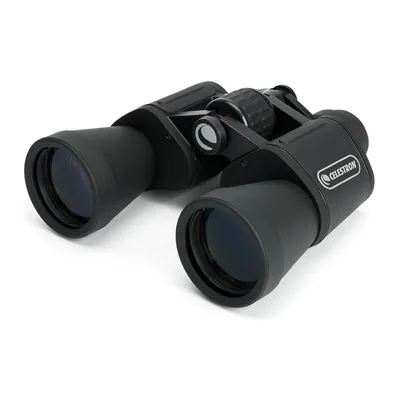
Celestron UpClose G2 10x50
10x50 Porro prism binoculars: 50mm objectives, 5mm exit pupil, 6.8° field of view, 27 oz, and tripod-adaptable (adapter sold separately).
View on Amazon (opens in a new tab)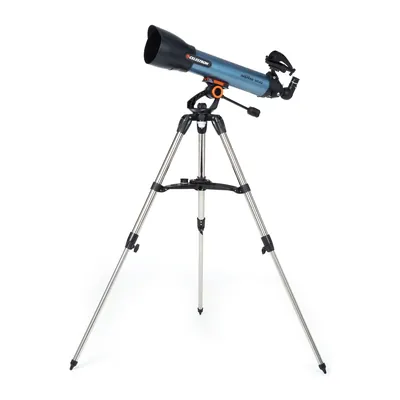
Celestron Inspire 100AZ
Short 100mm refractor with fully coated glass optics on a manual alt-azimuth mount, with 20mm and 10mm eyepieces, an erect-image diagonal, a red-dot finder and a smartphone adapter.
View on Amazon (opens in a new tab)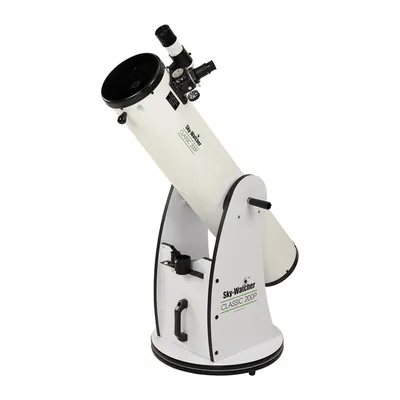
Sky-Watcher Classic 200 Dobsonian
8-inch (203 mm) Dobsonian reflector with a parabolic mirror, 1,200 mm focal length (f/5.9), 44-inch solid tube and a 2-inch focuser. A bulky instrument: plan where it will live.
View on Amazon (opens in a new tab)
Worth watching
J. Kelly Beatty of Sky & Telescope, at a Harvard-Smithsonian observatory night, covers a beginner telescope, equatorial mounts, eyepieces and price, to help match an instrument to how you will use it.
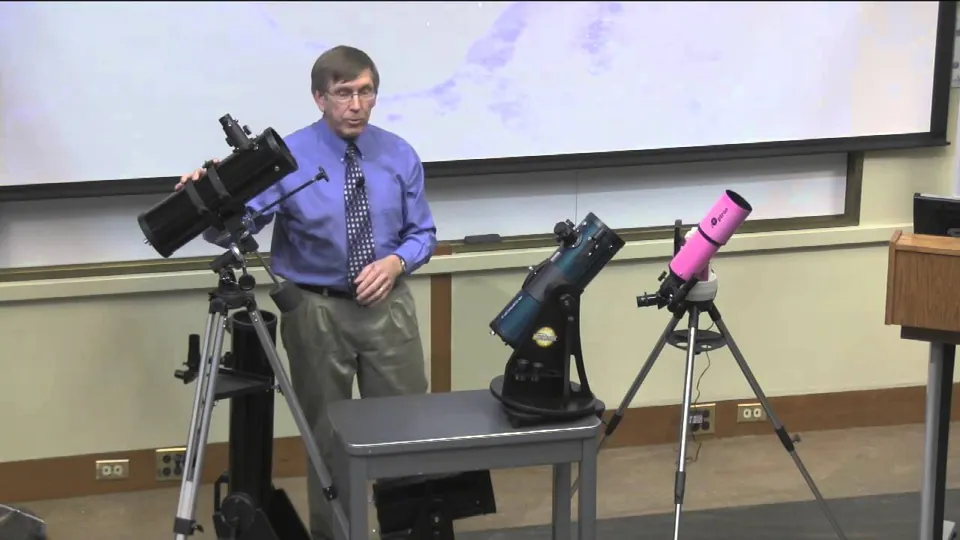
The video is hosted by YouTube (Google): nothing loads until you play it, and Google may then set cookies.
FAQ
What’s the best first telescope for a beginner?
The one you’ll use most. Aim for at least 70 mm (2.8 in) of aperture, a steady mount, and a size you’ll really carry outside. Sky & Telescope calls a 6- or 8-inch Dobsonian, roughly $300 to $500 (2021), the cheapest scope without serious compromises; the Planetary Society says $200 to $400 buys a good one (prices updated 2023). Try a few at a club first.
What magnification does a beginner telescope need?
Don’t go by the box. Top useful magnification is about 50 times the aperture in inches, or twice the millimeters: 140x for a 2.8-inch (70 mm) scope, 300x for a 6-inch (150 mm) one, and only on very steady nights. Divide the telescope’s focal length by the eyepiece’s to get yours. Start low: the image is brighter and easier to find and follow.
Should I buy binoculars before a telescope?
The sources split. NASA, the Planetary Society, and Andrew Fraknoi lean toward binoculars first: they’re affordable, wide-field, and useful for other things. Astronomy magazine says no, because the view, especially from a light-polluted site, often disappoints beginners. The sky explains it: under dark skies, binoculars show the Pleiades and the Orion Nebula well, while planets call for a telescope.
Are department-store telescopes really that bad?
The American Astronomical Society says to steer clear of them, especially ones that promise high magnification, because the optics are often poor and the mounts shaky. A 60 mm (2.4 in) scope advertised at 600x is no bargain: Sky-Watcher says such scopes mostly magnify the turbulence in the air. Look for at least 70 mm (2.8 in), a stable mount, and a seller who can answer your questions.
Can I look at the Sun through a telescope?
Only with a solar filter made for the purpose and fixed over the front of the instrument. Without one, severe eye injury happens instantly. Eclipse glasses don’t protect you behind an instrument. The small filters that thread into the eyepiece, sometimes packed with cheap telescopes, are dangerous: never use them. When in doubt, ask an astronomer.
Sources
- Sky & Telescope, Adrian R. Ashford, “How to Choose a Telescope,” January 25, 2021, accessed November 15, 2026. skyandtelescope.com https://skyandtelescope.com/astronomy-equipment/how-to-choose-a-telescope/ ↩
- Society for Popular Astronomy (UK), “Choosing a telescope,” updated February 20, 2026, accessed November 15, 2026. popastro.com https://www.popastro.com/help-advice/choosing-a-telescope/ ↩
- NASA Science, Night Sky Network, Kat Troche, “Binoculars: A Great First Telescope,” May 15, 2024, accessed November 15, 2026. science.nasa.gov https://science.nasa.gov/solar-system/skywatching/night-sky-network/binoculars-a-great-first-telescope/ ↩
- NASA Science, Night Sky Network, “Spot the King of Planets: Observe Jupiter,” February 2023, updated February 2024, accessed November 15, 2026. science.nasa.gov https://science.nasa.gov/solar-system/skywatching/night-sky-network/spot-the-king-of-planets-observe-jupiter/ ↩
- Royal Museums Greenwich (UK), “The Solar System through your own telescope,” accessed November 15, 2026. rmg.co.uk https://www.rmg.co.uk/stories/space-astronomy/solar-system-through-your-own-telescope ↩
- The Planetary Society, Cheyenne Polius, “How to pick the best beginner telescope,” August 12, 2020, prices updated June 2023, accessed November 15, 2026. planetary.org https://www.planetary.org/articles/how-to-pick-the-perfect-beginner-telescope ↩
- Sky & Telescope, “Observing the Great Orion Nebula,” Night Sky, January/February 2005, accessed November 15, 2026. skyandtelescope.com https://skyandtelescope.com/observing/celestial-objects-to-watch/observing-the-great-orion-nebula ↩
- Andrew Fraknoi, “A Buying Guide for a First Telescope,” 2025, accessed November 15, 2026. fraknoi.com https://fraknoi.com/wp-content/uploads/2025/02/Buying-Guide-to-First-Telescope.pdf ↩
- Astronomy, Michael E. Bakich, “Telescopes 101: 15 essential things to know,” February 12, 2024, updated September 23, 2026, accessed November 15, 2026. astronomy.com https://www.astronomy.com/observing/telescopes-101-15-essential-things-to-know/ ↩
- Astronomy, “How to buy your first telescope,” July 2, 2026, updated August 27, 2026, a supplement presented by Celestron, accessed November 15, 2026. astronomy.com https://www.astronomy.com/observing/how-to-buy-your-first-telescope/ ↩
- British Astronomical Association (UK), David Arditti, “What telescope should I give a child?” October 13, 2018, accessed November 15, 2026. britastro.org https://britastro.org/2018/what-telescope-should-i-give-a-child ↩
- Which? (UK consumer organization), “Best telescopes for beginners 2026,” with Dr Greg Brown of the Royal Observatory Greenwich, tested February 2026, page checked August 2026, accessed November 15, 2026. which.co.uk https://www.which.co.uk/reviews/telescopes/article/how-to-buy-the-best-telescope-atl543X1xOeJ ↩
- Sky-Watcher, “Usable Manifications,” September 28, 2011, accessed November 15, 2026. skywatcher.com https://skywatcher.com/post/product/usable-manifications/ ↩
- British Astronomical Association (UK), David Arditti, “What is the best telescope for an adult beginner?” December 27, 2018, accessed November 15, 2026. britastro.org https://britastro.org/2018/what-is-the-best-telescope-for-an-adult-beginner ↩
- American Astronomical Society, Solar Eclipse Task Force, “Telescopes & Binoculars,” accessed November 15, 2026. eclipse.aas.org https://eclipse.aas.org/resources/telescopes-binoculars ↩
- American Astronomical Society, Solar Eclipse Task Force, “Solar Filters for Optics: Telescopes, Binoculars & Cameras,” accessed November 15, 2026. eclipse.aas.org https://eclipse.aas.org/eye-safety/optics-filters ↩
- NASA Science, “Night Sky Network,” accessed November 15, 2026. science.nasa.gov https://science.nasa.gov/skywatching/night-sky-network/ ↩
- NASA, Night Sky Network, “Astronomy Clubs in the United States” (club search; the list needs JavaScript), accessed November 15, 2026. nightsky.jpl.nasa.gov https://nightsky.jpl.nasa.gov/clubs/ ↩
- Astronomical League, “Astronomy Clubs listed by State and Alphabetically,” accessed November 15, 2026. astroleague.org https://www.astroleague.org/astronomy-clubs-usa-state/ ↩
- Astronomical League, “Library Telescope Program,” accessed November 15, 2026. astroleague.org https://www.astroleague.org/library-telescope-program/ ↩
- NASA, “Eclipse Viewing Safety,” updated March 20, 2026, accessed November 15, 2026. science.nasa.gov https://science.nasa.gov/eclipses/safety/ ↩
- American Astronomical Society, Solar Eclipse Task Force, “About the ISO 12312-2 Standard for Solar Viewers,” accessed November 15, 2026. eclipse.aas.org https://eclipse.aas.org/eye-safety/iso12312-2 ↩
- Sky & Telescope, Jeff Medkeff, “Safe Solar Observing,” August 7, 2006, accessed November 15, 2026. skyandtelescope.com https://www.skyandtelescope.com/observing/safe-solar-observing/ ↩

Trail running, snow, water, nature and destinations
Nolwenn covers trail running, snow, water, nature and destinations for Outfarer. Curious about everything, from meteor showers to night-train schedules, she has a knack for digging up the one detail that changes everything, and nailing it in a single sentence.


 Erik Vadas-Gauden