 Français (France)
 English (UK)
 English (US)
 Deutsch (Deutschland)

Contents
What you will really see, step by step
A 70 mm telescope gathers about 100 times as much light as the naked eye, whose pupil opens to 7 mm at best [1]. A hundred times more, and a galaxy is still a pale oval. The Society for Popular Astronomy (SPA), a British amateur society founded in 1953, says the Andromeda Galaxy may look like a fuzzy oval rather than a dramatic spiral, but you are seeing with your own eyes light that has been travelling for some 2.5 million years [2]. Good news: that is worth a trip to the garden.
What you see depends on the instrument, and on the sky. The table below sets out, step by step, what Royal Museums Greenwich (which includes the Royal Observatory), NASA and the SPA say [2, 3, 4, 5, 6]. In town, faint objects vanish whatever the diameter: Sky & Telescope notes that only the small, bright core of a galaxy shines through heavy light pollution [1]. The Moon and the brighter planets, on the other hand, stay easy even in the brightest city lights, Which? quotes Greg Brown of the Royal Observatory Greenwich as saying [7].
| Step | What you can see |
|---|---|
| Naked eye | Mars, Jupiter, Venus and Saturn as points of light, with no detail; the Andromeda Galaxy as a faint fuzzy patch, under very dark skies [3] |
| Binoculars, 7x35 to 10x50 | Lunar craters about 6 miles (10 km) across and larger, one or two moons of Jupiter according to NASA, four according to Royal Museums Greenwich [5, 6]; large star clusters such as the Pleiades; from a dark site, the Andromeda Galaxy and the Orion Nebula. Not the rings of Saturn [4] |
| Telescope, 70 to 90 mm | The phases of Venus, the cloud bands of Jupiter and its four main moons, the rings of Saturn, the polar cap of Mars when it is close [5, 6]; the four stars of the Trapezium in the Orion Nebula from about 3 inches (76 mm), at 40x or 50x [8]. The gap in Saturn’s rings, the Cassini Division, is only just visible at 80 mm [2] |
| Telescope, 100 to 200 mm | The Cassini Division is usually obvious at 100 mm and clear at 130 mm [2]; more detail on the planets and more depth in the sky, with 100 mm or larger suggested for galaxies beyond Andromeda and Triangulum [7] |
Guide figures from the sources cited, under a reasonable sky. No telescope shows the colour and detail that photographs of faint objects reveal [2].
Should you start with binoculars? The sources do not agree. NASA’s Night Sky Network calls a good pair the first instrument of choice for many stargazers [4], and National Astronomy Week (NAW), a UK public astronomy event, suggests making the most of any you already own [9]. The SPA says small binoculars are a good beginner’s instrument, but that for the planets and most nebulae, clusters and galaxies you cannot do without a telescope [2]. A BAA article from 2018 on a child’s first telescope recalls Patrick Moore’s advice to start with binoculars, then gives the counter-argument: they will not show detail on the planets, nor much on the Moon, unless they are mounted [10]. A magazine supplement presented by a telescope maker, Celestron, answers a flat ‘No’: the view through binoculars, especially near a city, will not be what you expect, though it adds that they are valuable at a dark site [11]. A likely explanation is the sky: under dark skies, binoculars win on big objects such as the Pleiades; for the planets, you need a telescope. Our article on binoculars, and how to read their numbers helps you decide.
Aperture: the one number that matters most
The The diameter of the main lens or mirror of a telescope, in millimetres. sets both how much light the telescope collects, which is how bright the image is, and how fine the detail it can show [1]. Sky & Telescope, an American magazine, gives 2.8 inches (70 mm) up to 10 inches (254 mm) as the range commonly recommended for first telescopes [1]. The SPA says telescopes start at about 60 mm and that around 100 mm is a good size [2]. The light grows with the square of the diameter: a mirror twice as wide collects four times as much [11].
Do the sum. Compared with a 7 mm pupil, 70 mm gives about 100 times the light, 90 mm about 165 times, 114 mm about 265 times, 150 mm about 460 times and 200 mm about 815 times (our calculation, using the square of the diameter [1]). For the Moon and planets, Which? sets the floor at 70 mm, and NAW calls about 70 mm the smallest useful aperture [7, 12]. The SPA adds that with a 60 mm telescope no amount of magnification will show the Cassini Division, whereas with a 100 mm telescope it is usually obvious [2].
Magnification: one division and one limit
Magnification is not a feature of the telescope itself: it comes from the eyepiece. Divide the telescope’s The distance, in millimetres, over which a lens or mirror brings light to a focus. by the eyepiece’s: a 1,000 mm telescope with a 25 mm eyepiece gives 40x [1, 7]. The SPA’s example is 900 mm and 25 mm, giving 36x [13]. Change the eyepiece and the magnification changes; the telescope stays the same. The SPA adds that even expert astronomers start with low magnifications, which give a wider field, so that they can find the object and centre it first [13].
Then comes the limit. Sky & Telescope gives the usual rule: the top useful magnification is about twice the aperture in millimetres, and only if the optics are perfect and the air unusually steady [1]. Sky-Watcher, a telescope maker, gives the same rule, about 2x per millimetre under good conditions [14], and Which? lists a theoretical maximum of 140x for its 70 mm models [7]. That means 140x for 70 mm and 300x for 150 mm; Sky & Telescope even says that large telescopes are often limited to 250x or 300x on all but the steadiest nights [1]. There is a floor as well: Which? gives 10x as the minimum for a 70 mm telescope, which is what you get by dividing the aperture by a 7 mm pupil (our calculation) [7].
More magnification also means a narrower and dimmer view, and more nudging of the telescope to keep the target in sight, warns Which? [7]. Greg Brown says a telescope with a 700 mm focal length and a 10 mm eyepiece, which gives 70x by our calculation, can fill your view with the Moon [7]. That is why you begin with low power and a The small sighting scope or red-dot sight fixed to the side of the tube, used to aim the telescope. that works.
Refractor, Newtonian, Dobsonian, Maksutov: four families
A telescope is an optical tube and a mount. For the tube, four families cover almost every first purchase. The sources agree on the broad lines and argue about the details [1, 7, 15].
| Family | Strengths | Weaknesses |
|---|---|---|
| Refractor (lens) | Robust, low maintenance, good contrast, and ready to use almost as soon as it is outside [1, 15] | Colour fringing around bright objects; the price climbs steeply above about 120 mm [7, 15] |
| Newtonian reflector (mirror) | More aperture for the money, and no colour fringing [7, 15] | The mirrors need realigning from time to time, which is called collimation, and the mirror can get dusty [7, 15] |
| Dobsonian (a Newtonian on a simple swivelling base) | The cheapest way to a large aperture: the SPA says a 250 mm Dobsonian costs about the same as a 127 mm Maksutov on a GoTo mount [16] | Bulky: Which? lists a 152 mm Dobsonian at 23 kg with a tube 110 cm long, whereas its 130 mm FlexTube, with a retractable tube, weighs 6.2 kg [7] |
| Maksutov and Schmidt-Cassegrain (mirrors and lens) | Short tube and easy to carry; Maksutovs come in small sizes such as 90 mm and 127 mm [15] | Slow to cool to the night air, a narrow field, and a high price for the aperture above about 150 mm [1, 7, 17] |
Collimation means realigning the mirrors. Sky & Telescope says the mirrors of an average Newtonian may go for months without a tweak [1].
Two disagreements are worth knowing about. Table-top telescopes appeal for their light weight and low price, and Sky & Telescope notes that table-top mounts have made a comeback with many of the best budget scopes [1]. David Arditti, who signed the BAA article as director of its Equipment & Techniques Section, does not recommend them for a child’s first telescope: a telescope has to stand on the ground, he says, not wobble on a table [10]. On collimation, Sky & Telescope says months can pass between adjustments, while Astronomy says many skygazers realign their telescopes before each session because a reflector is sensitive to jostling in transport [1, 11]. The two are describing different habits: a telescope that stays put, and one that travels.
The mount: the main cause of disappointment
The best telescope in the world is useless on a wobbly mount. Sky & Telescope calls poor mounts by far the most common problem with budget telescopes, department-store ‘toys’ included, and says even reputable vendors sometimes pair a good tube with an undersized mount [1]. Arditti explains why: a telescope magnifies the slightest vibration and puff of wind, so with an inadequate mount the image flies about and cannot be focused; at the bottom end of the market, the usual problem is simply getting it to point at an object and stay there [10]. NAW adds that budget instruments on flimsy mountings can shudder just as you try to focus [12]. The bigger and heavier the telescope, the sturdier the mount must be, says Brown [7].
Mounts come in two families. An altazimuth mount moves up and down and from side to side, and is the easier to use [7]. An equatorial mount follows the sky with a single axis, but it has to be aligned on the pole star and needs heavy counterweights [12]. NAW judges a sturdy altazimuth better than a cheap equatorial [9], and the SPA says beginners often have trouble setting equatorial mounts up [16]. Arditti does not recommend them for beginners at the cheap end, where he says the weight and quality of construction needed to make one stable are out of reach [10]. His later article for adult beginners, however, names as his top recommendation a 150 mm reflector on a Sky-Watcher EQ5 equatorial mount, which cost £425 in total in December 2018 [17].
And GoTo, the computerised mount that finds objects for you? Opinion divides again. In between, some telescopes use a smartphone to show you which way to push: NAW placed these above £200 in 2020 [12]. The table sets out where the sources stand on the fully computerised kind.
| Source | Position |
|---|---|
| British Astronomical Association (Arditti, 2018) | Beginners should generally avoid them: so much can go wrong, and so much astronomical background is needed to get the best from them [17] |
| Society for Popular Astronomy (2026) | Useful, but you may quickly get bored, because GoTo removes the challenge of finding your way around the sky [16] |
| Sky & Telescope (2021) | On a tight budget, put all your money into good optics and a sturdy manual mount rather than half of it into GoTo [1] |
| Astronomy supplement presented by Celestron (2026) | Yes: even experienced observers prefer GoTo telescopes, which save time [11] |
Three of the four are cautious about GoTo for a first telescope; the fourth is presented by a maker of GoTo telescopes.
Why steer clear of the cheapest telescopes
The American Astronomical Society (AAS) is blunt: steer clear of telescopes found in department stores, drug stores or toy stores, especially those that promise high-power views, because their optics are often poor and their mounts shaky; buy instead from a knowledgeable dealer [18]. British sources say much the same in their own terms. The SPA notes that a camera shop or superstore may stock a few telescopes without always knowing what it is selling, and recommends a specialist supplier [16]. The BAA, too, advises a specialist astronomy dealer rather than the general internet, for sensible advice and decent after-sales service [10]. NAW says the cheapest camera-shop and catalogue-shop refractors are best avoided, and that if you buy from an unknown name off the internet you are on your own [12]. Price alone does not settle it either: Which? found that price is no indicator of quality, and that two telescopes at very different prices will often show the same things if their focal length and aperture match, the mount and finderscope making the rest of the difference [7].
The mechanics of the promise are simple. In 2026 Which? listed a 60 mm refractor with a focal length of 900 mm, supplied with 4 mm, 12.5 mm and 20 mm eyepieces and a 3x Barlow lens, at £117 to £119 [7]. A A lens fitted between the telescope and the eyepiece that multiplies the magnification by two or three. multiplies what the eyepiece gives. With the 4 mm eyepiece, 900 ÷ 4 gives 225x; add the Barlow lens and you reach 675x. Which? gives the same instrument a theoretical maximum of 120x. On paper, the kit can therefore reach about 5.6 times the magnification its optics can use, which is the sort of figure a box can print (our calculation from Which?’s published specifications [7]).
The 70 mm Centon 900x70 in the same listing has the same eyepieces and Barlow lens, so the same 675x, against a stated maximum of 140x: about 4.8 times (our calculation) [7].
- A huge magnification on a 60 mm aperture, such as 300x or 600x [1, 14].
- A Barlow lens thrown in to inflate the figure [12].
- A short-tubed Newtonian with a very long focal length, around 1,000 mm, achieved with an extra lens in the focuser, which NAW says lowers the optical quality [12].
- A tripod head that looks like a camera tripod head [10].
- A 5x finderscope, most of which are of very poor quality [1].
- A solar filter that threads into the eyepiece: dangerous (see the last section) [19].
- A seller with no advice to give [16, 18].
How much to budget
Every figure below comes from a British source, in pounds, with its year. Prices move, so take them as a guide rather than a shopping list. NAW’s more recent page puts it simply: do not expect too much from a cheap telescope, under about £150 [9].
| Source | Guide | Year |
|---|---|---|
| Which? | Many beginner telescopes cost £50 to £200; the ones it tested range from under £100 to nearly £300. Listed prices include £99 for a 60 mm Maksutov on a Dobsonian mount and £194 to £229 for a 130 mm Dobsonian with a retractable tube [7] | 2026 |
| Society for Popular Astronomy | Perfectly reasonable telescopes for around £200, and usable ones for less; computerised and motorised models from around £400; smart telescopes from £350; £2,000 or more for decent photographs [16] | 2026 |
| National Astronomy Week | Reasonable quality begins under £100, on flimsy mounts; aim for over £200 for a more satisfying view; GoTo at around £300 or more; Dobsonians from £150 [12] | 2020 |
| British Astronomical Association | A 70 mm refractor, the Sky-Watcher Mercury-707, at £79, which Arditti could fully recommend; 150 mm Dobsonians a little over £200; a 150 mm Newtonian tube at £179, or £425 on an EQ5 mount [10, 17] | 2018 |
Do not compare these figures too closely: the years and the types of instrument differ, and the 2018 prices will not match today’s shelves.
Keep some budget back for extras, advises Sky & Telescope: more eyepieces, a star atlas, a chair [1]. Look at what the price includes, too. In Which?’s listing the 130 mm Dobsonian comes with 10 mm and 25 mm eyepieces, a red-dot finder and a collimation cap [7]. For better telescopes, sold as a tube and a mount separately, Arditti suggests spending about two thirds on the tube and one third on the mount, or half and half with a computerised mount [17].
If a new telescope is out of reach, consider second-hand. NAW names astrobuysell.com/uk as a good, free source, but warns that you need to know what you are buying and should not expect advice [9]. The SPA says many second-hand telescopes perform as well after 20 years as when new, and its forum has a classified section; it also points to astronomy fairs such as Astrofest in London in February, and the Practical Astronomy Show and International Astronomy Show, usually in Warwickshire [16].
Try before you buy: join a society
On this point the sources nearly all agree: before buying, look through several instruments and talk to the people who own them. NAW says to get advice from your local astronomical society before you buy, and that joining one could save you from an expensive mistake [9]. Sky & Telescope recommends contacting a local club, which may hold observing nights where you can try various telescopes [1], and NASA’s Night Sky Network says the same of evenings hosted by clubs [4]. If there is no society near you, NAW suggests asking specialist telescope suppliers for advice by email or phone [9].
In the UK, the Federation of Astronomical Societies (FAS), founded in 1974, brings together nearly 200 affiliated societies in the UK and overseas [20]. Its county-by-county list gives each society’s website, meeting place and meeting night; some say visitors are welcome, and the list itself asks you to check a society’s website before you travel [21]. The BAA, founded in 1890, welcomes new members whatever their level of experience [22].
The Sun: the one rule that is not negotiable
The ISO 12312-2 standard covers eclipse glasses and handheld viewers. It does not apply to filters fitted over the front of a telescope, although a material that meets its requirements should work as one [25]. What matters is the principle: filter at the front, never at the back, and never leave a telescope unattended when children are about [26].
The rest is pleasure: a clear evening, a stand that does not move, a tiny disc in the middle of the eyepiece. Our guide on how to go stargazing says where to go and when, and our article on the Bortle scale and dark-sky maps shows how to judge how dark a site is. All that is left is to pick the night.
Kit related to this article
No affiliation: no commission, no sponsored products.
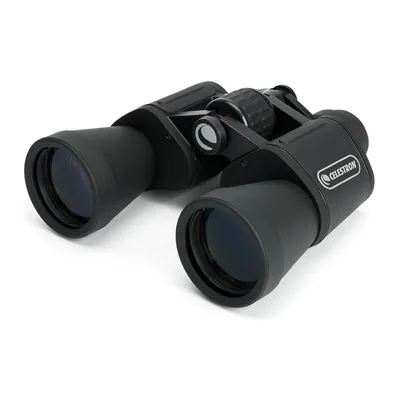
Celestron UpClose G2 10x50
10x50 Porro prism binoculars: 50 mm objectives, 5 mm exit pupil, 6.8° field of view, 765 g, and tripod-adaptable (adapter sold separately).
View on Amazon (opens in a new tab)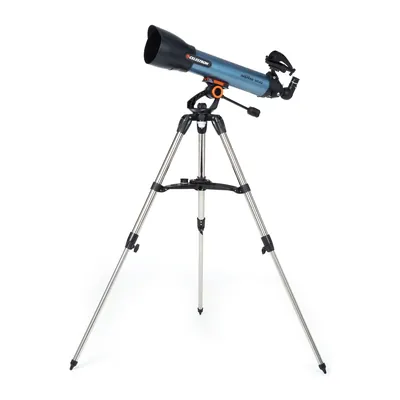
Celestron Inspire 100AZ
Short 100 mm refractor with fully coated glass optics on a manual alt-azimuth mount, with 20 mm and 10 mm eyepieces, an erect-image diagonal, a red-dot finder and a smartphone adapter.
View on Amazon (opens in a new tab)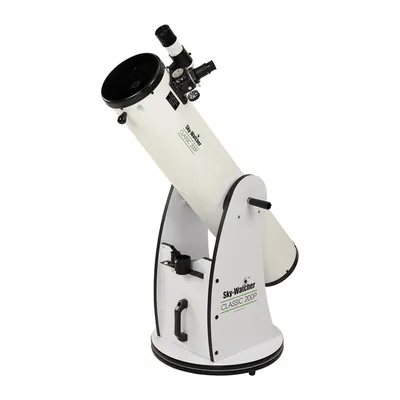
Sky-Watcher Skyliner-200P
203 mm (8 inch) Dobsonian reflector with a parabolic mirror, 1,200 mm focal length (f/5.9), 112 cm solid tube and a 2-inch focuser. A bulky instrument: plan where it will live.
View on Amazon (opens in a new tab)
Worth watching
Advice from BBC Sky at Night Magazine on buying a first telescope: the main types of telescope, the Dobsonian reflector and the different mounts. Filmed in 2010, so it gives principles rather than current models.
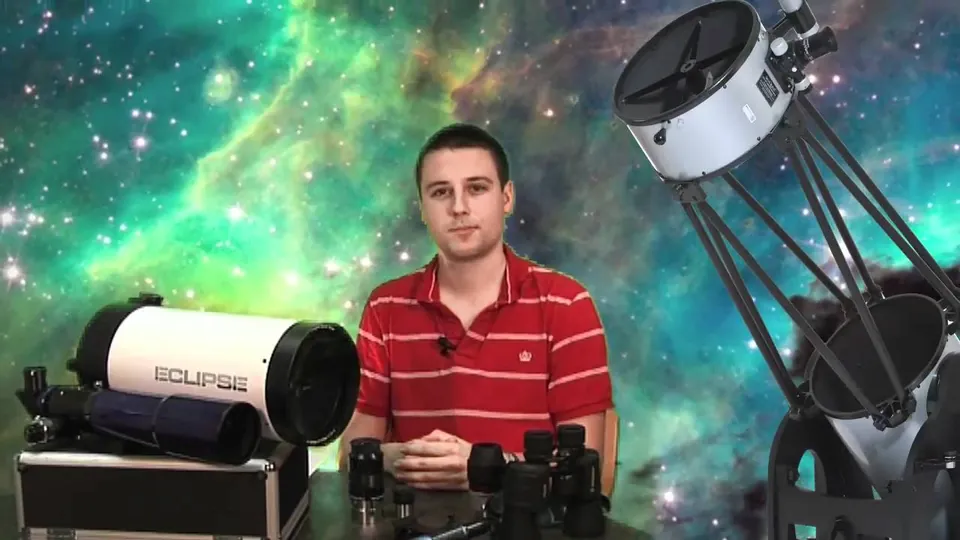
The video is hosted by YouTube (Google): nothing loads until you play it, and Google may then set cookies.
FAQs
What magnification do I need for a first telescope?
Ignore the figure on the box. The top useful magnification is about twice the aperture in millimetres, so 140x for a 70 mm telescope and 300x for a 150 mm one, and only when the air is steady. You get the magnification by dividing the telescope’s focal length by the eyepiece’s. Start with low power: the image is brighter and the target easier to keep in view.
Should I start with binoculars or a telescope?
The sources disagree. NASA’s Night Sky Network and National Astronomy Week favour binoculars first: cheap, wide-field and useful elsewhere. A magazine supplement presented by a telescope maker says no. The SPA says small binoculars are a good start, but you need a telescope for the planets and most faint objects. Under a dark sky binoculars show big clusters well.
Are cheap telescopes from high-street shops any good?
Usually not. The American Astronomical Society advises steering clear of department-store and toy-store telescopes, which often have poor optics and shaky mounts. The SPA recommends a specialist supplier, and National Astronomy Week advises against the cheapest camera-shop refractors. A 60 mm telescope advertised at 600x is a warning sign. Look for at least 70 mm, a steady mount and a seller who can answer your questions.
How much does a decent first telescope cost in the UK?
The SPA says you can get perfectly reasonable telescopes for around £200 (2026), and usable ones for less; computerised, motorised models start around £400. Which? found many beginner telescopes at £50 to £200 and tested models up to nearly £300 (2026). Prices change, so check current ones, and try a telescope at a local society before you buy.
Can I look at the Sun through a telescope?
Only with a solar filter made for the purpose and fixed over the front of the instrument. Without one, serious eye injury is instant. Eclipse glasses do not protect you behind an instrument. The small filters that thread into the eyepiece, sometimes supplied with cheap telescopes, are dangerous: never use them. If in doubt, ask an astronomer.
Sources
- Sky & Telescope, Adrian R. Ashford, ‘How to choose a telescope’, 25 January 2021, accessed 15 November 2026. skyandtelescope.com https://skyandtelescope.com/astronomy-equipment/how-to-choose-a-telescope/ ↩
- Society for Popular Astronomy (SPA), ‘Choosing a telescope’, page 1, updated 20 February 2026, accessed 15 November 2026. popastro.com https://www.popastro.com/help-advice/choosing-a-telescope/ ↩
- Royal Museums Greenwich (Royal Observatory), ‘Astronomy without a telescope: what can I see in the night sky?’, accessed 15 November 2026. rmg.co.uk https://www.rmg.co.uk/stories/space-astronomy/astronomy-naked-eye ↩
- NASA Science, Night Sky Network, Kat Troche, ‘Binoculars: A Great First Telescope’, updated April 2024, accessed 15 November 2026. science.nasa.gov https://science.nasa.gov/solar-system/skywatching/night-sky-network/binoculars-a-great-first-telescope/ ↩
- Royal Museums Greenwich, ‘Solar system through your own telescope’, accessed 15 November 2026. rmg.co.uk https://www.rmg.co.uk/stories/space-astronomy/solar-system-through-your-own-telescope ↩
- NASA Science, Night Sky Network, ‘Spot the King of Planets: Observe Jupiter’, updated February 2024, accessed 15 November 2026. science.nasa.gov https://science.nasa.gov/solar-system/skywatching/night-sky-network/spot-the-king-of-planets-observe-jupiter/ ↩
- Which?, ‘Best telescopes for beginners 2026’, 6 August 2026, with comments from Greg Brown of the Royal Observatory Greenwich, tests of February 2026, accessed 15 November 2026. which.co.uk https://www.which.co.uk/reviews/telescopes/article/how-to-buy-the-best-telescope-atl543X1xOeJ ↩
- Sky & Telescope, ‘Observing the Great Orion Nebula’, Night Sky, January-February 2005, accessed 15 November 2026. skyandtelescope.com https://skyandtelescope.com/observing/celestial-objects-to-watch/observing-the-great-orion-nebula ↩
- National Astronomy Week, ‘Thinking of getting a telescope?’, undated, accessed 15 November 2026. astronomyweek.org.uk https://astronomyweek.org.uk/thinking-of-getting-a-telescope/ ↩
- British Astronomical Association (BAA), David Arditti, ‘What telescope should I give a child?’, 13 October 2018, accessed 15 November 2026. britastro.org https://britastro.org/2018/what-telescope-should-i-give-a-child ↩
- Astronomy, ‘How to buy your first telescope’, July 2026, a supplement presented by Celestron, accessed 15 November 2026. astronomy.com https://www.astronomy.com/observing/how-to-buy-your-first-telescope/ ↩
- National Astronomy Week 2020, ‘Choosing a telescope: a beginner’s guide’, accessed 15 November 2026. mars2020.astronomyweek.org.uk https://mars2020.astronomyweek.org.uk/choosing-a-telescope/ ↩
- Society for Popular Astronomy (SPA), ‘Choosing a telescope’, page 3, updated 20 February 2026, accessed 15 November 2026. popastro.com https://www.popastro.com/help-advice/choosing-a-telescope/3/ ↩
- Sky-Watcher, ‘Usable magnifications’, 28 September 2011, accessed 15 November 2026. skywatcher.com https://skywatcher.com/post/product/usable-manifications/ ↩
- Society for Popular Astronomy (SPA), ‘Choosing a telescope’, page 2, updated 20 February 2026, accessed 15 November 2026. popastro.com https://www.popastro.com/help-advice/choosing-a-telescope/2/ ↩
- Society for Popular Astronomy (SPA), ‘Choosing a telescope’, page 4, updated 20 February 2026, accessed 15 November 2026. popastro.com https://www.popastro.com/help-advice/choosing-a-telescope/4/ ↩
- British Astronomical Association (BAA), David Arditti, ‘What is the best telescope for an adult beginner?’, 27 December 2018, with prices as of December 2018, accessed 15 November 2026. britastro.org https://britastro.org/2018/what-is-the-best-telescope-for-an-adult-beginner ↩
- American Astronomical Society, Solar Eclipse Task Force, ‘Telescopes and binoculars’, accessed 15 November 2026. eclipse.aas.org https://eclipse.aas.org/resources/telescopes-binoculars ↩
- American Astronomical Society, Solar Eclipse Task Force, ‘Optics and filters’, accessed 15 November 2026. eclipse.aas.org https://eclipse.aas.org/eye-safety/optics-filters ↩
- Federation of Astronomical Societies (FAS), home page, accessed 15 November 2026. fedastro.org.uk https://fedastro.org.uk/fas/ ↩
- Federation of Astronomical Societies (FAS), ‘Members’ Location by County’, accessed 15 November 2026. fedastro.org.uk https://fedastro.org.uk/fas/members-location-by-county/ ↩
- British Astronomical Association (BAA), ‘Join’, accessed 15 November 2026. britastro.org https://britastro.org/join ↩
- NASA, ‘Eclipse Viewing Safety’, updated 20 March 2026, accessed 15 November 2026. science.nasa.gov https://science.nasa.gov/eclipses/safety/ ↩
- College of Optometrists, ‘College issues eye safety advice ahead of the summer solar eclipse’, 10 August 2026, accessed 15 November 2026. college-optometrists.org https://www.college-optometrists.org/news/2026/august/eye-safety-advice-summer-eclipse ↩
- American Astronomical Society, Solar Eclipse Task Force, ‘ISO 12312-2’, accessed 15 November 2026. eclipse.aas.org https://eclipse.aas.org/eye-safety/iso12312-2 ↩
- Sky & Telescope, Jeff Medkeff, ‘Safe solar observing’, 7 August 2006, accessed 15 November 2026. skyandtelescope.com https://www.skyandtelescope.com/observing/safe-solar-observing/ ↩

Trail running, snow, water, nature and destinations
Nolwenn covers trail running, snow, water, nature and destinations for Outfarer. Curious about everything, from meteor showers to night-train timetables, she has a knack for unearthing the one detail that changes everything, and putting it in a single sentence.


 Erik Vadas-Gauden