 Français (France)
 English (UK)
 English (US)
 Deutsch (Deutschland)

Contents
What the two numbers on a pair of binoculars mean
In the dark, the pupil of a 20-year-old’s eye can open to more than 7 mm; by around 60, it may struggle to reach 5 mm [1]. That small detail of anatomy weighs more in the choice between 8x42 and 10x42 binoculars than many a shop-window promise. Good news: two numbers and one division are all it takes to understand why.
The first number is the How many times closer the object appears than to the naked eye.: through 10x binoculars, a bird perched 100 m away looks as close as if it were 10 m away [2]. The second is the diameter of each objective lens, the big lens at the front, in millimetres. The bigger it is, the more light it lets in, and the brighter the image [2, 3].
That diameter also sets the weight: the size and mass of a pair of binoculars depend mainly on it, far more than on the magnification, and the Swiss Ornithological Institute sees 30 to 50 mm as the right compromise between brightness and weight [3]. It also warns that the numbers do not tell the whole story: cheap 10x50s with poor glass and coatings can give a darker, less sharp image than good-quality 10x32s [3].
A third number often comes with the first two, on the body or in the specification sheet: the field of view, given as an angle or in metres at 1,000 m. We will come to it just after the one hiding in the division of the first two.
The exit pupil, the number that decides things at dusk
Divide the diameter by the magnification and you get the The diameter, in millimetres, of the beam of light that leaves each eyepiece and enters the eye. [4]. 8x42s give 5.25 mm, 10x42s 4.2 mm. It tells you how much light the binoculars can offer your eye.
Your eye still has to take it in. Its pupil measures 2 to 3 mm in bright daylight and opens up to 7 mm in the dark [4]. In daylight, an exit pupil of 3 mm or more is therefore enough to fill yours: 8x42s and 10x42s look just as bright as each other. The gap only appears when the light fades and your pupil opens wider than that of the binoculars. For dawn and dusk, Zeiss recommends an exit pupil as large as possible, and never smaller than 4 mm [5]; the LPO, France’s bird protection league, also advises at least 4 mm [6].
The detail that changes everything is your age. The pupil opens less and less over the years: more than 8 mm in a child, rarely more than 4 mm in old age, according to Zeiss [5]. At 25, at dusk, the 5.25 mm of 8x42s make a real difference against the 4.2 mm of 10x42s. If your pupil hardly opens beyond 5 mm any more, as can happen after 60 [1], the gap narrows sharply; and it disappears altogether once it no longer opens beyond 4.2 mm, because both pairs then give you all the light your eye can take.
You can actually see this exit pupil, as in the photo above. Hold the binoculars about 30 cm away, with the objective lenses pointing at a bright light: a small bright disc appears in the centre of each eyepiece [7]. On good binoculars, it is perfectly round, with crisp edges [3].
Field of view, in metres at 1,000 m or as an angle
The field of view is the width of landscape you can see without moving the binoculars. Specification sheets give it in metres at 1,000 m, as in ‘150 m at 1,000 m’ [2], or as an angle, like the 7.5° in the photo above. To switch from one to the other, a rule of thumb will do: divide the metres by 17 to get the angle. On older pairs, the field is sometimes given in feet at 1,000 yards: divide by 52.5 instead [1]. A pair with a 7° field thus covers about 122 m at 1,000 m.
The wider the field, the easier it is to find a bird and follow it when it flies off [7, 9]. Yet magnification narrows it. Take two pairs with eyepieces of the same design and an The angle at which your eye sees the image in the eyepiece; it depends on the design of the eyepieces. of 60°: according to the formula Nikon uses [7], 8x binoculars show about 145 m at 1,000 m, 10x binoculars about 115 m. The field loses 20% of its width and more than a third of its area. You feel the difference most in woodland, as a chiffchaff flits from branch to branch, and far less on a lake where ducks doze in the middle of the water.
If you wear glasses, check the eye relief
With glasses on, your eye sits further from the eyepiece. If the image forms too close to the lens, all you see is a shrunken disc ringed with black. The number to look for is the The distance, in millimetres, between the eyepiece lens and the point at which your eye sees the whole field of view.: Nikon recommends at least 15 mm to keep your glasses on without losing any field [7], and binoculars designed for birdwatching generally offer 15 to 20 mm [9].
The eyecups do the rest: twisted down with glasses, up without [6]. Before you buy, check that you can see the whole field of view through your own lenses [9]. Many glasses wearers can also take them off and let the focus correct their eyesight; with astigmatism, that is not really an option [1].
Close focus, weight and hand shake: the numbers for comfort
The The shortest distance at which the binoculars give a sharp image. is around 1 to 2 m on most binoculars [7]. It matters if you also enjoy butterflies, dragonflies or the garden bird feeder: the Swiss Ornithological Institute then advises a pair that focuses down to about 2 m, and points out that 8x binoculars focus closer than 10x [3].
On weight, the National Audubon Society, the American bird conservation society, reckons that beyond 42 mm objectives, binoculars become too big and heavy for most people to carry all day; below 30 mm, they lack brightness when the light fades [9]. Nikon puts the general limit for hand-held use at around 50 mm [4].
Then there is hand shake. Binoculars that magnify 10 times also magnify the small movements of your hands 10 times [9]. Nikon recommends 6x to 10x for general use and considers the image unstable above 12x [4]; for the RSPB, anything stronger than 10x needs a tripod for a steady view [10]. Strong magnification also amplifies the shimmer of warm air over a field or a marsh [9]. Image-stabilised binoculars do exist, but nearly all of them run on batteries, and use plenty [3].
To steady the view, hold them nearer the objective end than in the middle, sit down with your arms tucked against your body, or lean on a fence or a wall [1].
Roof or Porro prisms, coatings and waterproofing
In binoculars, prisms turn the image the right way up; otherwise the objective lens would deliver it upside down [11]. Two families share the shelves, and their shape is enough to tell them apart. Porro prisms, invented in the mid-19th century, send light along a Z-shaped path: the eyepieces sit closer together than the objective lenses [1], and the body is wider, but these prisms lose no light and are easy to make [11]. Roof prisms keep a straight path: two parallel tubes, slimmer and more compact [11].
The roof prism makes two demands, which specification sheets translate into jargon. One of its faces does not reflect all the light, so it is given a metal coating, of aluminium or silver, or a multilayer ‘dielectric’ coating that reflects more than 99%. Its roof edge also shifts the light slightly and costs some sharpness, even on a perfectly made prism: that is what the ‘phase-correction coating’ fixes [12]. Today, most high-quality binoculars use roof prisms, but both families make good binoculars [10]; for the night sky, where light is precious, the British Astronomical Association recommends Porro prisms instead [1].
Anti-reflective coatings limit light loss and reflections on every glass surface [2]. On the specification sheet, prefer ‘fully coated’ optics to merely ‘coated’ ones, which may only be coated on their outer surfaces [1].
Finally, waterproofing. At Nikon, waterproof binoculars have airtight tubes filled with nitrogen, which stops fogging and mould from forming inside; that does not mean they can go underwater [7]. Rubber armour protects against knocks, not water [3].
Birds, hills, night sky: which pair of numbers to choose
No pair of binoculars is perfect for everything, only compromises worth making. Here are the ones the specialists quoted here recommend, use by use.
| Use | Pair of numbers | Why |
|---|---|---|
| Birds in woodland or the garden | 8x32 or 8x42 | Wide field and steady image to follow birds at close range [10] |
| Birds at dawn and dusk | 8x42 | A 5.25 mm exit pupil, above the 4 mm advised when the light fades [5] |
| Birds in open country: lakes, estuaries, marshes | 10x42 | More detail at a distance, at the cost of a narrower field [10] |
| Hills, walking, travel | 8x32 or 10x32 | Lighter, a little less detail when the light fades [9] |
| Night sky, hand-held | 7x50 or 10x50 | 40 to 50 mm and an exit pupil of 5 mm or more [13] |
| Night sky, above 10x (12x50, 15x70) | On a camera tripod | Tripod advised at high magnification and above 50 mm [13] |
General guidance published by the sources quoted: trying them out, in the light you will be using them in, settles it.
For birds, the RSPB sums up the dilemma: in open country or across large stretches of water, 10x gives you extra detail; in woodland, at close quarters, or when the light is poorer, at dawn as at dusk, you are better off with 8x [10]. The LPO recommends staying between 7x and 10x, with 42 mm objectives [6], and many birdwatchers opt for 10x, notes the Swiss Ornithological Institute [3]. For garden bird counts, a few metres from the window, field of view and close focus matter more than magnification.
In the hills, every gram is carried for hours. Binoculars of 30 to 35 mm lose a little detail when the light fades, but make up for it in size and weight [9]. To pick out red deer on an open hillside, 10x has its case; for a pair that never leaves your rucksack, 8x is kinder to hands still breathless from the climb.
For the night sky, Nikon advises 40 to 50 mm, an exit pupil of 5 mm or more, never less than 3 mm, and a magnification of 7x to 10x held firmly; beyond that, or above 50 mm, a tripod [13]. A former section director of the British Astronomical Association says he uses his 10x50s more than any of his other binoculars: light and compact, they show a wealth of objects under a dark sky [1]. One practical snag: a camera tripod soon becomes useless near the zenith, where a reclining chair does a better job [1]. For meteors, though, leave them in the bag: they can appear anywhere, and the naked eye, which takes in the whole sky, catches more of them (our meteor shower calendar).

Finally, give your eyes 10 to 30 minutes to adjust to the dark, and cover your torch with red to read your star chart without starting all over again [13]: a head torch with a red light does the job. These are the same habits as for watching out for the northern lights.
That leaves the simplest and safest step: try before you buy, comparing several models [3], ideally in the light you plan to use them in [10]. A late winter afternoon at an optician’s counter will tell you more than any specification sheet. And then one morning, beside a pond still grey with dawn, a little egret will land in the middle of the circle, and you will know you chose the right numbers.
Kit related to this article
No affiliation: no commission, no sponsored products.
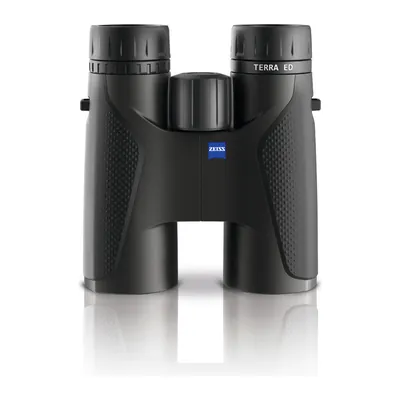
Zeiss Terra ED 8x42
8x42 binoculars: 5.3 mm exit pupil, 125 m field of view at 1,000 m, close focus from 1.6 m and 18 mm of eye relief for glasses wearers. 725 g, waterproof.
View on Amazon (opens in a new tab)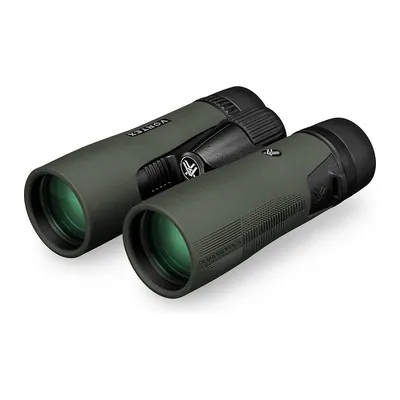
Vortex Diamondback HD 10x42
10x42 binoculars: 4.2 mm exit pupil, 110 m field of view at 1,000 m and 15 mm of eye relief, the minimum advised for glasses wearers. 604 g, waterproof and fogproof.
View on Amazon (opens in a new tab)
Worth watching
The RSPB explains what the numbers on binoculars mean, then lens sizes, coatings and the features to look for when choosing a pair for birdwatching.

The video is hosted by YouTube (Google): nothing loads until you play it, and Google may then set cookies.
FAQs
What do the numbers 10x42 on binoculars mean?
The 10 is the magnification: an object appears ten times closer, so a bird perched 100 m away looks as if it were 10 m away. The 42 is the diameter of each objective lens, in millimetres: the larger it is, the brighter the image, but the heavier the binoculars. Divide 42 by 10 and you get the exit pupil, 4.2 mm, a guide to brightness at dusk.
8x42 or 10x42: which is better for birdwatching?
8x42s give a wider field, a steadier image and a 5.25 mm exit pupil, valuable at dawn and dusk: they suit woodland, gardens and beginners. 10x42s show more detail in open country, over a lake or an estuary, but shake more. Try both, in the kind of light you will be watching in.
8x42 or 8x32: what is the difference?
The same magnification, but objective lenses of 42 or 32 mm. 8x42s give an exit pupil of 5.25 mm, 8x32s 4 mm. In daylight, you will not see the difference, because the pupil of the eye then measures only 2 to 3 mm; it shows at dusk. In return, 8x32s are more compact and lighter to carry all day.
Which binoculars should I choose if I wear glasses?
Look for at least 15 mm of eye relief, given in the specification sheet: it lets you see the whole field without taking your glasses off. Twist the eyecups down when you wear glasses and up without them. Before you buy, check through your own lenses that the field stays complete, with no black ring. With astigmatism, keep your glasses on: the focus cannot correct it.
Which binoculars are best for stargazing?
7x50s or 10x50s match the published guidance for the night sky: 50 mm objectives and an exit pupil of 5 to 7 mm, to gather as much light as possible when hand-held. Above 10x, or above 50 mm, mount them on a camera tripod with an adapter. Give your eyes 10 to 30 minutes to adjust to the dark.
Can I look at the sun through binoculars, even at sunset?
No, never, not even for a moment. Binoculars concentrate the sun’s rays and can seriously burn the retina, often without any pain at the time. Eclipse glasses do not protect you behind binoculars. Only a solar filter designed for the purpose, fitted over the front of the objective lenses, makes it possible, and NASA advises asking an astronomer before using one.
Sources
- Stewart L. Moore, ‘Binoculars for the travelling astronomer’, Journal of the British Astronomical Association, vol. 122, no. 1, 2012, republished by the British Astronomical Association, accessed 23 October 2026. britastro.org https://britastro.org/2017/binoculars-for-the-travelling-astronomer ↩
- Swarovski Optik, ‘Insights into observation optics’, accessed 23 October 2026. swarovskioptik.com https://www.swarovskioptik.com/us/en/outdoor/optics101/insights-into-observation-optics ↩
- Swiss Ornithological Institute and BirdLife Switzerland, ‘Les jumelles adaptées’ (in French; also in German and Italian), 2023, posted 22 September 2024, accessed 23 October 2026. vogelwarte.ch https://www.vogelwarte.ch/fr/conseils/les-jumelles-adaptees/ ↩
- Nikon, ‘Glossary of binocular terms’, Sport Optics Guide, accessed 23 October 2026. imaging.nikon.com https://imaging.nikon.com/sport-optics/guide/binoculars/glossary/ ↩
- Zeiss, ‘More things to consider when investing in new glass’, part 3: ‘Exit pupil’, Zeiss Hunting blog, 27 November 2022. blogs.zeiss.com https://blogs.zeiss.com/sports-optics/hunting/en/exit-pupil/ ↩
- Ligue pour la protection des oiseaux (LPO, the French bird protection league), ‘Comment bien choisir ses jumelles ?’ (in French), LPO shop, accessed 23 October 2026. boutique.lpo.fr https://boutique.lpo.fr/actus-et-conseils/Comment-bien-choisir-ses-jumelles ↩
- Nikon, ‘Choose by specifications’, Sport Optics Guide, accessed 23 October 2026. imaging.nikon.com https://imaging.nikon.com/sport-optics/guide/binoculars/choosing/choosing_02/ ↩
- Zeiss, ‘Twilight factor’, Zeiss Hunting blog, 13 December 2020. blogs.zeiss.com https://blogs.zeiss.com/sports-optics/hunting/en/twilight-factor/ ↩
- Wayne Mones, ‘The 2013 Audubon Guide to Binoculars’, National Audubon Society, 18 November 2013. audubon.org https://www.audubon.org/news/the-2013-audubon-guide-binoculars ↩
- Royal Society for the Protection of Birds (RSPB), ‘How to choose the best binoculars for bird watching’, RSPB shop, accessed 23 October 2026. shopping.rspb.org.uk https://shopping.rspb.org.uk/page/how-to-choose-binoculars-for-bird-watching ↩
- Nikon, ‘Prisms of binoculars’, Sport Optics Guide, accessed 23 October 2026. imaging.nikon.com https://imaging.nikon.com/sport-optics/guide/binoculars/technologies/technologies_06/ ↩
- Nikon, ‘Coating on roof (Dach) prism’, Sport Optics Guide, accessed 23 October 2026. imaging.nikon.com https://imaging.nikon.com/sport-optics/guide/binoculars/technologies/technologies_07/ ↩
- Nikon, ‘Stargazing’, Binocular User’s Guide, accessed 23 October 2026. imaging.nikon.com https://imaging.nikon.com/sport-optics/best/star/ ↩
- Nikon, ‘Precautions’, Sport Optics Guide, accessed 23 October 2026. imaging.nikon.com https://imaging.nikon.com/sport-optics/guide/binoculars/using/using_04/ ↩
- Île-de-France Regional Health Agency (ARS), ‘Éclipse solaire du 12 août 2026 : comment la regarder en toute sécurité ?’ (in French), 23 July 2026. iledefrance.ars.sante.fr https://www.iledefrance.ars.sante.fr/eclipse-solaire-du-12-aout-2026-comment-la-regarder-en-toute-securite ↩
- College of Optometrists, ‘College issues eye safety advice ahead of the summer solar eclipse’, 10 August 2026. college-optometrists.org https://www.college-optometrists.org/news/2026/august/eye-safety-advice-summer-eclipse ↩
- NASA, ‘Eclipse Viewing Safety’, updated 20 March 2026, accessed 23 October 2026. science.nasa.gov https://science.nasa.gov/eclipses/safety/ ↩

Trail running, snow, water, nature and destinations
Nolwenn covers trail running, snow, water, nature and destinations for Outfarer. Curious about everything, from meteor showers to night-train timetables, she has a knack for unearthing the one detail that changes everything, and putting it in a single sentence.

 Joséphine Garand

