 Français (France)
 English (UK)
 English (US)
 Deutsch (Deutschland)

Contents
- What a long-distance walk asks of your body
- Do you need to see a doctor before you start?
- How long before you set off should you start?
- Training with your rucksack, and in your boots
- Descents: the training everyone forgets
- Strength and balance: twenty minutes, twice a week
- The two-day test
- The last ten days, then the first stages
- Kit
- Video
- FAQs
Day one, everyone walks well. It’s the second morning that sorts people out: stiff thighs on waking, a rucksack that seems to have put on weight overnight, and a long descent before lunch. A long-distance walk doesn’t ask you to be an athlete. It asks you to be able to do it all again the next day, and that can be prepared two to three months ahead, without a gym membership.
What a long-distance walk asks of your body
The official Tour du Mont-Blanc site sets a simple benchmark: being able to walk for 6 hours with 1,000 m of ascent, with a rucksack on your back, and to put your boots back on the next day [1]. Its FAQ talks of the endurance to walk 5 to 8 hours a day for several consecutive days [2]. Closer to home, the West Highland Way runs for 96 miles (154 km) from Milngavie to Fort William, and its official site points out that the southern stages are easier and will prepare you for the more demanding northern ones [3].
So the difficulty isn’t one day, it’s the next one. The German Alpine Club (DAV) says as much about crossing the Alps on foot: the muscles have little time to recover, and you get used to that through training sessions that follow one another [4]. Terrain matters too. On the West Highland Way, the official site warns that some people find the stretch at the northern end of Loch Lomond, from Inversnaid to Inverarnan, much more difficult and slow-going than expected [5].
To turn these benchmarks into training walks, think in hours rather than miles. Naismith’s rule, published in 1892 in the journal of the Scottish Mountaineering Club, allows an hour for every 3 miles on the map, plus an hour for every 2,000 feet of ascent; William Naismith meant it for ‘men in fair condition’ on ‘easy expeditions’ [6]. Our walking time calculator does the sums for you, with his rule and two other methods.
Do you need to see a doctor before you start?
Not necessarily, but the NHS draws a clear line: speak to your GP first if you have not exercised for some time, or if you have medical conditions or concerns, and make sure the activity and its intensity suit your fitness [7]. To check yourself, the PAR-Q+ is a short questionnaire you fill in on your own: seven yes-or-no questions on a heart condition or high blood pressure, chest pain, dizziness or loss of consciousness, another chronic condition, prescribed medication, a bone or joint problem, and medically supervised activity. All ‘no’: you are cleared, so start slowly and build up gradually. One ‘yes’: two more pages, and possibly advice from your doctor or a qualified exercise professional [8].
The advice isn’t framed the same way everywhere. In France, the sports cardiologists’ club recommends a medical check-up before taking up intense sport again after 35 for men and 45 for women [9]. The NHS ties the GP visit to how long it’s been since you last exercised and to your health, while the PAR-Q+ asks anyone over 45 who isn’t used to vigorous exercise to consult a qualified exercise professional before taking it on [8]. Austria’s Alpine Club points out that sudden cardiac death is the second most frequent cause of death in mountain hiking, and that the risk increases considerably from 40 onwards [10]. If you’ve been inactive for a while, a week in the mountains with a rucksack is, to my mind, reason enough to book that appointment.
How long before you set off should you start?
Two to three months is enough for a walker who already gets out from time to time. The official Tour du Mont-Blanc site reckons that three months of steady preparation will turn the trek into a pleasure rather than a trial [1]. For a summer crossing of the Alps, the DAV even advises starting at the beginning of the year [4]. The West Highland Way’s official site publishes no training plan: it simply asks you to base the length of your stages on your ability and fitness [3].
If you’re starting from further back, build the base first. The NHS asks adults to do at least 150 minutes of moderate intensity activity a week, spread over 4 to 5 days or every day, plus strengthening activities that work all the major muscle groups on at least 2 days; hiking is one of its examples of moderate activity [7]. Brisk walking, which it puts at about 3 miles an hour, is the easiest way in: if you’re not very active, increase your walking distance gradually [11]. Once that rhythm is in place, the plan below takes over.
The official Tour du Mont-Blanc site publishes a four-stage calendar, which we summarise here [1].
| Period | Weekdays | At the weekend | Also add |
|---|---|---|---|
| 90 to 60 days before | Two sessions of 45 minutes to 1 hour at moderate effort: brisk walking, cycling, swimming, easy running or stairs | A walk of 2 to 3 hours, uphill if possible | A short strength session |
| 60 to 30 days before | The same two sessions | A walk of 4 to 6 hours with 700 to 1,000 m of ascent, adding weight to the rucksack gradually | Descents, gradually, and a first try at two days back to back |
| 30 to 10 days before | The same two sessions | The test: two or three days back to back with the rucksack and boots you’ll set off with | Fix any rubbing and adjustments |
| The last ten days | Less volume | No big walks | Sleep, drink, and test nothing new |
This calendar is built for a mountain trek. On the West Highland Way, the official itineraries are counted in miles, from 9 to 21 a day [5]: there, I would build the weekend walk up gradually towards your longest planned day.
Training with your rucksack, and in your boots
An hour’s walking with nothing on your back doesn’t prepare you for an hour with a rucksack. The official Tour du Mont-Blanc FAQ advises training with an 8 to 10 kg rucksack, on varied terrain, scree and rock slabs included [2], and its training page suggests adding weight gradually until you reach the load you’ll carry on the trek [1]. The DAV suggests at least two day walks with your rucksack packed, to test the weight in real conditions [4].
Better to know that weight early. The same Tour du Mont-Blanc page, citing France’s hiking federation, recommends keeping it below about 20% of your body weight on a long-distance walk [1]. Our guide to multi-day walks details what goes into it, and our article on rucksack size helps you choose the right one.
Your boots should do all the training with you. In his tips for the British Mountaineering Council, Chris Townsend, who has walked the Pacific Crest Trail, sees blisters and sore feet as probably the main reason most people give up on a long-distance walk, and properly fitting footwear as essential [12]. Our guide to preventing blisters deals with the rubbing your training reveals.
Descents: the training everyone forgets
Many walkers train for the climbs but underestimate long descents, warns the official Tour du Mont-Blanc site: they put considerable strain on the quadriceps and knees [1]. The reason lies in how the thigh works. Going down, it brakes: the muscle produces its force while lengthening, which is called an The muscle contracts while lengthening, to hold back a movement rather than to produce it.. Done for the first time, or long after the last time, it causes tiny injuries in the muscle, a loss of strength and soreness that lasts several days [13].
The good news is that it takes very little to protect yourself. In a Japanese trial published in 2017, 36 healthy young men who did no regular training walked downhill for 40 minutes on a treadmill set at a 28% gradient, the equivalent of about 900 m of descent, carrying 10% of their body weight. In those who had walked downhill for 5 minutes a week earlier, the signs of muscle damage, lost strength and soreness among them, were 47 to 64% smaller; 5 minutes on the flat gave no protection [13]. Another study by the same team found that by lengthening the descent from one weekly session to the next, from 10 to 70 minutes over four weeks, people gained as much strength without suffering muscle damage [14].
These are laboratory trials on small groups, but they say the same thing as the hills: build descents into your walks, gradually, as the official Tour du Mont-Blanc site advises [1]. Short of hills nearby, the authors of the 2017 trial suggest, without having tested it, that going down stairs for a similar drop, about 110 m, could stand in for their treadmill [13]. The NHS already suggests using the stairs instead of the lift to walk more [11]; I would take them on the way down too, since at every step the thigh holds back your body weight.
In the mountains, technique matters as much as your thighs. Austria’s Alpine Club estimates that about two thirds of all hiking accidents happen while descending, when fatigue erodes concentration, coordination and reaction. On steep descents, it advises keeping your centre of gravity over your feet, with your knees slightly bent, and taking breaks when descents are long and challenging [10]. Walking poles help too: in a study in Wales, walkers who went up and down Snowdon (Yr Wyddfa) with poles had less muscle soreness 24 and 48 hours later [15]. If your knees complain on the way down, our guide to knee pain walking downhill covers technique, poles and strengthening.
Strength and balance: twenty minutes, twice a week
Austria’s Alpine Club sums up what mountain walking demands: good core strength, enough strength endurance in the legs and hips, and good deep muscle sensitivity in the leg and foot, which keeps the knee and ankle stable. Its leaflet suggests six basic exercises, at least twice a week for about 20 minutes, each repeated 10 to 15 times or held three times for about 20 seconds, with the whole programme done twice [10]:
- the bridge, for the core;
- the side leg raise, lying on your side;
- the knee lift, for core strength and balance;
- the lunge, on an unstable surface;
- the knee bend, on an unstable surface such as a soft mat;
- the single-leg stand, for example while brushing your teeth.
The official Tour du Mont-Blanc site names the same families: squats, lunges, step-ups, core work and balance exercises [1]. Don’t forget your calves. The NHS’s gentle home strength routine includes slow, controlled calf raises, at least twice a week [16], and on the Camino de Santiago, the Galician physiotherapists’ guide published by the regional government names Achilles tendinitis as the most common among pilgrims [17].
The two-day test
It’s the most useful session of the plan. At 60 days out, the official Tour du Mont-Blanc site already suggests trying two consecutive days of walking, then, a month before, a realistic test of 2 or 3 days with exactly the kit you’ll take: that’s when the real weak points show, boots that rub, a badly adjusted rucksack, knee pain or insufficient recovery [1].
Do it a month before, with the real rucksack and the real boots; the DAV suggests that, with hills not too far away, a weekend walk there could be good training [4]. A month leaves time to change a pair of boots, adjust the straps or lighten the load. And if the test goes badly, it also leaves time to shorten your planned stages rather than endure them.
The last ten days, then the first stages
The last ten days are for recovery: train less, sleep, drink, and avoid big walks that could injure you, advises the official Tour du Mont-Blanc site, which sums up what’s at stake: you cannot build your fitness in a week, but you can easily compromise your departure by overtraining [1].
Once there, start gently. Austria’s Alpine Club advises avoiding long, unfamiliar exertion, especially on the first day [10]. Walked south to north, the West Highland Way does just that, its easier southern stages preparing you for the northern ones [3]. The DAV finds it useful to alternate demanding and easier stages, as recovery time is short [4], and Chris Townsend advises planning easier days and rest days; if your legs ache, have an easy day [12].
Muscle soreness usually appears 24 to 48 hours after unaccustomed effort and goes within two to seven days; gentle movement helps more than doing nothing, explains the DAV’s magazine [18]. A twisted ankle, a cold with a fever, or exhaustion that won’t go away are another matter: the same club feels the decision should then usually be to stop [4].
One last point for high routes: training doesn’t protect you from altitude sickness. The CDC, the US public health agency, points out that training and physical fitness do not affect the risk, and that any unacclimatised traveller who sleeps at 2,450 m or higher, and sometimes lower, is at risk [19]. The thresholds, symptoms and night rule are in the altitude sickness guide.
A good habit to get into fits in one sentence: train to start again. Two days back to back with your rucksack, a little more descent every week, and the second morning will feel like the first.
Kit related to this article
No affiliation: no commission, no sponsored products.
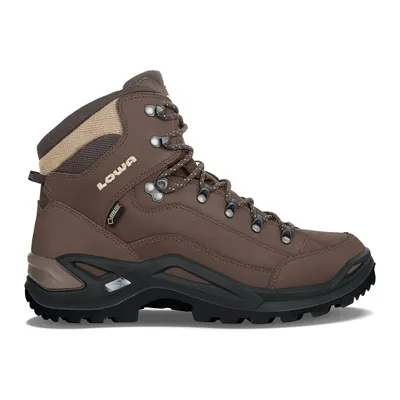
Lowa Renegade GTX Mid
A versatile mid-cut walking boot: leather upper, Gore-Tex membrane and Vibram sole, on a last made for medium-width feet. Men’s model, also made in a women’s version.
View on Amazon (opens in a new tab)
Worth watching
REI demonstrates eight exercises for the legs and core, from step-ups and heel downs to single-leg deadlifts, aimed at the muscles that carry a loaded rucksack mile after mile.
The video is hosted by YouTube (Google): nothing loads until you play it, and Google may then set cookies.
FAQs
How long does it take to train for a long-distance walk?
Two to three months for a walker who already gets out from time to time. The official Tour du Mont-Blanc site reckons three months of steady preparation is enough, and the German Alpine Club advises starting at the beginning of the year for a summer crossing of the Alps. If you’re starting from scratch, begin earlier, building up first to the NHS’s 150 minutes of moderate activity a week.
How should I train for the West Highland Way?
Its official site publishes no training plan: it asks you to base your stage lengths on your ability and fitness, and notes that the easier southern stages prepare you for the northern ones. Its suggested itineraries run from 9 to 21 miles a day, over 5 to 7 days, and it suggests weekend sections too, such as Milngavie to Balmaha, 20 miles: a fine test walk. For the rest, a general plan like the Tour du Mont-Blanc calendar works.
Should I train with a loaded rucksack?
Yes. The official Tour du Mont-Blanc site advises training with an 8 to 10 kg rucksack and adding weight gradually until you reach the load you’ll carry on the trek. The German Alpine Club suggests at least two day walks with your rucksack packed. Wear the boots you’ll set off in as well: these walks are when rubbing shows up.
How do I avoid aching legs on a multi-day walk?
Prepare for the descents before you go: in a 2017 trial, 5 minutes of downhill walking a week before a long descent made the signs of muscle damage 47 to 64% smaller. Once there, start with gentle days, alternate demanding and easier stages, and keep moving gently rather than doing nothing when soreness sets in.
How do I prepare my feet for a long-distance walk?
Train in the boots you’ll walk in, on long walks and on consecutive days, so that any rubbing shows up early. For Chris Townsend, writing for the British Mountaineering Council, blisters and sore feet are probably the main reason people give up on a long-distance walk, and properly fitting footwear is essential. Work on your calves too: the NHS suggests slow calf raises at least twice a week.
Sources
- Official Tour du Mont-Blanc website, ‘Training for the TMB: fitness, level and a 90-day plan’, accessed 12 November 2026. montourdumontblanc.com https://www.montourdumontblanc.com/en/actualites/training-for-the-tmb-fitness-and-90-day-plan ↩
- Official Tour du Mont-Blanc website, ‘FAQ’, accessed 12 November 2026. montourdumontblanc.com https://www.montourdumontblanc.com/en/faq ↩
- West Highland Way, ‘The route’, accessed 12 November 2026. westhighlandway.org https://www.westhighlandway.org/the-route/ ↩
- German Alpine Club (Deutscher Alpenverein, DAV), Jonas Kassner, ‘Alpenüberquerung: So geht’s’ (crossing the Alps: how it’s done), 12 June 2024, updated 4 September 2025 (in German), accessed 12 November 2026. alpenverein.de https://www.alpenverein.de/artikel/alpenueberquerung-so-gehts_76ece08b-d44d-4ff4-a372-af379e84a5cd ↩
- West Highland Way, ‘Suggested itineraries’, accessed 12 November 2026. westhighlandway.org https://www.westhighlandway.org/the-route/suggested-itineraries/ ↩
- William W. Naismith, ‘Cruach Ardran, Stobinian, and Ben More’, Scottish Mountaineering Club Journal, vol. 2, no. 3, September 1892, transcribed by the Glasgow Digital Library, accessed 12 November 2026. gdl.cdlr.strath.ac.uk http://gdl.cdlr.strath.ac.uk/smcj/smcj009/smcj0090603.htm ↩
- NHS, ‘Physical activity guidelines for adults aged 19 to 64’, page last reviewed 22 May 2024, accessed 12 November 2026. nhs.uk https://www.nhs.uk/live-well/exercise/physical-activity-guidelines-for-adults-aged-19-to-64/ ↩
- PAR-Q+ Collaboration, ‘The Physical Activity Readiness Questionnaire for Everyone’ (PAR-Q+), 2025 version, accessed 12 November 2026. eparmedx.com https://eparmedx.com/wp-content/uploads/2025/01/PARQPlus2025Fillable.pdf ↩
- Club des cardiologues du sport (French sports cardiologists’ club), ‘Les 10 règles d’or’, rules drawn up in 2006 (in French), accessed 12 November 2026. clubcardiosport.com https://www.clubcardiosport.com/10-regles-or ↩
- Austrian Alpine Club (Österreichischer Alpenverein, ÖAV), ‘Safe mountain hiking’, leaflet from the ‘SicherAmBerg’ series, English edition, 2020, accessed 12 November 2026. alpenverein.at https://www.alpenverein.at/portal_wAssets/docs/bergsport/sicheramberg/cardfolder/Mountain-Hiking-CF-2020-en.pdf ↩
- NHS, ‘Walking for health’, page last reviewed 15 December 2022, accessed 12 November 2026. nhs.uk https://www.nhs.uk/live-well/exercise/walking-for-health/ ↩
- British Mountaineering Council (BMC), ‘How to get into long-distance walking’, tips from Chris Townsend, accessed 12 November 2026. thebmc.co.uk https://www.thebmc.co.uk/en/beginner-long-distance-walks-tips-chris-townsend ↩
- S. Maeo et al., ‘Prevention of downhill walking-induced muscle damage by non-damaging downhill walking’, PLoS One, 12(3), e0173909, 2017, accessed 12 November 2026. pmc.ncbi.nlm.nih.gov https://pmc.ncbi.nlm.nih.gov/articles/PMC5348007/ ↩
- S. Maeo et al., ‘Downhill walking training with and without exercise-induced muscle damage similarly increase knee extensor strength’, Journal of Sports Sciences, 34(21), 2018-2026, 2016, abstract accessed 12 November 2026. pubmed.ncbi.nlm.nih.gov https://pubmed.ncbi.nlm.nih.gov/26920254/ ↩
- G. Howatson et al., ‘Trekking poles reduce exercise-induced muscle injury during mountain walking’, Medicine and Science in Sports and Exercise, 43(1), 140-145, 2011, abstract accessed 12 November 2026. pubmed.ncbi.nlm.nih.gov https://pubmed.ncbi.nlm.nih.gov/20473229/ ↩
- NHS, ‘Strength exercises’, page last reviewed 28 February 2024, accessed 12 November 2026. nhs.uk https://www.nhs.uk/live-well/exercise/strength-exercises/ ↩
- Colexio Oficial de Fisioterapeutas de Galicia (Galician physiotherapists’ association), ‘Fisioterapia en el Camino’, 2010 guide published by the Xunta de Galicia (in Spanish), accessed 12 November 2026. caminodesantiago.gal https://www.caminodesantiago.gal/documents/17639/100607/Fisioterapia%20en%20el%20Camino?version=1.0 ↩
- German Alpine Club (DAV), Martin Schlageter, ‘Wenn es zwickt und zwackt’ (on muscle and joint pain), Panorama 1/2025, 4 February 2025 (in German), accessed 12 November 2026. alpenverein.de https://www.alpenverein.de/artikel/muskel-und-gelenkbeschwerden_541bb22d-58b2-46b6-bf57-08465eafd4ef ↩
- Centers for Disease Control and Prevention (CDC), Yellow Book, ‘High-Altitude Travel and Altitude Illness’, 23 April 2025, accessed 12 November 2026. cdc.gov https://www.cdc.gov/yellow-book/hcp/environmental-hazards-risks/high-altitude-travel-and-altitude-illness.html ↩

Camping, wild camping, bushcraft and hiking
Guillaume Hoarau writes for Outfarer about camping, wild camping, bushcraft and hiking. A survival-skills enthusiast and a collector of old field manuals, he likes clear explanations, lists that earn their place and other people’s stories, which he tells well.


 Nolwenn Bastide