 Français (France)
 English (UK)
 English (US)
 Deutsch (Deutschland)

Contents
- What a multi-day hike asks of your body
- Do you need to see a doctor first?
- How long before your trip should you start training?
- Training with your pack, and in your boots
- Downhill: the training everyone skips
- Strength and balance: 20 minutes, twice a week
- The two-day test
- The last 10 days, then the first stages
- Gear
- Video
- FAQ
On day one, everybody hikes well. It’s the second morning that sorts things out: stiff thighs when you wake up, a pack that seems to have gained weight overnight, and a long descent before lunch. A multi-day hike doesn’t require you to be an athlete. It requires you to be able to do it again, day after day, and that’s something you can train for two to three months ahead, no gym membership needed.
What a multi-day hike asks of your body
The official Tour du Mont-Blanc site sets a simple benchmark: being able to hike for 6 hours with 3,281 feet (1,000 m) of elevation gain, pack on your back, and lace your boots back up the next day [1]. Its FAQ talks about the endurance to hike 5 to 8 hours a day for several days in a row [2]. On the Camino de Santiago, the civil protection service of Galicia, the Spanish region where the trail ends, asks pilgrims to be able to carry their own weight plus a pack for about 12.4 to 15.5 miles (20 to 25 km) a day, in heat, cold, rain, snow, or fog [3].
So the hard part isn’t one day, it’s the next one. The German Alpine Club (DAV) says as much about crossing the Alps on foot: your muscles get little time to recover, and you have to train for that with workouts that follow one another [4]. Terrain counts too. On the TMB, the FAQ notes that every day brings a pass to climb and descend, about 32,800 feet (10,000 m) of elevation gain over 106 miles (170 km), and recommends training on varied terrain, scree and rock slabs included [2].
To turn these benchmarks into training hikes, think in hours rather than miles. The French Hiking Federation (FFRandonnée) counts about 2.5 mph (4 km/h) on the flat and about 1,000 to 1,150 feet (300 to 350 m) of climbing per hour, breaks not included [5]; our hiking time calculator does the math for you.
Do you need to see a doctor first?
Usually not, if you’re healthy and you build up gradually. The Physical Activity Guidelines for Americans, published by the Department of Health and Human Services (HHS), say that healthy men and women who plan gradual increases in their weekly activity don’t need to consult a health care provider first. People without a diagnosed chronic condition, such as diabetes, heart disease, or osteoarthritis, and without symptoms such as chest pain or pressure, dizziness, or joint pain, most likely don’t need to either [6]. The National Park Service adds: consult a physician if you have any questions about your fitness level, health conditions, or medications [7].
To check yourself, there’s the PAR-Q+, a short questionnaire you fill out yourself: seven yes-or-no questions, from heart conditions and chest pain to dizziness and joint problems. All “no”: you’re cleared, so start slowly and build up gradually. One “yes”: two more pages, and possibly advice from your doctor or a qualified exercise professional. It also asks anyone over 45 who isn’t used to vigorous exercise to see a qualified exercise professional before taking it on [8].
The advice isn’t the same everywhere. In France, the sports cardiologists’ club recommends a medical checkup before taking up intense exercise again after age 35 for men and 45 for women [9], while the HHS guidelines tie the question to your health and symptoms. Austria’s Alpine Club points out that sudden cardiac death is the second most common cause of death in mountain hiking, and that the risk rises considerably after 40 [10]. If you do want advice, HHS says it’s especially appropriate before vigorous activity [6]; after a long break, a week in the Alps with a pack can qualify, in my book.
How long before your trip should you start training?
Two to three months is enough if you already hike now and then. The official Tour du Mont-Blanc site figures three months of steady preparation will turn the trek into a pleasure rather than an ordeal [1]. The HHS guidelines explain why you shouldn’t rush: to reduce the risk of injury, increase your activity gradually, over a period of weeks to months [6].
If you’re starting further back, build the base first. The HHS guidelines call for 150 to 300 minutes of moderate-intensity aerobic activity a week, plus muscle-strengthening activities that work all major muscle groups on 2 or more days a week; at first, strength work can be done just 1 day a week, at a light or moderate level [6]. Once that routine is in place, the plan below takes over.
There’s also a bare minimum: for the Camino, Galicia’s civil protection service recommends at least a week of short walks that get gradually longer, carrying your gear or an equivalent weight, in the clothes and shoes you’ll wear [3]. That’s a floor, not a goal. The official Tour du Mont-Blanc site publishes a four-phase calendar, summarized here [1].
| Timing | Weekdays | Weekends | Also add |
|---|---|---|---|
| 90 to 60 days out | Two 45- to 60-minute workouts at moderate effort: brisk walking, cycling, swimming, easy running, or stair climbing | A 2- to 3-hour hike, with some climbing if possible | A short strength session |
| 60 to 30 days out | The same two workouts | A 4- to 6-hour hike with 2,300 to 3,300 feet (700 to 1,000 m) of elevation gain, gradually adding weight to your pack | Descents, gradually, and a first try at two days back to back |
| 30 to 10 days out | The same two workouts | The test: two or three days back to back with the pack and boots you’ll start with | Fix any rubbing and adjustments |
| The last 10 days | Less volume | No big hikes | Sleep, hydrate, and test nothing new |
This calendar is built for a mountain trek. On the Camino de Santiago, mileage takes over from elevation: American Pilgrims on the Camino, the US pilgrims’ association, recommends a daily walking habit, an hour or more several times a week with a longer walk on the weekend, distances that grow gradually, and a few trial runs with your full backpack as the trip gets closer. It also suggests some hill training and core strength workouts [11].
Training with your pack, and in your boots
An hour of walking with nothing on your back won’t prepare you for an hour under a pack. The official TMB FAQ recommends training with an 18- to 22-pound (8 to 10 kg) pack [2], and its training page says to add weight gradually until you reach the load you’ll carry on the trek [1]. The National Park Service turns it into questions to ask yourself before you go: how much weight can you comfortably carry, and for how long [13]?
Better to know that weight early. American Pilgrims on the Camino says the accepted guidance is a pack that weighs no more than about 10% of your body weight, a good gauge rather than a hard and fast rule [14], and Galicia’s official Camino site tells pilgrims never to go over 10 kg (22 pounds) [15]. The official TMB site, citing the French Hiking Federation, sets the ceiling higher, at about 20% of body weight on a long-distance hike [1]. Our guide to multi-day hikes breaks down what goes in the pack, and our article on pack size helps you pick the right one.
Your boots should do all the training with you: American Pilgrims recommends trail-testing your footwear with longer back-to-back walks before you go [14]. Our guide to preventing blisters covers what to do about the rubbing those walks reveal.
Downhill: the training everyone skips
Plenty of hikers train for the climbs and underestimate long descents, warns the official Tour du Mont-Blanc site: they put heavy strain on the quads and knees [1]. The National Park Service asks the same question before any hike: have you practiced hiking up and down steep hills, or are you more comfortable on flat, paved paths [13]? The reason lies in how your thigh works. Going down, it brakes: the muscle produces force while it lengthens, what’s called an The muscle contracts while lengthening, to hold back a movement rather than to produce it.. Done for the first time, or long after the last time, it causes tiny muscle injuries, a loss of strength, and soreness that lasts several days [16].
The good news: it takes very little to protect yourself. In a Japanese trial published in 2017, 36 healthy young men who didn’t train regularly walked downhill for 40 minutes on a treadmill set at a 28% downhill grade and 3.1 mph, the equivalent of about 2,950 feet (900 m) of descent, carrying 10% of their body weight. In those who had walked downhill for 5 minutes a week earlier, the signs of muscle damage, lost strength and soreness among them, were 47 to 64% smaller; 5 minutes on the flat gave no protection [16]. Another study by the same team found that by lengthening the descent from one weekly session to the next, from 10 to 70 minutes over four weeks, participants gained just as much strength without the muscle damage [17].
These are lab trials on small groups, but they match what the trail teaches: work descents into your hikes, gradually, as the official TMB site advises [1]. No hills nearby? The authors of the 2017 trial suggest, without having tested it, that walking down stairs for a similar drop, about 360 feet (110 m), could stand in for their treadmill [16]. My take: take the stairs down instead of the elevator every chance you get, since your thighs hold back your body weight on every step.
In the mountains, technique matters as much as your legs. Austria’s Alpine Club estimates that about two thirds of all hiking accidents happen on the way down, when fatigue wears down concentration, coordination, and reaction time. On steep descents, it advises keeping your center of gravity over your feet, knees slightly bent, and taking breaks when descents are long and challenging [10]. Trekking poles help too: in a study in Wales, hikers who went up and down Mount Snowdon with poles had less muscle soreness 24 and 48 hours later [18]. If your knees complain on descents, our guide to knee pain when hiking downhill covers technique, poles, and strength work.
Strength and balance: 20 minutes, twice a week
Austria’s Alpine Club sums up what mountain hiking demands: good core strength, enough strength endurance in the legs and hips, and good deep muscle sensitivity in the leg and foot, which keeps the knee and ankle stable. Its leaflet suggests six basic exercises, at least twice a week for about 20 minutes, each repeated 10 to 15 times or held three times for about 20 seconds, with the whole program done twice [10]:
- the bridge, for your core;
- the side leg raise, lying on your side;
- the knee lift, for core strength and balance;
- the lunge, on an unstable surface;
- the knee bend, on an unstable surface such as a soft mat;
- the single-leg stand, for example while brushing your teeth.
The official TMB site names the same families: squats, lunges, step-ups, core work, and balance exercises [1]. Don’t forget your calves. Galicia’s official Camino site asks pilgrims to pay special attention to them, warming up and stretching throughout the route [15], and the Galician physiotherapists’ guide names Achilles tendinitis as the most common among pilgrims [12].
The two-day test
It’s the most useful workout in the plan. The official TMB site suggests a first try at 60 days out, then a realistic 2- or 3-day test a month before, with exactly the gear you’ll take: that’s when the real weak spots show up, boots that rub, a badly adjusted pack, knee pain, or not enough recovery [1]. The National Park Service agrees: take your pack for a fully loaded test run before your trip [19].
Do it a month out, with your real pack and real boots; the DAV suggests that, with a low mountain range not too far away, a weekend trip there could be good training [4]. That timing leaves room to swap a pair of boots, adjust straps, or lighten your load. And if the test goes badly, it also gives you time to shorten your planned stages rather than grind through them.
The last 10 days, then the first stages
The last 10 days are for recovery: train less, sleep, stay hydrated, and avoid big hikes that could injure you, says the official TMB site: you can’t build your fitness in a week, but you can easily compromise your departure by overtraining [1].
Once you’re there, start easy: Galicia’s civil protection service recommends shorter stages at first [3], and Austria’s Alpine Club warns against long, unfamiliar exertion, especially on day one [10]. The DAV finds it useful to alternate demanding and easier stages, since recovery time is short [4]. On a long route like the full Camino Francés, about 491 miles (790 km), American Pilgrims suggests planning some rest days, or at least a few shorter days [11].
Muscle soreness usually shows up 24 to 48 hours after unaccustomed effort and fades within two to seven days; gentle movement helps more than doing nothing, explains the DAV’s magazine [20]. A rolled ankle, a cold with a fever, or lasting exhaustion are another matter: then, says the same club, the decision should usually be to stop [4].
One last point for high routes: training won’t protect you from altitude sickness. The CDC points out that training and physical fitness don’t affect your risk, and that any unacclimatized traveler who sleeps at 8,000 feet (2,450 m) or higher, and sometimes lower, is at risk [21]. The National Park Service gives hikers the same 8,000-foot mark [13]. The thresholds, symptoms, and night rule are in the altitude sickness guide.
The smart move fits in one sentence: train to do it again. Two days back to back with your pack, a little more downhill every week, and your second morning will feel like the first.
Gear related to this article
No affiliation: no commission, no sponsored products.
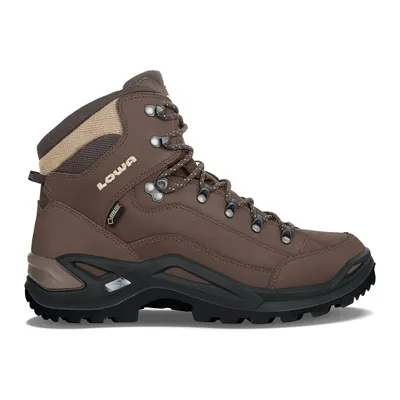
Lowa Renegade GTX Mid
A versatile mid-height hiking boot: leather upper, Gore-Tex membrane, and Vibram sole, on a last made for medium-width feet. Men’s model, also made in a women’s version.
View on Amazon (opens in a new tab)
Worth watching
REI walks you through eight exercises for your legs and core, from step-ups and heel downs to single-leg deadlifts, built for the muscles that carry a loaded pack mile after mile.
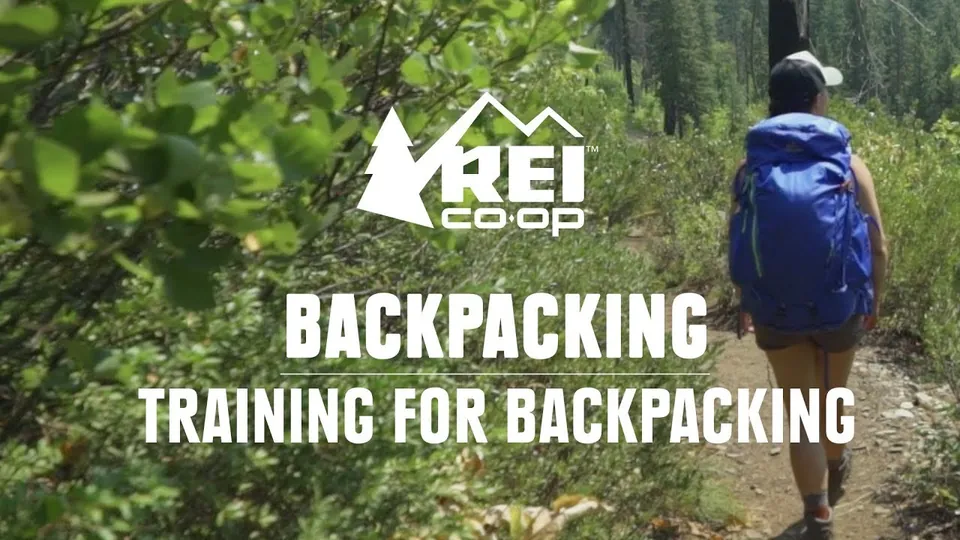
The video is hosted by YouTube (Google): nothing loads until you play it, and Google may then set cookies.
FAQ
How long should you train for the Tour du Mont-Blanc?
About three months, according to the official TMB site, which publishes a 90-day plan: two workouts a week, a weekend hike that grows to 4 to 6 hours with 2,300 to 3,300 feet (700 to 1,000 m) of elevation gain, then a two- or three-day test a month out. If you’re starting from scratch, begin earlier and build up gradually, over weeks to months.
How do you train for the Camino de Santiago?
American Pilgrims on the Camino recommends a daily walking habit, an hour or more several times a week with a longer walk on the weekend, distances that grow gradually, and trial runs with your full backpack as the trip gets closer, plus some hill training and core workouts. Most pilgrims walk 12.5 to 18.5 miles (20 to 30 km) a day, so build toward your planned stage length.
How do you get in shape for backpacking?
Start with the base the HHS guidelines recommend: 150 to 300 minutes of moderate aerobic activity a week, plus strength work on 2 or more days. Then add a weekend hike that gets longer and steeper, with a pack that gets gradually heavier, some downhill work, and a test of two days back to back a month before you go.
Do you need to see a doctor before training for a long hike?
Not usually, if you’re healthy and build up gradually, say the HHS guidelines. People with a chronic condition, or with symptoms such as chest pain or pressure, dizziness, or joint pain, should talk to a health care provider, as should anyone who develops new symptoms while increasing their activity. The National Park Service adds: consult a physician if you have any questions about your fitness, health, or medications.
How do you avoid sore legs on a multi-day hike?
Train for the descents before you go: in a 2017 trial, 5 minutes of downhill walking a week before a long descent made the signs of muscle damage 47 to 64% smaller. Once you’re there, start with shorter stages, alternate hard and easier days, and keep moving gently rather than resting completely when soreness sets in.
Sources
- Official Tour du Mont-Blanc website, “Training for the TMB: fitness, level and a 90-day plan,” accessed November 12, 2026. montourdumontblanc.com https://www.montourdumontblanc.com/en/actualites/training-for-the-tmb-fitness-and-90-day-plan ↩
- Official Tour du Mont-Blanc website, “FAQ,” accessed November 12, 2026. montourdumontblanc.com https://www.montourdumontblanc.com/en/faq ↩
- Xunta de Galicia (Galicia regional government), Civil Protection, “Guía de emergencias para la peregrinación por los Caminos de Santiago,” leaflet (in Spanish), accessed November 12, 2026. caminodesantiago.gal https://www.caminodesantiago.gal/documents/17639/100607/Folleto_guia_peregrinos_E_V6.pdf?version=1.0 ↩
- German Alpine Club (Deutscher Alpenverein, DAV), Jonas Kassner, “Alpenüberquerung: So geht’s” (crossing the Alps: how it’s done), June 12, 2024, updated September 4, 2025 (in German), accessed November 12, 2026. alpenverein.de https://www.alpenverein.de/artikel/alpenueberquerung-so-gehts_76ece08b-d44d-4ff4-a372-af379e84a5cd ↩
- French Hiking Federation (FFRandonnée), “Les itinéraires de randonnée” (in French), accessed November 12, 2026. ffrandonnee.fr https://www.ffrandonnee.fr/randonner/ou-pratiquer/les-itineraires-de-randonnee ↩
- U.S. Department of Health and Human Services, Physical Activity Guidelines for Americans, 2nd edition, 2018, accessed November 12, 2026. odphp.health.gov https://odphp.health.gov/sites/default/files/2019-09/Physical_Activity_Guidelines_2nd_edition.pdf ↩
- National Park Service, “Trip Planning Guide,” Health & Safety, updated August 21, 2026, accessed November 12, 2026. nps.gov https://www.nps.gov/subjects/healthandsafety/trip-planning-guide.htm ↩
- PAR-Q+ Collaboration, “The Physical Activity Readiness Questionnaire for Everyone” (PAR-Q+), 2025 version, accessed November 12, 2026. eparmedx.com https://eparmedx.com/wp-content/uploads/2025/01/PARQPlus2025Fillable.pdf ↩
- Club des cardiologues du sport (French sports cardiologists’ club), “Les 10 règles d’or,” rules drawn up in 2006 (in French), accessed November 12, 2026. clubcardiosport.com https://www.clubcardiosport.com/10-regles-or ↩
- Austrian Alpine Club (Österreichischer Alpenverein, ÖAV), “Safe mountain hiking,” leaflet from the “SicherAmBerg” series, English edition, 2020, accessed November 12, 2026. alpenverein.at https://www.alpenverein.at/portal_wAssets/docs/bergsport/sicheramberg/cardfolder/Mountain-Hiking-CF-2020-en.pdf ↩
- American Pilgrims on the Camino, “Prepare for Your Camino,” updated May 14, 2026, accessed November 12, 2026. americanpilgrims.org https://americanpilgrims.org/prepare-for-camino/ ↩
- Colexio Oficial de Fisioterapeutas de Galicia (Galician physiotherapists’ association), “Fisioterapia en el Camino,” 2010 guide published by the Xunta de Galicia (in Spanish), accessed November 12, 2026. caminodesantiago.gal https://www.caminodesantiago.gal/documents/17639/100607/Fisioterapia%20en%20el%20Camino?version=1.0 ↩
- National Park Service, “Hike Smart,” updated June 13, 2024, accessed November 12, 2026. nps.gov https://www.nps.gov/articles/hiking-safety.htm ↩
- American Pilgrims on the Camino, “Packing for the Camino de Santiago,” updated May 6, 2026, accessed November 12, 2026. americanpilgrims.org https://americanpilgrims.org/packing-list/ ↩
- Xunta de Galicia (Galicia regional government), Turismo de Galicia, “Consejos y recomendaciones” (in Spanish), accessed November 12, 2026. caminodesantiago.gal https://www.caminodesantiago.gal/es/preparate/consejos-y-recomendaciones ↩
- S. Maeo et al., “Prevention of downhill walking-induced muscle damage by non-damaging downhill walking,” PLoS One, 12(3), e0173909, 2017, accessed November 12, 2026. pmc.ncbi.nlm.nih.gov https://pmc.ncbi.nlm.nih.gov/articles/PMC5348007/ ↩
- S. Maeo et al., “Downhill walking training with and without exercise-induced muscle damage similarly increase knee extensor strength,” Journal of Sports Sciences, 34(21), 2018-2026, 2016, abstract accessed November 12, 2026. pubmed.ncbi.nlm.nih.gov https://pubmed.ncbi.nlm.nih.gov/26920254/ ↩
- G. Howatson et al., “Trekking poles reduce exercise-induced muscle injury during mountain walking,” Medicine and Science in Sports and Exercise, 43(1), 140-145, 2011, abstract accessed November 12, 2026. pubmed.ncbi.nlm.nih.gov https://pubmed.ncbi.nlm.nih.gov/20473229/ ↩
- National Park Service, “Before the Trip,” Camping, updated July 2, 2024, accessed November 12, 2026. nps.gov https://www.nps.gov/subjects/camping/before-the-trip.htm ↩
- German Alpine Club (DAV), Martin Schlageter, “Wenn es zwickt und zwackt” (on muscle and joint pain), Panorama 1/2025, February 4, 2025 (in German), accessed November 12, 2026. alpenverein.de https://www.alpenverein.de/artikel/muskel-und-gelenkbeschwerden_541bb22d-58b2-46b6-bf57-08465eafd4ef ↩
- Centers for Disease Control and Prevention (CDC), Yellow Book, “High-Altitude Travel and Altitude Illness,” April 23, 2025, accessed November 12, 2026. cdc.gov https://www.cdc.gov/yellow-book/hcp/environmental-hazards-risks/high-altitude-travel-and-altitude-illness.html ↩
Camping, backpacking, bushcraft and hiking
Guillaume Hoarau writes for Outfarer about camping, backpacking, bushcraft, and hiking. A survival-skills buff and a collector of vintage field manuals, he loves clear explanations, lists that actually help and other people’s stories, which he tells well.


