 Français (France)
 English (UK)
 English (US)
 Deutsch (Deutschland)

Contents
The summit’s behind you, lunch is eaten, and there are still 3,000 feet of descent between you and the trailhead. An hour later, your thighs are burning, one knee twinges at every rock step, and you catch yourself turning sideways, like someone going down a staircase without a handrail. Welcome to the part of the hike nobody talks about at the start.
This guide is about prevention: it doesn’t diagnose anything and it doesn’t replace a doctor. It explains why going downhill loads your knees so much, then how to make it easier on them, from your stride to your poles, from your pack to your workouts.
Why hiking downhill hurts your knees
Uphill, your thighs push; downhill, they brake. As a Grand Canyon ranger and former physiology professor puts it on the park’s podcast, any time you hike downhill, you use your muscles as a brake [1]. With every step, the quadriceps works while being stretched to hold your body back: that’s an a muscle contracting while it lengthens, as when you lower a heavy box slowly to the floor. In a 1997 study, these muscle forces made up 80% of the peak force inside the knee when walking downhill, and the push of the ground only 20% [2].
How much does all that braking weigh? The numbers depend on the method. Calculated with a model in 12 healthy people, the compressive force in the knee reached 8 times body weight going downhill, compared with 3.9 times on level ground [2]. Measured directly, using knee replacements fitted with sensors, it comes out lower: 3.39 times body weight walking down a ramp, against 2.74 times walking on the level [3], and 3.46 times going down stairs [4]. The authors of those measurements note that real forces are generally lower than the ones many mathematical models predict [4].
Your kneecap takes its share too. The main joint carries the biggest force, but the steepest rise is behind the kneecap: between it and the thighbone, compression is 3 to 4 times greater downhill than on level ground, comparable to running or going down stairs, which explains pain at the front of the knee on descents [5]. Then there’s soreness: it usually shows up 24 to 48 hours after unaccustomed effort and fades within two to seven days, says the German Alpine Club (DAV) [6]. A first descent, or one long after the last, readily causes muscle microdamage, lost strength, and days of soreness [7], which leaves you weaker for the hike back up, the Grand Canyon ranger adds [1].
Fatigue does the rest. About two-thirds of all hiking accidents happen on the way down, according to the Austrian Alpine Club (ÖAV), because concentration, coordination, and reactions fade [8].
Technique: short steps, soft knees
Europe’s alpine clubs all describe the same descent, with a few nuances.
- Shorten your stride. The steeper the slope, the shorter your steps: you save energy, spare your joints, and stay safer, the DAV explains [9].
- Keep your knees slightly bent, upper body a little forward, so your center of gravity stays over your feet [8]. Lean back and you’re more likely to slip and land on your backside, warns the Swiss Council for Accident Prevention (BPA) [10].
- Place your foot, don’t let it drop. The DAV advises loading the next step gently rather than stomping onto it, foot flat, rolling rather from the heel, with your eyes one or two steps ahead [9]. And walk down hills, don’t run, says MedlinePlus, the National Library of Medicine’s health site [11].
- Zigzag when the trail allows. Small switchbacks of your own ease the slope [9], and regularly changing how you walk, angled or straight on, spreads the effort [12].
- Take breaks. On long, tiring descents, the BPA suggests a short break every 15 to 20 minutes, and saving some energy for the end [10]. For pace, the National Park Service’s rule: if you can talk while you walk, your speed is right [13].
On one point, opinions differ. The DAV rolls the foot from the heel [9]; an article published in 2004 by the Swiss Alpine Club, based on a University of Salzburg study supported by a pole manufacturer, considers landing on the front of the foot less stressful on uneven ground, and puts the most favorable knee bend at around 15°, in the springy give that follows the foot landing, without bending too far [12]. What they share: a soft knee, never locked, that cushions instead of jarring.
Time matters too. Grand Canyon National Park, where you hike down first, tells visitors to plan on taking twice as long to hike up as it took to hike down: a third of your time for the descent, two-thirds for the climb back [14]. Its trip planner also warns that the faster hike down comes with high impact on your joints [15]. For a regular mountain trail, France’s hiking federation (FFRandonnée) counts 400 to 500 m, about 1,300 to 1,600 feet, of descent per hour for an average hiker [16]: build that into your schedule rather than making up lost time by charging downhill. Our guide to estimating hiking time explains the math.
Trekking poles: set longer, planted ahead
Poles take load off your legs going downhill: in a 1999 study of eight men on a laboratory ramp, the forces in the knee dropped by 12 to 25% [17]. The DAV says poles absorb “up to 30%” of the impact, without citing a study [18]. Our guide to trekking pole length lays out what the studies measured, and their limits.
For descents, Leki recommends lengthening your poles by 5 to 10 cm, about 2 to 4 inches, so you can plant them ahead and below without hunching over [19]. The DAV also likes them a little longer on steep descents, elbow at roughly a right angle, and suggests planting both poles together to get down a big step [18, 20].
One dissenting voice, and an old one: the Swiss Alpine Club’s 2004 article preferred shorter poles for descents, two-thirds of your height at most, and noted that 49% of the pole users observed got no relief from them [12]. Its conclusion still holds: good walking technique without poles beats poor technique with them.
Your pack and your weight: every pound comes down with you
Your pack adds its share. Among 14 active-duty US soldiers walking downhill on a treadmill, a backpack scaled to body weight increased the knee extension moment, the thigh’s effort to hold the leg back, the whole time the foot was on the ground [21]. For trips of several days, France’s FFRandonnée recommends carrying no more than 20% of your body weight [22], and Isle Royale National Park allows up to 30%, but under 50 lb no matter what you weigh [23]; our guide to backpack weight for multi-day hikes helps you get there.
Body weight works the same way. Among 142 older adults who were overweight and had knee osteoarthritis, each pound lost took about 4 lb of force off the knee with every step, walking on level ground [24]. MedlinePlus gives a similar order of magnitude: every extra pound puts about 5 more pounds of pressure on your kneecap going up and down stairs [11]. Particular situations, but the message is clear: at the knee, a pound is never just a pound.
Getting ready: strength, balance, and practice going down
Your best knee protection is still your thighs. Strengthening the muscles that support your knee reduces stress on the joint, and strong muscles help it absorb shock, says the American Academy of Orthopaedic Surgeons (AAOS) [25]. The Physical Activity Guidelines for Americans ask adults to do muscle-strengthening activities that work all the major muscle groups on 2 or more days a week [26].
| Program | How often | Exercises | Benchmark |
|---|---|---|---|
| Austrian Alpine Club (ÖAV) | At least twice a week, about 20 minutes | Six exercises, including lunges and knee bends on an unstable surface, and standing on one leg | Single-leg stand: at least 2 × 30 seconds per leg, for example while brushing your teeth |
| AAOS, “Knee Conditioning Program” | 2 to 3 days a week as maintenance, once you’ve recovered | Half squats, hamstring curls, calf raises, straight-leg raises, and hip exercises, with stretches before and after | Half squats: 3 sets of 10; no pain during any exercise |
| AAOS, kneecap pain (patellofemoral pain syndrome) | No frequency given | Conditioning of the quadriceps and the hip muscles, plus warm-ups and stretches | Increase the intensity and length of your training gradually |
From the ÖAV’s “Safe mountain hiking” leaflet and two AAOS OrthoInfo pages. The AAOS program is designed for recovery from an injury or surgery, under a doctor’s supervision. [8, 25, 27]
That leaves training the descent itself: in one trial, 5 minutes of downhill walking a week before a long descent cut the signs of muscle damage by 47 to 64% [7]. Our guide to training for a backpacking trip lays out a progression over three months.
What about knee braces?
They’re reassuring, but the evidence is thin. For pain around the kneecap, an international expert consensus published in 2018 recommends exercise therapy, especially combining hip and knee exercises, and calls the value of patellar taping and bracing uncertain [28]. The AAOS points the same way: for this kind of pain, strengthening and stretching the quadriceps and strengthening the hip muscles matter most, since they work together to stabilize the kneecap [27]. Grand Canyon’s rangers do suggest an elastic bandage in your first-aid kit, since wrapping a sore knee can help support the joint [29]. But if you need a brace on every hike, talk to a doctor rather than trying another model.
When to see a doctor
Sore muscles after a big descent are normal. Knee pain that settles in isn’t. MedlinePlus lists the signs that mean you should contact your health care provider [11]:
| Situation | What to do |
|---|---|
| You still have pain after 3 days of home treatment | Contact your provider |
| Your knee buckles, clicks, or locks, or you can’t bend it or straighten it all the way | Contact your provider |
| You can’t bear weight on your knee, or it’s deformed or misshapen | Contact your provider |
| Severe pain even without weight on it; fever, redness, or warmth around the knee; a lot of swelling | Contact your provider |
| Pain, swelling, numbness, tingling, or bluish skin in the calf below the sore knee | Contact your provider |
From MedlinePlus, “Knee pain,” reviewed November 7, 2024. For pain at the front of the knee, the AAOS adds: see a doctor if it doesn’t improve within a few days or if your knee is getting harder to move. [11, 27]
On the trail, a knee that locks or won’t take any weight far from the road is a reason to call for help: Grand Canyon National Park reminds hikers to know where they can call 911 in an emergency [15]. Our guide to calling for help without cell service covers what to do when the network drops out.
The smart move, the night before a big descent: lighten your pack, give yourself time to come down slowly, and lengthen your poles by 2 to 4 inches at the top, before the first step back toward the valley.
Gear related to this article
No affiliation: no commission, no sponsored products.
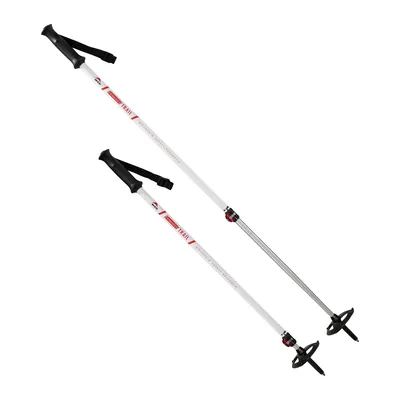
MSR DynaLock Trail Poles
Aluminum poles adjustable from 39.5 to 55 in, with a DynaLock lever lock that tightens without tools, plus snow and summer baskets: shorter uphill, longer downhill.
View on Amazon (opens in a new tab)
Worth watching
REI’s Miranda covers when trekking poles help, how to use them on climbs and descents to take some load off your knees, and how to keep them from damaging trails.
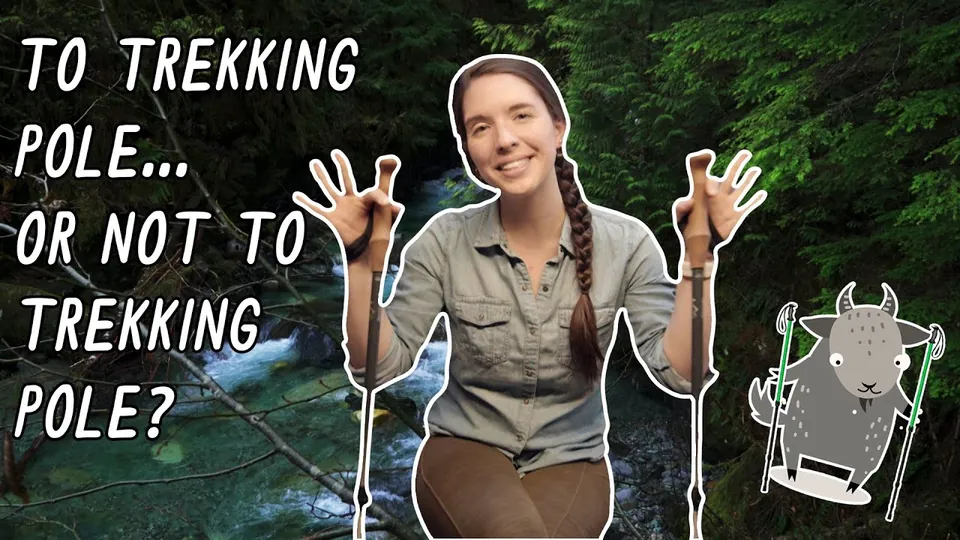
The video is hosted by YouTube (Google): nothing loads until you play it, and Google may then set cookies.
FAQ
Why do my knees hurt going downhill but not uphill?
Going downhill, your thigh muscles brake every step while being stretched, an eccentric contraction that’s harder on the muscle. The force in the knee also goes up: measured with sensor-equipped knee replacements, it reaches 3.39 times body weight on a ramp descent, against 2.74 times on level ground. Behind the kneecap, the force is smaller, but its increase is steeper: 3 to 4 times what it is on the level.
Should trekking poles be longer or shorter going downhill?
Longer, according to most sources: Leki recommends 2 to 4 inches more, so you can plant your poles ahead and below without hunching over, and the German Alpine Club sets them longer on steep descents, elbow at roughly a right angle. A 2004 article from the Swiss Alpine Club argued for shorter poles, but it stands alone.
What are the best knee exercises for hiking?
Exercises that strengthen your thighs and hips, plus balance work. The Austrian Alpine Club suggests lunges, knee bends on an unstable surface, and standing on one leg, at least twice a week for about 20 minutes. The American Academy of Orthopaedic Surgeons lists half squats, hamstring curls, and straight-leg raises, 2 to 3 days a week as maintenance, with no pain during any exercise.
How do you hike downhill without hurting your knees?
Shorten your steps, keep your knees slightly bent and your upper body a little forward, place each foot instead of letting it drop, and zigzag where the trail allows, as Europe’s alpine clubs advise. Lengthen your poles by 2 to 4 inches, lighten your pack, and on long descents take a short break every 15 to 20 minutes. And walk down, don’t run.
When should I see a doctor for knee pain after hiking?
According to MedlinePlus, contact your provider if you still have pain after 3 days of home treatment, if your knee buckles, locks, or can’t bear weight, if you can’t bend or straighten it, or if you have a fever, redness, warmth, or a lot of swelling. In an emergency on the trail, call 911.
Sources
- National Park Service, Grand Canyon National Park, “Behind the Scenery: Canyon Kinetics,” podcast and transcript, last updated October 14, 2021, accessed November 14, 2026. nps.gov https://www.nps.gov/grca/learn/photosmultimedia/behind-the-scenery-podcast-canyon-kinetics.htm ↩
- M. S. Kuster, G. A. Wood, G. W. Stachowiak, A. Gächter, “Joint load considerations in total knee replacement,” Journal of Bone and Joint Surgery (Br), 79(1), 109-113, 1997, abstract on PubMed, accessed November 14, 2026. pubmed.ncbi.nlm.nih.gov https://pubmed.ncbi.nlm.nih.gov/9020457/ ↩
- W. R. Taylor et al., “A comprehensive assessment of the musculoskeletal system: The CAMS-Knee data set,” Journal of Biomechanics, 65, 32-39, 2017, abstract on PubMed, accessed November 14, 2026. pubmed.ncbi.nlm.nih.gov https://pubmed.ncbi.nlm.nih.gov/29037443/ ↩
- I. Kutzner et al., “Loading of the knee joint during activities of daily living measured in vivo in five subjects,” Journal of Biomechanics, 43(11), 2164-2173, 2010, abstract on PubMed, accessed November 14, 2026. pubmed.ncbi.nlm.nih.gov https://pubmed.ncbi.nlm.nih.gov/20537336/ ↩
- M. Kuster, G. A. Wood, S. Sakurai, G. Blatter, “Stress on the femoropatellar joint in downhill walking: a biomechanical study,” Zeitschrift für Unfallchirurgie und Versicherungsmedizin, 86(3), 178-183, 1993, article in German, English abstract on PubMed, accessed November 14, 2026. pubmed.ncbi.nlm.nih.gov https://pubmed.ncbi.nlm.nih.gov/8130008/ ↩
- German Alpine Club (DAV), Martin Schlageter, “Wenn es zwickt und zwackt” (on muscle and joint aches), Panorama 1/2025, February 4, 2025 (in German), accessed November 14, 2026. alpenverein.de https://www.alpenverein.de/artikel/muskel-und-gelenkbeschwerden_541bb22d-58b2-46b6-bf57-08465eafd4ef ↩
- S. Maeo et al., “Prevention of downhill walking-induced muscle damage by non-damaging downhill walking,” PLoS One, 12(3), e0173909, 2017, accessed November 12, 2026. pmc.ncbi.nlm.nih.gov https://pmc.ncbi.nlm.nih.gov/articles/PMC5348007/ ↩
- Austrian Alpine Club (Österreichischer Alpenverein, ÖAV), “Safe mountain hiking,” leaflet from the “SicherAmBerg” series, English edition, 2020, accessed November 14, 2026. alpenverein.at https://www.alpenverein.at/portal_wAssets/docs/bergsport/sicheramberg/cardfolder/Mountain-Hiking-CF-2020-en.pdf ↩
- German Alpine Club (DAV), Max Bolland, “Gut gegangen!” (walking well), “So geht das” series, Panorama 3/2021, March 24, 2021, updated December 12, 2022 (in German), accessed November 14, 2026. alpenverein.de https://www.alpenverein.de/artikel/sicher-unterwegs-am-wanderweg_242178be-9133-4cff-8358-9ce2e1053c04 ↩
- Swiss Council for Accident Prevention (BPA, or BFU in German), “Rando en montagne” campaign, “Bien gérer la randonnée” (managing your hike) (in French), accessed November 14, 2026. rando-en-montagne.ch https://www.rando-en-montagne.ch/fr/bien-gerer-la-randonnee ↩
- MedlinePlus (National Library of Medicine), “Knee pain,” medical encyclopedia, review date November 7, 2024, accessed November 14, 2026. medlineplus.gov https://medlineplus.gov/ency/article/003187.htm ↩
- Swiss Alpine Club (SAC/CAS), Les Alpes 9/2004, Engelbert Eder, “Utilité des bâtons. Les avantages d’une bonne technique de marche” (the usefulness of poles and the benefits of good walking technique) (in French), accessed November 14, 2026. sac-cas.ch https://www.sac-cas.ch/fr/les-alpes/utilite-des-batons-les-avantages-dune-bonne-technique-de-marche-16826/ ↩
- National Park Service, “Hike Smart,” article, last updated June 13, 2024, accessed November 14, 2026. nps.gov https://www.nps.gov/articles/hiking-safety.htm ↩
- National Park Service, Grand Canyon National Park, “Hiking Tips,” last updated March 12, 2025, accessed November 14, 2026. nps.gov https://www.nps.gov/grca/planyourvisit/hike-tips.htm ↩
- National Park Service, Grand Canyon National Park, “Hiking Into Grand Canyon,” trip planner (PDF), accessed November 14, 2026. nps.gov https://www.nps.gov/grca/planyourvisit/upload/intro-bc-hike.pdf ↩
- Fédération française de la randonnée pédestre (FFRandonnée, the French hiking federation), “Les itinéraires de randonnée” (hiking routes) (in French), accessed October 21, 2026. ffrandonnee.fr https://www.ffrandonnee.fr/randonner/ou-pratiquer/les-itineraires-de-randonnee ↩
- H. Schwameder et al., “Knee joint forces during downhill walking with hiking poles,” Journal of Sports Sciences, 17(12), 969-978, 1999, abstract accessed November 8, 2026. pubmed.ncbi.nlm.nih.gov https://pubmed.ncbi.nlm.nih.gov/10622357/ ↩
- German Alpine Club (DAV), Joachim Merk, “Aus dem Tritt” (out of step: compensating postures and their effects), Panorama 4/2026, November 4, 2026 (in German), accessed November 14, 2026. alpenverein.de https://www.alpenverein.de/artikel/schonhaltungen-folgen-bergsport_b5e183ca-3f0c-4ba0-8958-a75d8cee741d ↩
- Leki UK, “Walking Pole Length Guide: What Size Do I Need?,” blog, June 17, 2026, accessed November 14, 2026. leki.co.uk https://www.leki.co.uk/blog/walking-pole-length-guide ↩
- German Alpine Club (DAV), Max Bolland, “So geht das: Trekkingstöcke richtig einsetzen” (how to use trekking poles properly), Panorama 4/2021, July 15, 2021, updated March 27, 2024 (in German), accessed November 14, 2026. alpenverein.de https://www.alpenverein.de/artikel/so-geht-das-trekkingstocke-richtig-einsetzen_d294025d-018e-4cb3-b1ab-d12c1311476b ↩
- J. T. Sturdy et al., “Joint moments and muscle excitations increase with body-mass normalized backpacks across walking slopes,” Gait & Posture, 120, 234-241, 2025, abstract on PubMed, accessed November 14, 2026. pubmed.ncbi.nlm.nih.gov https://pubmed.ncbi.nlm.nih.gov/40305925/ ↩
- Fédération française de la randonnée pédestre (FFRandonnée), “Préparer son sac à dos” (packing your backpack), June 6, 2024 (in French), accessed November 14, 2026. ffrandonnee.fr https://www.ffrandonnee.fr/randonner/conseils/preparer-son-sac-a-dos ↩
- National Park Service, Isle Royale National Park, “Packing Guide,” last updated September 25, 2026, accessed November 14, 2026. nps.gov https://www.nps.gov/isro/planyourvisit/packing-guide.htm ↩
- S. P. Messier et al., “Weight loss reduces knee-joint loads in overweight and obese older adults with knee osteoarthritis,” Arthritis & Rheumatism, 52(7), 2026-2032, 2005, abstract on PubMed, accessed November 14, 2026. pubmed.ncbi.nlm.nih.gov https://pubmed.ncbi.nlm.nih.gov/15986358/ ↩
- American Academy of Orthopaedic Surgeons (AAOS), OrthoInfo, “Knee Conditioning Program,” accessed November 14, 2026. orthoinfo.org https://www.orthoinfo.org/bodypart/kneelower-leg/knee-conditioning-program/ ↩
- U.S. Department of Health and Human Services, Physical Activity Guidelines for Americans, 2nd edition, 2018, accessed November 14, 2026. odphp.health.gov https://odphp.health.gov/sites/default/files/2019-09/Physical_Activity_Guidelines_2nd_edition.pdf ↩
- American Academy of Orthopaedic Surgeons (AAOS), OrthoInfo, “Patellofemoral Pain Syndrome,” accessed November 14, 2026. orthoinfo.org https://www.orthoinfo.org/bodypart/kneelower-leg/patellofemoral-pain-syndrome/ ↩
- N. J. Collins et al., “2018 Consensus statement on exercise therapy and physical interventions (orthoses, taping and manual therapy) to treat patellofemoral pain,” British Journal of Sports Medicine, 52(18), 1170-1178, 2018, abstract on PubMed, accessed November 14, 2026. pubmed.ncbi.nlm.nih.gov https://pubmed.ncbi.nlm.nih.gov/29925502/ ↩
- National Park Service, Grand Canyon National Park, “Hike Smart Podcast 02: Ten Essentials,” last updated May 12, 2021, accessed November 14, 2026. nps.gov https://www.nps.gov/grca/learn/photosmultimedia/hike_smart-02.htm ↩

Camping, backpacking, bushcraft and hiking
Guillaume Hoarau writes for Outfarer about camping, backpacking, bushcraft, and hiking. A survival-skills buff and a collector of vintage field manuals, he loves clear explanations, lists that actually help and other people’s stories, which he tells well.


 Julien de Jurquet
