 Français (France)
 English (UK)
 English (US)
 Deutsch (Deutschland)

Contents
On paper, a 10,000 mAh power bank should fill a phone with a 3,692 mAh battery, such as the iPhone 17, almost three times over [1]. The honest sum comes out well short of that. Nothing fraudulent about it: Nitecore, for instance, lists its NB10000 with a 10,000 mAh cell at 3.85 V, or 38.5 Wh, and a rated energy of 6,400 mAh at 5 V [2]. The whole subject fits in those two lines.
mAh or Wh: the only figure worth comparing
Milliamp-hours mean nothing without the voltage. Energy is counted in A watt-hour (Wh) measures a quantity of energy: the voltage in volts multiplied by the capacity in amp-hours.: voltage multiplied by capacity. The UK Civil Aviation Authority gives passengers the formula for any battery or power bank without a Wh rating on its case: volts times milliamp-hours, divided by 1,000 [3]. When that rating is missing, the box is left with the mAh, which has the merit of being the bigger number.
Cell voltage varies from one maker to the next. Anker writes that most power banks use 3.7 V cells [4]; Goal Zero quotes 3.6 V for its Flip 24 [5], Nitecore 3.85 V [2]. Let’s do the maths: 10,000 mAh therefore stores 36 to 38.5 Wh, depending on the cell. Anker says so itself: when comparing power banks, look at the Wh rather than the mAh [4].
What a power bank actually delivers
First loss, inside the power bank: the cell voltage has to be stepped up to the 5 V of USB. Anker puts that efficiency at 80 to 85% [4]. Nitecore publishes the result for its NB10000: 6,400 mAh at 5 V, which is 32 Wh delivered out of 38.5 Wh stored, or 83% [2]. Second loss, inside the phone as it charges: Anker puts it at 10 to 20%, an efficiency of 80 to 90% [4].
At the end of the chain, the 32 Wh delivered become 25.6 to 28.8 Wh in the phone. All that remains is to divide by the energy of the phone’s battery, and that is where it gets awkward: Apple and Google publish mAh, 3,692 for the iPhone 17 and a typical 4,970 for the Pixel 10 [1, 6], but not the voltage, so not the Wh. The only phone in watt-hours we could find is Anker’s theoretical example, at 18.2 Wh [4]: with that one, a 10,000 mAh power bank gives 1.4 to 1.6 full charges.
Makers that promise a number of charges stay vague about the phone. Goal Zero promises ‘3 Recharges’ of a smartphone from its Venture 35, at 35.52 Wh [7], and ‘about two recharges on most phones’ from its Flip 24, at 24.12 Wh [5]. Those numbers only work with a small phone; with a recent model, rely on the sum above.
The weight gap is just as clear. The NB10000 weighs 150 g for 38.5 Wh [2], the waterproof Venture 35 weighs 286.9 g for 35.52 Wh [7]: 3.9 g per watt-hour on one side, 8.1 on the other. For a rucksack packed for several days, that ratio tells you more than the mAh figure.
How many days without a socket?
Neither Apple nor Google publishes what a phone uses while navigating. Google merely advises against using navigation and GPS for long periods, two heavy drains [8], and Apple points out that low signal hurts battery life, because the phone keeps searching for a better network [9]. The only reliable figure is therefore yours: note the percentage used over an ordinary day’s walk, with your settings and your map.
- Airplane Mode where there is no signal: Apple gives it as the way to save battery in poor coverage [9].
- Location Services turned off for the apps that do not need them, and the screen dimmed [9].
- Low Power Mode: it turns itself off once the phone is charged back to 80%, so switch it on again after a top-up [10].
- A satellite messenger keeps its own accounts: Garmin quotes the inReach Mini 2 at 2 days under moderate tree cover with frequent tracking, and up to 30 days under open sky with sparse tracking [11].
For the mapping app and its offline maps, our comparison of walking apps in Britain covers the settings, and our guide to calling for help without signal explains why to keep some battery for an emergency.
The cold: less battery life, and sometimes no charging at all
Apple designs its iPhones for ambient temperatures of 0 to 35 °C; any colder and battery life drops temporarily, and a device that gets too cold may not charge or may stop charging [12]. Power banks have their own limits: -10 to 40 °C for the NB10000 according to its manual [13], down to -40 °C for the SUMMIT 10000, built for the cold [14]. Garmin rates the inReach Mini 2 for use from -20 to 60 °C, but only charges it between 0 and 45 °C [11].
The explanation is chemistry: below 0 °C, lithium ions move more slowly through the electrodes and the electrolyte, and forcing a charge can plate metallic lithium onto the anode, at the expense of safety and lifespan [15]. The fix follows from those temperature ranges: at night, phone and power bank sleep in your sleeping bag; by day, in an inside pocket.
Bothies, huts and solar panels: do not count on a socket
In Britain the question rather answers itself. The Mountain Bothies Association tells you to assume a bothy has no facilities at all: ‘No tap, no sink, no beds, no lights’ [16]. A socket does not make the list. In the Alps, the French hiking federation warns that charging in a mountain hut is no free-for-all: isolated huts mostly run on solar-charged batteries, and energy is limited [17]. Tips for a good night are in our guide to mountain huts in France.
And the solar panel? Goal Zero’s Nomad 10, 10 W for 0.51 kg, takes 4.5 to 9 hours to charge a Venture 35 according to the panel’s page, and 6 to 12 hours according to the power bank’s, the maker warning that it all depends on elevation, time of year and angle to the sun [18, 7]. For a little less than its 510 g, you can carry three NB10000s: 450 g and 115.5 Wh, no sunshine required. The panel still has a case on very long, sunny treks; for a week of huts or bothies, the second power bank wins.
Flying: what changed in 2026
Since 27 March 2026, an addendum to the ICAO Technical Instructions has set specific rules for power banks, as published by the UK Civil Aviation Authority: hand luggage only, individually protected when not in use, never recharged on board, and two per person at most; they should not be used to charge other devices in flight either [19]. Up to 100 Wh, no approval is needed; from 100 to 160 Wh, you need the airline’s approval [19]. The CAA adds that you may be asked to put power banks in the seat back pocket rather than an overhead locker [3], and GOV.UK tells you to check with your airline if you are not sure [20].
Some airlines go further. The Lufthansa Group has banned using or charging power banks on board its airlines’ flights since 15 January 2026, and keeps them out of overhead lockers [21]. Emirates accepts only one, under 100 Wh, and has banned using power banks on board since 1 October 2025 [22]. For 2027, the IATA tables only list power banks up to 100 Wh, two per passenger [23].
Looking after your power bank
The NB10000 manual asks you to recharge it every three months when it is not in use, not to use it if it is damaged, and to stop using it immediately at any sign of leakage or an unusual smell [13]. Apple adds that ambient temperatures above 35 °C can permanently damage battery capacity [9]: the dashboard of a car parked in the sun at the start of a walk is not a good place to leave it. And recalls do happen: on 1 June 2026, the Office for Product Safety and Standards published the recall of POM power banks sold at TK Maxx and Homesense, a fire risk because their internal wiring is not securely attached [24].
The rule to remember: count in watt-hours, knock off a quarter to a third for losses, and never count on a socket in a hut, let alone in a bothy.
Kit related to this article
No affiliation: no commission, no sponsored products.
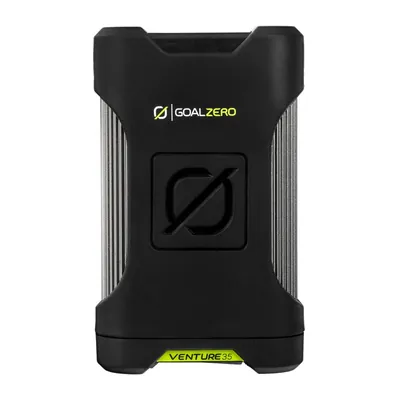
Goal Zero Venture 35
9,600 mAh (35.52 Wh at 3.7 V) power bank with an IP67 housing and protective sleeve, USB-C and USB-A ports, 50-lumen flashlight, 286.9 g. Operating range stated by Goal Zero: 0 to 45 °C.
View on Amazon (opens in a new tab)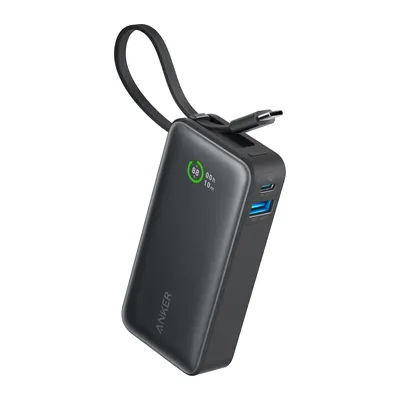
Anker Nano Power Bank 10,000 mAh (A1259)
10,000 mAh power bank with a built-in USB-C cable, one USB-C and one USB-A port, 30 W maximum on USB-C, 215 g. Anker’s page gives neither voltage nor Wh.
View on Amazon (opens in a new tab)
FAQs
How many phone charges do you get from a 10,000 mAh power bank?
Fewer than the figure suggests. A 10,000 mAh power bank stores about 36 to 38.5 Wh, delivers about 32 Wh at 5 V according to Nitecore, and the phone loses another 10 to 20% while charging according to Anker. With the 18.2 Wh phone Anker uses as an example, that makes 1.4 to 1.6 full charges. A recent phone with a big battery will get fewer.
What size power bank do I need for a 5-day walk?
It depends on your phone and how you use it, which Apple and Google don’t publish: measure your own use over an ordinary day’s walk. If your phone loses half its battery a day, five days need 150% on top of its own charge, which is roughly a 10,000 mAh power bank delivering 1.5 charges. Keep a margin for the cold and for an emergency call.
Can I take a power bank on a plane from the UK?
Yes, in your hand luggage only, never in the hold. Since 27 March 2026, the ICAO rule published by the CAA allows two power banks per person and bans recharging them on board. Up to 100 Wh, or about 27,000 mAh for a 3.7 V cell, no approval is needed; from 100 to 160 Wh, you need the airline’s approval. Some airlines, such as Emirates, accept only one.
Does a power bank work in freezing weather?
Less well, and each model has its own range: -10 to 40 °C for a Nitecore NB10000, down to -40 °C for a power bank designed for the cold. The phone itself is designed for 0 to 35 °C and may refuse to charge when it gets too cold. Keep both close to your body by day, and in your sleeping bag at night.
Solar panel or a second power bank for a long-distance walk?
For a week of huts or bothies, the second power bank usually wins: a Goal Zero Nomad 10 panel weighs 510 g and takes 4.5 to 12 hours to fill a 35 Wh power bank according to the maker’s own pages, while a 10,000 mAh Nitecore NB10000 weighs 150 g. The panel comes into its own on very long, sunny trips, far from any socket.
Sources
- Apple, EU product information sheet, iPhone 17, model A3520 (PDF, August 2025), accessed 13 November 2026. regulatoryinfo.apple.com https://regulatoryinfo.apple.com/cwt/api/ext/file?fileId=energyLabels%2FA3520_V1%2FA3520%2FA3520_Product_Information_Sheet_EN_EU.pdf ↩
- Nitecore, ‘NITECORE NB10000 Ultra Lightweight Carbon Fiber Energy Brick’, product page, accessed 13 November 2026. nitecore.com https://www.nitecore.com/mobile-product/nb10000 ↩
- UK Civil Aviation Authority, ‘Pack right. Safe flight.’, advice for passengers, accessed 13 November 2026. caa.co.uk https://www.caa.co.uk/air-passengers/about-your-trip/baggage/pack-right-safe-flight/ ↩
- Anker, ‘Why is the Rated Capacity of Power Banks Lower Than Expected?’, help page, accessed 13 November 2026. service.anker.com https://service.anker.com/au/article-description/Why-is-the-Rated-Capacity-of-Power-Banks-Lower-Than-Expected ↩
- Goal Zero, ‘Flip 24 Portable Power Bank’, product page, accessed 13 November 2026. goalzero.com https://goalzero.com/products/flip-24-power-bank ↩
- Google, ‘Pixel phone hardware tech specs’, Pixel Phone Help, accessed 13 November 2026. support.google.com https://support.google.com/pixelphone/answer/7158570?hl=en ↩
- Goal Zero, ‘Venture 35 Power Bank’, product page, accessed 13 November 2026. goalzero.com https://goalzero.com/products/venture-35-power-bank ↩
- Google, ‘Stretch a low battery’s power on Pixel phone’, Pixel Phone Help, accessed 13 November 2026. support.google.com https://support.google.com/pixelphone/answer/6187455?hl=en ↩
- Apple, ‘Batteries: Maximising Performance’, accessed 13 November 2026. apple.com https://www.apple.com/uk/batteries/maximizing-performance/ ↩
- Apple, ‘Use Low Power Mode to save battery life on your iPhone or iPad’, 1 October 2026, accessed 13 November 2026. support.apple.com https://support.apple.com/en-gb/101604 ↩
- Garmin, inReach Mini 2 owner’s manual (PDF, September 2026), accessed 13 November 2026. www8.garmin.com https://www8.garmin.com/manuals/webhelp/GUID-802DEF62-EBB2-463C-8C51-C58FB29F89E3/EN-US/inReach_Mini_2_OM_EN-US.pdf ↩
- Apple, ‘If your iPhone or iPad gets too hot or too cold’, 19 May 2026, accessed 13 November 2026. support.apple.com https://support.apple.com/en-gb/118431 ↩
- Nitecore, NB10000 user manual (PDF, May 2025, several languages), accessed 13 November 2026. nitecore.com https://www.nitecore.com/storage/images/manual/nb10000.pdf ↩
- Nitecore, ‘NITECORE SUMMIT 10000 Low Temperature Resistant Carbon Fiber Power Bank’, product page, accessed 13 November 2026. nitecore.com https://www.nitecore.com/mobile-product/summit10000 ↩
- ‘Lithium-Ion Batteries under Low-Temperature Environment: Challenges and Prospects’, Materials, 2022, 15(22):8166, accessed 13 November 2026. pmc.ncbi.nlm.nih.gov https://pmc.ncbi.nlm.nih.gov/articles/PMC9698970/ ↩
- Mountain Bothies Association, ‘What is a Bothy?’, accessed 13 November 2026. mountainbothies.org.uk https://www.mountainbothies.org.uk/bothies/what-is-a-bothy/ ↩
- Mon GR (French hiking federation, FFRandonnée), ‘Les clés pour une bonne nuit en refuge’ (in French), accessed 13 November 2026. mongr.fr https://www.mongr.fr/conseils/sinformer/les-cles-pour-une-bonne-nuit-en-refuge ↩
- Goal Zero, ‘Nomad 10 Foldable Solar Panel’, product page, accessed 13 November 2026. goalzero.com https://goalzero.com/products/nomad-10-solar-panel ↩
- UK Civil Aviation Authority, ‘Changes to rules on the carriage of lithium cells/batteries and power banks’ (ICAO rule effective from 27 March 2026), accessed 13 November 2026. caa.co.uk https://www.caa.co.uk/commercial-industry/airlines/dangerous-goods/changes-to-rules-on-the-carriage-of-lithium-cellsbatteries-and-power-banks/ ↩
- GOV.UK, ‘Hand luggage restrictions at UK airports: Electronic devices and electrical items’, accessed 13 November 2026. gov.uk https://www.gov.uk/hand-luggage-restrictions/electronic-devices-and-electrical-items ↩
- Lufthansa Group, ‘Power banks on board: updated regulations starting 15 January 2026’, 12 January 2026, accessed 13 November 2026. business.lufthansagroup.com https://business.lufthansagroup.com/be/en/program/experts/news/power-banks-on-board--updated-regulations-from-january-2026 ↩
- Emirates, ‘Emirates does not allow power bank usage onboard flights’, 30 September 2025, accessed 13 November 2026. emirates.com https://www.emirates.com/media-centre/emirates-safety-rules-for-customer-usage-of-power-banks-onboard---now-in-full-effect/ ↩
- IATA, Dangerous Goods Regulations, 68th edition, effective 1 January 2027, table 2.3.B (PDF), accessed 13 November 2026. iata.org https://www.iata.org/contentassets/6fea26dd84d24b26a7a1fd5788561d6e/dgr-68-en-2.3.b.pdf ↩
- Office for Product Safety and Standards, ‘Product Recall: POM Power Banks sold by TK Maxx (2605-0127)’, 1 June 2026, accessed 13 November 2026. gov.uk https://www.gov.uk/product-safety-alerts-reports-recalls/product-recall-pom-power-banks-sold-by-tk-maxx-2605-0127 ↩

Campervans, motorhomes, cycling and calculators
Julien de Jurquet writes for Outfarer about campervans, motorhomes, cycling and calculators. He reads instruction manuals to the very end and never lets a figure through without its unit, so that your choices rest on sums rather than promises.


 Guillaume Hoarau