 Français (France)
 English (UK)
 English (US)
 Deutsch (Deutschland)

Contents
Starting at a club: taster sessions, no bow to buy
Do you need to buy a bow to start? No, and that is rather the point: you begin at a club affiliated to your country’s federation, with club equipment and a coach on the shooting line. Most of the time, clubs lend this kit for a limited period, then encourage archers to get their own before the end of their first year [1].
The French archery federation (FFTA) wants to welcome children from the age of 7 [2]. In the United States, USA Archery clubs run programmes from the age of 8, and the federation points out that no experience is needed to give it a try [3].
Your first arrows will probably be shot indoors. The official distance there is 18 m, but some clubs move the target in to 10 or 15 m at first [4]. The season follows the calendar: indoors from September to March, outdoors from early spring to the end of summer [5], and 3D courses from March to November [6].
Membership, insurance and medical certificates
In France, the rule is plain: every member of a club affiliated to the FFTA must hold its licence, which includes third-party liability insurance [8]. In practice, if your arrow injures someone or breaks a window, that insurance pays for the damage done to others [9].
Your own injuries fall under a separate personal accident cover. The licence includes a basic one, for €0.28 a year, which you may decline in writing; two fuller options cost €35 and €50 [9]. A medical certificate is no longer required since the law of 2 March 2022: adults and minors fill in a health questionnaire, and a single ‘yes’ means a certificate less than six months old [10].
The cost of the licence adds up. For the 2026-2027 season, the national share, insurance included, is €36 for an adult who shoots at the club and €44 for an adult who competes. On top come €2 for major events, the regional and departmental shares, which vary from one region to another, and then each club’s own fee [8].
What changes from one country to the next
Elsewhere the logic is the same, with differences that matter before your first session. In Switzerland, membership goes through the club, and the federation’s insurance also covers people on beginners’ courses [11, 12]. In the UK, the National Field Archery Society (NFAS) takes new members on a provisional basis, and its insurance covers members only [13, 14]. In the United States, you can try archery at a USA Archery club without joining [3, 15]. In Germany, sports insurance comes through the club and each state’s sports confederation, the Landessportbund: in Lower Saxony, a non-member at a taster session is not, in principle, covered [16].
| Country | Body | Yearly cost for an adult | Insurance | Worth knowing |
|---|---|---|---|---|
| France | FFTA, through an affiliated club | National share of €36 (club) or €44 (competition), plus local shares and the club fee | Third-party liability included; basic personal accident cover at €0.28, which can be declined | Discovery licence from 1 March |
| Switzerland | SwissArchery, through a club | CHF 43 per active member, billed to the club; competition licence CHF 75 | Group liability cover up to CHF 5 million, beginners’ courses included | Worldwide cover, except Canada and the United States |
| United Kingdom (field archery) | NFAS | £20 | The society’s insurance, for members only | Provisional member until an approved archer signs you off as competent |
| United States | USA Archery | $20 (recreational) to $70 (all-access) | Liability and excess accident insurance included | You can try at a club without joining |
| Germany (Lower Saxony example) | Club affiliated to the Landessportbund | Club fee | Group sports insurance for members | Non-members at taster sessions not covered, in principle (2019) |
National membership only, club fees not included. For target archery in the UK, and in Austria, ask the club which national body it belongs to and what membership covers.
Recurve, compound, barebow or longbow: the bows you will come across
Four families of bows share the shooting lines, and the rules of each discipline say which ones are allowed [17]:
- The recurve bow: the only bow allowed at the Olympic Games. It comes apart, and carries a sight and stabilisers [17].
- The compound bow: pulleys, called cams, multiply the effort, the archer aims through a magnifying lens and releases the string with a A small mechanism held in the hand that holds the string and then lets it go, instead of the fingers. [17].
- The barebow: a recurve with no sight and no stabilisers [18].
- The longbow: a bow of traditional shape whose string touches only the nocks at its tips; World Archery requires it to be at least 150 cm long [19].
Your choice of bow also decides which disciplines are open to you. Recurve and compound bows share target archery; the barebow and the longbow have their place on courses. In Germany, the Deutscher Schützenbund only runs longbow competitions in field and 3D archery [20], while the FFTA admits the longbow in field archery, a French particularity [21].
Distances and targets: from 18 m indoors to 70 m outside
Indoors, everyone shoots at 18 m, at a 60 cm target face for under-15s and a 40 cm face after that [4]. Outdoors, the target grows and moves away. Recurve archers shoot at 70 m at a 122 cm face, whose 10 ring measures 12.2 cm; compound archers shoot at 50 m at an 80 cm face cut down to its inner rings [5, 22].
Young archers start closer: 20 m for under-11s, then 30, 40 and 60 m depending on age, and 70 m from about 18; archers aged 60 and over go back to 60 m with a recurve [5]. In field and 3D archery, the distance changes at every target, as the diagram shows.
Field archery and 3D courses: archery in the woods
Field archery is shot on a waymarked course that you follow from target to target, rather like golf, across fields and woods, with uphill, downhill and sideways-sloping shots [21]. The black and yellow faces stand up to 60 m away, at marked or unmarked distances; you shoot 3 arrows at each target, within 3 minutes [21].
3D archery keeps the idea of a course but swaps the faces for life-size foam animals: 24 targets, 2 arrows at each, from 5 to 30 m, and up to 45 m in the class the FFTA calls ‘tir libre’ [6]. A closer shooting peg is kept for young archers and for those trying the discipline [6]. Its cousin, the French nature round, uses 21 paper targets set between 5 and 40 m [23].
The FFTA says so itself: its only animals are made of foam or paper, and bowhunting falls under a framework other than its own [6]. It is not the subject of this guide. Finally, a course shares the woods with other users, walkers and mountain bikers first among them: the FFTA asks for separate waymarking for archers and for visitors [24].
The safety rules of the shooting line
The rules look alike from one country to the next, because they answer the same risk: an arrow travels fast and far. Archery’s record is good all the same: in the United States, according to 2017 hospital data compiled by the Archery Trade Association, an industry body, it saw 0.57 injuries per 1,000 participants, against 1.38 for golf [26].
The FFTA offers its clubs a list of basic rules to write into their house rules [7]:
- Never nock an arrow or draw the bow, even without an arrow, anywhere other than on the shooting line and towards the target.
- Never release the string without an arrow on it.
- An arrow dropped in front of the line is picked up once the end is over, not during it.
- Nothing is left between the shooting line and the target.
- Keep a good distance from an archer who is shooting.
- At the target, make sure nobody is standing right behind you before pulling your arrows.
- No running indoors or on the range, and never with arrows in your quiver.
- No damaged or unsuitable kit: arrows too short, a worn string, a faulty arrow rest.
In competition, World Archery adds that you draw your bow only while standing on the shooting line, always pointing at your own target, and bans any technique that could send an arrow beyond the safety zone [18]. Shooting is paced by sound signals, and one matters more than all the others: at least 5 blasts, and everyone stops shooting [18].
On a course, a few more rules
In the woods, the target no longer sits at the end of a closed range. The FFTA reminds its organisers that an arrow that misses the target can fly 100 m, and up to 250 m from a target placed on a summit. It recommends a safety corridor 100 m long and 11 m wide, where nobody walks or stands, and shorter shots in 3D, where arrows bounce off more often [24]. The rules of the UK’s NFAS spell out what this asks of the group [14]:
- Before shooting, make sure the target and the visible overshoot behind it are clear.
- Shout ‘Stop’ at the first sign of danger: the whole group stops shooting at once.
- Never move between targets with an arrow nocked on the string.
- Never start drawing a bow above a line parallel to the target.
- Nobody stands forward of the archer on the shooting peg.
- While scoring, pulling or looking for arrows, one adult in the group stays standing in front of the target.
- Keep to the marked path between targets, including once the round is over.
- Keep a dog on a lead of no more than 3 m whenever there is shooting nearby, a rule to add to those of walking with a dog.
The emergency signal itself changes from one set of rules to another. In target archery, World Archery uses at least 5 blasts; on NFAS courses, every adult carries a whistle, and the alarm is three blasts followed by a pause [18, 14]. On a permanent course, the FFTA also recommends a board at the entrance with the details of an on-call medical service [24]: find it, and know how to call for help without a signal.
What it costs to take up archery
The first season costs mostly the membership and the club fee, since the kit is on loan [1]. Personal accessories come next: the tab or glove that protects your fingers with a recurve, the armguard, and the quiver, ‘a very personal accessory, which is not lent’, as the FFTA puts it [28].
Your own bow usually arrives before the end of the first year. For a competition recurve, the FFTA quotes, as a rough guide, €200 to €700 for the riser and €100 to €700 for a pair of limbs, so about €300 to €1,500, without the sight or stabilisers. It points out that complete kits exist, that they suit adults too, and that limb length and draw weight are the two key settings; it advises talking to your coach before you buy [1].
Worth watching
World Archery’s barebow world champion David Jackson walks through a 3D round: foam animal targets out in the countryside, getting to the peg and setting up the shot.
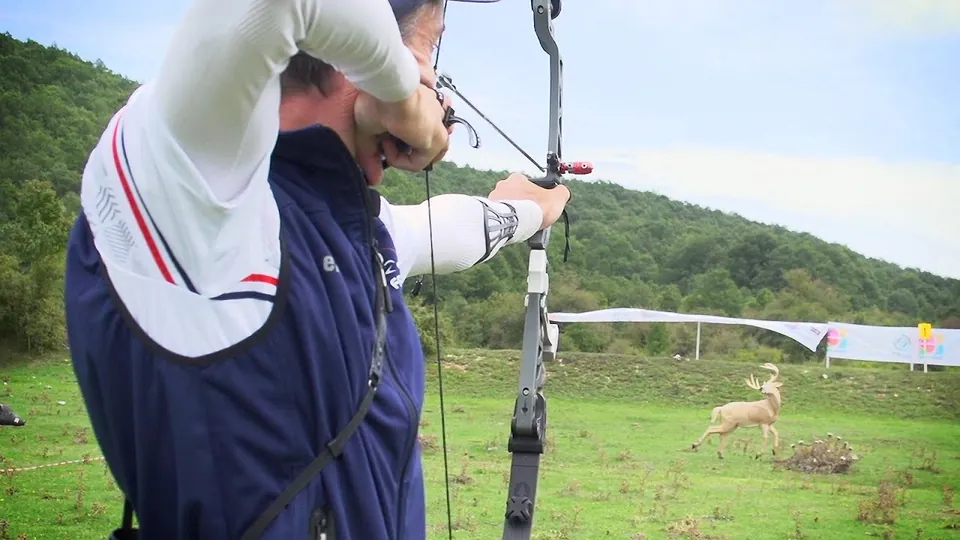
The video is hosted by YouTube (Google): nothing loads until you play it, and Google may then set cookies.
FAQs
What age can you start archery?
The French federation (FFTA) wants to welcome children from the age of 7, when control of posture is acquired, and its indoor competitions are open to under-11s. In the United States, USA Archery clubs run programmes from the age of 8. For adults, the FFTA’s age categories run up to archers aged 60 and over.
Do you need a medical certificate for archery?
In France, not as a rule. Since the law of 2 March 2022, the FFTA only asks adults and minors to fill in a health questionnaire. A single ‘yes’ means a medical certificate less than six months old. An under-11 competing with a bow of more than 18 lb must see a doctor approved by the FFTA.
How much does archery membership cost?
It depends on the country. In France, the FFTA’s national share for 2026-2027 is €36 for an adult shooting at the club and €44 for competition, insurance included, plus local shares and the club fee. In the UK, adult membership of the NFAS costs £20. In the United States, USA Archery memberships start at $20.
How far away is the target when you start?
Often 10 or 15 m indoors, before the official distance of 18 m. Outdoors, distances depend on age and bow: 20 m for under-11s, up to 70 m for an adult with a recurve and 50 m with a compound. On a 3D course, a closer shooting peg is kept for beginners.
Can you shoot a bow in the countryside, outside a club?
Nothing should be improvised. According to the French federation, an arrow that misses the target can fly 100 m, and 250 m from high ground: a course needs safety corridors and permission from landowners and the authorities. In Switzerland, the federation is concerned about archers shooting on public land. Before any shooting outside a club, ask the landowner and the local council.
Sources
- French archery federation (FFTA), ‘Bien choisir son premier arc classique de compétition’, feature from the federation’s magazine, accessed 23 October 2026. ffta.fr https://www.ffta.fr/bien-choisir-son-premier-arc-classique-de-competition ↩
- French archery federation (FFTA), ‘Moins de 10 ans’, accessed 23 October 2026. ffta.fr https://www.ffta.fr/pratiquer/decouvrir-et-pratiquer/de-10-ans ↩
- USA Archery, ‘Try Archery’, accessed 23 October 2026. usarchery.org https://www.usarchery.org/participate/try-archery ↩
- French archery federation (FFTA), ‘Le tir à 18m’, accessed 23 October 2026. ffta.fr https://www.ffta.fr/pratiquer/disciplines-officielles-et-nouvelles-pratiques/le-tir-en-salle ↩
- French archery federation (FFTA), ‘Le Tir à l’Arc Extérieur’, official distances, accessed 23 October 2026. ffta.fr https://www.ffta.fr/pratiquer/disciplines-officielles-et-nouvelles-pratiques/le-tir-larc-exterieur ↩
- French archery federation (FFTA), ‘Le tir 3D’, accessed 23 October 2026. ffta.fr https://www.ffta.fr/pratiquer/disciplines-officielles-et-nouvelles-pratiques/le-tir-3d ↩
- French archery federation (FFTA), ‘Le règlement intérieur’, sheet 6 of the Guide du dirigeant, March-April 2008, accessed 23 October 2026. ffta.fr https://www.ffta.fr/sites/default/files/2024-11/fiche_6_rgltinterieur.pdf ↩
- French archery federation (FFTA), ‘Les différents types de licences’, 2026-2027 season fees, accessed 23 October 2026. ffta.fr https://www.ffta.fr/nos-clubs/la-licence-federale/les-differents-types-de-licences ↩
- French archery federation (FFTA), ‘L’assurance des licenciés’, accessed 23 October 2026. ffta.fr https://www.ffta.fr/nos-clubs/assurances-licencies-et-clubs/lassurance-des-licencies ↩
- French archery federation (FFTA), ‘Certificat médical et questionnaire de santé’, accessed 23 October 2026. ffta.fr https://www.ffta.fr/nos-clubs/la-licence-federale/le-certificat-medical ↩
- SwissArchery, ‘Assurances’, accessed 23 October 2026. swissarchery.org https://www.swissarchery.org/assurances/ ↩
- SwissArchery, ‘Cotisations et licences’, accessed 23 October 2026. swissarchery.org https://www.swissarchery.org/cotisations-et-licences/ ↩
- National Field Archery Society (NFAS), ‘Membership Explained’, accessed 23 October 2026. nfas.net https://nfas.net/membership/membership-types ↩
- National Field Archery Society (NFAS), Rule Book 2025, safety rules in force since 1 April 2022, accessed 23 October 2026. nfas.net https://nfas.net/wp-content/uploads/2025/06/NFAS-RuleBook-2025.pdf ↩
- USA Archery, ‘Become a Member’, membership fees, accessed 23 October 2026. usarchery.org https://www.usarchery.org/memberships/become-a-member ↩
- LandesSportBund Niedersachsen, ‘Sie fragen - der LSB antwortet’, questions on sports insurance, LSB Magazin, October 2019, accessed 23 October 2026. lsb-niedersachsen.de https://www.lsb-niedersachsen.de/fileadmin/user_upload/2019_10_Fragen_von_SV_zur_ARAG_Sportversicherung.pdf ↩
- French archery federation (FFTA), ‘Les différents types d’arcs’, accessed 23 October 2026. ffta.fr https://www.ffta.fr/pratiquer/le-materiel/les-differents-types-darcs ↩
- World Archery, Rulebook, Book 3: Target Archery, version of 13 March 2026, articles 9.3, 10.9, 10.10, 11.3.1 and 11.3.3, accessed 23 October 2026. extranet.worldarchery.sport https://extranet.worldarchery.sport/documents/index.php/?doc=7626&inline=1 ↩
- World Archery, Rulebook, Book 4: Field and 3D Archery, version of 27 January 2026, article 19.5, accessed 23 October 2026. extranet.worldarchery.sport https://extranet.worldarchery.sport/documents/index.php/Rules/Rule_Book_versions/2026-01-27/EN-Book_4_-_2026-01-27_Version.pdf ↩
- Deutscher Schützenbund, ‘Langbogen’, accessed 23 October 2026. dsb.de https://www.dsb.de/bogensport/disziplinen/langbogen ↩
- French archery federation (FFTA), ‘Le tir en campagne’, accessed 23 October 2026. ffta.fr https://www.ffta.fr/pratiquer/disciplines-officielles-et-nouvelles-pratiques/le-tir-en-campagne ↩
- World Archery, ‘Disciplines’, accessed 23 October 2026. worldarchery.sport https://www.worldarchery.sport/sport/disciplines ↩
- French archery federation (FFTA), ‘Le Parcours Nature’, accessed 23 October 2026. ffta.fr https://www.ffta.fr/pratiquer/disciplines-officielles-et-nouvelles-pratiques/le-parcours-nature ↩
- French archery federation (FFTA), development department, Recommandations pour l’implantation de parcours (field, nature and 3D courses), accessed 23 October 2026. ffta.fr https://www.ffta.fr/sites/default/files/2024-11/implantation_parcours.pdf ↩
- National Field Archery Society (NFAS), ‘What We Do’, accessed 23 October 2026. nfas.net https://nfas.net/about-us/what-we-do ↩
- Archery Trade Association, Archery Safety, brochure published by USA Archery, 2017 data, accessed 23 October 2026. usarchery.org https://www.usarchery.org/resources/ata-athlete-safety-brochure-011021174802.pdf ↩
- SwissArchery, ‘Sécurité sur les terrains d’entraînement’, accessed 23 October 2026. swissarchery.org https://www.swissarchery.org/label-securite/ ↩
- French archery federation (FFTA), ‘Les accessoires de base’, accessed 23 October 2026. ffta.fr https://www.ffta.fr/pratiquer/le-materiel/les-accessoires-de-base ↩

Fact-checking, regulations and safety
Arnaud Couderc reviews our contributors’ articles and writes for Outfarer about regulations, safety, fishing, the sea and outdoor pursuits. He traces every rule back to its official text and every figure to its source, so that you set off with sound benchmarks.


 Guillaume Hoarau