 Français (France)
 English (UK)
 English (US)
 Deutsch (Deutschland)

From 930 to 4,350 miles (1,500 to 7,000 km): that is the spread in chain life Decathlon gives, depending on whether you ride a mountain bike through mud or a road bike on dry tarmac with regular upkeep [1]. A gap of nearly five to one is not something an odometer can settle. A percentage can, and you can measure it in two minutes with a ruler or a gauge.
A chain doesn’t stretch: it wears from the inside
‘Stretch’ is a misleading word. Sheldon Brown, writing in Adventure Cyclist in 2002, explained that the plates don’t deform: the main cause is wear where each rivet turns inside the inner plates every time the chain flexes. A 57-link chain has 456 parts [2]. Each joint loses a fraction of a millimetre, and the whole chain grows longer: that growth is what gauges measure.
It spreads to the rest of the drivetrain. According to Decathlon, a lengthened chain digs into and deforms the steel or aluminium of the cassette and chainrings; sprockets worn into shark-fin teeth then stop a new chain from seating properly, so it skips on every pedal stroke [1]. Park Tool puts it bluntly: running past the wear limit wears out sprockets and chainrings early [3]. On an e-bike, the motor’s torque speeds the process up [1].
How much elongation means it’s time to replace it?
It depends on the number of sprockets: the more a cassette has, the narrower the chain and the smaller the allowance. Park Tool gives three markers: 1% for a single-speed, 0.75% for 10 speeds and fewer, 0.5% for 11 speeds and more [3]. Its CC-4.2 gauge, which covers chains from 5 to 13 speeds, SRAM Flattop and T-Type included, marks exactly those three points [4]. The German magazine BIKE gives the same values: up to 0.75% for 8 to 10 sprockets, 0.5% for 11 or 12 [5].
SRAM reasons differently. Its support pages set replacement at 0.8% for an Eagle chain and for a Flattop chain on its RED AXS road groupset, to be measured with a tool the brand has approved [6] [7]. Decathlon puts the warning at 0.75% (change the chain soon) and the critical limit at 1%: replace the chain and rear cassette, and inspect the chainring [1]. Two makers, two figures: your drivetrain maker’s number beats any average.
Measuring wear: with a ruler or a gauge
Without a specialist tool, a ruler will do. Sheldon Brown lays it against a rivet at the 12-inch (304.8 mm) mark and looks at where the rivet 12 full links further on falls, that is 24 rivets along [2]. Park Tool describes the same method: beyond 1/16 inch (1.6 mm), the chain is stretched to the point of replacement [3]. Do the sums: 1.6 mm over 304.8 mm is about 0.5%, the limit for 11 speeds and up; 3.2 mm (1/8 inch) is 1%.
Sheldon Brown turned that into a scale. Under 1/16 inch, all is well. At 1/16, change the chain, and the sprockets are probably fine. At 1/8, the chain has been left too long: the most-used sprockets are badly worn, and a new chain will wear quickly on them. Beyond that, it will almost certainly skip, especially on the small sprockets [2].
A drop-in gauge is quicker. Decathlon describes its own: you slip the curved end between two rollers and set the other end a link further along, without pressing. If the 0.75 side drops in fully, the chain needs changing soon; if the 1.0 side does, the cassette needs changing too [1]. Not all gauges are equal: the Australian retailer Zero Friction Cycling cites a tool that read 0.75 when a digital gauge and the Shimano TL-CN42 read about 0.25, and advises measuring at 3 to 5 places on every check, because a chain doesn’t wear evenly [8].
With no tool at all, Decathlon suggests putting the chain on the big chainring and the smallest sprocket, then pulling one link forward off the front of the chainring: if the whole tip of a tooth shows, the chain is badly worn [1]. For derailleur chains, BIKE offers a pull test: a gap bigger than a matchstick head means the chain has to go [5]. Both tricks catch a very worn chain; neither replaces the percentage measurement.
Cleaning: degrease, rinse, dry
Park Tool describes the standard routine: a chain cleaner filled with degreaser, at least 30 turns of the crank backwards, a rinse in soapy water, then a wipe-down with a cloth before lubricating [9]. With no cleaner, a stiff brush dipped in degreaser does the job by hand.
Sheldon Brown preferred the bottle method: take the chain off, pour a little pure citrus degreaser into a plastic bottle, shake, rinse [2]. The advantage, he explained, is using more solvent than a cleaner clamped on the chain holds. It needs a quick link, because the rivets on recent chains are hard to separate.

How often? Trek advises cleaning and lubricating at least once a month if you ride regularly, and more often in muddy off-road riding [11]. That is common sense, not a standard. On a trip of several days, you need to carry something to lubricate with: see the bikepacking kit list.
Lubricating: one drop per rivet, then wipe
Park Tool: one small drop of chain lubricant on each rivet, then a clean, dry cloth to remove the excess, which would only attract dirt [9]. Trek says to aim at the top of each roller and keep lubricant off the outside of the chain [11]. Sheldon Brown added that you should lubricate the inner face, the one facing the sprockets, along the top of the lower run: spray thrown up by the front wheel lands on the outer face, so the inner face stays the cleaner part of the chain. He advised against aerosols, which put too much lubricant where it isn’t needed and too little where it is [2].
Cycling UK separates dry lubricant, for summer and dry roads, from wet lubricant, for rain, with one rule: never use too much, because the excess attracts dirt [12].
Wax or oil: what the measurements say
Silca, which makes chain wax, recommends it for nearly every use: cleaner, longer-lasting and more efficient, it says. It counts a re-wax every 300 miles (about 480 km) on clean roads, against a degrease every 150 to 200 miles (240 to 320 km) for an oil. It also notes the limits: in steady rain an oil needs less drying out, and the factory grease on a new chain has to come off before either [13]. That is a sales argument, and should be read as one.
Zero Friction Cycling, an Australian retailer, publishes a less partisan wear test: a chain on a test rig, a Tacx Neo set to 250 W at a cadence of 100 rpm, blocks of 620 miles (1,000 km) alternating clean and contaminated, with no cleaning, and a replacement limit set at 0.5% [14]. It measures wear, not speed: a product that eats steel is not a low-friction product, but two products with similar wear can’t be told apart in watts.
| Product | Type | At 620 miles (1,000 km), clean | At 1,240 miles (2,000 km), 620 of them dusty |
|---|---|---|---|
| Mspeedwax, new formula | Hot wax | 0.0% | 1.1% |
| Silca Hot Melt | Hot wax | 0.3% | 2.0% |
| Silca Super Secret Drip | Drip wax | 2.9% | 7.5% |
| Shimano factory grease | Grease | 10.9% | 31.7% |
| Finish Line Dry | Liquid lubricant | 14.9% | 50.0% |
| Muc-Off Nano Lube | Liquid lubricant | 37.7% | 145.4% |
100% = chain at 0.5% elongation. Six products picked by the editorial team from a list of about fifty; a test published by a single tester sets no standard.
The reading is clear. Over the first 620 miles (1,000 km), clean, the hot waxes sit at 0.0 to 0.3% of the limit and the liquid lubricants at 15 to 38%. After 1,240 miles (2,000 km), 620 of them dusty, the most worn of the six has already passed the replacement limit (145%), while a hot wax stays at 1 or 2%. The test says nothing about rust: Sheldon Brown judged wax fine in dry weather in 2002, but poor protection in the rain [2]. To work out what your cassette gives you on every turn of the pedals, see how gear ratios and development are calculated.
The rule to remember: measure before you clean, change the chain at your maker’s limit, then lubricate a clean chain, one drop per rivet.
Kit related to this article
No affiliation: no commission, no sponsored products.
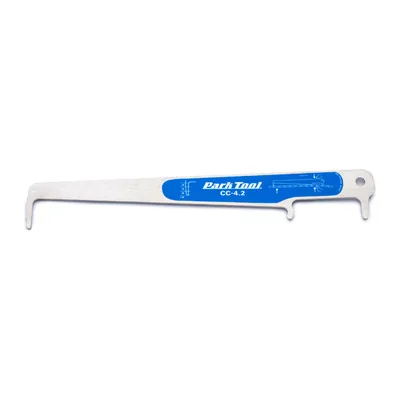
Park Tool CC-4.2 chain wear checker
A laser-cut drop-in gauge that marks the 0.5%, 0.75% and 1% wear points, for derailleur chains from 5 to 13 speeds, including SRAM Flattop and T-Type.
View on Amazon (opens in a new tab)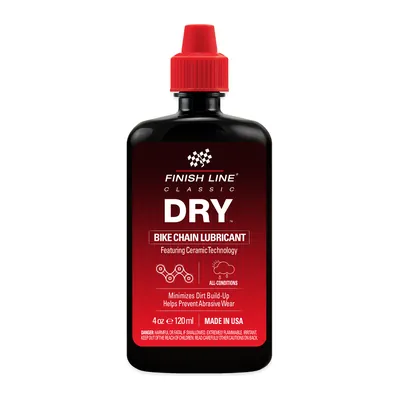
Finish Line DRY chain lube, 120 ml
Dry chain lubricant, 120 ml, that leaves a wax-like film: apply to a clean, dry chain, then wipe off the excess. Described by the maker for dry, dusty conditions.
View on Amazon (opens in a new tab)
Worth watching
Park Tool walks through four ways to measure chain wear, from lifting the chain off the chainring to the ruler and its chain wear checkers, with a wear chart. It films the checks this guide describes.
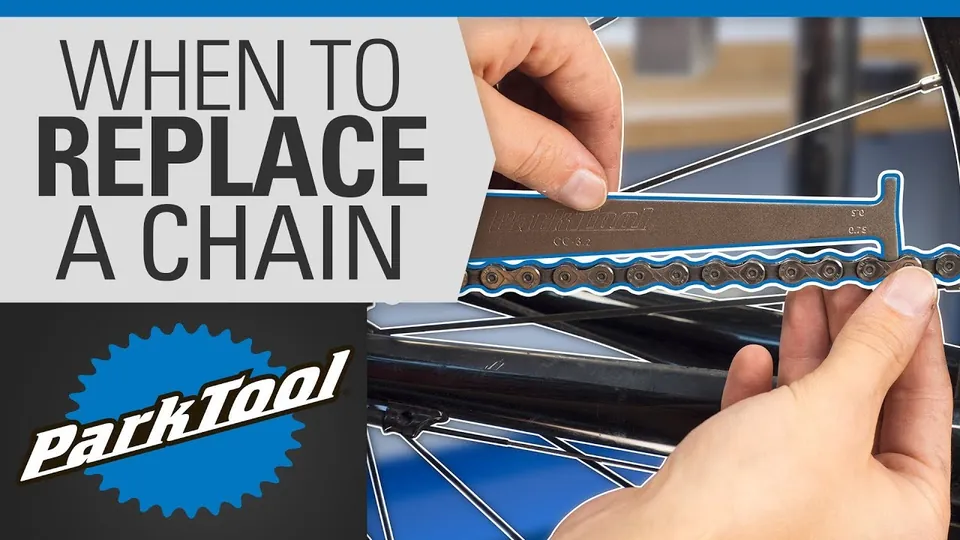
The video is hosted by YouTube (Google): nothing loads until you play it, and Google may then set cookies.
FAQs
How often should you clean and lubricate a bike chain?
Trek advises at least once a month with regular riding, and more often off-road in the mud. Silca counts in distance: a re-wax every 300 miles (about 480 km) on clean roads, a degrease every 150 to 200 miles (240 to 320 km) for an oil. Park Tool and Shimano give no figure: the frequency depends on use and conditions.
Should you change the cassette at the same time as the chain?
Not automatically. Decathlon recommends replacing the chain and rear cassette at 1% elongation, and inspecting the chainring. Sheldon Brown reckoned that at 1/16 inch (about 0.5%), the sprockets are probably fine. One sign doesn’t lie: a new chain that skips on an old cassette means the cassette has to go.
Can you lubricate a chain with an aerosol?
Sheldon Brown advised against it: an aerosol puts too much lubricant where it isn’t needed and too little where it is. He recommended a drip bottle, applied to the inner face of the lower run. Trek reminds you to keep lubricant off the outside of the chain, which attracts dirt, and to wipe off the excess before riding.
Does a new chain need degreasing before waxing?
Yes, if you choose wax: Silca asks you to remove the factory grease before either wax or oil. With a liquid lubricant, the question is less clear-cut. In Zero Friction Cycling’s test, Shimano’s factory grease sits at 10.9% of the wear limit after 620 miles (1,000 km), better than both liquid lubricants in the table.
Is a chain at 0.5% really due for replacement if it works fine?
It depends on the number of gears and on your maker. Park Tool and BIKE advise 0.5% from 11 speeds, 0.75% up to 10; SRAM gives 0.8% with its approved tool. A chain that still shifts well can already be wearing out the cassette: the percentage decides, not how it feels.
Sources
- Decathlon Conseil Sport, ‘Quand changer la chaîne de votre vélo ? Guide et usure’ (in French), page accessed 15 November 2026. conseilsport.decathlon.fr https://conseilsport.decathlon.fr/savoir-quand-changer-la-chaine-de-votre-velo ↩
- Sheldon Brown, ‘A Healthy Chain’, Adventure Cyclist, March 2002. sheldonbrown.com https://sheldonbrown.com/adv-cycling/healthy_chains.pdf ↩
- Park Tool, ‘When to Replace a Worn Chain’, page accessed 15 November 2026. parktool.com https://www.parktool.com/en-us/blog/repair-help/when-to-replace-a-chain-on-a-bicycle ↩
- Park Tool, CC-4.2 chain checker product page, accessed 15 November 2026. parktool.com https://www.parktool.com/en-us/product/chain-checker-cc-4-2 ↩
- Timo Dillenberger, ‘Ketten-Verschleiß: Wie wartet und repariert man eine Fahrradkette?’ (in German), BIKE, 16 February 2024. bike-magazin.de https://www.bike-magazin.de/werkstatt/werkzeug/ketten-verschleiss-wie-wartet-und-repariert-man-eine-fahrradkette/ ↩
- SRAM, ‘When should I replace my SRAM Eagle chain?’, support page accessed 15 November 2026. support.sram.com https://support.sram.com/hc/en-us/articles/5928711817755-When-should-I-replace-my-SRAM-Eagle-chain ↩
- SRAM, ‘When should the chain on my SRAM RED AXS groupset be replaced?’, support page accessed 15 November 2026. support.sram.com https://support.sram.com/hc/en-us/articles/25563525293339-When-should-the-chain-on-my-SRAM-RED-AXS-groupset-be-replaced ↩
- Zero Friction Cycling, page on the 0.5% wear limit and gauge accuracy, accessed 15 November 2026. zerofrictioncycling.com.au https://zerofrictioncycling.com.au/?p=8602 ↩
- Park Tool, ‘How to Clean and Lubricate a Chain’, page accessed 15 November 2026. parktool.com https://www.parktool.com/en-us/blog/repair-help/chain-cleaning-with-a-park-tool-chain-scrubber ↩
- Shimano, ‘Gebrauchsanweisung Kette’ (in German), instructions UM-0AH0A-007 (copy published by the retailer Rabe Bike), accessed 15 November 2026. rabe-bike.de https://www.rabe-bike.de/media/rabe/ProductSafetyDocuments/de/parts/Shimano/Kette/Shimano_Sicherheitsinformationen_Kette_Multilanguage.pdf ↩
- Trek, ‘Clean and lube your bike chain’, page accessed 15 November 2026. trekbikes.com https://www.trekbikes.com/us/en_US/clean-and-lube-your-bike-chain/ ↩
- Rebecca Armstrong, ‘Simple tips to keep your bike in peak condition’, Cycling UK, page accessed 15 November 2026. cyclinguk.org https://www.cyclinguk.org/article/simple-tips-keep-your-bike-peak-condition ↩
- Silca, ‘Wax vs Oil: What’s the Best Chain Lube for Your Bike’s Chain?’, page accessed 15 November 2026. silca.cc https://silca.cc/blogs/silca/chain-lub-wax-vs-oil ↩
- Zero Friction Cycling, ‘Lubricant Testing Aug 2024’, tables and protocol of the wear test, accessed 15 November 2026. zerofrictioncycling.com.au https://zerofrictioncycling.com.au/wp-content/uploads/2024/08/Lubricant-Testing-Aug-2024.pdf ↩

Campervans, motorhomes, cycling and calculators
Julien de Jurquet writes for Outfarer about campervans, motorhomes, cycling and calculators. He reads instruction manuals to the very end and never lets a figure through without its unit, so that your choices rest on sums rather than promises.


