 Français (France)
 English (UK)
 English (US)
 Deutsch (Deutschland)

Contents
A snowfield in full sun, just gone noon, not a cloud in sight. You squint, then reach for your everyday sunglasses: category 2, smart frames, bluish lenses. They look splendid. They are not built for this. It all comes down to two lines that the label keeps carefully apart: the category, which says how much light gets through, and the UV marking, which says how much of the invisible part you let in.
What does the category, from 0 to 4, really measure?
The ISO 12312-1 standard sorts sunglasses lenses into five categories, according to the share of visible light they let through, known as The share of visible light that passes through the lens, as a percentage. The lower it is, the darker the lens. [1]. The darker the lens, the higher the category and the lower the transmittance. So the category is about comfort and glare. On its own, it says nothing about protection from UV.
| Category | Visible light transmitted | Lens | Use as described by the Swiss health office |
|---|---|---|---|
| 0 | over 80% to 100% | very light | very little protection against glare, not sufficient as sunglasses |
| 1 | 43% to 80% | light | little protection against glare, not sufficient as sunglasses |
| 2 | 18% to 43% | medium | good protection, everyday use |
| 3 | 8% to 18% | dark | high protection: everyday wear, holidays, very sunny places such as the mountains or the beach |
| 4 | 3% to 8% | very dark | very high protection for extreme cases (sea, desert, high mountains, snow), side protection; not permitted in road traffic |
Ranges from the College of Optometrists (UK) and the Swiss Federal Office of Public Health (fact sheet of 2024, standard ISO 12312-1:2022). The uses are those of the Swiss office. [2]

The step from category 3 to category 4 is sharper than it looks: the light transmitted falls from 8 to 18% down to 3 to 8%, less than half as much. That is what makes category 4 superb on a glacier, and unusable as soon as your surroundings turn dark.
Does a dark tint protect better from UV?
No, and it is the commonest mix-up. The Swiss office puts it plainly: UV protection depends on the absorbing properties of the lens material, not on its colour or tint [2]. The US FDA adds that clear, green, amber, red or grey lenses can protect as well as very dark ones [3].
What to look for is the ‘100% UV’ or ‘UV400’ marking, together with the CE mark. For the FDA, it corresponds to more than 99% of UVA and UVB blocked [3]. The standard defines that 100% as under 0.05% transmission at wavelengths of 380 nm and below [2]. The Bundesamt für Strahlenschutz, Germany’s Federal Office for Radiation Protection, notes that measurements show the UV400 marking can be trusted fairly well [4]. The French consumer body INC states that the CE mark must appear on an arm for the glasses to be sold in France and the European Union [5].
Two pieces of good news and one less welcome. In a test commissioned by the Swiss office, all 57 pairs bearing the CE mark met the requirement of 100% UV protection, and no difference in optical quality was seen between expensive and cheap pairs [2]. The less welcome one: protection ages. The standard’s wear test aims at safe use for two years, at two hours of wear a day, and scratched lenses protect less [2].
Why snow and altitude change everything
Two effects add up. First, altitude: there is less atmosphere above you to filter the UV. The French health insurance body Assurance maladie counts a rise of 10 to 12% per 1,000 m [6], while the International Climbing and Mountaineering Federation (UIAA) uses 4% per 300 m of ascent [7], which comes to about 13% per 1,000 m.
Then the snow, which sends back up what the sky sends down: about 80% of UV according to the UIAA [7] and Assurance maladie [6], 85% according to the Met Office [8], and up to 90% for fresh snow according to the German radiation protection office [9]. The sources do not agree to within a few points; keep the order of magnitude: most of the UV comes back towards your face. The Met Office even estimates that your eyes can receive twice as much UV during winter sports [8].

The result is called snow blindness, or photokeratitis: sunburn of the cornea [6]. The trap is the delay. According to the UIAA, the damage is done before the symptoms appear: a few minutes without protection on a high-altitude glacier can be enough, and the signs sometimes arrive only the following night [7]. The American Academy of Ophthalmology describes pain, blurred vision, swelling and watering eyes [10].
The sides matter as much as the lenses

Without side protection, your eye takes in the UV reflected by its surroundings. The Swiss office considers side protection essential for category 4 and recommended for all the others, to limit pterygium and cataract [2]. The German office prefers glacier glasses with side protection for winter sport [9], and the UIAA speaks of glasses with side shields or goggles [7]. Even so, glasses do not block everything: a direct ray can get round them, and another comes from the ground or the diffuse sky [2]. For skiing and snowboarding, the American Academy of Ophthalmology rather recommends goggles with polycarbonate lenses, which generally give better peripheral vision than wraparound glasses [10]. On snowshoes, for example, sticking to waymarked routes as a beginner is no excuse for skipping this protection.
Category 4: perfect on the glacier, out of the question at the wheel
The car park at the start of the walk is where category 4 becomes a problem. According to the College of Optometrists, which summarises the standard, the filters suited to the road are categories 0, 1, 2 or 3, not 4 [1]. The standard also asks that traffic lights remain easy to recognise [1]. The Swiss office explains that these lenses are too dark to tell traffic lights apart [2]. The French consumer body INC adds that they prevent proper perception of depth, colour and contrast [5].
The wording changes from one country to the next, the conclusion does not. In Switzerland, the office calls such lenses ‘not permitted in road traffic’ [2], as does the German office [4]. In France, the Sécurité routière, the French road safety authority, writes that category 4 lenses, like those of ski glasses, are ‘strongly discouraged’ for driving [11], and the INC says not to wear them at the wheel [5]. A pair unsuited to the road also carries a crossed-out car pictogram according to the Swiss office [2], or a warning in France according to the INC [5].

When the light fades, no sunglasses will do. A filter that transmits less than 75% of the light is not suited to the road at dusk or at night [1], ADAC, the German motoring club, advises taking sunglasses off as soon as daylight goes [12], and the Swiss office advises against wearing them at night, at dusk or in poor light [2]. My advice: a second pair, category 2 or 3, in the glove compartment settles the problem of the drive down.
Polarising, photochromic, lens colour: are they worth it?
A polarising lens filters reflected light, and so the glare from flat surfaces such as water, wet roads or windows [5]. For snow, the Met Office [8] and the US National Eye Institute [13] find it useful. On the road, opinions differ: ADAC reports the view of an ophthalmologist who says polarisation only works in very precise laboratory conditions, not in everyday driving [12]. In every case, polarisation and UV protection are two different properties: check the second on the label.
Photochromic lenses darken under the effect of UV [5]. At the wheel, that is their flaw: the windscreen stops a good share of the UV they need, their reaction time of 30 seconds or more is judged unacceptable at the entrance to a tunnel, and even when clear they still absorb 20 to 30% of the light, according to ADAC [12].
That leaves colour. Brown and grey distort colours least, and so traffic lights too; blue and red hamper contrast and sharpness, according to the German and Swiss offices [4] [2]. ADAC judges yellow-filter lenses permanently unsuited to the road [12].
Which pair for which outing?
| Situation | Category cited | What to check |
|---|---|---|
| Every day, in town | 2 or 3 | CE mark, UV400, unscratched lenses |
| Mountains and snow, skiing, snowshoeing | 3; goggles for skiing | wraparound shape or side protection, UV400 |
| Glacier, high mountains, snow in full sun | 4 with side protection (3 or 4 according to the UIAA) | 100% UV, side shields or goggles, spare pair |
| Car journey | 0 to 3 only, not at night | traffic lights clearly recognisable |
According to the Swiss Federal Office of Public Health [2], the German radiation protection office [4], the UIAA [7] and the American Academy of Ophthalmology [10].
What to check before you set off
- Read the label: CE mark, UV400 or 100% UV, category and any note on driving.
- For snow at altitude, aim for category 3 or 4 with side protection, or goggles.
- Take a second pair, category 2 or 3, for the road and as a spare.
- Replace scratched lenses and pairs more than two years old.
- Put them on in the first minutes on snow, even when the sky is overcast.
One more layer of protection: near a reflective surface such as snow or a glacier, the Ligue contre le cancer, a French cancer charity, recommends UV-protective clothing [14]. And a good habit to get into fits in one sentence: the category sets the light, the UV marking protects the rest, and category 4 stays on the glacier.
Kit related to this article
No affiliation: no commission, no sponsored products.
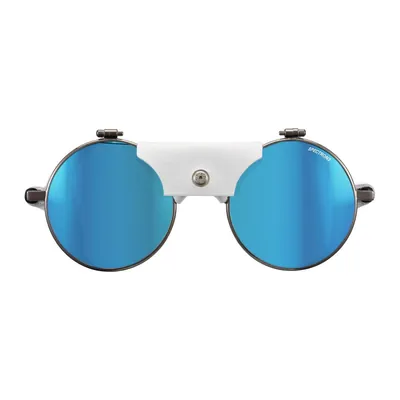
Julbo Vermont Classic, Spectron 3 lenses
Mountain glasses with round category 3 lenses (12% light transmission), 100% UV protection and leather side shields against reflected glare. 40 g.
View on Amazon (opens in a new tab)
FAQs
Can you drive in category 4 sunglasses?
No. The ISO 12312-1 standard reserves driving for filters of categories 0 to 3. Switzerland and Germany call these lenses not permitted in road traffic, and France’s Sécurité routière calls them strongly discouraged. They let through only 3 to 8% of the light, which impairs the perception of colours, traffic lights and contrast.
Do darker lenses protect better from UV?
No. UV protection depends on the lens material, not on its colour. According to the FDA, clear lenses can protect as well as very dark ones. What to look for is the CE mark and the ‘UV400’ or ‘100% UV’ marking, which indicates almost no transmission up to 380 nm.
How long does it take to get snow blindness?
A few minutes without protection on a high-altitude glacier can be enough, according to the UIAA, but the symptoms often appear only later, sometimes the following night. Recovery generally takes about 24 hours, with a risk of secondary infection. If you have pain or blurred vision, seek medical advice.
Do you need sunglasses on an overcast day?
Yes. The Swiss health office advises wearing sunglasses even under a cloudy sky, and on highly reflective surfaces such as snow, sand or water. On snow, the UIAA adds, glasses should be worn at all times, especially at altitude, so put them on within the first few minutes.
Sunglasses or ski goggles: which to choose?
For skiing and snowboarding, the American Academy of Ophthalmology recommends goggles with polycarbonate lenses, which generally give better peripheral vision than wraparound glasses. When you are not skiing, it judges wraparound glasses well suited. Either way, you need a filter that blocks at least 99% of UV.
Sources
- College of Optometrists, ‘Tints and driving’ (standard BS EN ISO 12312-1:2013), accessed 30 October 2026. college-optometrists.org https://www.college-optometrists.org/clinical-guidance/guidance/knowledge,-skills-and-performance/examining-patients-who-drive/tints-and-driving ↩
- Federal Office of Public Health (Switzerland), ‘Faktenblatt Sonnenbrillen für den Gebrauch im Alltag’ (in German), 23 October 2024. bag.admin.ch https://www.bag.admin.ch/dam/de/sd-web/SRRA-pHbch8q/faktenblatt-sonnenbrillen.pdf ↩
- FDA, ‘Tips to Stay Safe in the Sun: From Sunscreen to Sunglasses’, accessed 30 October 2026. fda.gov https://www.fda.gov/consumers/consumer-updates/tips-stay-safe-sun-sunscreen-sunglasses ↩
- Bundesamt für Strahlenschutz, ‘UV-Schutz für die Augen’ (in German), accessed 30 October 2026. bfs.de https://www.bfs.de/DE/themen/opt/uv/schutz/augen/augen.html ↩
- Institut national de la consommation, ‘Les lunettes de soleil’ (in French), accessed 30 October 2026. inc-conso.fr https://www.inc-conso.fr/content/les-lunettes-de-soleil ↩
- Assurance maladie, ‘Coup de soleil et conséquences sur la santé de l’exposition au soleil’ (in French), accessed 30 October 2026. ameli.fr https://www.ameli.fr/assure/sante/themes/coup-soleil/coup-soleil-risque-exposition-solaire ↩
- UIAA, ‘Dealing with eye problems in expeditions’, accessed 30 October 2026. theuiaa.org https://www.theuiaa.org/dealing-with-eye-problems-in-expeditions/ ↩
- Met Office, ‘UV and sun health’, accessed 30 October 2026. weather.metoffice.gov.uk https://weather.metoffice.gov.uk/warnings-and-advice/seasonal-advice/health-wellbeing/uv/uv-and-sun-health ↩
- Bundesamt für Strahlenschutz, ‘Sonne in den Bergen: auch im Winter auf UV-Schutz achten’ (in German), 2026. bfs.de https://www.bfs.de/SharedDocs/Pressemitteilungen/BfS/DE/2026/001.html ↩
- American Academy of Ophthalmology, ‘Winter UV Eye Safety’, accessed 30 October 2026. aao.org https://www.aao.org/eye-health/tips-prevention/winter-sun-eye-safety ↩
- Sécurité routière, ‘Au volant, bien voir, c’est la vie’ (in French), October 2024. securite-routiere.gouv.fr https://www.securite-routiere.gouv.fr/sites/default/files/2024-09/depliant_vue.pdf ↩
- ADAC, ‘Mit Sonnenbrille Auto fahren’ (in German), accessed 30 October 2026. adac.de https://www.adac.de/verkehr/verkehrssicherheit/wetter/sonnenbrille-autofahren/ ↩
- National Eye Institute, ‘Protecting your eyes from the sun’s UV light’, accessed 30 October 2026. nei.nih.gov https://www.nei.nih.gov/research-and-training/research-news/protecting-your-eyes-suns-uv-light ↩
- Ligue contre le cancer, ‘Soleil, UV et cancers’ (in French), accessed 30 October 2026. ligue-cancer.net https://www.ligue-cancer.net/nos-missions/la-prevention-des-cancers/soleil-uv-et-cancers ↩
Camping, wild camping, bushcraft and hiking
Guillaume Hoarau writes for Outfarer about camping, wild camping, bushcraft and hiking. A survival-skills enthusiast and a collector of old field manuals, he likes clear explanations, lists that earn their place and other people’s stories, which he tells well.


 Nolwenn Bastide