 Français (France)
 English (UK)
 English (US)
 Deutsch (Deutschland)

Contents
670 calories. That’s what Trek’n Eat’s beef stroganoff with rice, from Katadyn, works out to: 160 g (5.6 oz) of dry food, which the maker bills as a meal for one person [1]. On paper, that’s dinner. Next to a day of hiking with a loaded pack, it’s about 15% of what someone who weighs 154 lb (70 kg) burns. Let’s do the math, from calories to ounces, then to the water and fuel it takes to turn that pouch into a hot meal.
This guide picks up where our guide to water and food on a day hike leaves off, back at the car: here, the day keeps going with dinner, a night out, and breakfast. It expands on the “Water and food” step of our step-by-step guide to your first backcountry camping trip. Your stove, cook pot, and fuel canister are on our gear checklist: we only come back to them here to count fuel.
Calories burned on a day with a loaded pack
To put a number on effort, the researchers behind the Compendium of Physical Activities use the Metabolic equivalent: the ratio between the energy cost of an activity and that of resting. 1 MET is about 1 kilocalorie per kilogram (2.2 lb) of body weight per hour, roughly what you burn sitting quietly. [2]. Here, as on a US food label, a “calorie” means a kilocalorie (kcal), the unit European labels and most of our sources use. Backpacking rates 7 MET, and climbing hills with a 20-plus-pound load on a 5 to 20% grade, at a moderate to brisk pace, 10 MET [3]: for someone who weighs 154 lb, an hour of hiking with a loaded pack burns 490 to 700 calories, depending on the terrain.
| Activity | Value | Calories per hour |
|---|---|---|
| Backpacking | 7 MET | 490 |
| Hiking with a daypack | 7.8 MET | about 550 |
| Climbing hills, 20+ lb load, 5 to 20% grade, brisk pace | 10 MET | 700 |
| Camping, light to moderate effort | 2.5 MET | about 180 |
| Sleeping, or sitting quietly | 1 MET | 70 |
Codes 17010, 17012, 17060, 09110, 07030, and 07021 in the 2024 edition; 1 MET is about 1 calorie per kilogram per hour. [3, 4, 5]
A backpacking day isn’t just hiking. Let’s break it into 24 hours: 6 hours of actual hiking at 7 MET, 3 hours around camp at 2.5 MET, the value the Compendium gives camping, then 9 hours of sleep and 6 hours of meals and sitting breaks, at 1 MET each. For 154 lb (70 kg), that adds up to about 4,500 calories, two-thirds of them for the hiking alone; for 121 lb (55 kg), about 3,500, and for 198 lb (90 kg), 5,800.
For comparison, the European Food Safety Authority (EFSA), the European Union’s food safety agency, puts the average energy requirement of adults aged 30 to 39 with a moderately active lifestyle at 2,000 to 2,600 calories a day, depending on sex [6]. A backpacking day calls for nearly twice that. These numbers are ballpark figures, not a ration to weigh out: they assume 6 hours of actual hiking, breaks excluded, and an average MET for everyone.
For a single night, there’s no need to hit the exact number. The French Hiking Federation (FFRandonnée) calls for food in proportion to the effort, nothing excessive, but enough energy, taken in regularly, so you don’t bonk and slow down [7]. On a multiday trip, though, this math becomes the basis of your shopping list.
From calories to ounces: calorie density
Next, turn those calories into weight in your pack. The tool for that is The energy in a given weight of food, per 100 g or per ounce: it tells you how much weight you need to carry for the same energy., which you’ll find on the label or in a food composition table, such as the Swiss Food Composition Database from Switzerland’s Federal Food Safety and Veterinary Office (FSVO), in its July 2026 version [8]. The gaps are huge: 1,000 calories weigh about 5 oz (140 g) in walnuts, 6.6 oz (190 g) in dark chocolate, 10 oz (280 g) in dry pasta, 13.4 oz (380 g) in bread, and more than 4 lb (nearly 2 kg) in apples.
It all comes down to one word: water. A raw apple is 85% water, a tomato 94%, and cooked pasta 60%, versus 10% for dry pasta and 4% for walnuts [8]. Fats, meanwhile, concentrate energy: 900 calories per 100 g of olive oil, about 255 per ounce, while dry starches hover around 350 per 100 g. Apply that to our 4,500-calorie day: at an average of 450 calories per 100 g, about 130 per ounce, it fits in 2.2 lb (1 kg) of food; at 250 per 100 g, about 70 per ounce, with lots of bread and fresh fruit, you need 4 lb (1.8 kg).
A well-planned food bag starts with dry starches, adds nuts, hard cheese, or salami to boost the density, and saves a little fresh food as a first-night treat. Cans, heavy and bulky, stay home, as the French Hiking Federation advises [7]. As for the ounce-counters, they’ve already spotted the best deal on the chart: half an ounce (15 g) of olive oil stirred into dinner adds 135 calories.
Freeze-dried or homemade: weight, water, and time
There’s nothing magic about a Dried cold: the water is removed from the food at low temperature, which makes it lighter and lets it keep without refrigeration; you add the water back to eat it. meal: the maker took the water out, cold, and you put it back [9]. The label tells you everything. Trek’n Eat’s beef stroganoff calls for 380 ml (about 13 fl oz) of boiling water and 10 minutes of steeping, for 540 g (19 oz) of food ready to eat, 3.4 times the weight of the pouch, and keeps for 5 years [1]. The chicken couscous from Voyager, a French brand that makes its meals in France, weighs 80 g (2.8 oz) for 343 calories: 140 ml (about 4.7 fl oz) of boiling water and 5 to 8 minutes, or 30 minutes with cold water [9]. Two “servings,” and half the calories in the second.
| Dinner | Weight to carry | Calories | Boiling water | Wait |
|---|---|---|---|---|
| Freeze-dried beef stroganoff (Trek’n Eat) | 5.6 oz (160 g) | 670 | 13 fl oz (380 ml) | 10 min |
| Freeze-dried chicken couscous (Voyager) | 2.8 oz (80 g) | 343 | 4.7 fl oz (140 ml) | 5 to 8 min |
| Durum wheat semolina, olive oil, and salami, homemade | 5.8 oz (165 g) | about 670 | per the package | per the package |
Manufacturers’ labels; homemade dinner calculated from the Swiss Food Composition Database for 100 g (3.5 oz) of semolina, 15 g (0.5 oz) of olive oil, and 50 g (1.8 oz) of salami. [1, 9, 8]
On the scale, the homemade dinner ties: 5.8 oz (165 g) for about 670 calories, the same as the pouch. The difference lies elsewhere. A freeze-dried meal rehydrates in its pouch, with no pot to scrub, and the label tells you how much water to add; a homemade dinner is made to your taste, from grocery store staples. As for the stove, semolina swells off the heat, like a freeze-dried meal, while pasta needs the flame on for its whole cooking time. At Voyager, portions run from about 80 to 150 g (2.8 to 5.3 oz) of dry food, and meals average 400 to 600 calories [9]: check the calories, not the word “serving.”
Cooking water and fuel to plan for
Cooking water counts along with drinking water. For the menu below, one person heats 380 ml (about 1.6 cups) for dinner and 250 ml (about 1 cup) each for herbal tea, oatmeal, and morning coffee: about 1.1 liters, a little over a quart, on top of your water for the trail. If it comes from a creek, water brought to a rolling boil for your meal is rid of germs, provided you keep it boiling for 1 minute, or 3 minutes above 6,500 feet (about 2,000 m), according to the CDC [10]. Rehydrating with cold water, on the other hand, calls for water you’ve already treated: our guide to backcountry water compares the methods.
On the fuel side, MSR says its PocketRocket 2 stove boils 1 liter of water in 3.5 minutes, and that one 8-oz (227 g) canister boils 16 liters, or 2 liters per ounce of fuel [11]: about 14 g, half an ounce, of fuel per liter. Our menu therefore takes 16 g, a little over half an ounce, for 4 minutes of flame. Under the maker’s conditions, a 110 g (3.9 oz) canister would last nearly seven nights on this menu.
Conditions on the trail are less generous. MSR notes that its windshield boosts efficiency in breezy conditions [11], and that it formulated its IsoPro fuel to maintain higher internal pressure at lower temperatures [13]: a sign that wind and cold eat into efficiency, just as simmering eats into fuel. For one night, I’d plan on double, and weigh the canister before you leave: an IsoPro canister with 3.9 oz (110 g) of fuel weighs 7.4 oz (210 g) full [13], so about 3.5 oz (100 g) empty, and the difference tells you what’s left. Finally, where an order bans even stoves, as some do in France, explained in our guide to campfire rules in France, you’re left with cold-soaking and food that needs no cooking.
Breakfast and snacks: hot in the morning, dense on the trail
Breakfast follows the same logic as dinner: hot, quick, and no pot to scrub before you break camp. Voyager’s freeze-dried porridge, a kind of oatmeal, weighs 100 g (3.5 oz) for 437 calories and takes 250 ml (about 1 cup) of boiling water, then 5 to 8 minutes [14].
For snacks, the French Hiking Federation suggests dried fruit, granola bars (skipping chocolate ones when the sun is strong), and a few not-too-sweet cookies; for a more athletic outing, fruit jellies and energy bars [7]. Keep them within easy reach, as in your day hike pack: on a big day, they bridge the gap between meals and what you burn. Finally, add a small reserve. The National Park Service’s Ten Essentials go as far as an extra day’s supply of food, preferably no-cook items such as trail mix, nuts, and granola bars [15].
What keeps in the heat without a fridge
In the backcountry there’s no fridge, and the rules of kitchen hygiene take on a new meaning. The CDC says to refrigerate perishable food, cooked leftovers included, within 2 hours, or within 1 hour if it’s exposed to temperatures above 90 °F (32 °C), like a hot car or a picnic, and to wash your hands before, during, and after preparing food [16]. At camp, the conclusion is clear: cook only what you’ll eat, and leftovers don’t keep until the next day.
The French Hiking Federation lists cheese and meat as perishable, to be eaten at the very start of a trip, before you move on to cured meats or freeze-dried meals [7]. Those keep without refrigeration: up to 2 years depending on the recipe at Voyager, which says to eat a meal promptly once it’s rehydrated [9], and 5 years for Trek’n Eat’s stroganoff [1].
Trash, dishes, and food storage in bear country
Whatever you pack in, you pack out. The Leave No Trace principles, which the National Park Service publishes, say to pack out all trash, leftover food, and litter, and to repackage food before you go so there’s less waste to carry [18]. For dishes, they say to carry water 200 feet (about 60 m) away from streams or lakes, use small amounts of biodegradable soap, and scatter the strained dishwater [18]. A meal rehydrated in its pouch leaves only a spoon to wash anyway. Our guide to Leave No Trace hiking covers the details.
Leave No Trace also says to protect wildlife and your food by storing rations and trash securely, and never to feed animals, which damages their health and alters their natural behavior [18]. In bear country, the Park Service’s food storage advice goes further: never store food in your tent or backpack, keep bear-resistant containers closed and locked, and set them on flat, level ground 100 feet (about 30 m) or more from your campsite, away from cliffs and water sources, since a bear may knock a container around or roll it downhill [19]. Its backpacking tips also favor compact, high-calorie foods without strong odors, such as rice, tortillas, jerky, pasta, nuts, dried fruit, peanut butter, and protein bars: the dense end of the chart above [19]. Rules vary from park to park: some require food lockers or bear canisters, others allow hanging food from a tree, so check before you go [19]. At Yosemite, for example, food must go in an allowed bear-resistant container or a food locker, and hanging food is illegal throughout the park [20]. To a bear, anything with a scent is food: soap, sunscreen, bug repellent, trash, and cooking gear included [19]. Our guide to your first backcountry trip covers the rest of the night, in the step “The night”.
A sample menu for one night
Here’s a menu for one person, from the snack when you reach camp to the hike out the next day: the freeze-dried meal from the beginning, homemade oatmeal, and calorie-dense snacks. The products named are examples of labels, not buying recommendations, and the math works the same with any freeze-dried meal sold in the US; the homemade dinner from the section above would weigh as much as the pouch.
| When | What to pack | Weight | Calories | Hot water |
|---|---|---|---|---|
| Dinner | Freeze-dried meal (beef stroganoff), 1.4 oz of dark chocolate, herbal tea | 7.1 oz (200 g) | 890 | 21 fl oz (630 ml) |
| Breakfast | Homemade oatmeal (2.8 oz of rolled oats, 0.9 oz of whole milk powder, 1.1 oz of raisins), coffee or tea | 4.9 oz (140 g) | 520 | 17 fl oz (500 ml) |
| Snacks | 1.8 oz of almonds, 1.8 oz of dried apricots, a 1.8 oz granola bar, 2.1 oz of hard cheese, 3.5 oz of bread | 10.9 oz (310 g) | 1,140 | none |
| Reserve | 1.8 oz of walnuts, a 1.8 oz granola bar | 3.5 oz (100 g) | 560 | none |
| Total | 26.5 oz (750 g) | 3,110 | 38 fl oz (1,130 ml) |
Calories: manufacturer’s label for the meal, Swiss Food Composition Database for the rest; oatmeal water estimated from Voyager’s freeze-dried porridge; values rounded. [1, 8, 14]
All told, that’s about 26 oz (750 g) for 3,100 calories, reserve included, with 1.1 liters of water to heat, or 16 g (a little over half an ounce) of fuel by MSR’s numbers. Without the reserve, meals and snacks provide about 2,550 calories: less than the burn we calculated above, but one night doesn’t come down to the last calorie, and lunch before you hit the trail and after you get back happens at home. For a multiday trip, redo the day’s math with your own weight and hours on the trail.
The rule to remember: aim for 450 calories per 100 g, about 130 per ounce, and a backpacking day fits in 2.2 lb (1 kg) of food, plus water and fuel.
Gear related to this article
No affiliation: no commission, no sponsored products.
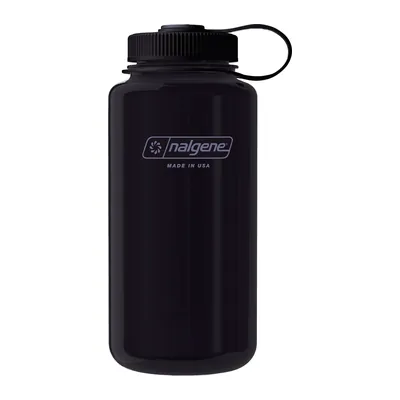
Nalgene Wide Mouth 32 oz
A 32 oz wide-mouth bottle in Tritan Renew, BPA- and BPS-free, leakproof and dishwasher-safe, 6.25 oz empty: the wide opening fills fast at a spigot and takes ice cubes.
View on Amazon (opens in a new tab)
Worth watching
Aaron, of Backcountry Foodie, explains why the two-pounds-of-food-a-day rule often fails, and how to estimate the calories you actually need to pack for a backpacking trip.
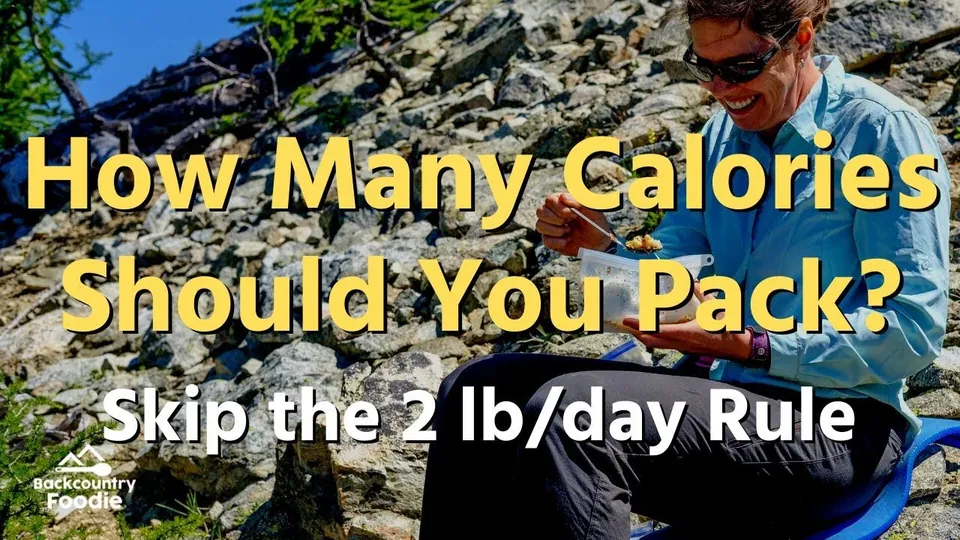
The video is hosted by YouTube (Google): nothing loads until you play it, and Google may then set cookies.
FAQ
How much food should I pack per day for backpacking?
For a day of hiking with a loaded pack, plan on about 4,500 calories if you weigh 154 lb (70 kg), 3,500 at 121 lb (55 kg), and 5,800 at 198 lb (90 kg), based on Compendium of Physical Activities values. With dry food at 450 calories per 100 g (about 130 per ounce), that’s about 2.2 lb (1 kg) a day; with bread and fresh fruit, about 4 lb. Our one-night menu weighs about 26 oz (750 g).
How many calories does backpacking burn?
The Compendium of Physical Activities rates backpacking at 7 MET, and climbing hills with a 20-plus-pound load on a 5 to 20% grade, at a moderate to brisk pace, at 10 MET. Since 1 MET is about 1 calorie per kilogram per hour, someone who weighs 154 lb (70 kg) burns 490 to 700 calories per hour of actual hiking. These are ballpark figures, not a ration to weigh out.
How much water does a freeze-dried meal need?
It’s printed on the pouch: 380 ml (about 13 fl oz) of boiling water for Trek’n Eat’s beef stroganoff, 140 ml (about 4.7 fl oz) for Voyager’s chicken couscous, and 120 to 400 ml depending on the meal at that French brand. Add hot drinks and breakfast: our one-night menu heats about 1.1 liters (a little over a quart) per person, on top of the water you drink.
How much fuel do I need for one night of backpacking?
MSR says its PocketRocket 2 stove boils 16 liters of water on an 8-oz (227 g) canister, or 2 liters per ounce of fuel: about 14 g per liter. For 1.1 liters of hot water per person per night, that’s about 16 g, a little over half an ounce, under the maker’s conditions. Wind, cold, and simmering cut efficiency: plan on double to be safe, and weigh your canister before you go.
What food keeps without a fridge when backpacking?
Foods that are stable at room temperature: bread, hard cheeses such as Comté, canned pâté, fruit, dried fruit, and energy bars, according to a French government food-safety office, plus freeze-dried meals and dry starches. The French Hiking Federation advises eating cheese and meat at the very start of a trip. Cooked food doesn’t keep: the CDC says to refrigerate leftovers within 2 hours, or 1 hour above 90 °F (32 °C).
How do I store food at night in bear country?
Follow the rules of the park you’re visiting: some require bear canisters or food lockers, others allow hanging food, and Yosemite bans hanging altogether. The National Park Service says never to store food in your tent or backpack, and to place bear-resistant containers on flat ground 100 feet (about 30 m) or more from camp. Anything with a scent counts as food, including soap, sunscreen, and trash.
Sources
- Katadyn (Trek’n Eat), product page for “Beef Stroganoff with Rice,” item 30202001, accessed October 29, 2026. katadyn.com https://katadyn.com/products/30202001-beef-stroganoff-with-rice ↩
- Adult Compendium of Physical Activities, “Definition of Terms,” accessed October 29, 2026. pacompendium.com https://pacompendium.com/ ↩
- Adult Compendium of Physical Activities, 2024 edition, “Walking,” codes 17010, 17012, and 17060, accessed October 29, 2026. pacompendium.com https://pacompendium.com/walking/ ↩
- Adult Compendium of Physical Activities, 2024 edition, “Miscellaneous,” code 09110, accessed October 29, 2026. pacompendium.com https://pacompendium.com/miscellaneous/ ↩
- Adult Compendium of Physical Activities, 2024 edition, “Inactivity,” codes 07021 and 07030, accessed October 29, 2026. pacompendium.com https://pacompendium.com/inactivity/ ↩
- European Food Safety Authority (EFSA), EFSA sets average requirements for energy intake, press release, January 10, 2013, accessed October 29, 2026. efsa.europa.eu https://www.efsa.europa.eu/en/press/news/130110 ↩
- French Hiking Federation (FFRandonnée), “Bien s’alimenter en randonnée” (in French), January 26, 2021, accessed October 29, 2026. ffrandonnee.fr https://www.ffrandonnee.fr/randonner/conseils/bien-s-alimenter-en-randonnee ↩
- Federal Food Safety and Veterinary Office (FSVO, Switzerland), Swiss Food Composition Database, version 7.1 of July 1, 2026, accessed October 29, 2026. naehrwertdaten.ch https://naehrwertdaten.ch/en/ ↩
- Voyager Nutrition, product page for “Couscous de poulet aux légumes lyophilisé” (80 g) and FAQ (in French), accessed October 29, 2026. voyager-nutrition.com https://voyager-nutrition.com/products/couscous-de-poulet-aux-legumes-80g ↩
- Centers for Disease Control and Prevention (CDC), About Water Treatment Options When Hiking, Camping, or Traveling, accessed October 29, 2026. cdc.gov https://www.cdc.gov/drinking-water/prevention/water-treatment-hiking-camping-traveling.html ↩
- MSR (Cascade Designs), PocketRocket 2 stove product page, accessed October 29, 2026. cascadedesigns.com https://cascadedesigns.com/products/pocketrocket-2-stove ↩
- Campingaz, instructions for the “Bivouac” stove (safety instructions), manufacturer’s leaflet, accessed October 29, 2026. campingaz.com https://www.campingaz.com/trade/images/SpareParts/01ad513b-3784-4fc5-9430-1d51b5db5b6b/4010057703.pdf ↩
- MSR (Cascade Designs), IsoPro fuel canister product page, accessed October 29, 2026. cascadedesigns.com https://cascadedesigns.com/products/msr-isopro-fuel ↩
- Voyager Nutrition, product page for “Porridge aux framboises” (100 g) (in French), accessed October 29, 2026. voyager-nutrition.com https://voyager-nutrition.com/products/porridge-aux-framboises-100g ↩
- National Park Service, “Ten Essentials,” updated May 28, 2026, accessed October 29, 2026. nps.gov https://www.nps.gov/articles/10essentials.htm ↩
- Centers for Disease Control and Prevention (CDC), Preventing Food Poisoning, accessed October 29, 2026. cdc.gov https://www.cdc.gov/food-safety/prevention/index.html ↩
- Direction départementale de la protection des populations de l’Ain (a French government food-safety office), “Les pique-niques” (in French), leaflet published by the Ain prefecture, accessed October 29, 2026. ain.gouv.fr https://www.ain.gouv.fr/contenu/telechargement/20318/143461/file/1_fiche_les_pique.pdf ↩
- National Park Service, “Leave No Trace Seven Principles,” June 16, 2022 (principles © 1999 Leave No Trace Center for Outdoor Ethics), accessed October 29, 2026. nps.gov https://www.nps.gov/articles/leave-no-trace-seven-principles.htm ↩
- National Park Service, “Storing Food” (bears), February 22, 2017, accessed October 29, 2026. nps.gov https://www.nps.gov/subjects/bears/storingfood.htm ↩
- National Park Service, Yosemite National Park, “Food Storage While Backpacking,” updated December 4, 2023, accessed October 29, 2026. nps.gov https://www.nps.gov/yose/planyourvisit/bearcans.htm ↩

Vans, RVs, biking and calculators
Julien de Jurquet writes for Outfarer about camper vans, RVs, biking, and calculators. He reads manuals cover to cover and never lets a number slide without its unit, so your choices rest on math, not promises.


 Guillaume Hoarau

 Arnaud Couderc