 Français (France)
 English (UK)
 English (US)
 Deutsch (Deutschland)

Contents
What does Beaufort force measure?
Force 6 or 25 knots? Both phrases say the same thing, in two different vocabularies. The Beaufort scale sorts wind speed into thirteen forces, from 0 (calm) to 12 (hurricane). The British admiral Sir Francis Beaufort (1774-1857) developed it in 1805 so that sailors could estimate the wind from what they saw of the sea [1]. Since then, each force has been tied to a measured speed: the table of the World Meteorological Organization (WMO), which national services follow, gives the limits in knots, metres per second and kilometres per hour [2].
What the scale measures, next: a mean wind, not a gust. In meteorology, speed is measured at 10 metres above the ground, to WMO standards, and averaged over 10 minutes. A gust, for Météo-France, is the highest speed recorded during the previous hour [3]. Force 6 is therefore a mean wind of 22 to 27 knots (25 to 31 mph), around which the wind can peak higher.
The full table: knots, mph and m/s
Here is the table, with the Met Office’s terms. The limits agree from one service to another, give or take rounding: the same numbers appear at the Met Office and the DWD, Germany’s weather service [4] [5]. To get a feel for the scale, from force 4 to force 8 each force starts 5 or 6 knots higher than the last: 11, 17, 22, 28, then 34 knots. On land in the UK, wind is quoted in mph; at sea, in knots, so both columns are given.
| Force | Description | Knots | mph | m/s |
|---|---|---|---|---|
| 0 | Calm | under 1 | under 1 | 0 to 0.2 |
| 1 | Light air | 1 to 3 | 1 to 3 | 0.3 to 1.5 |
| 2 | Light breeze | 4 to 6 | 4 to 7 | 1.6 to 3.3 |
| 3 | Gentle breeze | 7 to 10 | 8 to 12 | 3.4 to 5.4 |
| 4 | Moderate breeze | 11 to 16 | 13 to 18 | 5.5 to 7.9 |
| 5 | Fresh breeze | 17 to 21 | 19 to 24 | 8.0 to 10.7 |
| 6 | Strong breeze | 22 to 27 | 25 to 31 | 10.8 to 13.8 |
| 7 | Near gale | 28 to 33 | 32 to 38 | 13.9 to 17.1 |
| 8 | Gale | 34 to 40 | 39 to 46 | 17.2 to 20.7 |
| 9 | Severe gale | 41 to 47 | 47 to 54 | 20.8 to 24.4 |
| 10 | Storm | 48 to 55 | 55 to 63 | 24.5 to 28.4 |
| 11 | Violent storm | 56 to 63 | 64 to 72 | 28.5 to 32.6 |
| 12 | Hurricane | 64 or more | 74 or more | 32.7 or more |
Mean wind speeds. Sources: MeteoSwiss, November 2023 table from the WMO Manual on Codes, cross-checked against the Met Office and the DWD; mph from the National Weather Service (Miami), whose table gives force 12 as 72 to 83 mph, overlapping force 11: 64 knots is 73.6 mph, hence ‘74 or more’ (accessed 12 November 2026). The Met Office and the National Weather Service call force 9 a severe gale; the WMO’s own term is strong gale.
How do you convert knots to mph?
A knot is one nautical mile per hour, or 1.852 km/h [3]. In mph that is a factor of 1.15, and in metres per second 0.514 [4]. An example: the bulletin says 25 knots. 25 × 1.15 gives 28.8 mph (46 km/h), and 25 × 0.514 gives 12.9 m/s. In the table, 25 knots falls in force 6, which runs from 22 to 27 knots.
For a sum in your head, add a tenth, then half of that tenth again: 25 knots gives 25 + 2.5 + 1.25, about 29 mph, against 28.8 exactly. The error stays well under 1%. Beyond an estimate, use the exact factor or the table.
What does the wind do to the sea?
The scale was invented to read the wind in the sea: each force has its look, recognisable without instruments. White horses appear at force 3; spray begins around force 5; from force 8, the wind tears the crests into streaks of foam [2]. The table that follows adds the wave heights given by the Met Office and the DWD for each force, with a one-line description of the sea taken from the National Weather Service’s wording for use at sea.
| Force | Waves (m) | What you see at sea |
|---|---|---|
| 0 | 0 | Sea like a mirror |
| 1 | 0.1 | Ripples like scales, without foam crests |
| 2 | 0.2 | Small wavelets whose glassy crests do not break |
| 3 | 0.6 | Large wavelets, crests begin to break, a few white horses |
| 4 | 1 | Small waves growing larger, fairly frequent white horses |
| 5 | 2 | Moderate, longer waves, many white horses |
| 6 | 3 | Large waves forming, white foam crests more extensive |
| 7 | 4 | Sea heaps up, foam blown in streaks along the wind |
| 8 | 5.5 | Moderately high waves, crests breaking into spindrift, well-marked foam streaks |
| 9 | 7 | High waves, dense foam streaks, crests toppling over, spray may reduce visibility |
| 10 | 9 | Very high waves with long overhanging crests, sea looks white, visibility affected |
| 11 | 11.5 | Exceptionally high waves, sea covered in long white patches of foam |
| 12 | 14 or more | Air filled with foam and spray, sea completely white |
Significant wave height: the average of the highest third of the waves. Sea state: National Weather Service (Miami), shortened; heights: Met Office and DWD (accessed 12 November 2026).

These heights are for a well-developed sea in open water, meaning a wind that has blown for long enough over a large enough stretch. They leave out swell, the waves born elsewhere, which the DWD expressly sets aside [5]. The Met Office also reminds us that the sea takes time to respond when the wind picks up [4]. The table therefore gives a reference value, not the exact height of the waves in front of you.

The ratio jumps out of the diagram. From force 4 to force 8, the lower limit of the wind goes from 11 to 34 knots, a factor of about 3, and wave height from 1 to 5.5 m, a factor of 5.5. To tell wind sea from swell, and to read the period that goes with the height, you need another bulletin: see how to read a swell forecast.
From which force is a warning issued?
What the text says, first. Météo-France issues strong wind warnings (avis de vent fort) from 50 km/h (31 mph), force 7, near the coast, up to 35 km (22 miles) out to sea. Beyond that coastal band, warnings start at 62 km/h (39 mph), force 8, and are called gale warnings (avis de coup de vent). The same text calls a ‘storm’ at sea a depression that gives a mean wind above 90 km/h (56 mph), force 10 [3].
In the UK, the Met Office issues gale warnings for winds of force 8 or more, as part of the Shipping Forecast [6]. In the United States, the National Weather Service reasons in knots: a gale warning covers sustained winds of 34 to 47 knots (39 to 54 mph), a storm warning 48 knots (55 mph) or more. A small craft advisory covers 20 to 33 knots (23 to 38 mph), sometimes sea height too, depending on the local office, and the service states that there is no legal definition of a ‘small craft’ [7].
| Service | Warning | Threshold | Beaufort force |
|---|---|---|---|
| Météo-France, up to 35 km from the coast | Strong wind warning | from 50 km/h (31 mph) | 7 or more |
| Météo-France, beyond | Gale warning | from 62 km/h (39 mph) | 8 or more |
| Met Office | Gale warning | force 8 or more | 8 or more |
| National Weather Service | Small craft advisory | 20 to 33 knots (23 to 38 mph), varies by office | 5 to 7 |
| National Weather Service | Gale warning | 34 to 47 knots (39 to 54 mph) | 8 and 9 |
| National Weather Service | Storm warning | 48 knots (55 mph) or more | 10 or more |
Mean or sustained wind thresholds, noted on 12 November 2026 from the pages cited. The Beaufort equivalent is the one in the table above.
Same numbers, different words: gale, storm, coup de vent
The number is international; the word is not. In France and Switzerland, force 8 is a coup de vent and force 10 a tempête [2]. Belgium’s Royal Meteorological Institute (IRM) files force 8 under ‘vent de tempête’ and force 9 under ‘tempête’ [8]: the French and Belgian names are not translations of one another. In English, force 8 is a gale; force 9 is a strong gale for the WMO, which the Met Office calls a severe gale [4]. In German, the DWD speaks of ‘stürmischer Wind’ at force 8 and ‘Sturm’ at force 9 [5]. In the table below, the French, Belgian and German names are given in the original language of each service.
| Force | France and Switzerland | Belgium (IRM) | United Kingdom (Met Office) | Germany (DWD) |
|---|---|---|---|---|
| 6 | Vent frais | Vent fort | Strong breeze | Starker Wind |
| 7 | Grand vent frais | Vent très fort | Near gale | Steifer Wind |
| 8 | Coup de vent | Vent de tempête | Gale | Stürmischer Wind |
| 9 | Fort coup de vent | Tempête | Severe gale | Sturm |
| 10 | Tempête | Forte tempête | Storm | Schwerer Sturm |
| 11 | Violente tempête | Très forte tempête | Violent storm | Orkanartiger Sturm |
| 12 | Ouragan | Ouragan | Hurricane | Orkan |
Sources: MeteoSwiss, IRM, Met Office, DWD (accessed 12 November 2026). Names in the original language of each service.
And for paddling, which force is too strong?
No scale says, and rightly so: it all depends on you, the craft and the place. One official reference does give orders of magnitude. The South Australian government’s kayak and canoe safety reference guide (2018) recommends that novice paddlers stay on flat, sheltered water, in light wind of under 11 knots (13 mph). Intermediate paddlers limit themselves to under 17 knots (20 mph) and waves under 0.5 m; experienced paddlers, to under 25 knots (29 mph) [9].
In Beaufort terms: under 11 knots is force 3 at most; under 17 knots, force 4 at most; under 25 knots, a force 6 that has not yet reached its upper limit. These limits come from an Australian state, not from any UK rule: treat them as an order of magnitude from abroad. Any warning, whether Météo-France’s from force 7 or the Met Office’s from force 8, sits above all of these benchmarks. For equipment and the rules specific to paddlers, see how to read an inflatable paddleboard’s spec sheet, the rules for paddleboards and kayaks and choosing between a canoe and a kayak. For kitesurfing, where kite size follows the average wind and the gusts, see our guide to kite size.
Reading a bulletin in three steps
- The date and time of validity: this morning’s bulletin is no good tonight, and the sea answers the wind with a delay.
- The wind: the unit (knots, mph or Beaufort force), the mean wind and, when it is given, the gust.
- The sea: wave height, swell and period, then what changes during the day, not forgetting the tide: see how to read tide times and the French coefficient.
The flags on a supervised beach also turn a risk into colours: see French beach flags and what they mean. A rule is read with its date, and so is a bulletin. To check before you go: the unit of the wind, the difference between mean wind and gust, and the time until which the bulletin is valid.
Kit related to this article
No affiliation: no commission, no sponsored products.
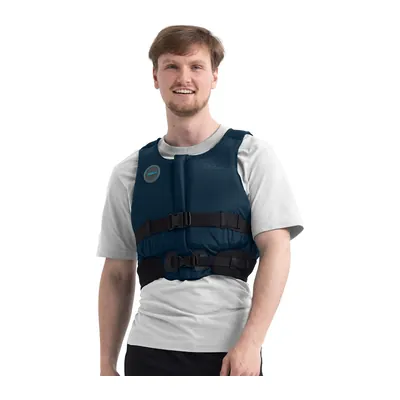
Jobe Adventure
An ISO-certified 50-newton buoyancy aid, cut short to stay comfortable when sitting in a kayak or canoe, with a zip and two buckles. Unisex, several sizes.
View on Amazon (opens in a new tab)
FAQs
How many knots is force 5?
Force 5, a fresh breeze, is a mean wind of 17 to 21 knots, or 19 to 24 mph (8 to 10.7 m/s), according to the WMO table reproduced by MeteoSwiss and the National Weather Service’s mph. At sea it comes with moderate waves, many white horses and sometimes spray, and a significant wave height of about 2 m in a well-developed sea.
What is the difference between mean wind and gust?
The mean wind is the wind speed averaged over 10 minutes, at a height of 10 m. A gust is the highest speed recorded over a shorter period: the previous hour, for Météo-France. Warnings are based on the mean wind, and the gust can exceed the announced figure markedly, so read both when the bulletin gives them.
From which force is it a storm?
On the Met Office’s scale, a storm is force 10: 48 to 55 knots, or 55 to 63 mph. At sea, Météo-France uses the word for a depression giving a mean wind above 90 km/h (56 mph), also force 10, whereas Belgium’s IRM already says ‘tempête’ at force 9. The word depends on the country; the force number stays the same.
Can a beginner kayaker go out in force 4?
According to South Australia’s safety guide, a novice paddler stays on flat, sheltered water with under 11 knots (13 mph), which is force 3 at most. Force 4, from 11 to 16 knots (13 to 18 mph), is for intermediate paddlers, with waves under 0.5 m. It is an order of magnitude from a foreign guide: the decision depends on the place, the gust and the sea on the day.
How do you convert knots to mph in your head?
Add a tenth of the number of knots, then half of that tenth again: 25 knots gives 25 + 2.5 + 1.25, about 29 mph. The exact sum multiplies by 1.15 and gives 28.8 mph here. The error stays well under 1%; for a safety decision, use the exact factor or the table.
Sources
- National Weather Service, Miami office, ‘Beaufort Wind Scale’, accessed 12 November 2026. weather.gov https://www.weather.gov/mfl/beaufort ↩
- MeteoSwiss, ‘Tabelle de la force des vents moyens selon l’échelle de Beaufort’ (in French), November 2023, from the WMO Manual on Codes, accessed 12 November 2026. meteosuisse.admin.ch https://www.meteosuisse.admin.ch/dam/jcr:3cf0284f-7014-4f3d-98c8-ba479ddde946/Beaufort_Tabelle_FR.pdf ↩
- Météo-France, Vigilance, ‘Qu’est-ce qu’un vent violent ?’ (in French), accessed 12 November 2026. vigilance.meteofrance.fr https://vigilance.meteofrance.fr/fr/dangers-meteorologiques-vent ↩
- Met Office, ‘Beaufort wind force scale’, accessed 12 November 2026. weather.metoffice.gov.uk https://weather.metoffice.gov.uk/guides/coast-and-sea/beaufort-scale ↩
- Deutscher Wetterdienst, ‘Beaufort-Skala See’ (in German), glossary, accessed 12 November 2026. dwd.de https://www.dwd.de/DE/service/lexikon/begriffe/B/Beaufort-Skala-See.html ↩
- Met Office, ‘Shipping forecast key’, accessed 12 November 2026. weather.metoffice.gov.uk https://weather.metoffice.gov.uk/guides/coast-and-sea/shipping-forecast ↩
- National Weather Service, Key West office, ‘Marine Definitions’, accessed 12 November 2026. weather.gov https://www.weather.gov/key/marine_definitions ↩
- Royal Meteorological Institute of Belgium, ‘Échelle de Beaufort’ (in French), weather glossary, accessed 12 November 2026. meteo.be https://www.meteo.be/fr/infos/dico-meteo/beaufort ↩
- Government of South Australia, Kayaks and canoes: safety reference guide, June 2018, accessed 12 November 2026. sa.paddle.org.au https://sa.paddle.org.au/wp-content/uploads/sites/3/2018/09/kayak-and-canoe-safety-handbook_2018.pdf ↩

Fact-checking, regulations and safety
Arnaud Couderc reviews our contributors’ articles and writes for Outfarer about regulations, safety, fishing, the sea and outdoor pursuits. He traces every rule back to its official text and every figure to its source, so that you set off with sound benchmarks.


 Chloé Schmidt
