 Français (France)
 English (UK)
 English (US)
 Deutsch (Deutschland)

Contents
Can you go walking in the shooting season? Yes. In Britain, game shooting opens with grouse on 12 August and closes with pheasant and partridge on 1 February [1, 2], while the open seasons for the different deer, taken together, cover every month of the year [3, 4]. Through autumn and winter, walkers and shoots share the same countryside, and a few rules, on both sides, keep that sharing safe.
Is it dangerous? The shooters’ own rulebook takes the question seriously. The Code of Good Shooting Practice, endorsed by shooting and countryside organisations, says that shoot managers and guns must make sure shooting does not obstruct, endanger or alarm anyone on a road, bridleway or footpath. It also warns that shooting across a right of way in use by walkers may amount to a public nuisance, which is a criminal offence, or to wilful obstruction [5]. That ‘must’ is the code’s own standard rather than a legal obligation, as the code points out, but it expects the effort from the shoot. Your part is to be seen, heard and predictable.
In England and Wales: what the law says
What the law says, first. Footpaths, bridleways and other rights of way are part of the public highway [5], and a shoot day changes nothing: a path can be closed temporarily only by the local authority, by a traffic regulation order, and only for certain reasons [6]. Near roads, the Highways Act 1980 makes it an offence to fire a gun within 50 feet (15 m) of the centre of a road, without lawful authority or excuse, if a road user is injured, interrupted or endangered as a result [7].
Open access land, the open country (mountain, moor, heath or down) and registered common land mapped under the Countryside and Rights of Way Act 2000, works differently. There, the owner can exclude or restrict the public for up to 28 days a year, and apply for longer restrictions for land management, sporting activities included. But these powers cannot be used on footpaths, bridleways or other public rights of way [8], and Natural Resources Wales says the same of the restrictions it publishes for Wales [9].
What it means for you: a ‘shooting in progress’ sign on a public footpath asks you to take care, but it doesn’t close the path. The shooting code recommends information signs on footpaths and bridleways on shoot days, where appropriate, and asks guns to pause shooting or beating so that path users can pass [5]. A sign that claims to shut a public path is another matter: misleading or intimidating signs on rights of way are unlawful, and South Gloucestershire Council, for one, asks walkers to report them; on the day, it advises avoiding a confrontation and taking another route if you can [10]. The Countryside Code gives the example of a ‘private, no entry’ sign on a public footpath, and sends you to the local authority [11].
Then there is the day of the week. In England and Wales, the Game Act 1831 makes it an offence to kill or take game, pheasant, partridge and grouse included, on a Sunday or on Christmas Day [1]. The rule covers game only: wildfowling, for instance, is barred on Sundays only in areas designated by order [2], so a Sunday is no guarantee of a quiet wood.
| Dates | What can be shot |
|---|---|
| 12 August to 10 December | Red grouse |
| 1 September to 1 February | Partridge |
| 1 October to 1 February | Pheasant |
| 1 September to 31 January, or 20 February below the high-water mark | Wild duck and geese |
| Every month, by species and sex | Deer in England and Wales: red, fallow and sika males 1 August to 30 April; roe bucks 1 April to 31 October; females 1 November to 31 March |
| All year for males | Deer in Scotland: males all year since 2023; red hinds 21 October to 15 February |
Northern Ireland and Ireland in the boxes further down. After the Game Act 1831, the Wildlife and Countryside Act 1981, the Deer Act 1991 and NatureScot. [1, 2, 3, 4]
Before you set off: find out where shooting is planned
The open season doesn’t tell you where or when a shoot will take place. On open access land, Natural England publishes restrictions on its online maps, and owners can flag them with signs where people are most likely to enter the land [8]; Natural Resources Wales shows the restrictions in force or planned in Wales on its own map [9]. Both are worth a look before a moorland walk from 12 August, when the grouse season opens.
In doubt about a sign or a restriction, ask the local authority, or the national park authority within a national park [8, 11]. Our guide to planning a walk puts this check alongside the weather forecast, the night before and on the morning you set off.
On the path: be seen and be heard
On the day, pay close attention to signs when you arrive and as you go, as NatureScot advises [4], and keep to marked paths unless wider access is available, as the Countryside Code asks [11]: the shooting code wants every gun to know where the rights of way are, and drives to be organised with them in mind [5]. Take extra care around dawn and dusk. In Scotland, the Access Code notes that wildfowling usually takes place then, and that deer control in forests, which can happen all year, often does too [12, 13].
- Wear something bright, on you or on your rucksack. The Countryside Code doesn’t ask for it, but France’s hiking federation recommends bright colours to walkers in its hunting season [14].
- Make yourself heard: the same federation suggests a bell or a whistle [14], and a steady conversation works too.
- Keep your dog close, on a lead or in sight, as the Countryside Code asks [11]; the owner of a grouse moor may even exclude dogs, except along public rights of way [8]. Our guide to walking with your dog covers the rest.
- Avoid a confrontation: if someone tries to stop you using a right of way, check on the map that you are on it, take another route if you can and report it to the council afterwards [10].
In the middle of a shoot
Found yourself in the middle of a shoot all the same? On a right of way in England and Wales, the code expects the guns to pause while you pass [5]: stay visible, keep to the line of the path and make yourself heard. In Scotland, the Access Code asks you to avoid crossing land where a shoot is taking place until it is safe to do so, and to take account of advice on alternative routes [17].
Understanding a driven hunt helps. France’s National Forests Office (ONF), describing the driven hunts in Normandy’s state forests, puts it like this: dogs and beaters work through a block of woodland, the drive, to push the animals out, while lines of hunters in fluorescent orange wait around its edge. Their safety instruction is not to shoot into the drive, and where it borders a road open to traffic, the line stands on the far side, so that nobody shoots across the road [18]. In Britain, the shooting code asks for particular care when guns are placed near roads, and for drives organised with rights of way in mind [5].
Scotland, Northern Ireland and Ireland
The check before you set off
To check before you set off, then: in England and Wales, the open access maps and the notices where the path starts; in Scotland, Heading for the Scottish Hills; in Northern Ireland and Ireland, the open seasons above. Walking in France this autumn? There, a ‘Chasse en cours’ sign warns of a hunt without closing the path [14], though a sign asking you not to enter, as hunters post around the hunted sector in some Normandy state forests, is best taken at its word [18]; in Wallonia, in southern Belgium, hunters can ask for the woods to be closed for a drive, which official posters on a red background then signal where public paths enter the area [24]. And in the rucksack, something brightly coloured: at the risk of sounding like the team’s resident killjoy, it’s the first thing I’d add to the day walk kit list from August to February.
Kit related to this article
No affiliation: no commission, no sponsored products.
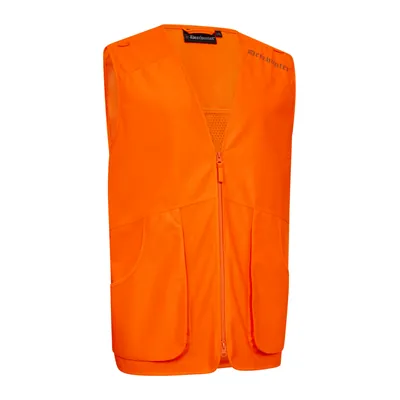
Deerhunter Hunting Mesh Safety Waistcoat, safety orange
A full-orange waistcoat certified to EN 17353:2020 for enhanced visibility, with a two-way zip and a mesh back: easy to pull over a jacket on a walk in the shooting season.
View on Amazon (opens in a new tab)
FAQs
Can you walk on a public footpath during a shoot?
Yes. In England and Wales, a footpath or bridleway stays open on a shoot day: only the local authority can close a path temporarily, by traffic regulation order and for certain reasons. The shooting code asks guns to pause shooting or beating so that you can pass. Stay on the path, make yourself seen and heard, and follow reasonable advice on alternative routes.
Can a landowner close open access land for shooting?
Yes, within limits. In England and Wales, the owner of open access land can exclude or restrict the public for up to 28 days a year, and apply for longer restrictions for land management, sporting activities included. These powers never apply to footpaths, bridleways or other public rights of way. Natural England and Natural Resources Wales publish restrictions on their online maps.
Is there shooting on Sundays?
It depends where you are. In England and Wales, the Game Act 1831 makes it an offence to kill game, such as pheasant, partridge and grouse, on a Sunday or Christmas Day, but the rule covers game only. In Northern Ireland, killing any wild bird or game on a Sunday is an offence. In Scotland, deer stalking does not usually take place on Sundays, says NatureScot.
When is the deer stalking season in Scotland?
All year, for males, since 2023. Most stag stalking still takes place between July and mid-October, and red deer hind stalking runs from 21 October to 15 February. The busiest spells are the first three weeks of October and late January to mid-February. Before a hill walk, check NatureScot’s Heading for the Scottish Hills service, and follow reasonable advice on alternative routes.
Do walkers need to wear orange in the shooting season?
The Countryside Code doesn’t ask for it, but a bright colour, on you or over your rucksack, is the simplest precaution of the season: it can be seen from a distance. France’s hiking federation recommends bright colours to walkers in its hunting season. Keep your dog close too, on a lead or in sight, and keep to marked paths.
Sources
- Game Act 1831, section 3, legislation.gov.uk, accessed 27 October 2026. legislation.gov.uk https://www.legislation.gov.uk/ukpga/Will4/1-2/32/section/3 ↩
- Wildlife and Countryside Act 1981, section 2, legislation.gov.uk, up to date with changes known to be in force on or before 25 October 2026, accessed 27 October 2026. legislation.gov.uk https://www.legislation.gov.uk/ukpga/1981/69/section/2 ↩
- Deer Act 1991, Schedule 1 (close seasons), legislation.gov.uk, accessed 27 October 2026. legislation.gov.uk https://www.legislation.gov.uk/ukpga/1991/54/schedule/1 ↩
- NatureScot, Scottish Outdoor Access Code, ‘Deer management and access’, updated 12 August 2025, accessed 27 October 2026. outdooraccess-scotland.scot https://www.outdooraccess-scotland.scot/practical-guide-all/deer-management-and-access ↩
- The Code of Good Shooting Practice, endorsed by shooting and countryside organisations, sections ‘The public highway’ and ‘Horses and walkers’, accessed 27 October 2026. codeofgoodshootingpractice.org.uk https://www.codeofgoodshootingpractice.org.uk/pdf/COGSP.pdf ↩
- South Gloucestershire Council, Public Rights of Way, ‘Temporary closures or restrictions’, accessed 27 October 2026. rightsofway.southglos.gov.uk https://rightsofway.southglos.gov.uk/temporary-closures-or-restrictions ↩
- Highways Act 1980, section 161, legislation.gov.uk, accessed 27 October 2026. legislation.gov.uk https://www.legislation.gov.uk/ukpga/1980/66/section/161 ↩
- Natural England and Department for Environment, Food & Rural Affairs, ‘Open access land and the coastal margin: how to restrict public access’, GOV.UK, updated 5 November 2025, accessed 27 October 2026. gov.uk https://www.gov.uk/guidance/open-access-land-and-the-coastal-margin-how-to-restrict-public-access ↩
- Natural Resources Wales, ‘Exclusions and restrictions’, accessed 27 October 2026. naturalresourceswales.gov.uk https://www.naturalresourceswales.gov.uk/days-out/exclusions-and-restrictions/?lang=en ↩
- South Gloucestershire Council, Public Rights of Way, ‘Using public rights of way’, questions and answers, accessed 27 October 2026. rightsofway.southglos.gov.uk https://rightsofway.southglos.gov.uk/using-public-rights-of-way ↩
- Natural England and Natural Resources Wales, ‘The Countryside Code: advice for countryside visitors’, GOV.UK, updated 26 May 2023, accessed 27 October 2026. gov.uk https://www.gov.uk/government/publications/the-countryside-code/the-countryside-code-advice-for-countryside-visitors ↩
- NatureScot, Scottish Outdoor Access Code, ‘Low ground shooting’, updated 11 August 2023, accessed 27 October 2026. outdooraccess-scotland.scot https://www.outdooraccess-scotland.scot/practical-guide-all/field-sports/low-ground-shooting ↩
- NatureScot, Scottish Outdoor Access Code, ‘Deer stalking in forests and woods’, updated 25 October 2023, accessed 27 October 2026. outdooraccess-scotland.scot https://www.outdooraccess-scotland.scot/practical-guide-all/deer-management/deer-stalking-forests-and-woods ↩
- French Hiking Federation (FFRandonnée), ‘Randonnée en période de chasse : la prudence est de mise !’ (in French), 11 September 2023, accessed 27 October 2026. ffrandonnee.fr https://www.ffrandonnee.fr/randonner/conseils/randonnee-en-periode-de-chasse-la-prudence-est-de-mise ↩
- Mountain Rescue England and Wales, ‘In case of emergency’, accessed 27 October 2026. mountain.rescue.org.uk https://www.mountain.rescue.org.uk/how-to-call-out-mr/ ↩
- Department of the Taoiseach, ‘How to contact emergency services in Ireland’, gov.ie, updated 11 April 2025, accessed 27 October 2026. gov.ie https://www.gov.ie/en/department-of-the-taoiseach/services/how-to-contact-emergency-services-in-ireland/ ↩
- NatureScot, Scottish Outdoor Access Code, ‘Grouse shooting’, updated 11 August 2023, accessed 27 October 2026. outdooraccess-scotland.scot https://www.outdooraccess-scotland.scot/practical-guide-all/field-sports/grouse-shooting ↩
- France’s National Forests Office (ONF), ‘Les calendriers de chasse 2026-2027 sont en ligne’ (in French), 21 September 2026, accessed 27 October 2026. onf.fr https://www.onf.fr/chasse/+/2dd6::les-calendriers-de-chasse-2026-2027-sont-en-ligne.html ↩
- NatureScot, Scottish Outdoor Access Code, ‘What is the Scottish Outdoor Access Code?’, updated 18 May 2026, accessed 27 October 2026. outdooraccess-scotland.scot https://www.outdooraccess-scotland.scot/act-and-access-code/scottish-outdoor-access-code-visitors-and-land-managers/what-scottish-outdoor-access-code ↩
- NatureScot, Scottish Outdoor Access Code, ‘Heading for the Scottish Hills’, updated 12 August 2025, accessed 27 October 2026. outdooraccess-scotland.scot https://www.outdooraccess-scotland.scot/practical-guide-all/deer-management-and-access/heading-scottish-hills ↩
- nidirect, ‘The Countryside Code’ (Northern Ireland), accessed 27 October 2026. nidirect.gov.uk https://www.nidirect.gov.uk/articles/countryside-code ↩
- Northern Ireland Environment Agency, ‘The Wildlife (NI) Order 1985, as amended: wildlife and game protection’, leaflet for firearm certificate holders, February 2026, published by the Police Service of Northern Ireland, accessed 27 October 2026. psni.police.uk https://www.psni.police.uk/sites/default/files/2026-02/Advice%20on%20Widlife%20and%20Game%20Protection.pdf ↩
- National Parks and Wildlife Service (Ireland), ‘Open Seasons Order’, accessed 27 October 2026. npws.ie https://www.npws.ie/legislation/irish-law/open-seasons-order ↩
- Wallonia, ‘Circuler en forêt en Wallonie’ (in French), Public Service of Wallonia, accessed 27 October 2026. wallonie.be https://www.wallonie.be/fr/demarches/circuler-en-foret-en-wallonie ↩

Fact-checking, regulations and safety
Arnaud Couderc reviews our contributors’ articles and writes for Outfarer about regulations, safety, fishing, the sea and outdoor pursuits. He traces every rule back to its official text and every figure to its source, so that you set off with sound benchmarks.

 Guillaume Hoarau

