 Français (France)
 English (UK)
 English (US)
 Deutsch (Deutschland)

Contents
Fishing with a rod and line for freshwater fish, trout or eel in England or Wales without a valid rod licence can mean a fine of up to £2,500 [1]. That is the rule, and the rest of a first trip follows from it. This guide takes the steps in order: the water, the licence and the permit, the rules of the day, the kit, the first rig, the swim, safety on the bank, and what you do with the fish. The licence prices are those GOV.UK showed on 20 November 2026, and the page announced no fees for 2027 [2].
It is written for an adult or a family who have never fished, on a canal, a lake or a river. Sea angling, fishing from a boat and the specialist branches such as pike or catfish are left out, with a few pointers at the end. England and Wales come first, because they share one licence; Scotland and Northern Ireland have their own rules, in a box of their own. A fishing rule should be read with its date and its place: the national byelaws set a floor, which a club, a fishery or the Canal & River Trust can raise [3]. At each step, the guide says what the text says, what it changes for you and what is left to check before you go.
| When | What to do |
|---|---|
| Now | Pick a water and find out who controls it: a canal, a club lake or a commercial fishery; check its permit and any close season; ask a local tackle shop, or look for a free Let’s Fish! session in spring |
| A few days before | Buy the rod licence (you can buy it up to 30 days before it starts) and the day ticket or permit; read the water’s rules; get a pole or rod, a ready-tied rig, a disgorger, a landing net and bait |
| The night before | Print or save the licence and permit; check the forecast, above all for thunder, and the river levels if you are fishing a river; charge your phone; tell someone where you are going and when you will be back |
| On the bank | Look up for overhead power lines before you assemble the rod, then choose a swim well away from them; plumb the depth; set up the landing net; carry rods horizontally when you move |
| Afterwards | Return the fish carefully, take litter and line home, and check, clean and dry your kit before the next water |
A summary of this guide: each point is detailed, with its source, in the step it belongs to.
1Where to fish, and what to fish for
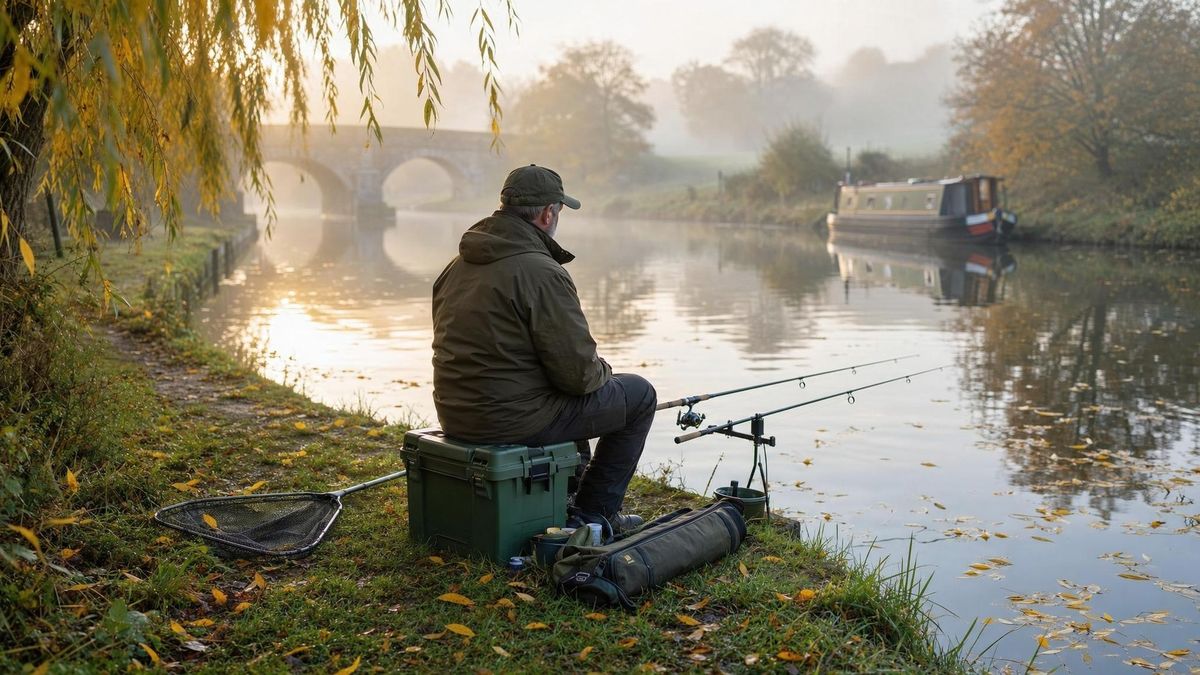
For a first trip, calm, shallow water and the freshwater fish that are not trout or salmon, known as coarse fish, make the simplest start [4]. The Angling Trust suggests learning on a slow, shallow canal [4], and the Canal & River Trust says that most canals are only about 4 or 5 feet (1.2 to 1.5 m) deep in the middle and perhaps 2 feet (0.6 m) at the edge, with food and shelter from overhanging trees, shrubs and boats [5]. The fish a beginner is most likely to catch there are roach, gudgeon, bream, perch, carp and tench [5].
Where can you fish, then? Wherever the owner of the fishing rights allows it: a club water, a commercial fishery that sells day tickets, or a stretch of canal or river with a permit. In freshwater, the Angling Trust says, you need the owner’s permission, usually gained by buying a day or season ticket or by joining the angling club that controls the fishing; your local tackle shop can tell you where to go [4]. On the Canal & River Trust’s 2,000 miles of canals, rivers and commercial fisheries, there is no free fishing: you need a rod licence and a permit [6]. On most stretches, a local angling club rents the fishing rights and sells the permit; on stretches that are not rented out, you buy a Waterway Wanderers permit from the Trust [7].
To start with company, the Canal & River Trust runs hundreds of ‘Let’s Fish!’ learn-to-fish taster sessions, typically between March and October, for adults and for children aged 6 or over; on the day, the tackle, the bait, a rod licence and the fishing permit are free, and a licensed coach teaches you [8]. The Angling Trust’s 2021 booklet says that it and partners such as Let’s Fish! run events for all abilities [4].
That leaves the seashore. According to the Angling Trust’s sea page, which we last read on 9 November 2026, no licence is required to fish recreationally for sea fish in the UK, though permits may be needed in privately owned places such as piers and harbours; the Inshore Fisheries and Conservation Authorities regulate fishing within 6 miles of the coast in England, so their local bylaws set bag limits and minimum sizes [9]. The Scottish Government adds that rules apply by species: for sea bass, for instance, there are seasonal closures, minimum sizes and catch limits [10]. This guide does not go into sea angling rules; for tide times, see our guide to reading tide times.
2The licence and the permit
The rule is simple. If you are 13 or over and fish with a rod and line for salmon, trout, freshwater fish, smelt or eel in England (except the River Tweed), in Wales or in the Border Esk region, you need a rod fishing licence for England and Wales [1]. It makes no difference whether the water is public or private: angling club waters and private fishing lakes are covered too [1]. The licence is the legal right to use a rod. It is not the only thing you need: you must also have permission from the land or fishery owner, usually in the form of a fishing permit [1]. Our guide to the rod licence in England goes deeper; here is what a beginner needs.
| Where | Licence | Permission |
|---|---|---|
| England and Wales, freshwater | Environment Agency rod licence from age 13, free for 13 to 16 | A permit or day ticket from the owner or club |
| Scotland | None, except in the Border Esk region | Permission from the holder of the fishing rights |
| Northern Ireland | A rod licence from DAERA or the Loughs Agency, depending on the water | A permit or day ticket |
| Sea angling | None required in the UK, according to the Angling Trust page we read on 9 November 2026 | Permits may be needed on private piers and harbours |
Sources: GOV.UK, Scottish Government, nidirect and the Angling Trust. Scotland and Northern Ireland are detailed in the box below.
There are two kinds of licence. The trout, coarse fish and eel licence covers non-migratory trout and all freshwater fish, including smelt and eel; the salmon and sea trout licence adds salmon and sea trout [11]. The licence also sets how many rods you may use: up to 2 rods for freshwater fish other than trout, for example, or up to 3 with a 12-month licence for freshwater fish other than non-migratory trout [11]. The water you fish may set a stricter limit [11].
| Licence | Trout and coarse, 2 rods | Trout and coarse, 3 rods | Salmon and sea trout |
|---|---|---|---|
| 1 day | £7.30 | Not available | £13.50 |
| 8 days | £14.70 | Not available | £30.50 |
| 12 months | £36.80 | £55.30 | £93.10 |
| 12 months, aged 66 or over, or disabled | £24.50 | £36.80 | £62.00 |
| 12 months, junior (13 to 16) | Free | Free | Free |
Source: GOV.UK fees page. There are no discounted prices for a 1-day or an 8-day licence. The reduced 12-month rate is for people aged 66 or over, or who have a Blue Badge or meet the eligibility criteria for one, or who get Personal Independence Payment or Disability Living Allowance.
You can buy a 1-day, 8-day or 12-month licence online, for yourself or someone else, up to 30 days before you want it to start, or by phone on 0344 800 5386 (Monday to Friday, 8am to 6pm, except public holidays) [2]. Licences sent by email or text usually arrive within an hour; those sent by post should arrive within 10 working days [2]. Without a valid licence to show when asked, the fine can reach £2,500 [1].
The permit is the second half. On a club water or a commercial fishery, you buy a day ticket or a season permit, or you join the club [4]. The Canal & River Trust’s Waterway Wanderers permit runs for 12 months from the day you buy it and, for permits bought from 1 April 2026, costs £28 for an adult, £18 with a concession and £7 for a junior aged 16 or under [7]. Carry both documents: the booklet advises making sure you have your permit and your rod licence with you, or finding out in advance whether you can buy a permit on the bank [4].
Children first. Under-13s need no licence, 13 to 16-year-olds need a junior licence, which is free, and a carer who goes along without fishing needs nothing [1]. The permit is a separate matter: some clubs let those too young to need a rod licence fish for free as long as they are with a responsible adult [4]. Ask the water.


3The rules: close seasons, limits, tackle and local byelaws
National byelaws set a floor, and local ones can add to it: the supplementary byelaws for your area tell you whether close-season dates differ and what extra limits apply to rods, tackle, bait or size [3]. Start with the calendar. A The yearly period when certain fishing must stop to let fish breed. is a period when you cannot fish for some types of fish on some types of water. In England and Wales, you cannot fish for coarse fish on any river from 15 March to 15 June [14]; the Angling Trust gives the reason: the fish may be spawning [4].
On most enclosed stillwaters and canals, you can fish for coarse fish, eels, rainbow trout and brown trout all year, subject to the local byelaws [14]. But privately owned waters can have their own close season: a club or a private fishery can add one or extend the statutory one, though it cannot shorten it [14, 3]. If the details are not on the permit or the notice board, the Angling Trust says to ask at the local tackle shop [4]. Game fishing carries on during the coarse close season, with restrictions on lures and bait that vary by region [14]. The Canal & River Trust’s permit rules add one of their own: no fishing on waters where the close season currently applies [7].
You may only keep a limited number of fish, of the right size: the others go back unharmed, and you measure a fish from the tip of the snout to the fork of the tail [16]. In England, on rivers, streams and drains, the national byelaws allow you to take each day a total of 15 small coarse fish of up to 20 cm, 2 grayling of 30 to 38 cm and 1 pike of up to 65 cm [3, 16]. The same limits apply on a short list of canals and lakes, among them the Norfolk Broads and Windermere; on other canals and stillwaters, you need the owner’s permission to remove fish [3]. The limits for salmon and trout are in your area’s byelaws, and selling a rod-caught salmon or sea trout is an offence [16].
| Fish | Daily limit | Size |
|---|---|---|
| Small coarse fish: barbel, chub, common bream, common carp, crucian carp, dace, perch, roach, rudd, silver bream, smelt, tench | 15 in total | Up to 20 cm |
| Grayling | 2 | 30 to 38 cm |
| Pike | 1 | Up to 65 cm |
Sources: GOV.UK, ‘fish size and catch limits’; Environment Agency, national rod fishing byelaws. Wales has its own byelaws, and the limits for salmon and trout are local.
The tackle rules are short. You must not leave a rod and line in the water unattended or without sufficient control; with several rods, the outermost butts must be no more than 3 m apart [17]. Lead weights are allowed only if they weigh 0.06 g or less, or more than 28.35 g (1 oz), which GOV.UK translates as lead shot from size 14 to size 8 and lead weights over 1 oz [17]; the Angling Trust notes that non-toxic weights are now widely available [4]. You must not use crayfish as bait, a gaff or a tailer, and you must return any fish hooked anywhere but the mouth or throat [17], as well as any eel, alive (conger excepted) [16].
The fishery’s own rules often go further. Clubs and fishery owners often have local rules, which should be printed on the permit, the Angling Trust says: they usually relate to specific methods and baits, or times for fishing such as no night fishing, and should always be observed [4]. Two more rules concern the water itself. Anglers can spread disease, parasites and invasive non-native species between waters, so the Angling Trust asks you to check, clean and dry your tackle between trips, above all nets, unhooking mats and waders [18]; the Environment Agency adds that hanging nets out to dry greatly reduces the risk [19]. And the Wildlife and Countryside Act 1981 bans releasing into the wild any animal that is not resident in, or a regular visitor to, Great Britain [20], while the Canal & River Trust’s permit rules say never to return zander or other non-native species to its waterways [7]. We found no national text that tells an angler what to do with a non-native fish: ask the fishery.
4The starter kit
A first trip needs little. The Angling Trust’s 2021 booklet said that, once you have a rod licence and a permit, you can be fishing for less than £75 with a short take-apart elasticated pole of 4 to 6 metres, ready-tied rigs with a float, weights and a small hook, a simple disgorger, a small landing net and some bait [4]. Those prices are five years old: for the same booklet, tackle that catches most types of coarse fish costs between £50 and £100, and the tackle shop can put you right on the rest [4].
The Canal & River Trust’s coaches give a more detailed shopping list for canals: a take-apart pole of 5 or 6 metres, longer if the budget stretches, with an elasticated top section (number 3 or 4 elastic); a couple of rigs made for canal fishing, with a float of around 0.3 to 0.4 g and a size 20 or 22 hook; a disgorger, a A small weight used to measure how deep the water is., a landing net and its handle, bait tins for maggots such as pinkies, something to mix groundbait in and a rod rest [21]. They warn against a common error: pole elastic set far too tight, which loses fish [21]. In hook sizes, the higher the number, the smaller the hook: our guide to hook sizes explains the scale.
Prices vary. On 20 November 2026, one retailer, Angling Direct, listed a 10 ft (3 m) float rod and reel combination, with the reel already filled with 6 lb line, at £99.99 [22], and a float tackle box kit, with floats, non-toxic shot and barbless hooklengths, at £18.99, marked down from £24.99 [23]. Two examples from one shop, not a budget.
As for bait, the Angling Trust lists bread, cheese, luncheon meat and many things you eat yourself, worms from your garden, and maggots, boilies or pellets from a tackle shop; at the start, find out what fish you are likely to catch, then use the baits they prefer [4]. Go easy on groundbait: the Environment Agency warns that groundbait that is not eaten rots on the bottom and takes oxygen out of the water [19]. Take care with bread on the surface too, which may attract water birds [4]. Use a A hook without the small backward-pointing spur, the barb, that holds the hook in place. or a micro-barb one where possible: hooked or entangled birds are then more likely to rid themselves of the hook, and removing it is much easier [4].

5Knots and your first rig
A first float rig reads from top to bottom: a short pole, a ready-tied rig with a float, weights and a small hook, and the bait on the hook [4]. Before you cast, plumb the depth: the Canal & River Trust’s learn-to-fish videos present plumbing as the best way of working out how deep the canal is, so that you can set the depth of your rig [24]. Set up the landing net before you begin fishing, the Angling Trust says, and keep a disgorger to hand: never try to pull a hook out [4].
Knots come next. The same booklet shows eight, including the Palomar and the tucked half blood knot, with one habit for all of them: moisten a knot before pulling it tight, then trim the free ends with scissors or nail clippers [4]. A good knot keeps more than 90% of the line’s strength and a poor one less than half, says the Illinois Department of Natural Resources [25]. Learn them at home, without a hook, rather than on the bank with cold fingers; our guide to fishing knots has the how-to.

6Choosing your swim and reading the water
Fish are not spread at random. The Canal & River Trust says that canals offer plenty of food and shelter from overhanging trees, shrubs and boats, and that experienced anglers say the fish often prefer to live near boats; roach and bream are usually found in shoals [5]. The Angling Trust adds that you should choose your swim with care, to reduce the risk of snagging bankside trees and vegetation [18], and look at the bank where you hope to fish to make sure that it is safe [4].
What time of day? The sources we read set no ideal hour, but they warn about heat. The Angling Trust notes that as temperatures rise, the amount of dissolved oxygen in the water decreases, and it asks anglers to think carefully before fishing for certain species in hot conditions [18]. Carp and eels cope better, while pike, barbel, trout, grayling and salmon are particularly badly affected; fish also use up oxygen when they fight, so large fish that take a long time to land are especially susceptible [18]. A slow, canalised river or a stillwater is likely to have lower oxygen levels in hot conditions than a flowing river with riffles and shallows, the guide adds, and it suggests carrying a thermometer to check the water temperature [18].
On rivers, conditions change fast. Heavy rain can cause spates and make riverbanks unsafe, so the Angling Trust advises checking the forecast and the river levels, upstream too [18]: GOV.UK publishes them online [26]. A spot that was safe before may not be now, since riverbanks and riverbeds can erode and river courses change [18].
7The day itself, and safety at the water’s edge
The danger fewest beginners know about is overhead. Many rods and poles conduct electricity, Electricity North West warns, and at higher voltages electricity may jump short distances through the air [27]. Its advice: look out and look up for overhead lines before rods are assembled, never estimate their height or distance from the ground, and fish at least 30 metres (100 ft) horizontally away from all overhead lines [27]. The Angling Trust and RoSPA give no distance but a similar message. The Angling Trust says never to fish underneath or near overhead electricity cables [4], and, because electricity can arc over considerable distances, to carry rods and poles horizontally and parallel with the ground [18]; RoSPA says to notice overhead cables and avoid contact, and reminds us that most modern rods are carbon fibre, a very efficient conductor [28].
| Source | What it says | Distance |
|---|---|---|
| Electricity North West (north-west England) | Look up before assembling rods; do not estimate distances from the ground | At least 30 m (100 ft), horizontally |
| Angling Trust (England) | Never fish underneath or near overhead cables; carry rods horizontally | No distance given |
| RoSPA (UK charity) | Notice overhead cables and avoid contact; carbon rods conduct electricity | No distance given |
| Canal & River Trust (Waterway Wanderers permit) | No fishing near or under overhead power lines | No distance given |
Advice from a network operator and from charities, not laws: no source we read gives one rule for the whole UK. For comparison, RTE and Enedis give 5 m in France and ewl at least 20 m in Lucerne.
That figure of 30 metres is not universal, and it is not a law. It is the advice of one network operator, Electricity North West, which runs the power network in north-west England; the Canal & River Trust’s permit rules simply ban fishing near or under overhead power lines [27, 7]. Elsewhere in Europe, other operators give other figures: 5 metres in France, from RTE and Enedis [29], and at least 20 metres in Lucerne, Switzerland, from ewl [30]. No source we read unifies them: do not fish under or near a line, and keep the biggest margin the place allows.
The second danger is the water. RoSPA lists drowning and electrocution from overhead power lines among the risks of angling [28]. We found no rule on lifejackets for bank fishing in the sources we read, only advice: RoSPA says to put on a good-quality life jacket, which it calls especially important when fishing from a boat or walking in deep water [28]. The Angling Trust says to wade only if it is safe and permitted, because water can be much deeper than it appears and silt much deeper than you think, and to use a wading staff [18]; it also advises taking a change of clothes or a blanket in the car in case you fall in, and being aware of the risk of Weil’s disease, bacteria and pathogens, with hand sanitiser before you eat and at the end of the session [18]. RoSPA says it is safer to fish with a buddy, and both organisations say to tell someone where you are going and when you expect to be home [28, 18]; RoSPA adds that you should not walk on ice-covered or frozen water [28]. The Angling Trust also says to avoid fishing near locks and weirs [4].
Thunder is not negotiable. The Angling Trust says never to fish during a thunderstorm, because carbon rods are great conductors and there is a real threat of death [18]; RoSPA says not to go fishing during thunderstorms or in other dangerous weather conditions, and to remember that weather can change quickly [28].
Then sun, hooks and ticks. The reflection of water can increase the risk of skin cancer, so the Angling Trust recommends sun cream, or better still sun block, and plenty to drink [18]; RoSPA says to go for SPF 30 or above [28]. Our guide to sunglasses explains that a polarised lens filters glare while UV protection is a separate property, read on the label. Take care with hooks and other sharp tools [28]. A hook stuck deeply in the skin, or in or near an eye, calls for medical help right away: do not try to remove it yourself [31]. In an emergency, dial 999; 112 also works in the UK [32]. As for ticks, the UK Health Security Agency says they are most active between spring and autumn, and asks you to check yourself, your children and your pets after being outdoors [33]; our guide to ticks covers the rest.


8Keeping, returning and handling the fish
The rules above already send many fish back: those you may not keep, any caught by a foul hook and any eel [16, 17]. What matters then is how you handle them. The Angling Trust’s guidance is the reference: handle fish with wet hands, which avoids removing their protective slime [18]. The Environment Agency adds that holding a fish in a towel rubs the slime off and leaves it vulnerable to disease: towels are for drying your hands [19]. Handle fish as little as possible and, if you can, unhook them in the water; if you must lift one, use an unhooking mat or cradle for larger species, and wet it first [18].
Never try to pull a hook out: use a disgorger, or ask another angler for help [4]. Barbless hooks make unhooking simpler and safer [18]. Pike and zander need specialist unhooking equipment and skills, and the Angling Trust says you should not try to catch pike unless you are confident that you have both [18].
| Do | Don’t |
|---|---|
| Wet your hands before touching the fish | Handle it with dry hands or a towel, which remove the protective slime |
| Unhook it in the net or the water, with a disgorger | Pull a hook out, or lift the fish high off the ground |
| For a photo, hold it over a wet mat, a cradle or the water | Keep it out of the water for longer than necessary |
| In a river, hold it facing upstream while it recovers | Pull it back and forth in the water |
| If you use a keepnet, gather the fish at the front and let them swim out | Tumble the fish down the net, which damages fins and scales |
Sources: Angling Trust, best practice guide and 2021 booklet; Environment Agency blog on towels and slime.
To release a fish, return it quickly and support it in the water while it recovers, and make sure it is strong enough to swim off [18, 19]. Heat adds to the strain: low water and high temperatures make fish more susceptible to disease and parasites, so extra care with handling is needed in warm weather, and the guide advises keeping fish in the water while you unhook them where possible [18]. A keepnet is optional on a first trip: the Canal & River Trust’s starter list asks for one only if you take part in two of its own events [21]. If you use one, the rules set its size and mesh, you may be fined for leaving fish in it after you have finished, and a keepsack may hold only one fish at a time [17, 3].
Eating your catch needs care too. We found no general advice from the Food Standards Agency for anglers. The one piece of advice we read concerns Lough Neagh in Northern Ireland, where blue-green algal blooms have been monitored since 2023: recreational anglers there should eat only the edible flesh of fish that have been properly gutted, and rinse the fillets with clean water [34]. That advice is specific to Lough Neagh. Before you take any fish home, ask the owner: on privately owned waters, you can be fined for removing fish without written permission [16].

9Going further: carp, fly, sea and children
The specialist branches have their own gear and rules. The Angling Trust says that large fish such as carp, tench, pike, catfish and barbel need strong gear, and that bolt rigs or semi-fixed leads should be used with care, with the leger weight able to slip free if the line snags [18]. Fisheries often add rules of their own on methods, baits and times, such as no night fishing [4]: ask before you set up for carp. For fly fishing, our guide to fly rod and line numbers decodes the system; for salmon, only an artificial fly or lure may be used before 16 June in England and Wales, and the fish must be returned unharmed [17].
Going with children? The licence rules are generous, and the advice is about company. The Angling Trust says that when you first start fishing it is best to go along with a reliable adult and to let someone know exactly where you are going [4]; the Canal & River Trust’s Let’s Fish! sessions welcome children aged 6 or over [8]. Electricity North West asks you to tell children never to fish near overhead lines, because they may not be able to judge the distance [27].
To progress with company, the Angling Trust says that hundreds of trained coaches are experts in passing on their knowledge, that they are trained in bankside safety and first aid, and that all of them are insured [4]. It also advises every angler to hold public liability insurance, which comes with its individual membership [18]. Last, leave the water as you found it: discarded fishing line is particularly hazardous to wildlife, so take litter and tackle home, even if it is not yours, and recycle damaged line through the Anglers National Line Recycling Scheme [18]. If you see fish in distress, phone the owner on a lake, or the Environment Agency incident hotline on 0800 80 70 60 on a river [19, 35]. The same hotline takes reports of illegal fishing, with nets or traps for instance: the Angling Trust asks you not to approach anyone yourself, and to tell the club bailiff or fishery owner too [18].


The checklist before you set off
Tick it off the night before, or print it and slip it into your rucksack.
- Water chosen, and who controls it identified: club, fishery or Canal & River Trust
- Rod licence for the right fish and number of rods, on your phone or printed
- Permit or day ticket for this water, and its rules read, close season included
- Pole or rod with a ready-tied float rig, small barbless hooks, disgorger, plummet, landing net
- Bait, and groundbait in small amounts
- Overhead power lines spotted before you assemble the rod, and a swim well away from them
- Forecast checked, no thunder; river levels checked if you fish a river
- Someone told where you are going and when you will be back; phone charged
- Waterproof jacket, warm layers, stout shoes, hat, drink and food; sun cream
- Wet hands, unhooking in the water, fish returned quickly and carefully
- Litter and line taken home; kit checked, cleaned and dried afterwards
- 999 in mind for an emergency: 112 also works in the UK
Kit related to this article
No affiliation: no commission, no sponsored products.
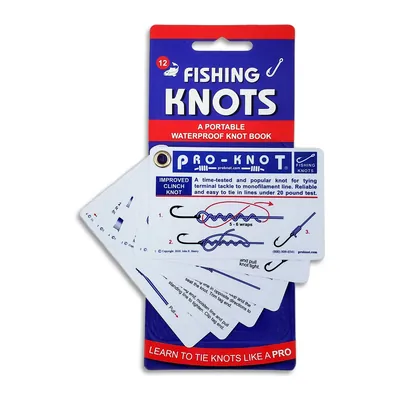
Pro-Knot Fishing Knots (waterproof knot cards)
Twelve fishing knots, the improved clinch among them, illustrated on six waterproof plastic cards held by a brass grommet: pocket-sized (9 x 6 cm), to keep in the tackle box.
View on Amazon (opens in a new tab)
Worth watching
A beginner video from a British coarse-fishing channel: setting up a pole, finding the water depth, baiting and unhooking with a disgorger, the first steps this guide describes.
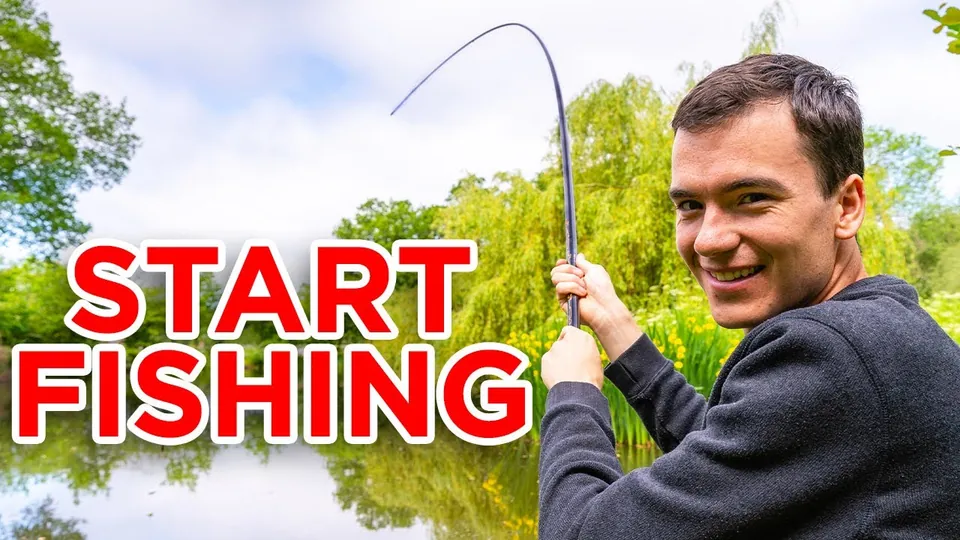
The video is hosted by YouTube (Google): nothing loads until you play it, and Google may then set cookies.
FAQs
Do I need a licence to fish in the UK?
It depends where. In England and Wales you need an Environment Agency rod licence from the age of 13, even on private water, plus the owner’s permission. Scotland has no recreational fishing licences, only permission, except in the Border Esk region. Northern Ireland needs a rod licence and a permit or day ticket from a Northern Irish agency.
How much does a rod licence cost?
On GOV.UK on 20 November 2026, a trout and coarse licence for up to 2 rods cost £7.30 for 1 day, £14.70 for 8 days and £36.80 for 12 months. Juniors aged 13 to 16 get a free licence. The permit or day ticket for the water is a separate cost.
Do you need a licence for sea fishing?
No: the Angling Trust page we read on 9 November 2026 says that no licence is required to fish recreationally for sea fish in the UK, though permits may be needed on private piers and harbours, and local Inshore Fisheries and Conservation Authorities set bag limits and minimum sizes. Confirm locally before you go.
When is the coarse fishing close season?
On all rivers, streams and drains in England and Wales, from 15 March to 15 June inclusive. Most stillwaters and canals have no statutory close season, though some sites of special scientific interest do. A club or private fishery can add its own, but cannot shorten the statutory one. Read your area’s byelaws and your permit.
What do I need to start fishing?
A rod licence if you are 13 or over, a permit or day ticket, a short pole or a rod and reel with a ready-tied float rig, small hooks, a disgorger, a landing net and bait. The Angling Trust said in 2021 that basic tackle could cost less than £75; prices have moved since.
Can children fish without a licence?
Under-13s need no licence in England and Wales, and 13 to 16-year-olds need a free junior licence. The permit is separate: some clubs let children too young for a licence fish free with a responsible adult. The Canal & River Trust’s free Let’s Fish! sessions suit children aged 6 or over.
Sources
- GOV.UK, ‘Buy a rod fishing licence: when you need a licence’, accessed 20 November 2026. gov.uk https://www.gov.uk/fishing-licences ↩
- GOV.UK, ‘Buy a rod fishing licence for England and Wales’ (fees, 1-day, 8-day and 12-month licences), accessed 20 November 2026. gov.uk https://www.gov.uk/fishing-licences/buy-a-fishing-licence ↩
- Environment Agency, ‘National rod fishing byelaws for England: freshwater fishing with a rod and line’, last updated 12 December 2023, accessed 20 November 2026. gov.uk https://www.gov.uk/guidance/national-rod-fishing-byelaws-for-england-freshwater-fishing-with-a-rod-and-line ↩
- Angling Trust, ‘Get Coarse Fishing With...’, National Fishing Month booklet, 24 July to 30 August 2021 (PDF), accessed 20 November 2026. anglingtrust.net https://anglingtrust.net/wp-content/uploads/2021/07/NFM-Coarse-fishing-booklet-digital.pdf ↩
- Canal & River Trust, ‘Beginner’s guide: canal fishing’, last edited 29 October 2026, accessed 20 November 2026. canalrivertrust.org.uk https://canalrivertrust.org.uk/things-to-do/fishing/learn-to-fish/beginners-guide-canal-fishing ↩
- Canal & River Trust, ‘Rod licences and fishing permits’, last edited 17 May 2024, accessed 20 November 2026. canalrivertrust.org.uk https://canalrivertrust.org.uk/things-to-do/fishing/where-to-fish/rod-licences-and-fishing-permits ↩
- Canal & River Trust, ‘Waterway Wanderers fishing permits’ (prices for permits bought from 1 April 2026, and permit rules), accessed 20 November 2026. canalrivertrust.org.uk https://canalrivertrust.org.uk/things-to-do/fishing/where-to-fish/waterway-wanderers-scheme ↩
- Canal & River Trust, ‘Let’s Fish!’, last edited 14 September 2026, accessed 20 November 2026. canalrivertrust.org.uk https://canalrivertrust.org.uk/things-to-do/fishing/lets-fish ↩
- Angling Trust, ‘Getting started in sea angling’, accessed 9 November 2026 (the page refused an automated check on 20 November 2026). anglingtrust.net https://anglingtrust.net/sea/getting-started-sea/ ↩
- Scottish Government, ‘Recreational fishing’, accessed 20 November 2026. gov.scot https://www.gov.scot/policies/salmon-and-recreational-fisheries/recreational-fishing/ ↩
- GOV.UK, ‘Buy a rod fishing licence: types of licences and rod limits’, accessed 20 November 2026. gov.uk https://www.gov.uk/fishing-licences/types-of-licences-and-rod-limits ↩
- GOV.UK, ‘Fishing in Scotland and Northern Ireland’, accessed 20 November 2026. gov.uk https://www.gov.uk/fishing-licences/fishing-in-scotland-and-northern-ireland ↩
- nidirect, ‘Angling rod licences explained’, accessed 20 November 2026. nidirect.gov.uk https://www.nidirect.gov.uk/articles/angling-rod-licences-explained ↩
- GOV.UK, ‘Freshwater rod fishing rules: when and where you can fish’, accessed 20 November 2026. gov.uk https://www.gov.uk/freshwater-rod-fishing-rules/when-and-where-you-can-fish ↩
- Natural Resources Wales, ‘Non-migratory trout, Arctic charr, coarse fish and eels open seasons’, accessed 20 November 2026. naturalresources.wales https://naturalresources.wales/guidance-and-advice/business-sectors/fisheries/angling-byelaws/when-what-and-where-you-can-fish/non-migratory-trout-arctic-charr-coarse-fish-and-eels-open-seasons/?lang=en ↩
- GOV.UK, ‘Freshwater rod fishing rules: fish size and catch limits’, accessed 20 November 2026. gov.uk https://www.gov.uk/freshwater-rod-fishing-rules/fish-size-and-catch-limits ↩
- GOV.UK, ‘Freshwater rod fishing rules: tackle you can use’, accessed 20 November 2026. gov.uk https://www.gov.uk/freshwater-rod-fishing-rules/tackle-you-can-use ↩
- Angling Trust, ‘Best Practice Guide for Freshwater Angling’ (PDF), accessed 20 November 2026. anglingtrust.net https://anglingtrust.net/wp-content/uploads/2025/09/Best-Practice-Guide-to-Freshwater-Angling-v8-compress.pdf ↩
- Environment Agency, ‘Responsible angling: a sport worth looking after’, blog, 5 August 2016, accessed 20 November 2026. environmentagency.blog.gov.uk https://environmentagency.blog.gov.uk/2016/08/05/responsible-angling-a-sport-worth-looking-after/ ↩
- GOV.UK, ‘Invasive non-native (alien) animal species: rules in England and Wales’, accessed 20 November 2026. gov.uk https://www.gov.uk/guidance/invasive-non-native-alien-animal-species-rules-in-england-and-wales ↩
- Canal & River Trust, ‘What to buy for a canal fishing starter kit’, last edited 25 February 2025, accessed 20 November 2026. canalrivertrust.org.uk https://canalrivertrust.org.uk/things-to-do/fishing/learn-to-fish/beginners-guide-canal-fishing/what-to-buy-for-canal-fishing-starter-kit ↩
- Angling Direct, ‘Guru Float Rod & Reel Combo’ product page (price and description), accessed 20 November 2026. anglingdirect.co.uk https://www.anglingdirect.co.uk/guru-float-rod-reel-combo ↩
- Angling Direct, ‘OMC FC Float Tackle Box Kit’ product page (price and description), accessed 20 November 2026. anglingdirect.co.uk https://www.anglingdirect.co.uk/omc-fc-float-tackle-box-kit ↩
- Canal & River Trust, ‘Learn to fish’ (videos on setting up the rig and plumbing the depth), last edited 8 October 2026, accessed 20 November 2026. canalrivertrust.org.uk https://canalrivertrust.org.uk/things-to-do/fishing/learn-to-fish/learn-to-fish ↩
- Illinois Department of Natural Resources, ‘Knot-Tying Guide’ (PDF), accessed 20 November 2026. dnr.illinois.gov https://dnr.illinois.gov/content/dam/soi/en/web/dnr/publications/documents/00000150.pdf ↩
- GOV.UK, ‘Check for flooding: find river, sea, groundwater and rainfall levels’, accessed 20 November 2026. check-for-flooding.service.gov.uk https://check-for-flooding.service.gov.uk/river-and-sea-levels ↩
- Electricity North West, ‘Safety advice for anglers’, accessed 20 November 2026. enwl.co.uk https://www.enwl.co.uk/advice-and-support/safety-advice-incident-reporting/safety-advice-for-anglers/ ↩
- Royal Society for the Prevention of Accidents (RoSPA), ‘Angling’, accessed 20 November 2026. rospa.com https://www.rospa.com/water-safety/angling ↩
- RTE, Enedis and Fédération de l’Ain pour la pêche et la protection du milieu aquatique, press release ‘Ensemble pour la sécurité des pêcheurs’, December 2020 (PDF, in French), accessed 20 November 2026. assets.rte-france.com https://assets.rte-france.com/preprod/public/2020-12/CP%20RTE%20Enedis%20%20Fede%20Peche%20Ain.pdf ↩
- ewl (Energie Wasser Luzern), ‘Allgemeines Verhalten in der Nähe von Freileitungen’, information sheet (PDF, in German), accessed 20 November 2026. ewl-luzern.ch https://www.ewl-luzern.ch/content-media/documents/ewl_Merkblatt_Verhaltenshinweise_Freileitungen.pdf ↩
- MedlinePlus (US National Library of Medicine), ‘Fishhook removal’, review date 14 October 2025, accessed 20 November 2026. medlineplus.gov https://medlineplus.gov/ency/article/000055.htm ↩
- GOV.UK, ‘999 and 112: the UK’s national emergency numbers’, updated 1 April 2025, accessed 20 November 2026. gov.uk https://www.gov.uk/guidance/999-and-112-the-uks-national-emergency-numbers ↩
- UK Health Security Agency, ‘Tick awareness’ leaflet (PDF), updated March 2023, accessed 20 November 2026. assets.publishing.service.gov.uk https://assets.publishing.service.gov.uk/media/642bec29fbe620000f17dbbe/Tick-awareness-A5-leaflet-April-2023.pdf ↩
- Food Standards Agency, ‘Latest testing provides reassurance on safety of Lough Neagh fish’, GOV.UK, 20 August 2026, accessed 20 November 2026. gov.uk https://www.gov.uk/government/news/latest-testing-provides-reassurance-on-safety-of-lough-neagh-fish ↩
- GOV.UK, ‘Report illegal fishing in England’, accessed 20 November 2026. gov.uk https://www.gov.uk/report-illegal-fishing-in-england ↩

Fact-checking, regulations and safety
Arnaud Couderc reviews our contributors’ articles and writes for Outfarer about regulations, safety, fishing, the sea and outdoor pursuits. He traces every rule back to its official text and every figure to its source, so that you set off with sound benchmarks.

 Guillaume Hoarau

 Julien de Jurquet